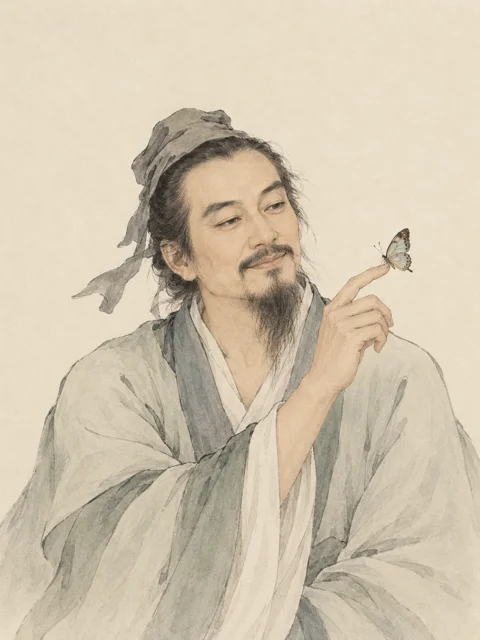
 AI 创作示意
GUANFU / en
庄子
AI 创作示意齊物論 / Chapter 2
版本按章对照,不代表逐句校勘对应。
中文原文(全三十三篇) / 庄子原典;维基文库贡献者整理
观复随文注释 · 94 条
南郭子綦寓言中的得道人物隱几倚靠几案而坐,仰天而噓,嗒焉形神若有所失的样子似喪其耦伴侣,此指形体与精神相对者。顏成子游立侍乎前,曰:「何居乎?形固可使如槁木枯死的树木,而心固可使如死灰乎?今之隱几者,非昔之隱几者也。」子綦曰:「偃,不亦善乎,而問之也!今者吾喪我忘却执著于分别的自我,汝知之乎?汝一作「女」聞人籟人为吹奏的声音而未聞地籟风吹自然孔穴的声音,汝一作「女」聞地籟而未聞天籟万物自然而然发出的声音夫!」子游曰:「敢問其方?」子綦曰:「夫大塊大地;亦指自然整体噫氣吐气,借指大地生风,其名爲風。是唯无作,作則萬竅怒呺猛烈呼啸。而獨不聞之翏翏长风吹动之声乎?山林之畏隹一作「佳」,大木百圍之竅穴,似鼻,似口,似耳,似枅柱上的横木,似圈,似臼,似洼者,似汙一作「污」者。激者,謞者,叱者,吸者,叫者,譹者,宎者,咬者,前者唱于,而隨者唱喁,泠風轻微的风則小和,飄風急骤的旋风則大和,厲風濟猛烈的风停息則衆竅爲虛。而獨不見之調調之刁刁乎?」子游曰:「地籟則衆竅是已,人籟則比竹排列起来的竹管乐器是已。敢問天籟?」子綦曰:「夫吹萬不同而使其自己一作「已」也,咸其自取,怒者其誰邪?」
大知閑閑宽广从容的样子,小知間間细碎计较的样子。大言炎炎气势盛大的样子,小言詹詹琐碎多言的样子。其寐也魂交睡梦中精神交扰,其覺也形開。與接爲構,日以心鬭,縵者,窖者,密者。小恐惴惴忧惧不安的样子,大恐縵縵。其發若機栝弩机与箭尾,喻心念迅疾发动,其司是非之謂也。其留如詛盟以誓约牢牢约束,其守勝之謂也。其殺如一作「若」秋冬,以言其日消也。其溺之所爲之,不可使復之也。其厭也如緘,以言其老洫衰老枯竭;洫读 xù也。近死之心,莫使復陽也。喜怒哀樂,慮嘆變慹,姚佚啓態,樂出虛,蒸成菌,日夜相代乎前,而莫知其所萌。已乎已乎,旦暮得此其所由以生乎?非彼无我,非我无所取,是亦近矣,而不知其所爲使。若有眞宰假设中主宰身心的力量,而特不得其朕征兆、迹象一作「眹」,可行已信,而不見其形,有情而无形。百骸九竅六藏,賅完备地包含而存焉,吾誰與爲親?汝皆悅一作「說」之乎?其有私焉?如是,皆有爲臣妾乎?其臣妾不足以相治乎?其遞相爲君臣乎?其有眞君存焉。如求得其情與不得,无益損乎其眞。一受其成一作「存」形,不亡以待盡,與物相刃相靡互相消磨,其行盡如馳,而莫之能止,不亦悲乎!終身役役劳碌不息的样子,而不見其成功,薾一作「𦬼」然疲役,而不知其所歸,可不哀邪?人謂之不死,奚益?其形化,其心與之然,可不謂大哀乎?人之生也,固若是芒乎?其我獨芒,而人亦有不芒者乎?夫隨其成心已经形成而执著不移的偏见而師之,誰獨且无師乎?奚必知代而心自取者有之,愚者與有焉。未成乎心而有是非,是今日適越而昔至也,是以无有爲有。无有爲有,雖有神禹,且不能知,吾獨且奈一作「柰」何哉?
夫言非吹也,言者有言,其所言者特未定也。果有言邪?其未嘗有言邪?其以爲異於鷇音初生小鸟的叫声;鷇读 kòu,亦有辯乎?其无辯乎?道惡乎隱而有眞僞?言惡乎隱而有是非?道惡乎往而不存?言惡乎存而不可?道隱於小成局部、片面的成见,言隱於榮華浮华的言辞,故有儒墨儒家与墨家之是非,以是其所非而非其所是。欲是其所非而非其所是,則莫若以明。物无非彼,物无非是,自彼則不見,自知則知之。故曰:「彼出於是,是亦因彼。」彼是,方生之說也。雖然,方生方死,方死方生,方可方不可,方不可方可。因是因非,因非因是,是以聖人不由,而照之于天,亦因是也。是亦彼也,彼亦是也。彼亦一是非,此亦一是非。果且有彼是乎哉?果且无彼是乎哉?彼是莫得其偶,謂之道樞贯通是非的枢纽。樞始得其環中圆环的中心,喻不偏执一端,以應无窮。是亦一无窮,非亦一无窮也,故曰「莫若以明」。
以指喻指之非指,不若以非指喻指之非指也;以馬喻馬之非馬,不若以非馬喻馬之非馬也。天地,一指也;萬物,一馬也。可乎可,不可乎不可。道,行之而成;物,謂之而然。惡乎然?然於然。惡乎不然?不然於不然。物固有所然,物固有所可。无物不然,无物不可。故(爲是)舉莛细小的草茎;读 tíng與楹厅堂的大柱,厲容貌丑陋者與西施古代著名美女,恢恑憰怪种种奇异怪诞的事物,道通爲一。其分也,成也;其成也,毀也。凡物无成與毀,復通爲一。唯達者知通爲一,爲是不用而寓諸庸寄托于日常通用之理。庸也者,用也;用也者,通也;通也者,得也;適得而幾矣,因是已。已而不知其然謂之道。勞神明爲一,而不知其同也,謂之朝三。「何謂朝三?」(曰):「狙公养猴的人;狙读 jū賦芧橡实;此处读 xù曰:『朝三(而)暮一作「莫」四。』衆狙皆怒;曰:『然則朝四而暮一作「莫」三。』衆狙皆悅。」名實未虧,而喜怒爲用,亦因是也。是以聖人和之以是非,而休乎天均自然的均衡一作「鈞」,是之謂兩行让相对的两端各得其行。
古之人,其知有所至矣。惡乎至?有以爲未始有物者,至矣,盡矣,不可以加矣。其次以爲有物矣而未始有封界限、区分也,其次以爲有封焉而未始有是非也。是非之彰也,道之所以虧也。道之所以虧,愛之所以成。果且有成與虧乎哉?果且无成與虧乎哉?有成與虧,故昭氏之鼔一作「鼓」琴也;无成與虧,故昭氏之不鼔一作「鼓」琴也。昭文古代善于弹琴的人之鼔一作「鼓」琴也,師曠春秋晋国乐师之枝策也,惠子之據梧靠着几案也,三子之知,幾乎,皆其盛者也,故載之末年。唯其好之也,以異於彼其好之也,欲以明之,彼非所明而明之,故以堅白名家关于坚硬与白色的辨论之昧一作「昩」終;而其子又以文之綸終,終身无成。若是而可謂成乎,雖我亦成也;若是而不可謂成乎,物與我无成也。是故滑疑之耀扰乱心智的疑说与炫耀,聖人之所圖也,爲是不用而寓諸庸,此之謂以明。
今且有言於此,不知其與是類乎?其與是不類乎?類與不類,相與爲類,則與彼无以異矣。雖然,請嘗言之:有始也者,有未始有始也者,有未始有夫未始有始也者;有有也者,有无也者,有未始有无也者,有未始有夫未始有无也者。俄而有无矣,而未知有无之果孰有孰无也。今我則已有謂矣,而未知吾所謂之,其果有謂乎?其果无謂乎?天下莫大於秋豪秋日鸟兽新生的细毛之末而太一作「大」山爲小,莫壽乎殤子未成年而夭折的人而彭祖传说中的长寿者爲夭,天地與我並生,(而)萬物與我爲一。旣已爲一矣,且得有言乎?旣已謂之一矣,且得无言乎?一與言爲二,二與一爲三。自此以往,巧歷善于计算的人不能得,而況其凡乎?故自无適有以至於三,而況自有適有乎?无適焉,因是已。
夫道未始有封,言未始有常,爲是而有畛界限;读 zhěn也。請言其畛:有左有右,有倫有義,有分有辯,有競有爭,此之謂八德。六合上下与四方,泛指天地之外,聖人存而不論。六合之內,聖人論而不議。春秋經世,先王之志,聖人議而不辯。故分也者,有不分也;辯也者,有不辯也。曰:何也?聖人懷之,衆人辯之以相示也,故曰:「辯也者,有不見也。」夫大道不稱,大辯不言,大仁不仁,大廉不嗛自满、自夸;此处读 qiàn,大勇不忮伤害、争强;读 zhì。道昭而不道,言辯而不及,仁常而不成,廉清而不信,勇忮而不成,五者园而幾向方矣。故知止其所不知,至矣。孰知不言之辯,不道之道?若有能知,此之謂天府自然蕴藏之府,喻无尽心境。注焉而不滿,酌焉而不竭,而不知其所由來,此之謂葆光内藏而不炫露的明智。
故昔者堯問於舜曰:「我欲伐宗、膾、胥敖寓言中的三个小国,南面面南而坐,指居君位而不釋然,其故何也?」舜曰:「夫三子者,猶存乎蓬艾之間。若不釋然,何哉?昔者十日並出,萬物皆照,而況德之進乎日者乎?」
齧缺寓言中的问道者問乎王倪寓言中的得道者曰:「子知物之所同是乎?」曰:「吾惡乎知之?」「子知子之所不知邪?」曰:「吾惡乎知之?」「然則物无知邪?」曰:「吾惡乎知之?雖然,嘗試言之:庸詎怎么、哪里知吾所謂『知之』非不知邪?庸詎知吾所謂『不知』之非知邪?且吾嘗試問乎汝一作「女」:民溼一作「濕」寢,則腰疾偏死半身麻痹,鰌然乎哉?木處,則惴慄恂懼,猨猴然乎哉?三者孰知正處?民食芻豢草食、谷饲的牲畜,泛指肉食,麋鹿食薦茂盛的草,蝍蛆蜈蚣一类虫名,古说不一一作「且」甘帶,鴟鴉嗜一作「耆」鼠,四者孰知正味?猨,猵狙以爲雌,麋與鹿交,鰌與魚游。毛嬙、麗姬古代著名美女,人之所美也,魚見之深入,鳥見之高飛,麋鹿見之決驟迅疾奔逃,四者孰知天下之正色哉?自我觀之,仁義之端,是非之塗一作「徒」,樊然殽亂,吾惡能知其辯?」齧缺曰:「子不知利害,則至人固不知利害乎?」王倪曰:「至人,神矣!大澤焚而不能熱,河漢黄河与天河,泛指大川冱一作「沍」而不能寒,疾雷破山、風振一作「震」海而不能驚。若然者,乘雲氣,騎日月,而遊乎四海之外,死生无變於己,而況利害之端乎?」
瞿鵲子問乎長梧子曰:「吾聞諸夫子:『聖人不從事於務,不就利,不違害,不喜求,不緣道,无謂有謂,有謂无謂,而遊乎塵垢之外。』夫子以爲孟浪粗率而不切实际之言,而我以爲妙道之行也。吾子以爲奚若?」長梧子曰:「是黃帝之所聽瑩迷惑不明一作「熒」也,而丘也何足以知之?且汝一作「女」亦大早計,見卵而求時夜报晓,指鸡司晨,見彈而求鴞炙烤熟的鸮鸟肉。予嘗爲汝一作「女」妄言之,汝一作「女」以妄聽之奚?旁日月,挾宇宙,爲其䐇一作「脗」合,置其滑涽,以隸相尊;衆人役役,聖人愚芚浑朴而无机心;芚读 tún,參萬歲而一成純。萬物盡然,而以是相蘊。予惡乎知悅一作「說」生之非惑邪?予惡乎知惡死之非弱喪幼年流落他乡而忘归而不知歸者邪?麗之姬,艾封人之子也,晉國之始得之也,涕泣沾襟;及其至於王所,與王同匡一作「筐」牀,食芻豢,而後悔其泣也。予惡乎知夫死者不悔其始之蘄生求生;蘄通祈乎?夢飲酒者,旦而哭泣;夢哭泣者,旦而田獵。方其夢也,不知其夢也,夢之中又占其夢(焉),覺而後知其夢也。且有大覺,而後知此其大夢也,而愚者自以爲覺,竊竊然知之。君乎?牧乎?固哉!丘也與汝一作「女」皆夢也,予謂汝一作「女」夢,亦夢也。是其言也,其名爲弔詭奇异诡谲的说法。萬世之後而一遇大聖,知其解者,是旦暮遇之也。旣使我與若辯矣,若勝我,我不若勝,若果是也,我果非也邪?我勝若,若不吾勝,我果是也,而果非也邪?其或是也,其或非也邪?其俱是也,其俱非也邪?我與若,不能相知也,則人固受其黮闇昏暗不明;黮读 dǎn,吾誰使正之?使同乎若者正之,旣與若同矣,惡能正之?使同乎我者正之,旣同乎我矣,惡能正之?使異乎我與若者正之,旣異乎我與若矣,惡能正之?使同乎我與若者正之,旣同乎我與若矣,惡能正之?然則我與若與人,俱不能相知也,而待彼也邪?」
「何謂和之以天倪自然的分际?」曰:「是不是,然不然。是若果是也,則是之異乎不是也,亦无辯;然若果然也,則然之異乎不然也,亦无辯。化聲之相待,若其不相待。和之以天倪,因之以曼衍随顺无穷的变化,所以窮年也。忘年忘義,振於无竟,故寓諸无竟。」
罔兩影子边缘的淡影問景同影,影子曰:「曩从前;读 nǎng子行,今子止,曩子坐,今子起,何其无特操與?」景曰:「吾有待而然者邪?吾所待,又有待而然者邪?吾待,蛇蚹蛇腹下帮助爬行的鳞片蜩翼邪?惡識所以然?惡識所以不然?」
昔者莊周夢爲胡蝶,栩栩然胡蝶也,自喻適志與,不知周也。俄然覺,則蘧蘧然惊醒后清晰自觉的样子周也。不知周之夢爲胡蝶與?胡蝶之夢爲周與?周與胡蝶,則必有分矣,此之謂物化事物与自我相互转化。
观复随文注释 · AI 辅助独立整理,待持续人工校订。释义以本章语境为依据;存在异说或底本疑讹的地方另作提示。原文及版本来源保留如下。
参考: 本站所收原典:齊物論 ↗
原典公有领域;电子文本据维基文库贡献者,按 CC BY-SA 4.0 保留署名及相同方式共享;调整空白与排版。 · 查看原始版本
欢迎引用本站资源,分享道家与道教文化。引用时请注明出处“观复”,并附上所引用内容的原始页面链接,方便读者查阅。
观复白话释义(AI 辅助) / 观复 · AI 辅助独立整理
【白话释义|AI 辅助独立整理,未经人工学术审定】
南郭子綦靠着几案坐着,仰天缓缓吐气,神情恍惚,像失去了与自己相伴的形体。颜成子游站在面前侍候,问:“这是怎么回事?身体固然可以像枯木,心难道也可以像冷却的死灰吗?今天靠着几案的人,已经不是从前靠着几案的人了。”子綦说:“偃,你问得好!刚才我忘掉了那个执着的自我,你知道吗?你听过人发出的乐声,却没听过大地的声音;听过大地的声音,却还没听过自然自发的天籁啊!”子游说:“请问这是什么意思?”
子綦说:“大地吐出的气,叫作风。风不发作便罢,一旦发作,各种孔窍就猛烈地呼号。你没听见那呜呜的长声吗?山林高峻处,那些粗达百围的巨木上的孔穴,有的像鼻,有的像嘴,有的像耳,有的像柱头上的方孔,有的像圈栏,有的像舂米的臼,有的像深洼,有的像浅池。发出的声音,有的像水冲激,有的像箭呼啸,有的像呵斥,有的像吸气,有的尖叫,有的号哭,有的沉深,有的细切。前面的唱‘于’,后面的应‘喁’;微风吹来,响应轻细;狂风吹来,响应猛烈;大风停息,各种孔窍便都归于空寂。你没看见树枝摇曳、摆动的样子吗?”子游说:“地籁是各种孔窍发出的声音,人籁是排列起来的竹管发出的声音。那么请问什么是天籁?”子綦说:“风吹动万物,声音各不相同,使它们各自呈现自身的状态。它们都是依照自己的条件发声;究竟是谁在使它们怒号呢?”
见识广大的人胸怀宽缓,见识狭小的人忙于细分。宏大的言论开朗明白,琐细的言论喋喋不休。人睡着时,魂神交接纷扰;醒来时,形体展开活动。他们一接触外物,便同外物纠结,每天用心争斗:有的迟缓,有的深藏,有的严密防范。小的恐惧令人惴惴不安,大的恐惧令人失魂落魄。他们发表判断时,像弩机发箭,这是说他们急于裁定是非;他们固守判断时,像立下诅咒盟誓,这是说他们坚持要占上风。他们的精神像秋冬万物一样衰败,一天天消耗下去;沉溺在自己的作为中,无法再恢复。他们的心封闭得像被绳索捆紧,这是说它随着衰老而堵塞枯竭。接近死亡的心,已经不能再恢复生气。
喜、怒、哀、乐,忧虑、叹息、反复、恐惧,轻浮、放纵、张扬、作态,这些情绪仿佛乐声从空腔中发出、菌类由湿气蒸郁而生,日夜在眼前交替出现,却不知道从哪里萌生。罢了,罢了!难道我们朝夕经历这些,就能找到它们产生的缘由吗?没有那些情态,便无从显出我;没有我,那些情态也无从承受。这已经接近了,可还是不知道是什么使它们如此。似乎有一个真正的主宰,却找不到它的迹象。它的作用确实可信,却看不见形体;有真实的作用,而没有可见的形状。
各种骨节、九个孔窍、六种脏器,都齐备地存在于身体里,我该特别亲近哪一个?你对它们全都喜欢,还是偏爱其中某个?如果不是偏爱,那它们都只是臣仆吗?这些臣仆难道不能彼此协调管理?还是轮流做君主和臣属?莫非其中确实存在一个真正的君主?无论人能否追究出它的实情,对于它自身的真实,都不会有所增减。一个人一旦得到成形的身体,就维持着它等待耗尽;同外物相互冲突、相互磨损,生命奔逝如飞,却无法让它停下,岂不可悲!终身劳碌,看不到所期待的成效;困顿疲惫,不知道最后归向哪里,岂不可哀!人们说这样还没有死,又有什么好处?身体衰败,心也跟着衰败,难道不是极大的悲哀?人生本来就这样昏昧吗?还是只有我昏昧,别人也有不昏昧的呢?
如果各人都顺从自己已有的成见,把它当作老师,那么谁会没有老师?哪里一定要懂得事物变化、心里善于取舍的人才有成见,愚人也一样有。没有预先形成的心意,却说已经有是非,就像今天才出发去越国,却说昨天已经到了一样,这是把不存在的说成存在。把不存在的说成存在,纵然聪明如神的大禹也理解不了,我又能怎么办?
说话并不只是吹气:说话者总有所表达,可是所表达的意思并没有固定不移的标准。这样究竟算有所表达,还是从来没有真正表达什么?人们认为言论与雏鸟的啼叫不同,究竟确有区别,还是没有区别?道被什么遮蔽了,才有真伪之分?言语被什么遮蔽了,才有是非之争?道到哪里会不存在?言论在什么立场下会完全没有可成立之处?道被局部的成就遮蔽,言语被华丽的辞藻遮蔽,所以才有儒家、墨家彼此的是非争论:一方肯定另一方否定的,否定另一方肯定的。若要重新审视双方的肯定与否定,最好用明彻的眼光来看。
万物无不可以称为“彼”,也无不可以称为“此”。从对方的位置看不到自己所见的这一面,从自己这一面才显得明白。因此说:“彼由此产生,此也依靠彼成立。”彼与此,是互相产生的关系。即便如此,正产生的也在趋向消亡,正消亡的也在趋向产生;正被认为可以的,也可以被认为不可以,正被认为不可以的,也可以被认为可以。依着肯定而生出否定,依着否定而生出肯定。因此圣人不沿着一端的是非走下去,而以自然的明光照看它们,也顺应事物各自的情形。此也就是彼,彼也就是此;彼有一套是非,此也有一套是非。究竟真有绝对的彼此吗?究竟真没有彼此吗?彼与此不再作为彼此对立的一对,这叫作“道的枢纽”。枢纽处在圆环的中心,便能应对无穷变化。肯定可以无穷地延展,否定也可以无穷地延展。所以说,最好用明彻的眼光来看。
用“指”本身去说明“指不是指”,不如借“非指”的角度去说明;用“马”本身去说明“马不是马”,不如借“非马”的角度去说明。从道的贯通看,天地可以合为一指,万物可以合为一马。认为可以,便说可以;认为不可以,便说不可以。道路是人行走出来的,事物的名称和判定是人称说出来的。为什么说它如此?因为依照某种认定,认为它如此。为什么说它不如此?因为依照另一种认定,认为它不如此。事物本来各有可以认可的一面,各有可以成立的一面;没有什么全无可认可之处,也没有什么全无可成立之处。
所以,一根小草茎和一根大屋柱,丑人和西施,以及种种宏大、奇异、怪诞的东西,从道来看,都相通为一。一物的分解,同时是另一物的形成;一物的形成,同时是另一物的毁坏。万物本来没有绝对的形成和毁坏,又重新贯通为一。只有通达的人懂得这种贯通,所以不固执自己的判断,而把事情寄托在日常的作用之中。所谓日常,就是实际的运用;实际运用便能贯通,贯通便能自得。达到适合的自得,就已经接近了,只须顺应如此而已。如此而不知道为什么如此,这就叫作道。
费尽精神强求统一,却不知道事物本来相通,这叫作“朝三”。什么是朝三?养猴的人分橡实,说:“早晨三个,晚上四个。”猴子们都生气。养猴人说:“那么早晨四个,晚上三个。”猴子们都高兴了。名目和实际所得并未减少,却产生了喜怒的作用;养猴人也只是顺着它们的反应改变说法。所以圣人调和是非,安处于自然的均衡,让两面都各得其行,这叫作“两行”。
古人的认识曾经达到极深的境地。深到哪里?有人认为,最初甚至未曾有任何事物。这就至高而穷尽,不能再增加了。其次,认为有事物,但事物之间还没有划定界限。再其次,认为已有界限,却还没有是非分别。是非一旦鲜明,道的完整便受到了亏损;道受到亏损,偏爱也就形成。究竟真有形成与亏损吗?究竟真没有形成与亏损吗?若说有,就如昭文弹琴:发出了这些声音,也就排除了其他声音;若说没有,就如昭文没有弹琴,尚未作出这样的选择。
昭文弹琴,师旷持杖击节,惠子倚着梧几辩论,这三个人的才智,都接近他们各自技艺最盛的境地,因此终身从事这些事。只是他们各有所爱,又以为自己的爱好高于别人,便想把它阐明给别人看;有些本不适于这样强行阐明,却一定要阐明,最后便落在坚白之辩的昏昧里。昭文的儿子又终身继承父亲拨弦弹琴的事业,却没有成就。假如这样就可以叫成就,那么连我也有成就;假如这样不能叫成就,那么万物和我也都没有绝对的成就。所以那些扰乱心智、使人迷惑的炫耀,正是圣人所要审视的。他不执着这些,而寄托于日常事物的自然作用,这叫作明彻地看待。
现在我也要发表一些话,不知道它和以上那些言说同类,还是不同类。可是“同类”和“不同类”,彼此又可以共同归入一类,那么我的话与别人的话也就没有什么差别。虽然如此,还是试着说说:有开始,有尚未有开始的时候,又有尚未有那“尚未有开始”的时候。有存在,有不存在,有尚未有不存在的时候,又有尚未有那“尚未有不存在”的时候。突然间便有了有和无,却不知道这有与无,到底哪个真有、哪个真无。现在我已经说了些话,却不知道我说的究竟算说了什么,还是并没有说什么。
从不把大小、寿夭固定化的角度说,天下没有什么比秋毫的尖端更大,泰山反倒算小;没有什么比夭折的孩子更长寿,彭祖反倒算短命。天地与我一同发生,万物与我合为一体。既然已经合一,还能另有言说吗?既然已经说它是“一”,还能说没有言说吗?“一”加上关于一的言说,就成了二;二再加上原来的一,便成了三。这样推演下去,善于计算的人也算不清,何况普通人!从无言走向有言,尚且已到了三,何况从已有的言说再生出更多言说?不要追着它走,只顺应自然如此就够了。
道本来没有划定界限,言语本来没有固定的准则;由于各人认定某一面为是,才有了区隔。试说这些区隔:有左、有右,有分类、有评议,有区分、有辨析,有竞逐、有争夺,这就是八种分别的表现。天地四方之外的事,圣人承认它可能存在,却不加论说;天地四方之内的事,圣人有所论述,却不妄加评判;记载历代治世和先王事迹的历史,圣人有所评议,却不争辩。可见,作区分时有不强行区分的地方,作辨析时有不强行争辩的地方。为什么?圣人把这些包容在心中,一般人却互相争辩、炫示自己的见解。所以说,争辩的人总有自己看不见的一面。
大道不靠夸说,最高的辩明不靠争言,最大的仁不刻意标榜仁,真正的廉正不特意显示谦退,真正的勇敢不在于伤害他人。道若刻意昭示为某种规定,便失去道的完整;言语强为分辩,反而达不到所要表达的境地;仁爱固定地偏在一边,便不能周全;廉洁过分自清,便不能广信于人;勇敢用于伤人,便不能成就真正的勇。这五者如果拘束在狭小的园囿中,就渐渐变成有棱有角的限制了。因此,知道在自己不知道的地方止步,才是认识的极致。谁能懂得不靠言说的辩明、不靠称道的道?能懂得这个,便叫作天然的府藏。向里面注入,不会满;从里面取出,不会竭,却不知道它从哪里来。这就叫作涵藏光明。
从前尧问舜:“我想讨伐宗、脍、胥敖三个小国,可是坐在君位上,总觉得心里不舒畅,这是什么缘故?”舜说:“那三个国君还生活在荒草丛间那样闭塞的境地,你何必为此不舒畅?从前十个太阳一起出来,万物都受到照耀;何况你的德性比太阳还要高明,何不让它普遍照临呢?”
啮缺问王倪:“你知道万物共同认定为对的标准吗?”王倪说:“我怎么会知道?”啮缺问:“你知道自己不知道什么吗?”王倪说:“我怎么会知道?”啮缺问:“那么万物就都没有真正的认识吗?”王倪说:“我怎么会知道?虽然如此,姑且试着说说。我怎么知道我所谓的‘知道’,不是不知道?又怎么知道我所谓的‘不知道’,不正是知道?我且问你:人睡在潮湿的地方,会腰痛、半身不遂,泥鳅会这样吗?人住在树上,会战栗害怕,猿猴会这样吗?三者当中,谁知道绝对合宜的住处?人吃牛羊猪狗,麋鹿吃草,蜈蚣爱吃蛇,鸱鸦喜欢吃鼠,四者谁知道绝对合宜的滋味?猿与猵狙相配,麋与鹿交合,泥鳅与鱼同游。毛嫱、丽姬,是人认为美的女子;鱼见了潜入深水,鸟见了飞向高空,麋鹿见了赶快跑开。人、鱼、鸟、鹿四者,谁知道天下绝对的美色?照我看来,仁义的端绪、是非的道路,纷杂混乱,我怎么能知道它们确定的分界!”
啮缺说:“你不知道利害,难道至人也不知道利害吗?”王倪说:“至人的境界神妙了!大泽焚烧不能使他觉得热,江河冻结不能使他觉得冷,疾雷劈山、狂风撼海不能使他惊惧。这样的人乘着云气,驾着日月,游于四海之外,生死也不能改变他的内在状态,何况利害这些小事!”
瞿鹊子问长梧子:“我从老师那里听说,圣人不忙于世务,不趋就利益,不刻意躲避祸害,不欣喜地追求什么,也不拘守固定的道路;无言中有所表达,有言中又不执着表达,游于尘俗之外。老师认为这些话太轻率,我却认为这正是玄妙大道的实践。先生觉得怎样?”长梧子说:“这些道理,连黄帝听了也会迷惑,孔丘又哪里足以真正懂得!而你也过于急切,看见蛋就要求它报晓,看见弹丸就想吃到烤鸟。我姑且随意说说,你也姑且随意听听,如何?圣人依傍日月,怀抱宇宙,与万物浑然契合,放下纷乱的分别,把卑下和尊贵都相通看待。众人奔波劳碌,圣人却显得浑朴无知。他融贯漫长的岁月,使一切浑成纯一;万物各有其所以然,并由此互相包容。
“我怎么知道喜爱生命不是迷惑?怎么知道厌恶死亡,不像一个幼年流落他乡、不知回归故里的人?丽姬是艾地守疆人的女儿。晋国最初得到她时,她哭得泪水湿透衣襟;等到了国君宫中,同国君共寝,吃上丰美的肉食,才后悔先前哭泣。我怎么知道死去的人,不会后悔当初苦苦求生呢?梦见饮酒欢乐的人,醒来可能哭泣;梦中哭泣的人,醒来可能出外游猎。做梦时,不知道自己在梦中,甚至在梦里还要占解梦的吉凶;醒来之后,才知道那是梦。必须有一次大的觉醒,才知道这一生也像一场大梦。愚人却自以为清醒,窃窃自得地认定自己明白:这是君主,那是牧人——多么固执!孔丘和你都在梦中,我说你在梦中,也还是梦中的话。这些说法,可称为极其奇诡。即使万世以后才遇到一位能理解它的大圣人,也像早晚间就遇到一样难得而相契。
“假使我同你辩论,你胜过我,我没有胜过你,就一定是你对、我错吗?我胜过你,你没有胜过我,就一定是我对、你错吗?是其中一个对、一个错?还是都对,或者都错?我和你不能共同判明,别人也处在这种昏暗中,我让谁来裁正?请与你意见相同的人裁正,他已经与你相同,怎么能公正裁正?请与我相同的人裁正,他已经与我相同,怎么能公正裁正?请与我和你都不同的人裁正,他已经与我们都不同,怎么能裁正?请与我和你都相同的人裁正,他既然与我们都相同,又怎么能裁正?那么我、你和别人都无法互相彻底判明,还要等待另外一个人来定论吗?”
“什么叫用自然的分际来调和它们?”回答说:“把对与不对、如此与不如此一并看待。如果所谓对,确实是绝对的对,那么它与不对的区别,本来就不需要争辩;如果所谓如此,确实绝对如此,那么它与不如此的区别,也本来不需要争辩。各种变化的言说互相依赖,就把它们看得如同不相依赖,用自然的分际来调和,顺着无尽的变化延展,就可以度尽天年。忘掉寿命的长短,忘掉强定的义理,振奋自得于无穷之境,所以把精神寄寓在无穷之中。”
影子边缘的微阴问影子:“先前你走,现在你停;先前你坐,现在你起,怎么没有自己的操守?”影子说:“我是不是依靠什么才这样?我依靠的东西,是不是又依靠别的东西才这样?我所依靠的,难道像蛇腹下用来爬行的鳞片、蝉用来飞翔的翅膀那样吗?我哪里知道为什么如此,又哪里知道为什么不如此?”
从前庄周梦见自己变成一只蝴蝶,轻快飞舞,俨然就是蝴蝶,自己觉得自在满意,完全不知道还有庄周。忽然醒来,惊然发现自己分明是庄周。不知道是庄周梦成了蝴蝶,还是蝴蝶梦成了庄周?庄周和蝴蝶之间,毕竟有区别;这种彼此转化,就叫作“物化”。
校订说明:本篇许多句子历来解释分歧较大,以上采用贯通上下文的一种释法,不把它表述为定论。“指”“马”保留古代名辩论题的名称;“八德”依上下文作八种分别表现解,非八项道德。源文“五者园而幾向方矣”疑有传写或电子录入问题,暂按拘限于方隅释出。“猵狙”“蝍蛆”“帶”等古代动物名称并不全能对应现代分类。“天籁”“道枢”“两行”“物化”等概念的释义仍需专业校订。
观复白话释义:AI 辅助依据古文独立编写,已进行文本覆盖核对,未经人工学术审定;原典来源及电子底本署名、许可见对应中文版本。 · 查看原始版本
Herbert A. Giles 英译(全三十三篇) / Herbert A. Giles(翟理斯),1889
The Identity of Contraries.
[Translator’s note] Argument :—Contraries spring from our subjective individuality—Identity of subjective and objective—The centre where all distinctions are merged in One —How to reach this point—Speech an obstacle—The negative state—Light out of darkness—Illustrations.
Tzŭ Ch'i of Nan-kuo sat leaning on a table. Looking up to heaven, he sighed and became absent, as though soul and body had parted.
Yen Ch'êng Tzŭ Yu, who was standing by him, exclaimed, "What are you thinking about that your body should become thus like dry wood, your mind like dead ashes? Surely the man now leaning on the table is not he who was here just now."
"My friend," replied Tzŭ Ch'i, "your question is apposite. To-day I have buried myself .... Do you understand?... Ah! perhaps you only know the music of Man, and not that of Earth. Or even if you have heard the music of Earth, you have not heard the music of Heaven."
"Pray explain," said Tzŭ Yu.
"The breath of the universe," continued Tzŭ Ch'i, "is called wind. At times, it is inactive. But when active, every aperture resounds to the blast. Have you never listened to its growing roar?
"Caves and dells of hill and forest, hollows in huge trees of many a span in girth;—these are like nostrils, like mouths, like ears, like beam-sockets, like goblets, like mortars, like ditches, like bogs. And the wind goes rushing through them, sniffing, snoring, singing, soughing, puffing, purling, whistling, whirring, now shrilly treble, now deeply bass, now soft, now loud; until, with a lull, silence reigns supreme. Have you never witnessed among the trees such a disturbance as this?"
"Well, then," enquired Tzŭ Yu, "since the music of earth consists of nothing more than holes, and the music of man of pipes and flutes,—of what consists the music of Heaven?"
"The effect of the wind upon these various apertures," replied Tzŭ Ch'i, "is not uniform. But what is it that gives to each the individuality, to all the potentiality, of sound?
"Great knowledge embraces the whole:
[Translator’s note] Sees both "the upper and under side of the medal of Jove" at once.
small knowledge, a part only. Great speech is universal:
[Translator’s note] Speech, according to Chuang Tzŭ's ideal, always covers the whole ground in question, leaving no room for positive and negative to appear in antagonism.
small speech is particular.
"For whether when the mind is locked in sleep or whether when in waking hours the body is released, we are subject to daily mental perturbations,—indecision, want of penetration, concealment, fretting fear, and trembling terror. Now like a javelin the mind flies forth, the arbiter of right and wrong.
[Translator’s note] Thus recognising contraries.
Now like a solemn covenanter it remains firm, the guardian of rights secured.
[Translator’s note] Adhering to an opinion formed.
Then, as under autumn and winter's blight, comes gradual decay, a passing away, like the flow of water, never to return. Finally, the block when all is choked up like an old drain,—the failing mind which shall not see light again.
"Joy and anger, sorrow and happiness, caution and remorse, come upon us by turns, with ever-changing mood. They come like music from hollowness, like mushrooms from damp. Daily and nightly they alternate within us, but we cannot tell whence they spring. Can we then hope in a moment to lay our finger upon their very Cause?
"But for these emotions I should not be. But for me , they would have no scope. So far we can go; but we do not know what it is that brings them into play. 'Twould seem to be a soul ; but the clue to its existence is wanting. That such a Power operates, is credible enough, though we cannot see its form. It has functions without form.
[Translator’s note] As will be gathered later on, Chuang Tzŭ conceives of the soul as an emanation from God, passing to and from this earth through the portals of Life and Death.
"Take the human body with all its manifold divisions. Which part of it does a man love best? Does he not cherish all equally, or has he a preference? Do not all equally serve him? And do these servitors then govern themselves, or are they subdivided into rulers and subjects? Surely there is some soul which sways them all.
"But whether or not we ascertain what are the functions of this soul, it matters but little to the soul itself. For coming into existence with this mortal coil of mine, with the exhaustion of this mortal coil its mandate will also be exhausted. To be harassed by the wear and tear of life, and to pass rapidly through it without possibility of arresting one's course,—is not this pitiful indeed? To labour without ceasing, and then, without living to enjoy the fruit, worn out, to depart, suddenly, one knows not whither,—is not that a just cause for grief?
"What advantage is there in what men call not dying? The body decomposes, and the mind goes with it. This is our real cause for sorrow. Can the world be so dull as not to see this? Or is it I alone who am dull, and others not so?
"If we are to be guided by the criteria of our own minds, who shall be without a guide?
[Translator’s note] The mind should be a tabula rasa , free from all judgments or opinions of its own as to the external world, and ready only to accept things as they are, not as they appear to be.
What need to know of the alternations of passion,
[Translator’s note] As above described.
when the mind thus affords scope to itself?—verily even the minds of fools! Whereas, for a mind without criteria
[Translator’s note] As it should be.
to admit the idea of contraries, is like saying, I went to Yüeh to-day, and got there yesterday .
[Translator’s note] One of Hui Tzŭ's paradoxes. See ch. xxxiii .
Or, like placing nowhere somewhere,—topography which even the Great Yü
[Translator’s note] The famous engineer of antiquity ( B.C. 2205), who drained the empire of a vast body of water and arranged its subdivision into nine provinces.
would fail to understand; how much more I?
"Speech is not mere breath. It is differentiated by meaning. Take away that, and you cannot say whether it is speech or not. Can you even distinguish it from the chirping of young birds?
"But how can Tao be so obscured that we speak of it as true and false? And how can speech be so obscured that it admits the idea of contraries? How can Tao go away and yet not remain?
[Translator’s note] Being omnipresent.
How can speech exist and yet be impossible?
[Translator’s note] See p. 13 .
" Tao is obscured by our want of grasp. Speech is obscured by the gloss of this world.
[Translator’s note] I.e. by the one-sided meanings attached to words and phrases.
Hence the affirmatives and negatives of the Confucian and Mihist schools,
[Translator’s note] Mih Tzŭ was a philosopher of the fourth century B.C. , who propounded various theories which were vigorously attacked by the Confucianists under Mencius. We shall hear more of him by-and-by.
each denying what the other affirmed and affirming what the other denied. But he who would reconcile affirmative with negative and negative with affirmative,
[Translator’s note] The "union of impossibilities," which Emerson credits to Plato alone.
must do so by the light of nature.
[Translator’s note] I.e. Have no established mental criteria, and thus see all things as ONE.
"There is nothing which is not objective: there is nothing which is not subjective. But it is impossible to start from the objective. Only from subjective knowledge is it possible to proceed to objective knowledge. Hence it has been said,
[Translator’s note] By Hui Tzŭ.
'The objective emanates from the subjective; the subjective is consequent upon the objective. This is the Alternation Theory .' Nevertheless, when one is born, the other dies. When one is possible, the other is impossible. When one is affirmative the other is negative. Which being the case, the true sage rejects all distinctions of this and that. He takes his refuge in God , and places himself in subjective relation with all things.
[Translator’s note] It was to this end that Tzŭ Ch'i "buried himself."
"And inasmuch as the subjective is also objective, and the objective also subjective, and as the contraries under each are indistinguishably blended, does it not become impossible for us to say whether subjective and objective really exist at all?
[Translator’s note] What is positive under the one will be negative under the other. Yet as subjective and objective are really one and the same, their positives and negatives must also be one and the same.
[Translator’s note] It is as though we were to view them through a kind of mental Pseudoscope, by which means each would appear to be the other.
"When subjective and objective are both without their correlates, that is the very axis of Tao . And when that axis passes through the centre at which all Infinities converge, positive and negative alike blend into an infinite One . Hence it has been said that there is nothing like the light of nature.
[Translator’s note] Probably an allusion to Lao Tzŭ's "Use the light that is within you to revert to your natural clearness of sight." We should then be able to view things in their true light. See Tao-Tê-Ching , ch. lii., and The Remains of Lao Tzŭ , p. 34.
"To take a finger in illustration of a finger not being a finger is not so good as to take something which is not a finger. To take a horse in illustration of a horse not being a horse is not so good as to take something which is not a horse.
"So with the universe and all that in it is. These things are but fingers and horses in this sense. The possible is possible: the impossible is impossible. Tao operates, and given results follow. Things receive names and are what they are. They achieve this by their natural affinity for what they are and their natural antagonism to what they are not. For all things have their own particular constitutions and potentialities. Nothing can exist without these.
[Translator’s note] These last few sentences are repeated in ch. xxvii . ad init.
[Translator’s note] "We can never know anything but phenomena. Things are what they are, and their consequences will be what they will be."— J. S. Mill.
"Therefore it is that, viewed from the standpoint of Tao , a beam and a pillar are identical.
[Translator’s note] The horizontal with the vertical.
So are ugliness and beauty, greatness, wickedness, perverseness, and strangeness. Separation is the same as construction: construction is the same as destruction. Nothing is subject either to construction or to destruction, for these conditions are brought together into One .
"Only the truly intelligent understand this principle of the identity of all things. They do not view things as apprehended by themselves, subjectively; but transfer themselves into the position of the things viewed.
[Translator’s note] Avoiding the fallacious channels of the senses.
And viewing them thus they are able to comprehend them, nay, to master them;—and he who can master them is near. So it is that to place oneself in subjective relation with externals, without consciousness of their objectivity,—this is Tao . But to wear out one's intellect in an obstinate adherence to the individuality of things, not recognising the fact that all things are One ,—this is called Three in the Morning ."
"What is Three in the Morning ?" asked Tzŭ Yu.
"A keeper of monkeys," replied Tzŭ Ch'i, "said with regard to their rations of chestnuts that each monkey was to have three in the morning and four at night. But at this the monkeys were very angry, so the keeper said they might have four in the morning and three at night, with which arrangement they were all well pleased. The actual number of the chestnuts remained the same, but there was an adaptation to the likes and dislikes of those concerned. Such is the principle of putting oneself into subjective relation with externals.
"Wherefore the true Sage, while regarding contraries as identical, adapts himself to the laws of Heaven. This is called following two courses at once.
[Translator’s note] He is thus prevented from trying to walk through walls, etc., as later Taoists have professed themselves able to do, of course with a view to gull the public and enrich themselves. " God ," says Locke, "when he makes the prophet, does not unmake the man."
[Translator’s note] So Carlyle in his essay on Novalis:—"To a Transcendentalist, matter has an existence but only as a Phenomenon.... It is a mere relation, or rather the result of a relation between our living souls and the great First Cause."
"The knowledge of the men of old had a limit. It extended back to a period when matter did not exist. That was the extreme point to which their knowledge reached.
"The second period was that of matter, but of matter unconditioned.
[Translator’s note] By time or space. "Being, in itself," says Herbert Spencer, "out of relation, is itself unthinkable." Principles of Psychology , iii. p. 258.
"The third epoch saw matter conditioned, but contraries were still unknown. When these appeared, Tao began to decline. And with the decline of Tao , individual bias arose.
"Have then these states of falling and rising real existences? Surely they are but as the falling and rising of Chao Wên's music,—the consequences of his playing.
Chao Wên played the guitar. Shih K'uang wielded the bâton .
[Translator’s note] To keep time.
Hui Tzŭ argued. Herein these three men excelled, and in the practice of such arts they passed their lives.
"Hui Tzŭ's particular views being very different from those of the world in general, he was correspondingly anxious to enlighten people. But he did not enlighten them as he should have done,
[Translator’s note] By the cultivation and passive manifestation of his own inward light.
and consequently ended in the obscurity of the 'hard and white.'
[Translator’s note] Hui Tzŭ regarded such abstractions as hardness and whiteness as separate existences, of which the mind could only be conscious separately, one at a time.
Subsequently, his son searched his works for some clue, but never succeeded in establishing the principle. And indeed if such were possible to be established, then even I am established; but if not, then neither I nor anything in the universe is established!
"Therefore what the true Sage aims at is the light which comes out of darkness. He does not view things as apprehended by himself, subjectively, but transfers himself into the position of the things viewed. This is called using the light.
"There remains, however, Speech. Is that to be enrolled under either category of contraries, or not? Whether it is so enrolled or not, it will in any case belong to one or the other, and thus be as though it had an objective existence. At any rate, I should like to hear some speech which belongs to neither category.
[Translator’s note] Contraries being disposed of, there remains the vehicle Speech , i.e. the actual terms in which it is stated that contraries have ceased to be.
"If there was a beginning, then there was a time before that beginning. And a time before the time which was before the time of that beginning.
"If there is existence, there must have been non-existence. And if there was a time when nothing existed, then there must have been a time before that—when even nothing did not exist. Suddenly, when nothing came into existence, could one really say whether it belonged to the category of existence or of non-existence? Even the very words I have just now uttered,—I cannot say whether they have really been uttered or not.
[Translator’s note] I.e. The words in the text, denying the existence of contraries.
"There is nothing under the canopy of heaven greater than the tip of an autumn spikelet. A vast mountain is a small thing. Neither is there any age greater than that of a child cut off in infancy. P'êng Tsu himself died young. The universe and I came into being together; and I, and everything therein, are One .
"If then all things are One , what room is there for Speech? On the other hand, since I can utter these words, how can Speech not exist?
"If it does exist, we have One and Speech = two; and two and one = three. From which point onwards even the best mathematicians will fail to reach:
[Translator’s note] Tao.
how much more then will ordinary people fail?
"Hence, if from nothing you can proceed to something, and subsequently reach three, it follows that it would be still more easy if you were to start from something. To avoid such progression, you must put yourself into subjective relation with the external.
"Before conditions existed, Tao was. Before definitions existed, Speech was. Subjectively, we are conscious of certain delimitations which are,—
Right and Left Relationship and Obligation Division and Discrimination Emulation and Contention
These are called the Eight Predicables .
[Translator’s note] Not, of course, in the strict logical sense.
For the true Sage, beyond the limits of an external world, they exist, but are not recognised. By the true Sage, within the limits of an external world, they are recognised, but are not assigned. And so, with regard to the wisdom of the ancients, as embodied in the canon of Spring and Autumn ,
[Translator’s note] Confucius' history of his native State. Now one of the canonical books of China.
the true Sage assigns, but does not justify by argument. And thus, classifying he does not classify; arguing, he does not argue."
"How can that be?" asked Tzŭ Yu.
"The true Sage," answered Tzŭ Ch'i, "keeps his knowledge within him, while men in general set forth theirs in argument, in order to convince each other. And therefore it is said that in argument he does not manifest himself.
[Translator’s note] Others try to establish their own subjective view. The true Sage remains passive, aiming only at the annihilation of contraries.
"Perfect Tao does not declare itself. Nor does perfect argument express itself in words. Nor does perfect charity show itself in act. Nor is perfect honesty absolutely incorruptible. Nor is perfect courage absolutely unyielding.
"For the Tao which shines forth is not Tao . Speech which argues falls short of its aim. Charity which has fixed points loses its scope. Honesty which is absolute is wanting in credit. Courage which is absolute misses its object. These five are, as it were, round, with a strong bias towards squareness. Therefore that knowledge which stops at what it does not know, is the highest knowledge.
"Who knows the argument which can be argued without words?—the Tao which does not declare itself as Tao ? He who knows this may be said to be of God . To be able to pour in without making full, and pour out without making empty, in igno rance of the power by which such results are accomplished,—this is accounted Light ."
Of old, the Emperor Yao said to Shun, "I would smite the Tsungs, and the Kueis, and the Hsü-aos. Ever since I have been on the throne I have had this desire. What do you think?"
"These three States," replied Shun, "are paltry out-of-the-way places. Why can you not shake off this desire? Once upon a time, ten suns came out together, and all things were illuminated thereby. How much more then should virtue excel suns?"
[Translator’s note] Illustrating the use of "light." Instead of active force, substitute the passive but irresistible influence of virtue complete. The sun caused the traveller to lay aside his cloak when the north wind succeeded only in making him draw it tighter around him.
Yeh Ch'üeh asked Wang I,
[Translator’s note] A disciple and tutor of remote antiquity. Said to have been two of the four Sages on the Miao-ku-shê mountain mentioned in ch. i .
saying, "Do you know for certain that all things are subjectively the same?"
"How can I know?" answered Wang I. "Do you know what you do not know?"
"How can I know?" replied Yeh Ch'üeh. "But can then nothing be known?"
"How can I know?" said Wang I. "Nevertheless, I will try to tell you. How can it be known that what I call knowing is not really not knowing, and that what I call not knowing is not really knowing? Now I would ask you this. If a man sleeps in a damp place, he gets lumbago and dies. But how about an eel? And living up in a tree is precarious and trying to the nerves;—but how about monkeys? Of the man, the eel, and the monkey, whose habitat is the right one, absolutely? Human beings feed on flesh, deer on grass, centipedes on snakes, owls and crows on mice. Of these four, whose is the right taste, absolutely? Monkey mates with monkey, the buck with the doe; eels consort with fishes, while men admire Mao Ch'iang and Li Chi,
[Translator’s note] Beauties of the fifth and seventh centuries B.C. , respectively. The commentators do not seem to have noted the very obvious anachronism here involved.
at the sight of whom fishes plunge deep down in the water, birds soar high in the air, and deer hurry away.
[Translator’s note] For shame at their own inferiority.
Yet who shall say which is the correct standard of beauty? In my opinion, the standard of human virtue, and of positive and negative, is so obscured that it is impossible to actually know it as such."
"If you then," asked Yeh Ch'üeh, "do not know what is bad for you, is the Perfect Man equally without this knowledge?"
"The Perfect Man," answered Wang I, "is a spiritual being. Were the ocean itself scorched up, he would not feel hot. Were the Milky Way frozen hard, he would not feel cold. Were the mountains to be riven with thunder, and the great deep to be thrown up by storm, he would not tremble. In such case, he would mount upon the clouds of heaven, and driving the sun and the moon before him, would pass beyond the limits of this external world, where death and life have no more victory over man;—how much less what is bad for him?"
Chü Ch'iao addressed Chang Wu Tzŭ
[Translator’s note] A disciple and tutor of antiquity.
as follows:—"I heard Confucius say, 'The true sage pays no heed to mundane affairs. He neither seeks gain nor avoids injury. He asks nothing at the hands of man. He adheres, without questioning, to Tao . Without speaking, he can speak; and he can speak and yet say nothing. And so he roams beyond the limits of this dusty world. These,' added Confucius, 'are wild words.'
[Translator’s note] Han Fei Tzŭ tells us that Lao Tzŭ, whose doctrines Confucius seems to be here deriding, said exactly the opposite of this; viz: "The true Sage is beforehand in his attention to mundane affairs," i.e. "takes time by the forelock." Neither utterance, however, appears in the Tao-Tê-Ching . See The Remains of Lao Tzŭ , p. 44.
Now to me they are the skilful embodiment of Tao . What, Sir, is your opinion?"
"Points upon which the Yellow Emperor doubted," replied Chang Wu Tzŭ, "how should Confucius know?
[Translator’s note] Lao Tzŭ and the Yellow Emperor have always been mixed up in the heads of Taoist writers, albeit separated by a chasm of some two thousand years. Confucius is here evidently dealing with the actual doctrines of Lao Tzŭ.
You are going too fast. You see your egg, and expect to hear it crow. You look at your cross-bow, and expect to have broiled duck before you. I will say a few words to you at random, and do you listen at random.
"How does the Sage seat himself by the sun and moon, and hold the universe in his grasp? He blends everything into one harmonious whole, rejecting the confusion of this and that. Rank and precedence, which the vulgar prize, the Sage stolidly ignores. The revolutions of ten thousand years leave his Unity unscathed. The universe itself may pass away, but he will flourish still.
"How do I know that love of life is not a delusion after all? How do I know but that he who dreads to die is not as a child who has lost the way and cannot find his home?
"The lady Li Chi was the daughter of Ai Fêng.
[Translator’s note] A border chieftain.
When the Duke of Chin first got her, she wept until the bosom of her dress was drenched with tears. But when she came to the royal residence, and lived with the Duke, and ate rich food, she repented of having wept. How then do I know but that the dead repent of having previously clung to life?
"Those who dream of the banquet, wake to lamentation and sorrow. Those who dream of lamentation and sorrow wake to join the hunt. While they dream, they do not know that they dream. Some will even interpret the very dream they are dreaming; and only when they awake do they know it was a dream. By and by comes the Great Awakening, and then we find out that this life is really a great dream. Fools think they are awake now, and flatter themselves they know if they are really princes or peasants. Confucius and you are both dreams; and I who say you are dreams,—I am but a dream myself. This is a paradox. Tomorrow a sage may arise to explain it; but that tomorrow will not be until ten thousand generations have gone by.
"Granting that you and I argue. If you beat me, and not I you, are you necessarily right and I wrong? Or if I beat you and not you me, am I necessarily right and you wrong? Or are we both partly right and partly wrong? Or are we both wholly right and wholly wrong? You and I cannot know this, and consequently the world will be in ignorance of the truth.
"Who shall I employ as arbiter between us? If I employ some one who takes your view, he will side with you. How can such a one arbitrate between us? If I employ some one who takes my view, he will side with me. How can such a one arbitrate between us? And if I employ some one who either differs from, or agrees with, both of us, he will be equally unable to decide between us. Since then you, and I, and man, cannot decide, must we not depend upon Another?
[Translator’s note] Upon God, in whose infinity all contraries blend indistinguishably into One .
Such dependence is as though it were not dependence. We are embraced in the obliterating unity of God. There is perfect adaptation to whatever may eventuate; and so we complete our allotted span.
"But what is it to be embraced in the obliterating unity of God? It is this. With reference to positive and negative, to that which is so and that which is not so,—if the positive is really positive, it must necessarily be different from its negative: there is no room for argument. And if that which is so really is so, it must necessarily be different from that which is not so: there is no room for argument.
"Take no heed of time, nor of right and wrong. But passing into the realm of the Infinite, take your final rest therein."
[Translator’s note] Our refuge is in God alone, the Infinite Absolute. Contraries cannot but exist, but they should exist independently of each other without antagonism. Such a condition is found only in the all-embracing unity of God, wherein all distinctions of positive and negative, of right and wrong, of this and of that, are obliterated and merged in One .
[Translator’s note] Herbert Spencer says, "The antithesis of subject and object, never to be transcended while consciousness lasts, renders impossible all knowledge of the Ultimate Reality in which subject and object are united." Principles of Psychology , i. p. 272.
The Penumbra said to the Umbra, "At one moment you move: at another you are at rest. At one moment you sit down: at another you get up. Why this instability of purpose?" "I depend," replied the Umbra, "upon something which causes me to do as I do; and that something depends in turn upon something else which causes it to do as it does. My dependence is like that of a snake's scales or of a cicada's wings.
[Translator’s note] Which do not move of their own accord.
How can I tell why I do one thing, or why I do not do another?"
[Translator’s note] Showing how two or more may be the phenomena of one.
Once upon a time, I, Chuang Tzŭ, dreamt I was a butterfly, fluttering hither and thither, to all intents and purposes a butterfly. I was conscious only of following my fancies as a butterfly, and was unconscious of my individuality as a man. Suddenly, I awaked, and there I lay, myself again. Now I do not know whether I was then a man dreaming I was a butterfly, or whether I am now a butterfly dreaming I am a man. Between a man and a butterfly there is necessarily a barrier. The transition is called Metempsychosis .
[Translator’s note] Showing how one may appear to be either of two.
原著及 Herbert A. Giles 历史译本公有领域;据 Project Gutenberg #59709,完整电子书及使用条款见本站资料来源。 · 查看原始版本
我的书签(此浏览器)
还没有书签。