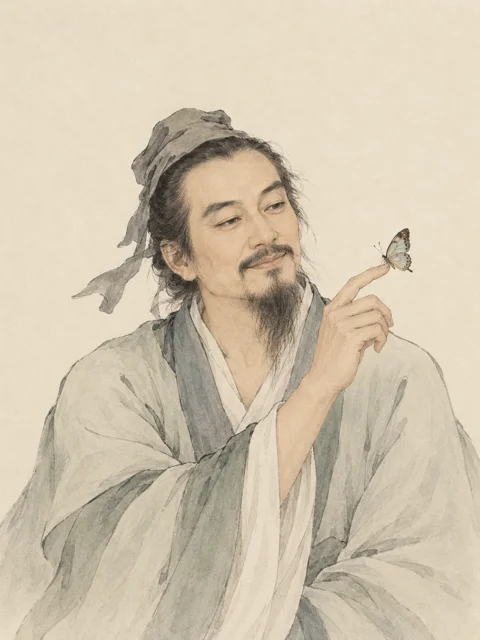
 AI 创作示意
GUANFU / en
庄子
AI 创作示意Chapter 20
版本按章对照,不代表逐句校勘对应。
中文原文(全三十三篇) / 庄子原典;维基文库贡献者整理
观复随文注释 · 57 条
莊子行於山中,見大木,枝葉盛茂,伐木者止其旁而不取也。問其故,曰:「无所可用。」莊子曰:「此木以不材不合世俗的取材标准得終其天年夫!」(子)出於山,舍於故人之家,故人喜,命豎一作「堅」子童仆殺鴈而烹之。豎子請曰:「其一能鳴,其一不能鳴,請奚殺?」主人曰:「殺不能鳴者。」明日,弟子問於莊子曰:「昨日山中一作「木」之木,以不材,得終其天年。今主人之鴈一作「雁」,以不材,死。先生將何處?」莊子笑曰:「周將處夫材與不材之間。材與不材之間,似之而非也,故未免乎累。若夫乘道德而浮遊,則不然,无譽无訾没有毁谤;訾读 zǐ,一龍一蛇时而显达、时而退隐,與時俱化,而无肯專爲,一上一下,以和爲量,浮遊乎萬物之祖,物物而不物於物顺应外物而不受外物役使,則胡可得而累邪?此神農、黃帝之法則也。若夫萬物之情,人倫之傳,則不然,合則離,成則毀,廉則挫,尊則議,有爲則虧,賢則謀,不肖則欺,胡可得而必乎哉?悲夫!弟子志之,其唯道德之鄉乎!」
市南宜僚楚国隐者,住市南而得称見魯侯,魯侯有憂色。市南子曰:「君有憂色,何也?」魯侯曰:「吾學先王之道,脩先君之業,吾敬鬼尊賢,親而行之,无須臾離居,然不免於患,吾是以憂。」市南子曰:「君之除患之術,淺矣!夫豐狐文豹皮毛丰美的狐狸与有斑纹的豹子,棲於山林,伏於巖穴,靜也;夜行晝居,戒也;雖飢渴隱約穷困,猶且胥疏疏远、远避一作「䟽」於江湖之上而求食焉,定也:然且不免於罔羅機辟捕兽的机关陷阱之患,是何罪之有哉?其皮爲之災也。今魯國,獨非君之皮邪?吾願君,刳形去皮剖去形体外饰,喻放下身份牵累,洒心洗涤心灵;洒读 xǐ去欲,而遊於无人之野。南越有邑焉,名爲建德之國寓言中淳朴无争的理想国,其民愚而朴,少私而寡欲,知作而不知藏,與而不求其報,不知義之所適,不知禮之所將,猖狂妄行,乃蹈乎大方,其生可樂,其死可葬。吾願君,去國捐俗,與道相輔而行。」君曰:「彼其道,遠而險,又有江山,我无舟車,奈何?」市南子曰:「君无形倨外貌倨傲,无留居,以爲君車。」君曰:「彼其道,幽遠而无人,吾誰與爲鄰?吾无糧,餓一作「我」无食,安得而至焉?」市南子曰:「少君之費,寡君之欲,雖无糧,而乃足。君其涉於江而浮於海,望之而不見其崖,愈往而不知其所窮,送君者皆自崖而反,君自此遠矣!故有人者累,見有於人者憂。故堯非有人,非見有於人也。吾願:去君之累,除君之憂,而獨與道遊於大莫之國空寂无为的境地。」方舟并连两船而濟於河,有虛船來觸舟,雖有褊一作「惼」心心胸狭窄之人,不怒;有一人在其上,則呼張歙张开与收缩,指操舟避让之,一呼而不聞不求显扬声名,再呼而不聞,於是三呼邪,則必以惡聲隨之。向(也)不怒而今也怒,向也虛而今也實。人能虛己以遊世,其孰能害之?
北宮奢卫国负责铸钟筹资的人爲衞靈公賦斂以爲鍾,爲壇乎郭門之外,三月而成上下之縣上下悬挂的编钟;縣通悬。王子慶忌見而問焉,曰:「子何術之設?」奢曰:「一之間,无敢設也。奢聞之:『旣彫一作「雕」旣琢,復歸於朴。』侗乎无知无心的样子其无識,儻乎其怠疑,萃乎芒乎,其送往而迎來,來者勿禁,往者勿止,從其彊梁,隨其曲傅曲折的依附;傅通附,因其自窮,故朝(夕)賦斂,而豪一作「毫」毛不挫,而況有大塗大道者乎?」
孔子圍於陳、蔡之間,七日不火食。太公任往弔之,曰:「子幾死乎?」曰:「然。」「子惡死乎?」曰:「然。」任曰:「予嘗言不死之道。東海有鳥焉,其名曰意怠寓言中的鸟名。其爲鳥也,翂翂翐翐缓慢飞翔的样子,而似无能,引援相互牵引扶助而飛,迫脅而棲,進不敢爲前,退不敢爲後,食不敢先嘗,必取其緒剩余的食物,是故其行列不斥,而外人卒不得害,是以免於患。直木先伐,甘井先竭。子其意者,飾知以驚愚,脩身以明汙,昭昭乎如揭日月而行,故不免也。昔吾聞之大成之人曰:『自伐自我夸耀者无功,功成者墮,名成者虧。』孰能去功與名,而還與衆人?道流而不明居,得行而不名處,純純常常,乃比於狂,削迹捐勢,不爲功名,是故无責於人,人亦无責焉。至人不聞,子何喜哉?」孔子曰:「善哉!」辭其交遊一作「游」,去其弟子,逃於大澤,衣裘褐皮衣与粗布衣服,食杼栗橡实、栗子之类食物,入獸不亂羣,入鳥不亂行。鳥獸不惡,而況人乎?
孔子問子桑雩曰:「吾再逐於魯,伐樹於宋,削迹於衞,窮於商、周,圍於陳、蔡之間。吾犯此數患,親交益疏,徒友益散,何與?」子桑雩曰:「子獨不聞假人假国之人;假为古地名,存异说之亡與?林回棄千金之璧,負赤子婴儿而趨。或曰:『爲其布财物;布为古代货币與?赤子之布寡矣。爲其累與?赤子之累多矣。棄千金之璧,負赤子而趨,何也?』林回曰:『彼以利合,此以天屬天然的亲属关系也。』夫以利合者,迫窮禍患害,相棄也;以天屬者,迫窮禍患害,相收也。夫相收之與相棄,亦遠矣。且君子之交淡若水,小人之交甘若醴甜酒;读 lǐ;君子淡以親,小人甘以絕。彼无故以合者,則无故以離。」孔子曰:「敬聞命矣!」徐行翔佯从容徘徊;同徜徉而歸,絕學捐書,弟子无挹作揖、屈己奉承於前,其愛益加進。異日,桑雩又曰:「舜之將死,眞泠真诚地告诫;此词古注有异说禹曰:『汝戒之哉!形莫若緣,情莫若率。』緣則不離,率則不勞。不離不勞,則不求文以待形。不求文以待形,固不待物。」
莊子衣大布而補之,正緳束衣的带子;读 xié係履,而過魏王。魏王曰:「何先生之憊此指精神困顿、志不得行邪?」莊子曰:「貧也,非憊也。士有道德不能行,憊也。衣弊履穿,貧也,非憊一作「弊」也。此所謂非遭時也。王獨不見夫騰猨一作「猿」乎?其得柟梓豫章楠、梓、樟等高大树木也,攬蔓其枝,而王長其間,雖羿、逢一作「蓬」蒙传说中的善射者后羿与逢蒙,不能睥睨也;及其得柘棘枳枸丛生多刺的灌木之間也,危行側視,振動悼慄,此筋骨非有加急而不柔也,處勢不便,未足以逞其能也。今處昏上亂相之間,而欲无憊,奚可得邪?此比干之見(剖)心,徵也夫!」
孔子窮於陳、蔡之間,七日不火食,左據槁木,右擊槁枝,而歌猋一作「焱」氏之風,有其具而无其數,有其聲而无宮角古代音阶中的宫、角二音,木聲與人聲,犁然畅快契合的样子有當於人之心。顏回端拱還目而窺之。仲尼恐其廣己而造大也,愛己而造哀也,曰:「回,无受天損易,无受人益難,无始而非卒也,人與天一也。夫今之歌者,其誰乎?」回曰:「敢問无受天損易?」仲尼曰:「飢渴寒暑,窮桎不行,天地之行也,運物之泄也,言與之偕逝之謂也,爲人臣者,不敢去之。執臣之道猶若是,而況乎所以待天乎?」「何謂无受人益難?」仲尼曰:「始用四達,爵祿並至而不窮,物之所利,乃非己也,吾命有在外者也。君子不爲盜,賢人不爲竊,吾若取之,何哉?故曰:鳥莫知於鷾鴯燕子;读 yì ér,目之所不宜處,不給視,雖落其實,棄之而走;其畏人也,而襲諸人間社稷存焉爾一作「耳」。」「何謂无始而非卒?」仲尼曰:「化其萬物,而不知其禪之者,焉知其所終?焉知其所始?正而待之而已耳。」「何謂人與天一邪?」仲尼曰:「有人,天也。有天,亦天也。人之不能有天,性也。聖人晏然安宁自得的样子,體逝随顺自然流逝变化而終矣。」
莊周遊乎雕陵之野一作「樊」,覩一異鵲,自南方來者,翼廣七尺,目大運寸,感周之顙额头;读 sǎng,而集於栗林。莊周曰:「此何鳥哉?翼殷不逝,目大不覩!」蹇裳躩步提起衣裳,大步疾行,執彈而留之;覩一蟬,方得美蔭而忘其身;螳蜋執翳借草木遮蔽;翳读 yì而搏之,見得而忘其形;異鵲從而利之,見利一作「得」而忘其眞。莊周怵然,曰:「噫!物固相累,二類相召也!」捐彈而反走,虞人管理山林的人逐而誶责骂;读 suì之。莊周反入,三月不庭不出庭院。藺且從而問之:「夫子何爲頃間甚不庭乎?」莊周曰:「吾守形而忘身,觀於濁水而迷於清淵。且吾聞諸夫子曰:『入其俗,從其俗。』今吾遊於雕陵而忘吾身,異鵲感吾顙,遊於栗林而忘眞,栗林虞人以吾爲戮,吾所以不庭也。」
陽子之宋,宿於逆旅旅舍、客栈。逆旅人有妾二人,其一人美,其一人惡,惡者貴,而美者賤。陽子問其故。逆旅小子對曰:「其美者自美自以为美、恃美骄人,吾不知其美也。其惡者自惡,吾不知其惡也。」陽子曰:「弟子記之:行賢而去自賢之行,安往而不愛哉?」
观复随文注释 · AI 辅助独立整理,待持续人工校订。释义以本章语境为依据;存在异说或底本疑讹的地方另作提示。原文及版本来源保留如下。
原典公有领域;电子文本据维基文库贡献者,按 CC BY-SA 4.0 保留署名及相同方式共享;调整空白与排版。 · 查看原始版本
欢迎引用本站资源,分享道家与道教文化。引用时请注明出处“观复”,并附上所引用内容的原始页面链接,方便读者查阅。
观复白话释义(AI 辅助) / 观复 · AI 辅助独立整理
【观复白话释义|AI 辅助·未经人工学术审定】
庄子在山中行走,看到一棵大树,枝叶繁茂。伐木的人停在旁边,却不砍它。庄子问原因,他们说:“没有什么用处。”庄子说:“这棵树因为不成材,得以活尽天然的年寿啊!”他出山后,住到老朋友家。朋友高兴,叫童仆杀鹅招待。童仆问:“一只会叫,一只不会叫,请问杀哪只?”主人说:“杀不会叫的。”第二天,弟子问庄子:“昨天山里的树,因为不成材而享尽天年;如今主人家的鹅,因为没有本领而死。先生要处在哪一边呢?”庄子笑道:“我将处在有用与无用之间。不过,有用与无用之间,只像是合道,却还不是,仍免不了牵累。若是乘着道德自由游行,就不同了:不受赞誉毁谤拘束,时而如龙显现,时而如蛇潜伏,随着时机共同变化,不肯固执一种做法;时上时下,以和谐为尺度,游于万物的根源,把物作为物来对待,而不被物所支配,哪里还能受到牵累呢?这就是神农、黄帝的法则。
“万物通常的情势、人间流行的关系却不是这样:合了会离,成了会毁,锋利会受挫,尊贵会被议论,有所作为会遭损害,贤能会被算计,不贤会受欺负,哪里能保证某一条办法永远可靠呢?可悲啊!弟子们记住,能安顿的,大概只有道德的境界吧!”
市南宜僚拜见鲁侯,鲁侯面有忧色。市南子问:“您为什么忧虑?”鲁侯说:“我学习先王之道,修治先君的事业,敬奉鬼神,尊重贤人,亲自实践,片刻不离,却仍然不能免于祸患,所以忧虑。”市南子说:“您排除祸患的办法,太浅了!皮毛丰美的狐狸和花纹华丽的豹子,栖息山林,藏身岩穴,够安静了;夜间行动,白天休息,够戒备了;即使饥渴困乏,仍小心远离人迹,到江湖边找食物,够有定见了。却依然逃不过罗网机关的灾难,这又有什么罪过?是它们的皮招来了祸患。如今鲁国不正是您的那张皮吗?我愿您去掉形体名位的执著,剥去这张皮,洗净心思,除去欲望,游于无人干扰的原野。
“南越有个地方,叫建德之国。那里的人浑厚质朴,少私寡欲,知道劳作,不知道积藏,给予别人却不求回报,不知道义要趋向哪里、礼要引到何处,放任自在地行动,反而踏上大道。他们活着可以快乐,死去可以安葬。我愿您放下国政的牵累,舍去世俗,同道相伴而行。”鲁侯说:“那里道路遥远险阻,又隔着江河山岭,我没有舟车,怎么办?”市南子说:“您不要以身份自高,不要固守原来的位置,这就可以成为您的车。”鲁侯说:“那条路幽深遥远,没有人,我跟谁作邻居?我没有粮食,饿了没东西吃,怎么到得了?”市南子说:“减少您的耗费,减轻您的欲望,即使没有粮食,也会自觉充足。您渡过江河,浮游大海,望去看不见边岸,越往前越不知道尽头。送您的人都从岸边返回,您从此就远离他们了。所以,占有别人的人受牵累,被别人占有的人有忧患。尧既不把人民据为己有,也不让自己被他人占有。我愿去掉您的牵累,解除您的忧患,让您独自同道游于广漠之国。”
把船并在一起渡河,一条空船漂来撞上,即使性情急躁的人也不会生气。若船上有一个人,就会喊他撑开、避让;喊一次不应,再喊一次不应,等到第三次,恶声辱骂便接着来了。先前不怒,如今发怒,只因为先前是空船,如今里面有人。人若能虚空自我而游于世间,谁又能伤害他呢?
北宫奢替卫灵公征集财物铸钟,在外城门外设坛,三个月就把上下悬挂的整套钟做好了。王子庆忌问:“您施用了什么方法?”北宫奢说:“专一于此,不敢另外施设技巧。我听说:‘经过雕刻琢磨,还要返回质朴。’我朦胧得像没有知识,坦然得像迟缓无疑,混同于众而不露分别,送走去的,迎接来的。来的不阻挡,去的不挽留,顺应强硬的人,也随顺委曲的人,让他们各自尽其所能。因此,早晚征集财物,却连人一根毫毛也不损伤。何况掌握大道的人呢?”
孔子被困在陈、蔡之间,七天吃不上熟食。太公任来慰问:“您快死了吗?”孔子说:“是。”又问:“您厌恶死吗?”孔子说:“是。”太公任说:“我曾谈过免于死亡的办法。东海有一种鸟,名叫意怠,飞起来慢吞吞,像没有本领;要借同伴带引才飞,挤在群鸟中才栖息。前进不敢抢先,后退不敢落后,吃东西不敢先尝,只取余下的。因此,鸟群不排斥它,外人始终不能伤它,便免了祸患。笔直的树先被砍,甘甜的井先被汲干。您大概是修饰智慧惊动愚人,修养自身显出别人的污浊,明晃晃地像举着日月走路,所以不能免灾。
“从前我听通达的人说:‘自夸的人没有功劳;功成容易败落,名成容易亏损。’谁能放下功与名,重新同众人相处呢?道如水流行,不以显耀自居;德落实于行动,不占据名声的位置。纯朴平常,甚至像个狂人;消去显眼的行迹,舍去权势,不求功名。因此不责求别人,别人也不责求他。至人不求闻名,您为什么喜好这些呢?”孔子说:“说得好!”于是辞别交游,离开弟子,退到大泽,穿粗陋皮衣,吃橡实栗子。走进兽群,不扰乱群兽;进入鸟群,不惊乱行列。鸟兽都不厌恶他,何况人呢?
孔子问子桑雩:“我两次被鲁国驱逐,在宋国遭遇砍树的威胁,在卫国被排斥得无处留迹,在商、周之地困厄,又被围在陈、蔡之间。几次遭难之后,亲近的朋友更加疏远,弟子同伴更加离散,这是为什么?”子桑雩说:“你没听过假国人逃难的故事吗?林回丢掉价值千金的璧,背着婴儿逃跑。有人问:‘是为了婴儿的财物吗?婴儿财物太少了;是为了少受拖累吗?婴儿的拖累太多了。丢下千金之璧,背着婴儿逃,为什么?’林回说:‘那块璧是因利益同我相合,婴儿却与我有天然亲属关系。’因利益结合,遇到困厄祸害就相互舍弃;因天然情分相连,遇到困厄祸害就相互接纳。接纳同舍弃,差得太远了。君子的交情淡如水,小人的交情甜如甜酒;君子虽淡却亲近,小人虽甜却终至断绝。没有真实根由而相合,也就会无缘无故而离散。”孔子说:“我恭敬领受教诲!”他慢慢徘徊着回去,断绝矜夸的学问,放下书本,弟子不再在面前拘于礼貌,彼此的亲爱反而日益加深。
另一天,桑雩又说:“舜临死时,郑重告诫禹:‘你要谨慎!形体的行动莫如顺应,内在的感情莫如率真。’顺应,就不偏离;率真,就不劳苦。不偏离、不劳苦,就不必追求文饰来装点形体。不求文饰装点形体,自然就不依赖外物。”
庄子穿着打补丁的粗布衣,整理腰带,系好破鞋,去见魏王。魏王说:“先生怎么如此困惫?”庄子说:“这是贫穷,不是困惫。士人有道德而无法实行,那才是困惫;衣服破、鞋子穿,那是贫穷,不是困惫。这叫没有遇上适宜的时世。王难道没看见跳跃的猿猴吗?它得到楠、梓、豫章一类大树,攀住枝蔓,在其间自在称雄,即使羿和逢蒙那样的射手,也不能觑准它。等它落进柘、棘、枳、枸一类带刺的灌木,便小心行走,侧目察看,惊动发抖。不是筋骨忽然紧缩、不柔韧了,而是所处形势不便,不足以施展本领。如今处在昏君乱相之间,想不困惫,怎么可能呢?比干被剖心,就是明证啊!”
孔子困在陈、蔡之间,七天吃不到熟食。他左手靠着枯木,右手敲着枯枝,唱古代猋氏的歌。有唱歌的样子,却无固定节拍;有声音,却不拘宫角音律。木头声同人声清楚地相和,触动人心。颜回端坐拱手,转眼看他。孔子怕他把自己看得过分伟大,又因爱自己而过分悲伤,便说:“回,不把自然的损害当成损害,容易;不接受人为的增益,难。没有一个开始不连着终结,人与天原是一体。如今唱歌的,又是谁呢?”
颜回问:“什么叫不把自然的损害当成损害容易?”孔子说:“饥渴寒暑,困顿束缚、不能前行,都是天地运行、万物迁化的表现,只是同这些变化一起过去罢了。做臣子的,尚且不敢随意逃避职责;守臣道都如此,何况面对自然呢?”颜回问:“什么叫不接受人为的增益难?”孔子说:“一旦受任用,四面通达,爵位俸禄不断来到;那是外物带来的利益,并不是自身的本真,我的际遇还有取决于身外的部分。君子不做强盗,贤人不行偷窃,我若把不属于本真的东西攫为己有,又算什么呢?所以说,鸟中没有比燕子更聪明的:遇到不适合停留的地方,连看也不多看,即使食物落在那里,也舍弃飞走。它虽怕人,却又在人居和社坛附近筑巢,以保全自己。”颜回问:“什么叫没有开始不连着终结?”孔子说:“万物变化,却不知道是谁使它们递相更替,哪里知道终点,哪里知道起点?只是端正自己,等待变化罢了。”颜回问:“什么叫人与天一体?”孔子说:“人为的存在,本出于天;天然的存在,也是天。人不能以己力占有或支配天,这是本性的限度。圣人安然自处,体随变化流逝,直到终了。”
庄周游于雕陵的园地,见一只奇怪的鹊从南方飞来,翅膀展开七尺,眼睛直径约一寸,擦过庄周额头,停在栗树林里。庄周说:“这是什么鸟?翅膀很大却飞不远,眼睛很大却看不清!”他提起衣裳,快步走去,拿弹弓瞄准。却看见一只蝉正在享受树荫,忘了自身危险;螳螂借叶片遮蔽,准备捕蝉,只看见猎物,也忘了自身;那只异鹊又跟在后面,想得螳螂的便宜,见到利益便忘了本真。庄周惊醒,说:“唉!万物本会相互牵累,利与害相互招引!”于是丢开弹弓,转身跑走。看园的人追上来责骂他。
庄周回家,三个月不在庭院露面。弟子蔺且问:“先生近来为什么一直不出来?”庄周说:“我顾着外物的形迹,却忘了自身;观察浊水,却迷失了清澈的深潭。我又听老师说:‘进入别人的地方,要顺从那里的规矩。’如今我游雕陵,忘了自身,以至异鹊擦到额头;游栗林,又忘了守真,看园人把我当作该责罚的人。这就是我不出来的原因。”
阳子去宋国,住在旅店。店主有两个妾,一个美,一个丑;丑的受重视,美的反受轻视。阳子问缘故,旅店的小伙子答:“美的自以为美,我们便觉不出她的美;丑的自知丑,我们便觉不出她的丑。”阳子说:“弟子们记住:行贤德,却去掉自以为贤的态度,到哪里会不受喜爱呢?”
【篇末疑难注记】“建德之国”为篇中理想之国。“侗乎”“儻乎”“萃乎芒乎”等形容词语义含混,按不露机巧、浑然顺任处理。“假人”按假国之人,“布”按财货解释。“真泠”按郑重告诫理解。“猋氏”是所给文本的古氏名,不另作史实认定。“鷾鴯”通常释为燕子。“吾守形而忘身”中“形”所指有歧解,正文按注意外在形迹而忘自身理解。“三月不庭”依所给文本保留,未改作其他时长。篇中孔子的经历及古帝王故事均按本文寓言叙述呈现。
观复白话释义:AI 辅助依据古文独立编写,已进行文本覆盖核对,未经人工学术审定;原典来源及电子底本署名、许可见对应中文版本。 · 查看原始版本
Herbert A. Giles 英译(全三十三篇) / Herbert A. Giles(翟理斯),1889
Mountain Trees.
[Translator’s note] Argument :—The alternatives of usefulness and uselessness— Tao a tertium quid —The human a hindrance to the divine—Altruism—Adaptation—Destiny—Illustrations.
[This chapter is supplementary to chapter iv.]
Chuang Tzŭ was travelling over a mountain when he saw a huge tree well covered with foliage. A woodsman had stopped near by, not caring to take it; and on Chuang Tzŭ enquiring the reason, he was told that it was of no use.
"This tree," cried Chuang Tzŭ, "by virtue of being good for nothing succeeds in completing its allotted span."
When Chuang Tzŭ left the mountain, he put up at the house of an old friend. The latter was delighted, and ordered a servant to kill a goose and cook it.
"Which shall I kill?" enquired the servant; "the one that cackles or the one that doesn't?"
His master told him to kill the one which did not cackle. And accordingly, the next day, a disciple asked Chuang Tzŭ, saying, "Yesterday, that tree on the mountain, because good for nothing, was to succeed in completing its allotted span. But now, our host's goose, which is good for nothing, has to die. Upon which horn of the dilemma will you rest?"
"I rest," replied Chuang Tzŭ with a smile, "halfway between the two. In that position, appearing to be what I am not, it is impossible to avoid the troubles of mortality;
[Translator’s note] The text is here doubtful, and commentators explain according to the fancy of each. When a Chinese commentator does not understand his text, he usually slurs it over. He never says "I do not understand." Chu Fu Tzŭ alone could rise to this height.
though, if charioted upon Tao and floating far above mortality, this would not be so. No praise, no blame; both great and small; changing with the change of time, but ever without special effort; both above and below; making for harmony with surroundings; reaching creation's First Cause; swaying all things and swayed by none;—how then shall such troubles come? This was the method of Shên Nung and Huang Ti.
[Translator’s note] "If another guest had happened to arrive," says Lin Hsi Chung, "I fancy the chance even of the cackling goose would have been small."
"But amidst the mundane passions and relationships of man, such would not be the case. For where there is union, there is also separation; where there is completion, there is also destruction; where there is purity, there is also oppression; where there is honour, there is also disparagement; where there is doing, there is also undoing; where there is openness, there is also underhandedness; and where there is no semblance, there is also deceit. How then can there be any fixed point? Alas indeed! Take note, my disciples, that such is to be found only in the domain of Tao ."
I Liao
[Translator’s note] A sage of the Ch'u State.
of Shih-nan paid a visit to the prince of Lu. The latter wore a melancholy look; whereupon the philosopher of Shih-nan enquired what was the cause.
"I study the doctrines of the ancient Sages," replied the prince. "I carry on the work of my predecessors. I respect religion. I honour the good. Never for a moment do I relax in these points; yet I cannot avoid misfortune, and consequently I am sad."
"Your Highness' method of avoiding misfortune," said the philosopher of Shih-nan, "is but a shallow one. A handsome fox or a striped leopard will live in a mountain forest, hiding beneath some precipitous cliff. This is their repose. They come out at night and keep in by day. This is their caution. Though under the stress of hunger and thirst, they lie hidden, hardly venturing to slink secretly to the river bank in search of food. This is their resoluteness. Nevertheless, they do not escape the misfortune of the net and the trap. But what crime have they committed? 'Tis their skin which is the cause of their trouble; and is not the State of Lu your Highness' skin? I would have your Highness put away body and skin alike, and cleansing your heart and purging it of passion, betake yourself to the land where mortality is not.
[Translator’s note] Tao.
"In Nan-yüeh there is a district, called Established-Virtue. Its people are simple and honest, unselfish, and without passions. They can make, but cannot keep. They give, but look for no return. They are not conscious of fulfilling obligations. They are not conscious of subservience to etiquette.
[Translator’s note] Theirs is the natural etiquette of well-regulated minds.
Their actions are altogether uncontrolled, yet they tread in the way of the wise. Life is for enjoyment; death, for burial. And thither I would have your Highness proceed, power discarded and the world left behind, only putting trust in Tao ."
"The road is long and dangerous," said the prince. "Rivers and hills to be crossed, and I without boat or chariot;—what then?"
"Unhindered by body and unfettered in mind," replied the philosopher, "your Highness will be a chariot to yourself."
"But the road is long and dreary," argued the prince, "and uninhabited.
[Translator’s note] This is a play on "where mortality is not," above.
I shall have no one to turn to for help; and how, without food, shall I ever be able to get there?"
"Decrease expenditure
[Translator’s note] Of energy.
and lessen desires," answered the philosopher, "and even though without provisions, there will be enough. And then through river and over sea your Highness will travel into shoreless illimitable space. From the border-land, those who act as escort will return; but thence onwards your Highness will travel afar.
"It is the human in ourselves which is our hindrance; and the human in others which causes our sorrow. The great Yao had not this human element himself, nor did he perceive it in others. And I would have your Highness put off this hindrance and rid yourself of this sorrow, and roam with Tao alone through the realms of Infinite Nought.
"Suppose a boat is crossing a river, and another empty boat is about to collide with it. Even an irritable man would not lose his temper. But supposing there was some one in the second boat. Then the occupant of the first would shout to him to keep clear. And if the other did not hear the first time, nor even when called to three times, bad language would inevitably follow. In the first case there was no anger, in the second there was; because in the first case the boat was empty, and in the second it was occupied. And so it is with man. If he could only roam empty through life, who would be able to injure him?"
[Translator’s note] With his mind in a negative state, closed to all impressions conveyed within by the senses from without.
Pei Kung Shê, minister to Duke Ling of Wei, levied contributions for making bells. An altar was built outside the city gate;
[Translator’s note] For purposes of sacrifice.
and in three months the bells, upper and lower, were all hung.
[Translator’s note] The bell-chime consisted of a frame with bells swung on an upper and lower bar.
When Wang Tzŭ Ch'ing Chi
[Translator’s note] Minister to the ruling House of Chou.
saw them, he asked, saying, "How, Sir, did you manage this?"
"In the domain of ONE ," replied Shê, "there may not be managing. I have heard say that which is carved and polished reverts nevertheless to its natural condition. And so I made allowances for ignorance and for suspicion. I betrayed no feeling when welcomed or dismissed. I forbade not those who came, nor detained those who went away. I showed no resentment towards the unwilling, nor gratitude towards those who gave. Every one subscribed what he liked; and thus in my daily collection of subscriptions, no injury was done.— How much more then those who have the great WAY ?"
[Translator’s note] If my success was due to the simple principle above enunciated, what a success would result from Tao , which is the infinite extension of such principles into every phase of existence!
[Translator’s note] The Chinese word here used for "way," as a synonym of Tao , settles the original meaning of the latter in the sense of "road." Thus Lao Tzŭ is said to have explained that the Way he taught was not the way which could be walked upon.
When Confucius was hemmed in between Ch'ên and Ts'ai, he passed seven days without food.
The minister Jen went to condole with him, and said, "You were near, Sir, to death."
"I was indeed," replied Confucius.
"Do you fear death, Sir?" enquired Jen.
"I do," said Confucius.
"Then I will try to teach you," said Jen, "the way not to die.
"In the eastern sea there are certain birds, called the i-êrh . They behave themselves in a modest and unassuming manner, as though unpossessed of ability. They fly simultaneously: they roost in a body. In advancing, none strives to be first; in retreating, none ventures to be last. In eating, none will be the first to begin; it is considered proper to take the leavings of others. Therefore, in their own ranks they are at peace, and the outside world is unable to harm them. And thus they escape trouble.
"Straight trees are the first felled. Sweet wells are soonest exhausted. And you, you make a show of your knowledge in order to startle fools. You cultivate yourself in contrast to the degradation of others. And you blaze along as though the sun and moon were under your arms; consequently, you cannot avoid trouble.
[Translator’s note] See p. 243 .
"Formerly, I heard a very wise man say, Self-praise is no recommendation. In merit achieved there is deterioration. In fame achieved there is loss. Who can discard both merit and fame and become one with the rest? Tao pervades all things but is not seen. Tê
[Translator’s note] This is "virtue," the expression of Tao .
moves through all things but its place is not known. In its purity and constancy, it may be compared with the purposeless. Remaining concealed, rejecting power, it works not for merit nor for fame. Thus, not censuring others, it is not censured by others.
"And if the perfect man cares not for fame, why, Sir, should you take pleasure in it?"
"Good indeed!" replied Confucius; and forthwith he took leave of his friends and dismissed his disciples and retired to the wilds, where he dressed himself in skins and serge and fed on acorns and chestnuts. He passed among the beasts and birds and they took no heed of him. And if so, how much more among men?
[Translator’s note] An unquestionably spurious episode.
Confucius asked Tzŭ Sang Hu,
[Translator’s note] See ch. vi .
saying, "I have been twice expelled from Lu. My tree was cut down in Sung. I have been tabooed in Wei. I am a failure in Shang and Chou. I was surrounded between Ch'ên and Ts'ai. And in addition to all these troubles, my friends have separated from me and my disciples are gone. How is this?"
[Translator’s note] See p. 180 .
"Have you not heard," replied Sang Hu, "how when the men of Kuo fled, one of them, named Lin Hui, cast aside most valuable regalia and carried away his child upon his back? Some one suggested that he was influenced by the value of the child;—but the child's value was small. Or by the inconvenience of the regalia;—but the inconvenience of the child would be much greater. Why then did he leave behind the regalia and carry off the child?
"Lin Hui himself said, 'The regalia involved a mere question of money. The child was from God.'
"And so it is that in trouble and calamity mere money questions are neglected, while we ever cling nearer to that which is from God. And between neglecting and clinging to, the difference is great.
"The friendship of the superior man is negative like water. The friendship of the mean man is full-flavoured like wine. That of the superior man passes from the negative to the affectionate. That of the mean man passes from the full-flavoured to nothing. The friendship of the mean man begins without due cause, and in like manner comes to an end.
"I hear and obey," replied Confucius; and forthwith he went quietly home, put an end to his studies and cast aside his books. His disciples no longer saluted him as teacher; but his love for them deepened every day.
On another occasion, Sang Hu said to him again, "When Shun was about to die, he commanded the Great Yü as follows:—Be careful. Act in accordance with your physical body. Speak in accordance with your feelings. You will thus not get into difficulty with the former nor suffer annoyance in the latter. And as under these conditions you will not stand in need of outward embellishment of any kind, it follows that you therefore will not stand in need of anything."
[Translator’s note] Also an episode of doubtful authorship. The commentators, however, have nothing to say against its genuineness.
Chuang Tzŭ put on cotton clothes with patches in them, and arranging his girdle and tieing on his shoes,
[Translator’s note] To keep them from falling off.
went to see the prince of Wei.
"How miserable you look, Sir!" cried the prince.
"It is poverty, not misery," replied Chuang Tzŭ. "A man who has Tao cannot be miserable. Ragged clothes and old boots make poverty, not misery. Mine is what is called being out of harmony with one's age.
"Has your Highness never seen a climbing ape? Give it some large tree, and it will twist and twirl among the branches as though monarch of all it surveys. Yi and Fêng Mêng
[Translator’s note] An ancient archer and his apprentice.
can never catch a glimpse of it.
"But put it in a bramble bush, and it will move cautiously with sidelong glances, trembling all over with fear. Not that its muscles relax in the face of difficulty, but because it is at a disadvantage as regards position, and is unable to make use of its skill. And how should any one, living under foolish sovereigns and wicked ministers, help being miserable, even though he might wish not to be so?
"It was under such circumstances that Pi Kan was disembowelled."
[Translator’s note] See ch. iv . The above episode is too much even for Chinese critics, and has been condemned accordingly.
When Confucius was hemmed in between Ch'ên and Ts'ai and had gone seven days without food, then, holding in his left hand a piece of dry wood and in his right hand a dry stick, he sang a ballad of Piao Shih.
[Translator’s note] An ancient ruler.
He had an instrument, but the gamut was wanting. There was sound, but no tune. The sound of the wood accompanied by the voice of the man yielded a harsh result, but it was in keeping with the feelings of his audience.
Yen Hui, who was standing by in a respectful attitude, thereupon began to turn his eyes about him; and Confucius, fearing lest he should be driven by exaltation into bragging, or by a desire for safety into sorrow,
[Translator’s note] As a result of hearing the song.
spoke to him as follows:—
"Hui! it is easy to escape injury from God; it is difficult to avoid the benefits of man. There is no beginning and there is no end. Man and God are ONE . Who then was singing just now?"
"Pray, Sir, what do you mean," asked Yen Hui, "by saying that it is easy to escape injury from God?"
"Hunger, thirst, cold, and heat," replied Confucius, "are but as fetters in the path of life. They belong to the natural laws which govern the universe; and in obedience thereto I pass on my allotted course. The subject dares not disregard the mandates of his prince. And if this is man's duty to man, how much more shall it be his duty to God?"
"What is the meaning of difficult to avoid the benefits of man?" asked Yen Hui.
"If one begins," replied Confucius, "by adapta tion to surroundings, rank and power follow without cease. Such advantages are external; they are not derived from oneself. And my life is more or less dependent upon the external. The superior man does not steal these; nor does the good man pilfer them. What then do I but take them as they come?
"Therefore it has been said that no bird is so wise as the swallow. If it sees a place unfit to dwell in, it will not bestow a glance thereon; and even though it should drop food there, it will leave the food and fly away. Now swallows fear man. Yet they dwell among men. Because there they find their natural abode."
[Translator’s note] In the same way, man should adapt himself to the conditions which surround him.
"And what is the meaning," enquired Yen Hui, "of no beginning and no end?"
"The work goes on," replied Confucius, "and no man knoweth the cause. How then shall he know the end, or the beginning? There is nothing left to us but to wait."
"And that man and God are One ," said Yen Hui. "What does that mean?"
"That man is," replied Confucius, "is from God. That God is, is also from God. That man is not God, is his nature.
[Translator’s note] Sc. that which makes him man.
The Sage quietly waits for death as the end."
[Translator’s note] Which shall unite him once again with God.
When Chuang Tzŭ was wandering in the park at Tiao-ling, he saw a strange bird which came from the south. Its wings were seven feet across. Its eyes were an inch in circumference. And it flew close past Chuang Tzŭ's head to alight in a chestnut grove.
"What manner of bird is this?" cried Chuang Tzŭ. "With strong wings it does not fly away. With large eyes it does not see."
[Translator’s note] Or it would not have flown so near.
So he picked up his skirts and strode towards it with his cross-bow, anxious to get a shot. Just then he saw a cicada enjoying itself in the shade, forgetful of all else. And he saw a mantis spring and seize it, forgetting in the act its own body, which the strange bird immediately pounced upon and made its prey. And this it was which had caused the bird to forget its own nature.
[Translator’s note] And approach so close to man.
[Translator’s note] This episode has been widely popularised in Chinese every-day life. Its details have been expressed pictorially in a roughly-executed woodcut, with the addition of a tiger about to spring upon the man, and a well into which both will eventually tumble. A legend at the side reads,—"All is Destiny!"
"Alas!" cried Chuang Tzŭ with a sigh, "how creatures injure one another. Loss follows the pursuit of gain."
[Translator’s note] Those who would prey on others are preyed upon in turn themselves.
So he laid aside his bow and went home, driven away by the park-keeper who wanted to know what business he had there.
For three months after this, Chuang Tzŭ did not leave the house; and at length Lin Chü
[Translator’s note] A disciple.
asked him, saying, "Master, how is it that you have not been out for so long?"
"While keeping my physical frame," replied Chuang Tzŭ, "I lost sight of my real self. Gazing at muddy water, I lost sight of the clear abyss. Besides, I have learnt from the Master as follows:—"When you go into the world, follow its customs."
[Translator’s note] This saying is attributed, in uncanonical works, to Confucius. But if any one was "Master" to Chuang Tzŭ, it would of course be Lao Tzŭ.
Now when I strolled into the park at Tiao-ling, I forgot my real self. That strange bird which flew close past me to the chestnut grove, forgot its nature. The keeper of the chestnut grove took me for a thief. Consequently I have not been out."
When Yang Tzŭ
[Translator’s note] Yang Chu. See ch. viii .
went to the Sung State, he passed a night at an inn.
The innkeeper had two concubines, one beautiful, the other ugly. The latter he loved; the former, he hated.
Yang Tzŭ asked how this was; whereupon one of the inn servants said, "The beautiful one is so conscious of her beauty that one does not think her beautiful. The ugly one is so conscious of her ugliness that one does not think her ugly."
"Note this, my disciples!" cried Yang Tzŭ. "Be virtuous, but without being consciously so; and wherever you go, you will be beloved."
原著及 Herbert A. Giles 历史译本公有领域;据 Project Gutenberg #59709,完整电子书及使用条款见本站资料来源。 · 查看原始版本
我的书签(此浏览器)
还没有书签。