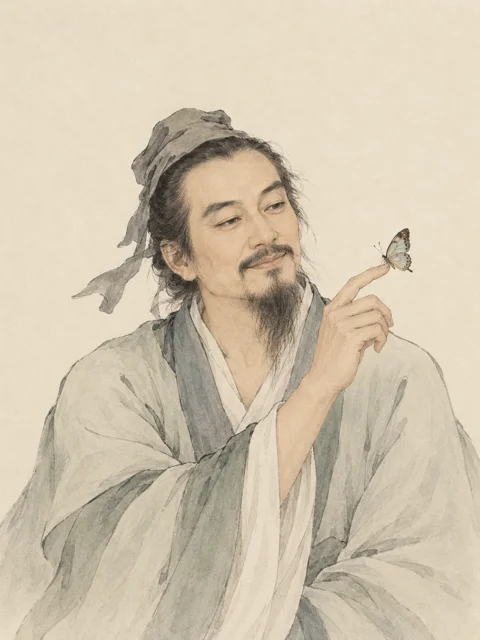
 AI 创作示意
GUANFU / en
庄子
AI 创作示意Chapter 22
版本按章对照,不代表逐句校勘对应。
中文原文(全三十三篇) / 庄子原典;维基文库贡献者整理
观复随文注释 · 66 条
知寓言人物,名字借指知识北遊於玄水之上,登隱弅之丘,而適遭无爲謂寓言人物,寓意无为无言焉。知謂无爲謂曰:「予欲有問乎若:何思何慮則知道?何處何服則安道?何從何道則得道?」三問而无爲謂不荅一作「答」也。非不荅一作「答」,不知荅一作「答」也。知不得問,反於白水之南,登狐闋之上一作「丘」,而睹狂屈寓言中的问道人物焉。知以之言也問乎狂屈。狂屈曰:「唉,予知之,將語若。」中欲言而忘其所欲言。知不得問,反於帝宮,見黃帝而問焉。黃帝曰:「无思无慮不以成见、机巧强求始知道,无處无服始安道,无從无道始得道。」知問黃帝曰:「我與若知之,彼與彼不知也,其孰是邪?」黃帝曰:「彼无爲謂眞是也,狂屈似之,我與汝終不近也。夫知者不言,言者不知,故聖人行不言之教。道不可致,德不可至,仁可爲也,義可虧也,禮相僞也,故曰:『失道而後德,失德而後仁,失仁而後義,失義而後禮,禮者道之華而亂之首也。』故曰:『爲道者日損逐日减去人为执著,損之又損之,以至於无爲,无爲而无不爲也。』今已爲物也,欲復歸根,不亦難乎?其易也,其唯大人乎?生也死之徒,死也生之始,孰知其紀?人之生,氣之聚以气的聚散解释生命的古代观念也,聚則爲生,散則爲死。若死生爲徒,吾又何患?故萬物一也。是其所美者爲神奇神妙美好的事物,其所惡者爲臭腐腐败恶臭的事物,臭腐復化爲神奇,神奇復化爲臭腐,故曰:通天下一氣耳。聖人故貴一。」知謂黃帝曰:「吾問无爲謂,无爲謂不應我,非不我應,不知應我也。吾問狂屈,狂屈中欲告我而不我告,非不我告,中欲告而忘之也。今予問乎若,若知之,奚故不近?」黃帝曰:「彼其眞是也,以其不知也。此其似之也,以其忘之也。予與若,終不近也,以其知之也。」狂屈聞之,以黃帝爲知言。
天地有大美而不言,四時有明法而不議,萬物有成理自身形成的条理而不說。聖人者,原天地之美,而達萬物之理。是故至人无爲,大聖不作,觀於天地之謂也。今彼神明,至精與!彼百化物,已死生方圓,莫知其根也扁然,而萬物自古以固存。六合上下四方爲巨,未離其內;秋豪极细小的秋毛;豪同毫爲小,待之成體一作「禮」;天下莫不沈浮一作「浮沈」,終身不故始终不断更新变化;陰陽四時運行,各得其序;惛然若亡而存,油然不形而神,萬物畜而不知。此之謂本根,可以觀於天矣。
齧缺問道乎被衣寓言中的古代高士,被衣曰:「若正汝形,一汝視,天和自然的和谐將至;攝汝知收敛机巧知识,一汝度,神將來舍。德將爲汝美,道將爲汝居,汝瞳焉无知无心地注视的样子如新生之犢,而无求其故。」言未卒,齧缺睡寐。被衣大悅一作「說」,行歌而去之,曰:「形若槁骸,心若死灰,眞其實知,不以故自持,媒媒晦晦浑朴幽昧而不自炫的样子,无心而不可與謀。彼何人哉?」
舜問乎丞传说中的贤者,篇中舜的问道对象曰:「道可得而有乎?」曰:「汝身非汝有也,汝何得有夫一作「乎」道?」舜曰:「吾身非吾有也,孰有之哉?」曰:「是天地之委形天地所托付的形体也。生非汝有,是天地之委和天地所赋予的和气也。性命非汝有,是天地之委順也。孫子非汝有,是天地之委蛻天地蜕变衍生的形体也。故行不知所往,處不知所持,食不知所味。天地之彊陽运动变化之气,古注有异解,氣也,又胡可得而有邪?」
孔子問於老耼曰:「今日晏閒安闲,敢問至道。」老耼曰:「汝齋戒,疏瀹疏通涤荡;瀹读 yuè而心,澡雪洗涤清洁而精神,掊擊而知打破你的智巧;而通尔。夫道,窅然幽深难见;窅读 yǎo難言哉!將爲汝言其崖略大概、梗概:夫昭昭生於冥冥,有倫生於无形,精神生於道,形本生於精,而萬物以形相生,故九竅者胎生以孔窍区分胎卵生的古代说法,八竅者卵生,其來无迹,其往无崖,无門无房,四達之皇皇也。邀於此者,四枝四肢彊,思慮恂達畅通无碍,耳目聰明,其用心不勞,其應物无方。天不得不高,地不得不廣,日月不得不行,萬物不得不昌,此其道與?且夫博之不必知,辯之不必慧,聖人以斷之矣。若夫益之而不加益,損之而不加損者,聖人之所保也。淵淵乎其若海,魏魏乎其終則復始也,運量萬物而不匱,則君子之道,彼其外與?萬物皆往資焉而不匱,此其道與?中國有人焉,非陰非陽,處於天地之間,直且爲人,將反於宗。自本觀之,生者,喑醷物元气凝聚的东西;古注有异解也,雖有壽夭,相去幾何?須臾之說也,奚足以爲堯、桀之是非?果蓏树上的果实与草本瓜果有理,人倫雖難,所以相齒。聖人遭之而不違,過之而不守。調而應之,德也;偶而應之,道也。帝之所興,王之所起也。人生天地之間,若白駒之過郤白马掠过缝隙,喻人生短暂,忽然而已。注然勃然,莫不出焉;油然漻然,莫不入焉;已化而生,又化而死,生物哀之,人類悲之。解其天弢天然的束缚;弢为弓袋,墮其天𧙍天然的包裹,借指形体束缚,紛乎宛乎,魂魄將往,乃身從之,乃大歸死后归于自然乎!不形之形,形之不形,是人之所同知也,非將至之所務也,此衆人之所同論也。彼至則不論,論則不至,明見无值。辯不若默,道不可聞,聞不若塞,此之謂大得。」
東郭子問於莊子曰:「所謂道,惡乎在?」莊子曰:「无所不在。」東郭子曰:「期而後可。」莊子曰:「在螻蟻蝼蛄和蚂蚁,泛指微小虫类。」曰:「何其下邪?」曰:「在稊稗田野杂草;读 tí bài。」曰:「何其愈下邪?」曰:「在瓦甓瓦与砖;甓读 pì。」曰:「何其愈甚邪?」曰:「在屎溺尿,此处读 niào。」東郭子不應。莊子曰:「夫子之問也,固不及質,正獲之問於監市监督市场的人,履狶踩猪腿以判断肥瘦;狶为猪也,每下愈況越往下试越能显明实情。汝唯莫一作「无」必,无乎逃物。至道若是,大言亦然。周、徧、咸周遍、遍及、全部,皆含普遍义,三者異名同實,其指一也。嘗相與遊乎无何有之宮,同合而論,无所終窮乎?嘗相與无爲乎?澹而靜乎?漠而清乎?調而閒乎?寥已吾志,无往焉而不知其所至,去而來,(而)不知其所止,吾已往來焉,而不知其所終,彷徨乎馮閎广大空旷的境界,大知入焉,而不知其所窮。物物者使万物成其为物的根本,與物无際。而物有際者,所謂物際者也。不際之際,際之不際者也,謂盈虛衰殺。彼爲盈虛非盈虛,彼爲衰殺非衰殺,彼爲本末非本末,彼爲積散非積散也。」
妸荷甘與神農同學於老龍吉。神農隱几闔戶晝瞑,妸一作「阿」荷甘日中奓戶推开门;奓读 zhā而入,曰:「老龍死矣!」神農隱几擁杖而起,嚗然放杖而笑,曰:「天知予僻陋慢訑怠慢轻忽的样子,故棄予而死。已矣夫!子无所發子一作「予」之狂言而死矣夫!」弇堈弔聞之,曰:「夫體道者,天下之君子所繫焉。今於道,秋豪之端,萬分未得處一焉,而猶知藏其狂言而死,又況夫體道者乎?」視之无形,聽之无聲,於人之論者謂之冥冥,所以論道而非道也。
於是泰清寓言人物,名字寓清虚問乎无窮曰:「子知道乎?」无窮曰:「吾不知。」又問乎无爲,无爲曰:「吾知道。」曰:「子之知道,亦有數乎?」曰:「有。」曰:「其數若何?」无爲曰:「吾知道之可以貴,可以賤,可以約,可以散,此吾所以知道之數也。」泰清以之言也問乎无始寓言人物,名字寓无始之道,曰:「若是,則无窮之弗知,與无爲之知,孰是而孰非乎?」无始曰:「不知,深矣;知之,淺矣。弗知,內矣;知之,外矣。」於是泰清卬一作「中」而歎曰:「弗知乃知乎!知乃不知乎!孰知不知之知?」无始曰:「道不可聞,聞而非也;道不可見,見而非也;道不可言,言而非也。知形形之不形使有形之物形成者本身无形乎,道不當名。」无始曰:「有問道而應之者,不知道也。雖問道者,亦未聞道。道无問,問无應。无問問之,是問窮也;无應應之,是无內也。以无內待問窮,若是者,外不觀乎宇宙,內不知乎大初,是以不過乎崐崘,不遊乎大虛广大虚空。」
光曜寓言人物,名字借指光明問乎无有曰:「夫子有乎?其无有乎?」光曜不得問,而孰視其狀貌,窅然空然,終日視之而不見,聽之而不聞,搏之触摸、捕捉它而不得也。光曜曰:「至矣,其孰能至此乎?予能有无矣,而未能无无连对无的执著也消除也。及爲无有矣,何從至此哉?」
大馬官名,通司马之捶鉤锻制带钩者,年八十矣,而不失豪芒细微的差错;豪同毫。大馬曰:「子巧與?有道與?」曰:「臣有守也。臣之年二十,而好捶鉤,於物无視也,非鉤无察也。」是用之者,假不用者也,以長得其用,而況乎无不用者乎?物孰不資焉?
冉求孔子弟子,字子有問於仲尼曰:「未有天地,可知邪?」仲尼曰:「可,古猶今也。」冉求失問而退。明日復見,曰:「昔者吾問:『未有天地可知乎?』夫子曰:『可,古猶今也。』昔日吾昭然,今日吾昧然。敢問:何謂也?」仲尼曰:「昔之昭然也,神者先受之;今之昧然也,且又爲不神者求邪?无古无今,无始无終。未有子孫而有孫子一作「子孫」,可乎?」冉求未對。仲尼曰:「已矣,末一作「未」應矣!不以生生死,不以死死生。死生有待邪?皆有所一體。有先天地生者,物邪?物物者非物使物形成的本原并非具体物,物出不得先物也,猶其有物也。猶其有物也无已,聖人之愛人也終无已者,亦乃取於是者也。」
顏淵問乎仲尼曰:「回嘗聞諸夫子曰:『无有所將,无有所迎一作「近」。』回敢問其遊?」仲尼曰:「古之人,外化而內不化。今之人,內化而外不化。與物化者,一不化者也。安化?安不化?安與之相靡相互磨合、顺随?必與之莫多。狶韋氏之囿园林,黃帝之圃,有虞氏之宮,湯、武之室。君子之人,若儒墨者,師故把古人的成迹作为准则以是非相䪡也,而況今之人乎?聖人處物不傷物。不傷物者,物亦不能傷也。唯无所傷者,爲能與人相將迎。山林與,皋一作「皐」壤與,使我欣欣然而樂與?樂未畢也,哀又繼之。哀樂之來,吾不能禦;其去,弗能止。悲夫!世(之)人直爲物逆旅客舍,喻心随外物暂住耳!夫知遇而不知所不遇,知能能而不能所不能,无知无能者,固人之所不免也。夫務免乎人之所不免者,豈不亦悲哉!至言去言,至爲去爲。齊知之所知以有限认识划定知识界限,則淺矣。」
观复随文注释 · AI 辅助独立整理,待持续人工校订。释义以本章语境为依据;存在异说或底本疑讹的地方另作提示。原文及版本来源保留如下。
原典公有领域;电子文本据维基文库贡献者,按 CC BY-SA 4.0 保留署名及相同方式共享;调整空白与排版。 · 查看原始版本
欢迎引用本站资源,分享道家与道教文化。引用时请注明出处“观复”,并附上所引用内容的原始页面链接,方便读者查阅。
观复白话释义(AI 辅助) / 观复 · AI 辅助独立整理
【观复白话释义|AI 辅助·未经人工学术审定】
“知”向北游到玄水边,登上隐弅山,恰巧遇见“无为谓”。知问:“我想请教你:怎样思考谋虑,才能知道道?安处哪里、实行什么,才能安于道?跟从什么、循着什么途径,才能得到道?”一连三问,无为谓都不回答。不是故意不回答,而是不知道怎样回答。知问不出结果,回到白水南边,登上狐阕山,见到狂屈,就拿这些话问他。狂屈说:“啊,我知道,正要告诉你。”正想说,却忘了要说什么。知又问不出结果,回到帝宫,见黄帝而问。黄帝说:“不强作思虑,才开始知道道;不固定安处、不执定服行,才开始安于道;不认定跟从对象、不划定求取路径,才开始得到道。”
知问:“我和你知道这些,他们两个却不知道,究竟谁对?”黄帝说:“无为谓真正合道,狂屈近似,我和你始终还不接近。知道的人不说,说的人不知道,所以圣人实行不言的教化。道不能靠人为招致,德不能靠刻意追求达到;仁可以施行,义可能减损,礼则容易使人互相矫饰。所以说:‘道失去了,才讲德;德失去了,才讲仁;仁失去了,才讲义;义失去了,才讲礼。礼是道的外在花饰,也是混乱的开端。’又说:‘体道的人一天天减损造作,减了再减,直到无为;无所强为,便没有什么不能成就。’如今已成了有形之物,还想返回根源,不难吗?能把它做得容易的,大概只有通达之人吧。生是死的同类,死又是生的开端,谁知道它们的纲纪?人活着,是气聚合;聚合便生,离散便死。死生若属同一流转,我又担忧什么?所以万物原是一体。人喜欢的叫神奇,厌恶的叫臭腐;臭腐又能化为神奇,神奇又能化为臭腐。因此说,贯通天下的不过一气,圣人所以贵重这一体。”
知说:“我问无为谓,他不应答,不是拒绝,而是不知道应答;我问狂屈,他想告诉我却没告诉,不是拒绝,而是在要说的时候忘了。如今我问你,你知道,为什么反说不接近?”黄帝说:“无为谓真正合道,因为他不以知自居;狂屈近似,因为他忘了;我和你始终不接近,因为还自以为知道。”狂屈听说这些,认为黄帝的话说得有见识。
天地有伟大的美,却不说话;四时有清楚的法度,却不议论;万物有成就自身的条理,却不解释。圣人探究天地的美,通达万物的理。因此,至人无所强为,大圣不妄加造作,说的就是观察、顺应天地。那神妙的根源,多么精微!万物百般变化,死生方圆不断迁移,谁也不能分明指出根本,而万物自古一直存在。上下四方虽大,仍不离它的范围;秋毫虽小,也依靠它形成自身。天下万物无不沉浮变化,终其存在,不停留在旧态;阴阳四时运行,各得次序。它昏茫得似无而实存,流行着不显形而有神妙作用,养育万物,万物却不知道。这就叫本根,可以由此观察自然。
啮缺向被衣问道。被衣说:“端正形体,专一目光,自然的和气就会到来;收敛智虑,统一心中的尺度,精神就会来安住。德将成为你的美,道将成为你的居所。你懵然像刚出生的小牛,不再追求为什么如此。”话没说完,啮缺已睡着。被衣很高兴,唱着歌走去:“形体像枯骨,心境像冷灰;他的真知充实,却不用成见把持自己。昏昏默默,没有机心,不能与他商量算计。他是何等样的人啊!”
舜问丞:“道可以得到并据为己有吗?”丞说:“你的身体都不是你独有的,又怎么能占有道?”舜问:“我的身体不是我的,又是谁的?”丞说:“它是天地暂时托付给你的形体。生命不是你独有的,是天地托付的和气;性命不是你独有的,是天地托付的自然顺序;子孙不是你独有的,是天地托付的蜕变。因此,行走不必执定去处,安住不必执定所守,饮食不必执定滋味。天地间强健运行的,都是气,你又怎么能把它占为己有呢?”
孔子问老聃:“今天安闲,冒昧请教至道。”老聃说:“你先斋戒,疏通洗涤你的心,清洁精神,打破成见。道幽深,难以言说!我给你谈个大略。明亮的从幽暗中生出,有条理的从无形中生出;精神生于道,形体本生于精气,万物又凭形体相互生育。所以,九窍的胎生,八窍的卵生。道来时没有踪迹,去时没有边际,不受门户房舍拘束,四面通达,广大明亮。与它相合的人,四肢强健,思虑通达,耳聪目明,用心不劳,回应事物没有固定一方。天不得不高,地不得不广,日月不得不运行,万物不得不生长,这就是道的作用吧?知识广博未必真知,善于辩说未必明慧,圣人已把这些执著截断。
“增加它而不会更丰厚,减损它而不会更亏少的,正是圣人所保守的。深沉如海,崇高广大,终而复始;运化、容纳万物而不匮乏。君子平常讲的道,难道还只在它的外层吗?万物都去取资,它却不穷竭,这就是道吧?中土有人,不偏属于阴,也不偏属于阳,处在天地之间,暂时成为人,终将返回本根。从本根看,生命不过是气凝聚而成的东西,虽然有长寿短命,相差又有多少?都是片刻间的事,哪里值得据此固执尧桀的是非?木实草实各有自身条理,人伦虽复杂,也有依次相处的条件。圣人遇上它,不违逆;经过它,不留守。调和着回应,是德;自然相合而回应,是道。这是帝业兴起、王业建立的根源。
“人生于天地之间,像白马掠过缝隙,忽然就过去了。纷纷涌起,万物无不从中出生;悠悠消散,万物无不返回其中。已经变化而生,又变化而死,活着的生物为此哀伤,人类为此悲痛。解开天然的弓袋,脱去天然的衣囊,纷然婉转,魂魄将离去,身体也随之,这才是大归返啊!无形化为有形,有形归于无形,这些是人们共同知道、共同谈论的,还不是将要达到至境的人执意从事的。真正达到便不再议论,仍在议论就还没达到;只凭明白的见解,并不能与道相值。辩说不如沉默,道不能靠听闻获取,听闻不如停止逐声寻求,这叫作大得。”
东郭子问庄子:“所谓道在哪里?”庄子说:“无处不在。”东郭子说:“总要指定个地方才行。”庄子说:“在蝼蚁里。”东郭子问:“怎么这么低下?”庄子说:“在稊草稗草里。”又问:“怎么更低了?”庄子说:“在砖瓦里。”又问:“怎么越来越甚?”庄子说:“在屎尿里。”东郭子不说话了。庄子说:“你的问法,本没问到实质。正获向监市的人询问检验猪肥瘦的方法,要踩按猪身较难长肥的下部,越往下越能看清。你只不要先划定必然的范围,道就不会逃出任何一物。至道如此,至大的言说也如此。周、遍、咸,三个词名称不同,实质相同,所指都是无不包含。
“何不一起游于无何有的宫室,融为一体而谈论,没有终止穷尽?何不一起无为,淡泊而安静,寂寞而清明,和调而闲适?我的心志空旷,没有执定的去处,也不预知到哪里;来来去去,不知道停在哪里;我已在其中往来,却不知道终点,徘徊于广大空阔之中,大智进入,也不知其边际。使万物成为万物的根源,同万物并无隔绝的界限;但具体事物自有界限,这就叫物的界限。无界限的根源使有界限者成形,却不受那些界限限定。说到盈虚衰减,使盈虚发生的根源,本身不是盈虚;使衰减发生的,本身不是衰减;使本末成立的,本身不是本末;使聚散发生的,本身不是聚散。”
妸荷甘和神农同在老龙吉门下学习。神农关着门,靠几案午睡,妸荷甘中午推门进来,说:“老龙死了!”神农扶几抱杖起身,突然放下手杖,笑道:“先生知道我偏狭浅陋、怠慢放纵,所以弃我而死。罢了!先生还没把那超乎俗见的话启发给我,就死了啊!”弇堈前来吊唁,听了说:“体道的人,是天下君子所依归的。如今我们对于道,连秋毫尖的万分之一都未得到,他却还知道把那些非常之言藏住而死,何况真正体道的人呢?”看它没有形体,听它没有声音,人们议论时称它幽深冥默;这些只是用来谈道的话,并不是道本身。
泰清问无穷:“你懂道吗?”无穷说:“我不懂。”又问无为,无为说:“我懂道。”泰清问:“你懂道,也有一定条目吗?”无为说:“有。”问是什么,无为说:“我知道道可以显贵,可以卑贱,可以收束,可以散开,这就是我知道道的条目。”泰清拿这些话问无始:“无穷的不知道,同无为的知道,谁对谁错?”无始说:“不以为知道,深;自以为知道,浅。不以为知道,接近内在;自以为知道,停在外面。”泰清仰头叹道:“不知道才是知道啊!知道反而是不知道啊!谁能知道这种不知的知呢?”
无始说:“道不能听见,听见的就不是;道不能看见,看见的就不是;道不能言说,说出的就不是。你知道,使有形者成形的,本身无形吗?道不与固定的名称相当。”无始又说:“有人问道便给出确定答案的,并不知道道;即使问道的人,也还未闻道。道不是可用定式提问的,问它也无固定答案。对无可问者硬问,是把问题逼到穷处;对无可答者硬答,是内无真得。用内无真得来应付穷问,这样的人,外不能观察宇宙,内不能认识太初,所以不能超越昆仑,也不能游于广大虚空。”
光曜问无有:“先生是存在,还是不存在?”没有得到回答。他仔细看无有的形貌,只见深远空寂;看一整天也看不见,听也听不见,摸也摸不到。光曜说:“到极处了!谁能达到这里?我能理解‘有一种无’,却还不能连这‘无’也不执存。要真正成为无有,怎样才能到这一步呢?”
大司马手下有个锻造带钩的人,八十岁了,制作仍丝毫不差。大司马问:“你真灵巧,有什么方法?”老人说:“我有所专守。二十岁起就喜欢锻钩,对别的东西不留意,不是钩便不仔细观察。”他所以能把所用的能力发挥出来,正借助对其他方面不妄用心,因此长久保持其本领。何况能无所不运用的道呢?哪一样事物不依靠它!
冉求问孔子:“天地还没有形成以前,可以知道吗?”孔子说:“可以,古同今一样。”冉求没再问,退了下去。第二天又来,说:“昨天我问天地未形成以前可不可以知道,先生说可以,古同今一样。昨天我觉得明白,今天却糊涂了,请问是什么意思?”孔子说:“昨天的明白,是你的精神先领会;今天的糊涂,难道又用不灵明的分别智来求它了吗?本无古今,也无始终。还没有子孙,却已有子孙,可以吗?”冉求没有回答。孔子说:“罢了,先不要回答!不要只凭生的立场推求死,也不要只凭死的立场否定生。死生是彼此等待才成立的吗?它们都有共同的一体。若说有先于天地而生的,难道还是某个具体物吗?使物成为物的,不是物;既作为物出现,就不能先于一切物,否则仍旧只是物。物不断出现,没有尽头。圣人爱人也始终无尽,正是从这里取法。”
颜渊问孔子:“我听先生说,‘不执意送别,不执意迎接’,请问怎样游心于这种境界?”孔子说:“古人外在随物变化,内在不改本真;今人内心随外物迁变,外在却固执一套。能够同万物一起变化的,正由于内在守住统一而不变。哪里是变化,哪里是不变,哪里又是与物一起消磨?不要在这些分别上过分纠缠。狶韦氏的园囿,黄帝的园圃,有虞氏的宫室,汤武的居处,都已变化。那些号称君子的人,像儒墨,奉旧迹为师,用是非互相争排,何况今日的一般人呢?圣人同物相处,不伤物;不伤物,物也不能伤他。只有不造成伤害的人,才能同人相迎相送。
“山林啊,水边平地啊,使我欣欣然快乐吗?快乐未完,悲哀又接着来。哀乐来时我不能挡,去时我不能留。可悲啊,世人简直只是供外物暂住的旅舍!人知道已遇见的,不知道未遇见的;能做自己能做的,不能做自己不能做的。有不知、有不能,本来是人无法避免的。偏要摆脱人无法避免的局限,不也可悲吗?最高的言说放下言说,最高的作为放下强为。若只把认识限定在自己已经知道的范围,就浅了。”
【篇末疑难注记】“知”“无为谓”“无穷”“无始”“光曜”“无有”等是拟人化称谓,正文保留。“九窍胎生、八窍卵生”为老聃在本文中的古代说法。“喑醷”按气凝聚的状态解释。“天弢”“天𧙍”为包裹束缚形体的比喻,正文保留弓袋、衣囊意象。“正获”“监市”身份与踩猪验肥的语义依上下文处理。“弇堈吊闻之”及其言论所指有歧解,正文不据此建立人物传记。“不以生生死,不以死死生”“无问问之”等句意高度凝缩,本释义采取暂行解释。“狶韦氏”保留古氏名;“相䪡”按相互争排理解。所有宇宙生成、古史及人物故事均归属于篇中叙述与言说。
观复白话释义:AI 辅助依据古文独立编写,已进行文本覆盖核对,未经人工学术审定;原典来源及电子底本署名、许可见对应中文版本。 · 查看原始版本
Herbert A. Giles 英译(全三十三篇) / Herbert A. Giles(翟理斯),1889
Knowledge Travels North.
[Translator’s note] Argument :—Inaction and Tao —The universe our model—Spontaneity our watchword—Omnipresence and indivisibility of Tao —External activity, internal passivity—Man's knowledge finite—Illustrations.
[This chapter is supplementary to chapter vi.]
When Knowledge travelled north, across the Black Water, and over the Dark-Steep Mountain, he met Do-nothing Say-nothing and asked of him as follows:—
"Kindly tell me by what thoughts, by what cogitations, may Tao be known? By resting in what, by according in what, may Tao be approached? By following what, by pursuing what, may Tao be attained?"
To these three questions, Do-nothing Say-nothing returned no answer. Not that he would not answer, but that he could not. So when Knowledge got no reply, he turned round and went off to the south of the White Water and up the Ku-chüeh Mountain, where he saw All-in-extremes, and to him he put the same questions.
"Ha!" cried All-in-extremes, "I know. I will tell you...."
But just as he was about to speak he forgot what he wanted to say. So when Knowledge got no reply, he went back to the palace and asked the Yellow Emperor. The latter said, "By no thoughts, by no cogitations, Tao may be known. By resting in nothing, by according in nothing, Tao may be approached. By following nothing, by pursuing nothing, Tao may be attained."
Then Knowledge said to the Yellow Emperor, "Now you and I know this, but those two know it not. Who is right?"
"Of those two," replied the Yellow Emperor, "Do-nothing Say-nothing is genuinely right, and All-in-extremes is near. You and I are wholly wrong. Those who understand it do not speak about it, those who speak about it do not understand it.
[Translator’s note] These words occur in the Tao-Tê-Ching , ch. vi. See also ante , p. 170 .
Therefore the Sage teaches a doctrine which does not find expression in words.
[Translator’s note] See ante , ch. v . Also The Remains of Lao Tzŭ , p. 7.
Tao cannot be made to come. Virtue cannot be reached.
[Translator’s note] Virtue ( Tê ), here the exemplification of Tao .
Charity can be evoked. Duty to one's neighbour can be wrongly directed. Ceremonies are mere shams.
"Therefore it has been said, 'If Tao perishes, then Tê will perish. If Tê perishes, then charity will perish. If charity perishes, then duty to one's neighbour will perish. If duty to one's neighbour perishes, then ceremonies will perish. Ceremonies are but a showy ornament of Tao , while oft-times the source of trouble.'
[Translator’s note] The above is from the Tao-Tê-Ching , ch. xxxviii. It is interesting to note how the Yellow Emperor annihilates time by quoting a work not written until many centuries after his date.
"Therefore it has been said, 'Those who practise Tao suffer daily loss. If that loss proceeds until inaction ensues, then by that very inaction there is nothing which cannot be done.'
[Translator’s note] Also in the Tao-Tê-Ching , ch. xlviii.
"Now, we are already beings. And if we desire to revert to our original condition, how difficult that is! 'Tis a change to which only the greatest among us are equal.
"Life follows upon death. Death is the beginning of life. Who knows when the end is reached? The life of man results from convergence of the vital fluid. Its convergence is life; its dispersion, death. If then life and death are but consecutive states, what need have I to complain?
"Therefore all things are One . What we love is animation. What we hate is corruption. But corruption in its turn becomes animation, and animation once more becomes corruption.
"Therefore it has been said, The world is permeated by a single vital fluid, and Sages accordingly venerate One ."
[Translator’s note] "Tota formatio procedens ex nomine uno." Liber Jezirah , p. Bi. (Parisiis: G. Postello, 1552.)
Then Knowledge said to the Yellow Emperor, "I asked Do-nothing Say-nothing, but he did not answer me. Not that he, would not; he could not. So I asked All-in-extremes. He was just going to tell me, but he did not tell me. Not that he would not; but just as he was going to do so, he forgot what he wanted to say. Now I ask you, and you tell me. How then are you wholly wrong?"
"Of those two," replied the Yellow Emperor, "the former was genuinely right, inasmuch as he did not know . The latter was near, inasmuch as he forgot . You and I are wholly wrong, inasmuch as we know ."
[Translator’s note] Tao is attained, not by knowledge, but by absence of knowledge.
When All-in-extremes heard of this, he considered that the Yellow Emperor had spoken well.
[Translator’s note] "Spoken knowingly" gives the only chance of bringing out what is here a forced play upon words.
The universe is very beautiful, yet it says nothing. The four seasons abide by a fixed law, yet they are not heard. All creation is based upon absolute principles, yet nothing speaks.
And the true Sage, taking his stand upon the beauty of the universe, pierces the principles of created things. Hence the saying that the per fect man does nothing, the true Sage performs nothing, beyond gazing at the universe.
[Translator’s note] In the hope of attaining, by contemplation, a like spontaneity.
For man's intellect, however keen, face to face with the countless evolutions of things, their death and birth, their squareness and roundness,—can never reach the root. There creation is, and there it has ever been.
[Translator’s note] But the secret of life is withheld.
The six cardinal points, reaching into infinity, are ever included in Tao . An autumn spikelet, in all its minuteness, must carry Tao within itself. There is nothing on earth which does not rise and fall, but it never perishes altogether.
[Translator’s note] Nihilo nil posse reverti.
The Yin and the Yang , and the four seasons, keep to their proper order. Apparently destroyed, yet really existing; the material gone, the immaterial left;—such is the law of creation, which passeth all understanding. This is called the root, whence a glimpse may be obtained of God.
[Translator’s note] From this point, upon which the finger of man can never be laid, his mind may perhaps faintly discern the transcendent workings of that Power by which all creation is swayed;—"uncover those secret recesses where Nature is sitting at the fires in the depths of her laboratory." Swedenborg.
Yeh Ch'üeh enquired of P'i I about Tao .
[Translator’s note] For the former see ch. ii . Of the latter there is no record.
The latter said, "Keep your body under proper control, your gaze concentrated upon One ,—and the peace of God will descend upon you. Keep back your knowledge, and concentrate your thoughts upon One ,—and the holy spirit shall abide within you. Virtue shall beautify you, Tao shall establish you, aimless as a new-born calf which recks not how it came into the world."
While P'i I was still speaking, Yeh Ch'üeh had gone off to sleep; at which the former rejoiced greatly, and departed singing,
[Translator’s note] His mortal trammels had fallen off by his absorption into Tao .
Shun asked Ch'êng,
[Translator’s note] His tutor.
saying, "Can one get Tao so as to have it for one's own?"
"Your very body," replied Ch'êng, "is not your own. How should Tao be?"
"If my body," said Shun, "is not my own, pray whose is it?"
"It is the delegated image of God," replied Ch'êng. "Your life is not your own. It is the delegated harmony of God.
[Translator’s note] The affinity of the Yin and Yang causes them, when in due proportions, to combine and produce life.
Your individuality is not your own. It is the delegated adaptability of God.
[Translator’s note] Providing the endless variety of shapes with an endless variety of complexion.
Your posterity is not your own. It is the delegated exuviæ of God.
[Translator’s note] As God sends us into the world, so He wishes us to "increase and multiply."
You move, but know not how. You are at rest, but know not why. You taste, but know not the cause. These are the operation of God's laws. How then should you get Tao so as to have it for your own?"
[Translator’s note] Cf. "Know ye not that your body is the temple of the Holy Ghost," etc. I. Corinthians vi. 19.
Confucius said to Lao Tzŭ, "To-day you are at leisure. Pray tell me about perfect Tao ."
"Purge your heart by fasting and discipline," answered Lao Tzŭ. "Wash your soul as white as snow. Discard your knowledge. Tao is abstruse and difficult of discussion. I will try, however, to speak to you of its outline.
"Light is born of darkness. Classification is born of formlessness. The soul is born of Tao . The body is born of the vital essence.
[Translator’s note] Existence springs from non-existence.
"Thus all things produce after their kind. Creatures with nine channels of communication are born from the womb. Creatures with eight are born from the egg.
[Translator’s note] Nature is always self-similar.
Of their coming there is no trace. In their departure there is no goal. No entrance gate, no dwelling house, they pass this way and that, as though at the meeting of cross-roads.
"Those who enter herein become strong of limb, subtle of thought, and clear of sight and hearing. They suffer no mental fatigue, nor meet with physical resistance.
"Heaven cannot but be high. Earth cannot but be broad. The sun and moon cannot but revolve. All creation cannot but flourish. To do so is their Tao .
"But it is not from extensive study that this may be known, nor by dialectic skill that this may be made clear. The true Sage will have none of these. It is in addition without gain, in diminution without loss, that the true Sage finds salvation.
"Unfathomable as the sea, wondrously ending only to begin again, informing all creation without being exhausted, the Tao of the perfect man is spontaneous in its operation. That all creation can be informed by it without exhaustion, is its Tao .
[Translator’s note] The Tao of Tao .
"In the Middle Kingdom there are men who recognise neither positive nor negative. They abide between heaven and earth. They act their part as mortals, and then return to the Cause.
"From that standpoint,
[Translator’s note] Of the Cause, sc. God, which is commensurate with infinity.
life is but a concentration of the vital fluid, whose longest and shortest terms of existence vary by an inappreciable space,—-hardly enough for the classification of Yao and Chieh.
[Translator’s note] As good and bad. See ch. iv .
"Tree-fruits and plant-fruits exhibit order in their varieties; and the relationships of man, though more difficult to be dealt with, may still be reduced to order.
[Translator’s note] These have been classified as follows:—
[Translator’s note] 1. Sovereign and Subject. 2. Husband " Wife. 3. Father " Son. 4. Elder Brother " Younger Brother. 5. Friend " Friend.
The true Sage who meets with these, does not violate them. Neither does he continue to hold fast by them.
[Translator’s note] He adapts himself to the exigencies of his environment.
Adaptation by arrangement is Tê . Spontaneous adaptation is Tao , by which sovereigns flourish and princes succeed.
"Man passes through this sublunary life as a white horse passes a crack. Here one moment, gone the next. Neither are there any not equally subject to the ingress and egress of mortality. One modification brings life; then another, and it is death. Living creatures cry out; human beings sorrow. The bow-sheath is slipped off; the clothes-bag is dropped; and in the confusion the soul wings its flight, and the body follows, on the great journey home!
"The reality of the formless, the unreality of that which has form,—this is known to all. Those who are on the road to attainment care not for these things, but the people at large discuss them. Attainment implies non-discussion: discussion implies non-attainment. Manifested, Tao has no objective value; hence silence is better than argument. It cannot be translated into speech; better then say nothing at all. This is called the great attainment."
Tung Kuo Tzŭ asked Chuang Tzŭ, saying, "What you call Tao ,—where is it?"
"There is nowhere," replied Chuang Tzŭ, "where it is not."
"Tell me one place at any rate where it is," said Tung Kuo Tzŭ.
"It is in the ant," replied Chuang Tzŭ.
"Why go so low down?" asked Tung Kuo Tzŭ.
"It is in a tare," said Chuang Tzŭ.
"Still lower," objected Tung Kuo Tzŭ.
"It is in a potsherd," said Chuang Tzŭ.
"Worse still!" cried Tung Kuo Tzŭ.
"It is in ordure," said Chuang Tzŭ. And Tung Kuo Tzŭ made no reply.
"Sir," continued Chuang Tzŭ, "your question does not touch the essential. When Huo, inspector of markets, asked the managing director about the fatness of pigs, the test was always made in parts least likely to be fat. Do not therefore insist in any particular direction; for there is nothing which escapes. Such is perfect Tao ; and such also is ideal speech. Whole , entire , all , are three words which sound differently but mean the same. Their purport is One .
"Try to reach with me the palace of Nowhere, and there, amidst the identity of all things, carry your discussions into the infinite. Try to practise with me inaction, wherein you may rest motionless, without care, and be happy. For thus my mind becomes an abstraction. It wanders not, and yet is not conscious of being at rest. It goes and comes and is not conscious of stoppages. Backwards and forwards without being conscious of any goal. Up and down the realms of Infinity, wherein even the greatest intellect would fail to find an end.
"That which makes things the things they are, is not limited to such things. The limits of things are their own limits in so far as they are things. The limits of the limitless, the limitlessness of the limited,—these are called fulness and emptiness, renovation and decay. Tao causes fulness and emptiness, but it is not either. It causes renovation and decay, but it is not either. It causes beginning and end, but it is not either. It causes accumulation and dispersion, but it is not either."
O Ho Kan was studying with Shên Nung under Lao Lung Chi.
[Translator’s note] No record of the first and last. Shên Nung was a legendary emperor who invented agriculture. See p. 196 .
Shên Nung used to remain shut up, with his head on the table, absorbed in day-dreams. On one occasion, O Ho Kan knocked at the door, and entering said, "Lao Lung is dead!"
Thereupon Shên Nung, leaning on his staff, arose; and flinging down his staff with a bang, smiled and said, "O my Master, thou knewest me to be worthless and self-sufficient, and thou didst leave me and die. Now I, having no scope for my vain talk, I too will die."
When Yen Kang Tiao
[Translator’s note] "A man of Tao ." Comm.
heard this, he said, "Those who exemplify Tao are sought after by all the best men in the empire. Now if one who has not attained to more Tao than the ten-thousandth part of the tip of an autumn spikelet, is still wise enough to withhold vain talk and die,—how much more those who exemplify Tao ? To the eye it is formless, and to the ear it is noiseless. Those who discuss it, speak of it as 'the obscure.' But the mere fact of discussing Tao makes it not Tao ."
At this the Empyrean asked Without-end, saying, "Do you know Tao ?"
"I do not," replied Without-end; whereupon the Empyrean proceeded to ask Inaction.
"I do know Tao ," said Inaction.
"Is there any method," asked the Empyrean, "by which you know Tao ?"
"There is," replied Inaction.
"What is it?" asked the Empyrean.
"I know," answered Inaction, "that Tao may honour and dishonour, bind and loose. That is the method by which I know Tao ."
The Empyrean repeated these words to No-beginning, and asked him which was right, the ignorance of Without-end or the knowledge of Inaction.
"Not to know," replied No-beginning, "is profound. To know is shallow. Not to know is internal. To know is external."
Here the Empyrean broke in with a sigh, "Then ignorance is knowledge, and knowledge ignorance! But pray whose knowledge is the knowledge of not knowing?"
" Tao ," said No-beginning, "cannot be heard. Heard, it is not Tao . It cannot be seen. Seen, it is not Tao . It cannot be spoken. Spoken, it is not Tao . That which imparts form to forms is itself formless; therefore Tao cannot have a name."
[Translator’s note] Form precedes name.
No-beginning continued, "He who replies to one asking about Tao , does not know Tao . Although one may hear about Tao , he does not really hear about Tao . There is no such thing as asking about Tao . There is no such thing as answering such questions. To ask a question which cannot be asked is vain. To answer a question which cannot be answered is unreal. And one who thus meets the vain with the unreal is one who has no physical perception of the universe, and no mental perception of the origin of existence,—unfit alike to roam over the K'un-lun peak or to soar into the Supreme Void."
Light asked Nothing, saying, "Do you, Sir, exist, or do you not exist?"
But getting no answer to his question, Light set to work to watch for the appearance of Nothing.
Hidden, vacuous,—all day long he looked but could not see it, listened but could not hear it, grasped at but could not seize it.
[Translator’s note] See The Remains of Lao Tzŭ , p. 31.
"Bravo!" cried Light. "Who can equal this? I can get to be nothing,
[Translator’s note] Darkness.
but I cannot get as far as the absence of nothing. Assuming that Nothing has an objective existence, how can it reach this next stage?"
The man who forged swords for the Minister of War was eighty years of age. Yet he never made the slightest slip in his work.
The Minister of War said to him, "Is it your skill, Sir, or have you any method?"
[Translator’s note] Any Tao ?—in its earlier sense of way of doing things.
"It is concentration," replied the man. "When twenty years old, I took to forging swords. I cared for nothing else. If a thing was not a sword, I did not notice it. I availed myself of whatever energy I did not use in other directions in order to secure greater efficiency in the direction required. Still more of that which is never without use;—
[Translator’s note] Tao .
So that there was nothing which did not lend its aid.
Jen Ch'iu asked Confucius, saying, "Can we know about the time before the universe existed?"
"We can," replied Confucius. "Time was of old precisely what it is now."
At this rebuff, Jen Ch'iu withdrew. Next day he again visited Confucius and said, "Yesterday when I asked you that question and you answered me, I was quite clear about it. To-day I am confused. How is this?"
"Your clearness of yesterday," answered Confucius, "was because my answer appealed direct to your natural intelligence. Your confusion of to-day results from the intrusion of something other than the natural intelligence.
[Translator’s note] You have passed from "simple apprehension" to "judgment."
There is no past, no present, no beginning, no end.
[Translator’s note] To-day will be the yesterday of to-morrow.
To have posterity before one has posterity,—is that possible?"
Jen Ch'iu made no answer, and Confucius continued, "That will do. Do not reply. If life did not give birth to death, and if death did not put an end to life, surely life and death would be no longer correlates, but would each exist independently. What there was before the universe, was Tao . Tao makes things what they are, but is not itself a thing. Nothing can produce Tao ; yet everything has Tao within it, and continues to produce it without end.
[Translator’s note] In its offspring.
And the endless love of the Sage for his fellow-man is based upon the same principle."
Yen Yüan asked Confucius, saying, "Master, I have heard you declare that there may be no eagerness to conform, no effort to adapt. If so, pray how are we to get along?"
[Translator’s note] Reach that condition which is only attained by adaptation to environment.
"The men of old," replied Confucius, "practised physical, but not moral, modification.
[Translator’s note] They adapted themselves to the requirements of matter, while their hearts remained the same.
The men of to-day practise moral, not physical modification.
[Translator’s note] They allow their hearts to be influenced while resisting the exigencies of the external.
Let your modification extend to the external only. Internally, be constant without modification.
"How shall you modify, and how shall you not modify? How reconcile the divergence?—By not admitting division.
[Translator’s note] I.e. "by being constant without modification," says Lin Hsi Chung.
"There was the garden of Hsi Wei, the park of the Yellow Emperor, the palace of Shun, the halls of T'ang and Wu.
[Translator’s note] The allusion appears to be to schools of learning, like the Grove of Academus. See chs. vi , xii .
These were perfect men; but had they been taught by Confucianists and Mihists, they would have hammered one another to pieces over scholastic quibbles. How much more then the men of to-day?
"The perfect Sage, in his relations with the external world, injures nothing. Neither does anything injure him. And only he who is thus exempt can be trusted to conform and to adapt.
"Mountain forests and loamy fields swell my heart with joy. But ere the joy be passed, sorrow is upon me again.
[Translator’s note] Familiarity destroys the charm.
Joy and sorrow come and go, and over them I have no control.
"Alas! the life of man is but as a stoppage at an inn. He knows that which comes within the range of his experience. Otherwise, he knows not. He knows that he can do what he can do, and that he cannot do what he cannot do. But there is always that which he does not know and that which he cannot do; and to struggle that it shall not be so,—is not this a cause for grief?
"The best language is that which is not spoken, the best form of action is that which is without deeds.
[Translator’s note] Then conformity and adaptation are not required.
Spread out your knowledge and it will be found to be shallow."
[Translator’s note] It will by no means cover the area of the knowable. "Read this chapter," says one critic, "and the Tripitaka and the Mahâyâna will open out before you as beneath a sharp-edged blade."
原著及 Herbert A. Giles 历史译本公有领域;据 Project Gutenberg #59709,完整电子书及使用条款见本站资料来源。 · 查看原始版本
我的书签(此浏览器)
还没有书签。