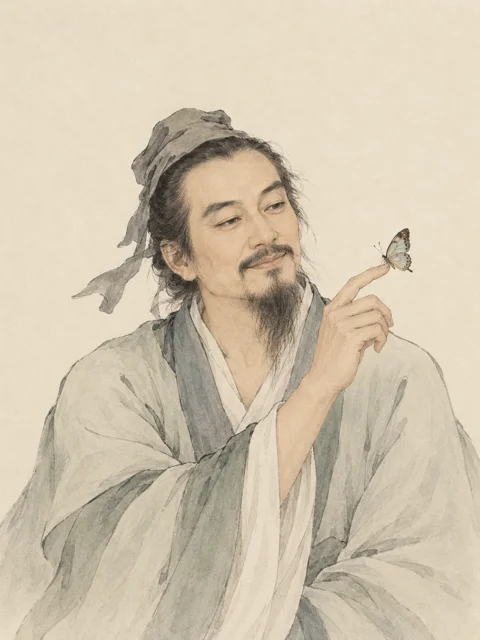
 AI 创作示意
GUANFU / en
庄子
AI 创作示意Chapter 33
版本按章对照,不代表逐句校勘对应。
中文原文(全三十三篇) / 庄子原典;维基文库贡献者整理
观复随文注释 · 97 条
天下之治方術各家局部的方法、学说者,多矣,皆以其有爲,不可加矣。
古之所謂道術贯通整体的根本道理者,果惡乎在?曰:无乎不在。曰:神何由降?明何由出?聖有所生,王有所成,皆原於一出于统一的根本。不離於宗,謂之天人与自然合一的人。不離於精,謂之神人精神超越形迹的人。不離於眞,謂之至人德性臻于完善的人。以天爲宗,以德爲本,以道爲門,兆於變化显现于万物变化之中,謂之聖人。以仁爲恩,以義爲理,以禮爲行,以樂爲和,薰然慈仁,謂之君子。以法爲分,以名爲表,以參参验、比较一作「操」爲驗,以稽考核、核验爲決,其數一二三四是也,百官以此相齒依次排列、各任职分。以事爲常,以衣食爲主,蕃息畜藏,老弱孤寡(爲意)皆有以,養民之理也。
古之人,其備乎!配神明,醇天地,育萬物,和天下,澤及百姓,明於本數根本法则,係於末度具体制度、细节,六通四辟上下四方处处通达一作「闢」,小大精粗,其運无乎不在。其明而在數度者,舊法,世傳之史尚多有之;其在於詩、書、禮、樂者,鄒、魯儒学兴盛的两个地区之士,搢紳插笏于带的士人,泛指士大夫先生,多能明之。詩以道一作「導」志,書以道一作「導」事,禮以道一作「導」行,樂以道一作「導」和,易以道一作「導」陰陽,春秋以道一作「導」名分。其數,散於天下,而設於中國者,百家之學,時或稱而道之。
天下大亂,賢聖不明,道德不一,天下多得一察片面的见解焉以自好,譬如耳目鼻口,皆有所明,不能相通,猶百家衆技也,皆有所長,時有所用。雖然,不該不徧,一曲之士只通晓一个方面的人也。判天地之美,析萬物之理,察古人之全,寡能備於天地之美,稱神明之容,是故內聖外王内修圣德、外成王业的理想之道,闇而不明,鬱而不發。天下之人,各爲其所欲焉,以自爲方。悲夫,百家往而不反,必不合矣!後世之學者,不幸不見天地之純、古人之大體,道術將爲天下裂!
不侈於後世,不靡於萬物,不暉於數度,以繩墨自矯,而備世之急。古之道術有在於是者,墨翟墨子,墨家创始人;翟读 dí、禽滑釐墨子弟子;滑读 gǔ,釐读 lí聞其風而悅之。爲之太過,已之大循,作爲非樂墨家反对奢侈音乐礼乐的主张,命之曰節用节省财物、反对浪费,生不歌,死无服。墨子氾愛广泛地爱人,兼利,而非鬭,其道不怒,又好學而博不異,不與先王同,毀古之禮樂。黃帝有咸池,堯有大章传说中尧的乐曲,舜有大韶,禹有大夏,湯有大濩传说中商汤的乐曲;濩读 hù,文王有辟雍周代礼乐教化场所之樂,武王、周公作武。古之喪禮,貴賤有儀,上下有等,天子棺槨七重,諸侯五重,大夫三重,士再重。今墨子獨生不歌,死不服,桐棺三寸而无槨,以爲法式。以此教人,恐不愛人;以此自行,固不愛己。末敗墨子道。雖然,歌而非歌,哭而非哭,樂而非樂,是果類乎?其生也勤,其死也薄,其道大觳过于刻苦、俭薄;觳读 hú,使人憂,使人悲,其行難爲也,恐其不可以爲聖人之道,反天下之心。天下不堪,墨子雖獨(能)任,奈一作「柰」天下何?離於天下,其去王也,遠矣。墨子稱道曰:「昔者禹之湮洪水,決江河,而通四夷九州也,名川三百,支川三千,小者无數。禹親自操橐耜盛土之具与铲土农具,而九雜汇集、整治九州水流;古注有异解天下之川,腓无胈腿肚磨得没有细毛,脛无毛,沐甚雨,櫛疾風,置萬國。禹,大聖也,而形勞天下也如此。」使後世之墨者,多以裘褐爲衣,以跂蹻草鞋等粗陋鞋履爲服,日夜不休,以自苦爲極,曰:「不能如此,非禹之道也,不足謂墨。」相里勤之弟子五侯之徒,南方之墨者苦獲、己齒、鄧陵子之屬,俱誦墨經,而倍譎彼此背离、意见不同不同,相謂別墨墨家内部的不同派别。以堅白同異名辩中关于属性、异同的论题之辯相訾,以觭偶奇与偶,单与双;觭读 jī不仵之辭相應,以巨子墨家团体首领;亦作钜子爲聖人,皆願爲之尸主、主持者,冀得爲其後世,至今不決。墨翟、禽滑釐之意則是,其行則非也。將使後世之墨者,必自苦,以腓无胈、脛无毛,相進而已矣,亂之上也,治之下也。雖然,墨子眞天下之好也,將求之不得也,雖枯槁,不舍也,才士也夫!
不累於俗,不飾於物,不苟於人,不忮於衆,願天下之安寧,以活民命,人我之養,畢足而止,以此白心。古之道術有在於是者,宋鈃战国思想家;鈃读 xíng、尹文战国思想家,与宋钘并称聞其風而悅之。作爲華山之冠形似华山的平顶帽,表示齐同以自表,接萬物以別宥消除偏见、宽容差别爲始。語心之容,命之曰心之行。以聏合调和融洽;聏读 ér驩,以調海內,請欲置之以爲主。見侮不辱受侮辱而不视为耻辱,救民之鬭;禁攻寢兵停止战争,救世一作「民」之戰。以此周行天下,上說下教,雖天下不取,强聒坚持不断地劝说;聒读 guō而不舍(者)也,故曰:「上下見厭,而强見也。」雖然,其爲人太多,其自爲太少,曰:「請欲固置五升之飯,足矣。」先生恐不得飽,弟子雖飢,不忘天下,日夜不休,曰:「我必得活哉!」圖傲乎救世之士哉!曰:「君子不爲苛察,不以身假物。」以爲无益於天下者,明之,不如已也。以禁攻寢兵爲外,以情欲寡淺认为人的本来欲望较少爲內,其小大精粗,其行適至是而止。
公而不黨,易而无私,決然无主,趣物而不兩,不顧於慮,不謀於知,於物无擇,與之俱往。古之道術有在於是者,彭蒙战国思想家、田駢战国思想家;駢读 pián、愼到慎到,战国思想家聞其風而悅之。齊萬物把万物看作平等以爲首,曰:「天能覆之而不能載之,地能載之而不能覆之,大道能包之而不能辯之。」知萬物皆有所可,有所不可,故曰:「選則不徧,教則不至,道則无遺者矣。」是故愼到棄知去己,而緣不得已,泠汰随顺放任;读 líng tài於物,以爲道理,曰:「知不知,將薄知,而後鄰傷之者也。」謑髁不拘小节的样子;古注有异解无任而笑天下之尚賢也,縱脫无行而非天下之大聖,椎拍輐斷浑然无棱角、不加裁断的样子,與物宛轉,舍是與非,苟可以免。不師知慮,不知前後,魏然巍然、不动心的样子而已一作「己」矣。推而後行,曳而後往,若飄風之還,若羽之旋,若磨石之隧。全而无非,動靜无過,未嘗有罪。是何故?夫无知之物,无建己不建立自我成见之患,无用知之累,動靜不離於理,是以終身无譽,故曰:「至於若无知之物而已一作「己」,无用賢聖。夫塊不失道。」豪桀相與笑之,曰:「愼到之道,非生人之行,而至死人之理,適得怪焉。」田駢亦然,學於彭蒙,得不教焉。彭蒙之師曰:「古之道,人至於莫之是、莫之非而已一作「己」矣,其風閾一作「窢」然,惡可而言?」常反人,不聚觀,而不免於魭斷。其所謂道,非道,而所言之韙是、正确;读 wěi,不免於非。彭蒙、田駢、愼到,不知道,雖然,概乎皆常一作「嘗」有聞者也。
以本爲精,以物爲粗,以有積爲不足,澹然獨與神明居。古之道術有在於是者,關尹关令尹喜,古代传说中的道家人物、老耼聞其風而悅之。建之以常无有,主之以太一统一万物的根本。以濡弱柔弱;濡通柔謙下爲表,以空虛不毀萬物爲實,關尹曰:「在己无居不固守自己的立场,形物自著万物的形态自然显现。」其動若水,其靜若鏡,其應若響。芴乎若亡,寂乎若清。同焉者和,得焉者失。未嘗先人,而常隨人。老耼曰:「知其雄,守其雌,爲天下谿。知其白一作「曰」,守其辱,爲天下谷。」人皆取先,己獨取後,曰:「受天下之詬一作「垢」。」人皆取實,己獨取虛。无藏也,故有餘,巋然高大独立的样子;巋读 kuī而有餘。其行身也,徐而不費,无爲也而笑巧。人皆求福,己獨曲全委曲而保全自身,曰:「苟免於咎。」以深爲根,以約爲紀,曰:「堅則毀矣,銳則挫矣。」常寬容於物,不削於人,可謂至極。關尹、老耼乎,古之博大眞人哉!
芴一作「寂」漠幽微寂静无形,變化无常。死與?生與?天地並與?神明往與?芒乎何之?忽乎何適?萬物畢羅,莫足以歸。古之道術有在於是者,莊周聞其風而悅之。以謬悠旷远、难以确指之說,荒唐广大无边,并非现代荒谬义之言,无端崖之辭,時恣縱而(不)儻,不以觭見偏执于一面的见解之也。以天下爲沈一作「沉」濁,不可與莊語庄重严肃的言说。以巵言随物变化、不固执的言说爲曼衍,以重言借重前贤长者之言爲眞,以寓言借外在人物、故事立论爲廣。獨與天地精神往來,而不敖倪傲视;同傲睨於萬物,不譴是非,以與世俗處。其書雖瓌瑋奇伟瑰丽,而連抃宛转随顺;本有连犿异文一作「犿」无傷也。其辭雖參差,而諔詭奇异诡谲;諔读 chù可觀。彼其充實,不可以已。上與造物者遊,而下與外死生、无終始者爲友。其於本也,弘大而辟宏大开阔一作「闢」,深閎而肆。其於宗也,可謂調適而上遂矣。雖然,其應於化而解於物也,其理不竭,其來不蛻,芒乎昧乎,未之盡者。
惠施战国名家人物,亦称惠子多方,其書五車,其道舛駁错杂、不一致;舛读 chuǎn,其言也不中。厤一作「歷」物逐一辨析事物之意,曰:「至大无外,謂之大一无外的最大整体;至小无內,謂之小一无内的最小单位。无厚,不可積也,其大千里。天與地卑,山與澤平。日方中方睨刚到中天便开始倾斜,物方生方死。大同而與小同異,此之謂小同異;萬物畢同畢異,此之謂大同異。南方无窮而有窮。今日適越而昔來。連環可解名家悖论之一,解释历来有争议也。我知天(下)之中央,燕之北、越之南是也。氾愛萬物,天地一體也。」惠施以此爲大,觀於天下,而曉辯者,天下之辯者相與樂之。
卵有毛名辩命题,或从潜在变化立说。雞三足名辩命题,不应当作生物事实。郢有天下。犬可以爲羊。馬有卵。丁子幼儿,古注有异说有尾。火不熱。山出口。輪不蹍地。目不見,指不至,至不絕。龜長於蛇。矩不方,規不可以爲圓。鑿不圍枘卯眼不包围榫头,名辩命题。飛鳥之景同影,影子未嘗動也。鏃矢带箭头的箭;鏃读 zú之疾,而有不行不止之時。狗非犬。黃馬驪牛三把属性与物分别计数的名辩命题。白狗黑。孤駒未嘗有母。一尺之捶一尺长的木杖;捶通棰,日取其半,萬世不竭。辯者以此與惠施相應,終身无窮。
桓團、公孫龍战国时期的名辩学者,辯者之徒,飾人之心,易人之意,能勝人之口,不能服人之心,辯者之囿也。惠施日以其知,與人之辯,特與天下之辯者爲怪,此其柢根本;读 dǐ也。然惠施之口談,自以爲最賢,曰:「天地其壯乎施!存雄而无術!」
南方有畸一作「倚」人有异于常人的人物焉,曰黃繚,問天地所以不墜不陷、風雨雷霆之故,惠施不辭而應,不慮而對。徧爲萬物說,說而不休,多而无已,猶以爲寡,益之以怪。以反人爲實,而欲以勝人爲名,是以與衆不適也。弱於德,强於物,其塗隩深曲闭塞;此处读 ào矣。由天地之道,觀惠施之能,其猶一蚊一作「蚉」一虻一作「䖟」之勞者也,其於物也何庸?夫充一尚可,曰「愈貴道」,幾矣。惠施不能以此自寧,散於萬物而不厭,卒以善辯爲名。惜乎,惠施之才!駘蕩散漫无所归宿的样子而不得,逐萬物而不反,是窮響以聲用新声追逐旧回响,喻无止境争辩,形與影競走也。悲夫!
观复随文注释 · AI 辅助独立整理,待持续人工校订。释义以本章语境为依据;存在异说或底本疑讹的地方另作提示。原文及版本来源保留如下。
参考: 本站所收原典:杂篇 · 天下 ↗
原典公有领域;电子文本据维基文库贡献者,按 CC BY-SA 4.0 保留署名及相同方式共享;调整空白与排版。 · 查看原始版本
欢迎引用本站资源,分享道家与道教文化。引用时请注明出处“观复”,并附上所引用内容的原始页面链接,方便读者查阅。
观复白话释义(AI 辅助) / 观复 · AI 辅助独立整理
【观复白话释义|AI 辅助·未经人工学术审定】
天下研究各种学说与方法的人很多,都认为自己掌握的那一套已经无以复加。
古代所谓完整的道术,究竟在哪里?回答是:无处不在。又问:神妙的作用从哪里降临?明彻的智慧从哪里产生?圣人的境界有所由生,王者的事业有所由成,它们都发源于同一个根本。不离开根源,叫作天人;不离开精微,叫作神人;不离开本真,叫作至人。以自然为宗,以德性为本,以大道为门,从变化中显现征兆,叫作圣人。用仁来施恩,用义来条理事情,用礼来规范行为,用乐来促成和谐,温和慈爱,叫作君子。用法划定职分,用名称标明职责,用实际参验来核实,用考察来裁决,各项制度像一二三四那样有条有理,百官依此相互排列、配合。以日常劳作为常业,以衣食为主要需要,繁育生息,储蓄收藏,使老弱孤寡都得到供养,这是养育人民的道理。
古人所具备的,多么完备!配合神明,纯合天地,养育万物,调和天下,恩泽及于百姓;既明白根本法则,又联系细末制度,通达上下四方,大小精粗,无处没有这种道术的运行。其中显明地体现为制度、尺度和旧法的,历代流传的史籍还保存了很多;体现在《诗》《书》《礼》《乐》中的,邹、鲁的士人和缙绅先生,多能说明。《诗》表达心志,《书》记述政事,《礼》引导行为,《乐》引导和谐,《易》阐明阴阳,《春秋》说明名分。它的具体方法散布天下,在中原各地施设实行,诸子百家的学说,也时常援引讲述其中一部分。
后来天下大乱,贤圣之道不再显明,道德不再统一。人们多是得到一方面的见解,就自以为高明,好比耳、目、鼻、口,各有自己明白的东西,却不能彼此贯通;也像百家的种种技艺,各有所长,有时派得上用场。可是,它们不能包举全体,不能普遍通达,只是偏于一隅的学问。它们分割天地的美,拆开万物的条理,把古人完整的道术切成片段,很少还能具备天地整体的美,符合神明广大包容的状态。因此,内在成圣、外在成王的道路暗而不明,郁结不能舒展。天下人各从自己的欲求,建立自己的方法。可悲啊,百家走出去便不再返回整体,必定不能会合!后世学者不幸,看不到天地纯全的面貌和古人的宏大整体,道术将被天下人割裂!
不给后世留下奢侈的风气,不耗费万物,不以制度文饰炫耀,用绳墨般的准则矫正自己,准备救济世间的急难:古代道术中,有这方面的内容。墨翟、禽滑釐听到这种风尚,喜爱它,却实行得太过,对自己的节制也过严,提出反对音乐的主张,称之为节省费用,活着不歌唱,死后不讲究丧服。墨子普遍爱人,使众人同得利益,反对争斗;他的道不以愤怒为本,又好学而广博,不主张差别偏爱。他不与先王的做法相同,毁弃古代礼乐。
按本篇所述,黄帝有《咸池》,尧有《大章》,舜有《大韶》,禹有《大夏》,汤有《大濩》,文王有辟雍之乐,武王、周公制作《武》。古代丧礼,贵贱有不同仪式,上下有不同等级,天子的棺椁七重,诸侯五重,大夫三重,士两重。如今唯独墨子要求活着不歌唱,死后不讲丧服,只用三寸厚的桐木棺,不设外椁,并把它定为法式。拿这教人,恐怕并不算爱人;自己这样做,也实在不爱惜自己。这样的末流做法,终究会败坏墨子的道。况且,人自然想歌唱,却认定歌唱不对;自然想哭,却认定哭不对;自然想快乐,却认定快乐不对,这果真合乎人情吗?活着辛劳,死后葬得菲薄,这种道太苛苦,使人忧愁、悲伤,行为很难做到,恐怕不能成为圣人之道,因为它违背天下人的心。天下人忍受不了,即使墨子独自能承担,又能把天下人怎样?离开天下人的实情,也就离王道很远了。
墨子称述说:“从前禹治理洪水,疏通江河,使四夷九州相互通达。大的河川有三百,支流有三千,小的更无数。禹亲自拿着盛土的器具和掘土的耜,反复奔走,疏理天下河流,腿肚子磨得没有细毛,胫骨上也不长毛,暴雨给他洗头,疾风替他梳发,终于安置万国。禹是大圣,为天下操劳身体竟到了这个地步。”这使后世墨者多穿皮衣粗布,脚踏简陋的草鞋木屐,日夜不停,把自苦做到极点,还说:“不能这样,就不是禹的道,不配称为墨者。”
相里勤的弟子、五侯一派,南方墨者苦获、己齿、邓陵子等,都诵读《墨经》,却彼此违背,解释不同,互相指责对方是别出的墨家。他们用坚白、同异之辩互相非难,用奇偶不合的言辞互相应对;各把自己的巨子奉为圣人,都希望自己成为师主,继承并传下这一学统,到今天还争不出结果。墨翟、禽滑釐的用意是好的,实行的方法却不对。这样只会使后世墨者必定自苦,争着把小腿磨得无毛,相互竞进罢了。在导致纷乱方面,这类做法居前;在成就治理方面,却居后。即便如此,墨子确实是爱天下的人,像他这样的人,想求也难求。他即使形容枯槁,也不放弃自己的志愿,真是有才的士人!
不受世俗拖累,不靠外物修饰自己,不随便迎合别人,不伤害众人,愿天下安宁,以保全民众的生命;他人和自己的供养,只求都得到满足,就停止追求,用这样的主张表明自己的心:古代道术中,有这方面的内容。宋钘、尹文听到这种风尚,喜爱它。他们做华山形的帽子来表示自己的志向,接触万物,先从分别而宽容入手;讲述心的容受,称为心的运行。他们用柔和调合欢悦,调节天下,想把这立为主导。受到侮辱不认作内在耻辱,以解救人们的争斗;禁止攻伐,停止用兵,以解救世间的战争。他们因此周游天下,在上游说,在下教导,即使天下不采纳,也不停地强聒劝说。因此有人说:“上下都厌烦他们,他们却仍坚持求见。”
不过,他们为他人做得太多,为自己做得太少,说:“只求每天固定有五升饭,就足够了。”老师恐怕吃不饱,弟子即使饥饿,也不忘天下,日夜不休,还说:“我一定要使人活下去!”真是胸怀宏图、以救世自任的士人啊!他们又说:“君子不做苛细的考察,不把自身借给外物役使。”认为凡对天下没有益处的事情,与其弄清它,不如停止追究。在外,以禁止攻伐、停止战争为务;在内,以情欲少而浅为本。他们学说中无论大小精粗,实行所达到的,也就止于这里。
公正而不结党,平易而无私心,决然不持固定成见,随顺事物而不分两端;不反复盘算,不用智巧谋求,对事物不选择取舍,而与它们共同前行:古代道术中,有这方面的内容。彭蒙、田骈、慎到听到这种风尚,喜爱它,以齐同万物为首要主张。他们说:“天能覆盖万物,却不能承载;地能承载万物,却不能覆盖;大道能包容万物,却不分别它们。”他们知道万物都有能做到的,也都有做不到的,所以说:“有选择就不能普遍,有教导就有所不到,唯有道不遗漏任何东西。”
因此,慎到抛开智虑,去掉自我,顺着不得已的情势,随物推移,以此为道理。他说:“知道自己有所不知,就会轻视依恃知识,随后才可接近避免受知所伤的境地。”他随便散漫,不任事,却嘲笑天下崇尚贤能;放纵脱略,没有一定行检,却非议天下推尊大圣。磨去棱角,与物圆转,舍弃是非,只求免除伤害;不以智虑为师,不辨前后,安然巍立罢了。推一下才走,拉一下才往,如旋风回转,如羽毛飘旋,如磨石旋转下落。保全自身而不招非议,动静都没有过失,未曾获罪。
为什么能这样?因为没有知觉的东西,没有树立自我的祸患,没有运用知识的拖累,动与静都不离开自然条理,所以终身也没有赞誉。他们因此说:“只要达到像无知觉之物一样就够了,无须贤圣。土块也不会失去道。”豪杰们相互笑他,说:“慎到的道,不是活人的行为,而是走到了死人的道理,只是怪异罢了。”
田骈也这样。他向彭蒙学习,得到的是不以固定教条施教的方式。彭蒙的老师说:“古来的道,人只须到不肯定什么、也不否定什么的境地。它的风貌倏然而过,哪里能用话说清?”他们的主张常与别人相反,不能会合各种见解,自己却仍免不了削平分别、一概混同。他们所说的道,算不上完整的道;他们认定为对的,也免不了错。彭蒙、田骈、慎到并未真正知晓大道,不过大体上都曾听闻过其中一部分。
把根本看作精要,把外物看作粗末,认为执意积聚占有,恰是内心不知足的表现,恬淡地独与神明相处:古代道术中,有这方面的内容。关尹、老聃听到这种风尚,喜爱它。以恒常的无与有建立学说,以浑然一体的根本作为主导;以柔弱、谦下表现于外,以空虚、不毁伤万物作为实质。关尹说:“自己不固守一个位置,有形的事物就自然显现。”他的动像水,静像镜,应物像回声;恍惚得像不存在,寂静得如一片清明。同于自然便和谐,执意有所得反而有失。他从不抢在别人之前,总是随在别人之后。
老聃说:“知道雄强,却守住雌柔,成为天下汇聚的溪涧。知道明白显耀,却守住卑辱,成为天下容纳的山谷。”别人都争先,他独取其后,说:“承受天下的污辱。”别人都求充实,他独取虚空。不积藏,所以有余,而且充足稳固。他修养自身,舒缓而不耗费,无为而笑看机巧。别人都求福,他独能委曲保全,说:“只求免于过咎。”以深厚为根,以简约为纲,说:“坚硬就会毁坏,锐利就会挫折。”始终宽容万物,不侵削他人,可以说到达了极高境地。关尹、老聃,真是古代博大而守真的人啊!
幽寂无形,变化不定。是死吗?是生吗?与天地并存吗?与神明同往吗?茫茫然去向哪里,恍惚间到达何处?万物虽都罗列眼前,却没有一物足以成为最终的归宿:古代道术中,有这方面的内容。庄周听到这种风尚,喜爱它。他用悠远难测的说法、广大出奇的言语、没有边际的辞章,时而纵情挥洒,却不偏执,不用片面的见解来显露自己。他认为天下沉浊,不能与之正面庄重地说理,于是以卮言使言说自由流衍,以重言增加可信的分量,以寓言扩大表达的范围。
他独自与天地的精神往来,却不傲视万物,不以是非去谴责别人,因此能与世俗相处。他的书虽然奇伟,却能宛转随顺,不造成伤害;他的言辞虽然参差多变,却奇异巧妙,值得观览。他精神充实,不能止息。向上与造物者同游,向下与置生死于外、不受终始拘束的人为友。他对于根本的理解,宏大开阔,深广舒展;对于最高宗旨,可以说调和适当,向上通达。不过,他顺应变化而疏解外物时,道理无穷,随变化而来的思想不脱离根本,茫茫昧昧,仍有未能被穷尽的地方。
惠施学问多方,著作有五车之多,但在本篇作者看来,他的道理错杂,他的言论不切中根本。他逐一分析事物的意思,提出:“最大的,没有外面,叫作大一;最小的,没有里面,叫作小一。没有厚度的东西不能积叠,却可以广大到千里。天与地一样低,山与泽一样平。太阳正到中午,也正开始偏斜;事物正出生,也正在走向死亡。大的相同与小的相同有所不同,这叫小同异;万物可以说全都相同,也可以说全都不同,这叫大同异。南方没有穷尽,却又有穷尽。今天往越国去,却在昨天已经到来。相连的环能够解开。我知道天下的中央,就在燕国以北、越国以南。普遍爱万物,天地本是一体。”惠施把这些看得很重大,向天下展示,又讲给辩者听,天下的辩者也都乐于讨论。
辩者们又提出这些说法:“蛋有毛。鸡有三只脚。郢都拥有整个天下。狗可以叫作羊。马有卵。小儿有尾巴。火不热。山从口中出来。车轮不碾压地面。眼睛不能看见。手指不能到达事物。到达并不意味着穷尽。龟比蛇长。矩不方,规不能用来画圆。榫孔不包围榫头。飞鸟的影子从来不动。箭飞得极快,却有既不前进、也不停住的时候。狗不是犬。黄马、黑牛合为三个。白狗是黑的。孤独的小马从来没有母亲。一尺长的木棍,每天取去一半,万世也取不完。”辩者们拿这些话与惠施相互应答,终身争论,没有穷尽。
桓团、公孙龙一类辩者,修饰人的心思,转变人的意念,能够压倒别人的口,却不能使别人的心信服,这就是辩者受限的地方。惠施每天拿自己的智慧与人辩论,只顾和天下的辩者一起制造奇说,这就是他的根本所在。可是惠施口头谈论,自以为最贤能,说:“天地间还有比我更强的吗?”他存心争雄,却没有贯通大道的方法。
南方有个奇异的人,名叫黄缭,向他问天为什么不坠、地为什么不陷,以及风雨雷霆的缘由。惠施不推辞就回答,不思量就应对,对万物都要遍作解释,说个不停,越说越多,没有止境,还嫌太少,再增添怪异之论。他把反对别人当作实质,把胜过别人当作求名的办法,因此与众人不能相适。他在德性上弱,在逐物辨析上强,所走的路却越来越狭隘。从天地大道来看惠施的能力,就像一只蚊、一只虻的劳作,对万物能有什么作用?若能充实、专一于道,尚且可以;若再说要更尊重道,也就接近了。惠施却不能凭此安顿自己,心智分散在万物上而不厌,终于只留下善辩的名声。可惜了惠施的才能!奔驰流荡而无所得,追逐万物却不返回,像想用不停发声来穷尽回声,又像形体和自己的影子赛跑。可悲啊!
【篇末疑难注记】“方术”指各家局部的方法、学说,“道术”在本篇中偏重整体而完备的道。上文对诸子的评价均为本篇作者的判断。“搢绅”即缙绅,指士大夫;“中国”按古代中原诸国释,不套用现代国名范围。“已之大循”“其道不怒”“博不异”语义有争议,依节制、非争与不作差等的上下文试释。“九杂天下之川”暂解反复遍治河流,不据此补列工程。“五侯”与相里勤弟子的关系及诸墨者名字的断法不尽明确,正文不扩充生平。“觭偶不仵”指彼此难合的论辩,“巨子”为墨家领袖称号。“别宥”“聏”“图傲”训义有歧义,依宽容调和、救世自任试释。“知不知,将薄知,而后邻伤之者也”原句难通,正文属试释,不作为定论。“椎拍輐断”“魭断”均按磨去分别、混同圆转解。“常无有”亦可有不同断读,本文保留无、有两方面。“其来不蜕”暂解随化而不失根本。惠施及辩者的命题,多利用概念、名称、时空与分割方式的差别;本篇未提供逐条论证,正文完整转述命题,不虚构证明。“丁子”暂作小儿解,“指”“至”也可能涉及名家术语,正文按字面试释。“黄马骊牛三”保留为三的反常计数,不擅改为二。“天地其壮乎施”及“夫充一尚可,曰愈贵道几矣”断句、训义有争议,正文所取读法待校订。
〔补校:“皆愿为之尸”暂以各自希望充当师主、承续学统释读;“以有积为不足”暂按积聚者内心不知足解释,保留有关训释分歧,仍待学术校勘。〕
观复白话释义:AI 辅助依据古文独立编写,已进行文本覆盖核对,未经人工学术审定;原典来源及电子底本署名、许可见对应中文版本。 · 查看原始版本
Herbert A. Giles 英译(全三十三篇) / Herbert A. Giles(翟理斯),1889
The Empire.
[Summary by early editors.]
Systems of government are many. Each man thinks his own perfect. Where then does what the ancients called the system of Tao come in? There is nowhere where it does not come in.
It may be asked whence our spirituality, whence our intellectuality. The true Sage is born; the prince is made. Yet all proceed from an original One .
He who does not separate from the Source is one with God. He who does not separate from the essence is a spiritual man. He who does not separate from the reality is a perfect man. He who makes God the source, and Tê the root, and Tao the portal, passively falling in with the modifications of his environment,—he is the true Sage.
[Translator’s note] These are but four different denominations of the ideal man.
He who practises charity as a kindness, duty to one's neighbour as a principle, ceremony as a convenience, music as a pacificator, and thus becomes compassionate and charitable,—he is a superior man.
[Translator’s note] We sink here to a lower level, though still a high one. The "superior man" is the ideal man of Confucian ethics. In him divinity finds no place.
He who regulates his conduct by law, who regards fame as an external adjunct, who verifies his hypotheses, who bases his judgment upon proof,—such men rank one, two, three, four, etc. It is thus that officials rank. In a strict sense of duty, in making food and raiment of paramount importance, in caring for and nourishing the old, the weak, the orphan, and the widow, they all exemplify the principle of true government.
[Translator’s note] Partly, if not wholly. This the dead level of ordinary mortality, still within the operation of Tao .
Thus far-reaching was the extension of Tao among the ancients.
The companion of the gods, the purifier of the universe, it nourishes all creation, it unites the empire, it benefits the masses. Illuminating the fundamental, it is bound up with the accessory, reaching to all points of the compass and to the opposite extremes of magnitude. There is indeed nowhere where it is not!
How it enlightened the polity of past ages is evidenced in the records which historians have preserved to us. Its presence in the Canons of Poetry , History , Rites , and Music , has been made clear by many scholars of Chou and Lu. It in forms the Canon of Poetry with its vigour, the Canon of History with its usefulness, the Canon of Rites with its adaptability, the Canon of Music with its harmonising influence, the Canon of Changes with its mysterious Principles, and the Spring and Autumn with its discriminations. Spread over the whole world, it is focussed in the Middle Kingdom, and the learning of all schools renders constant homage to its power.
But when the world is disorganised, true Sages do not manifest themselves, Tao ceases to exist as One , and the world becomes cognisant of the idiosyncrasies of the individual. These are like the senses of hearing, sight, smell, and taste,—not common to each organ. Or like the skill of various artisans,—each excellent of its kind and each useful in its turn, but not equally at the command of all.
Consequently, when a mere specialist comes forward and dogmatises on the beauty of the universe the principles which underlie all creation, the position occupied by the ancients in reference to the beauty of the universe, and the limits of the supernatural,—it follows that the Tao of inner wisdom and of outer strength is obscured and prevented from asserting itself. Every one alas! regards the course he prefers as the infallible course. The various schools diverge never to meet again; and posterity is debarred from viewing the original purity of the universe and the grandeur of the ancients. For the system of Tao is scattered in fragments over the face of the earth.
Not to covet posthumous fame, nor to aim at dazzling the world, nor to pose as a benefactor of mankind, but to be a strict self-disciplinarian while lenient to the faults of others,—herein lay the Tao of the ancients.
Mih Tzŭ and Ch'in Hua Li
[Translator’s note] A disciple of Mih Tzŭ.
became enthusiastic followers of Tao , but they pushed the system too far, carrying their practice to excess. The former wrote an essay Against Music , and another which he entitled Economy .
[Translator’s note] To be found in the collection which passes under the name of Mih Tzŭ.
There was to be no singing in life, no mourning after death. He taught universal love and beneficence towards one's fellow men, without contentions, without censure of others. He loved learning, but not in order to become different from others. Yet his views were not those of the ancient Sages, whose music and rites he set aside.
The Yellow Emperor gave us the Hsien-ch'ih . Yao gave us the Ta-chang . Shun, the Ta-shao . Yü, the Ta-hsia . T'ang, the Ta-hu . Wên Wang, the P'i-yung . Wu Wang and Chou Kung added the Wu .
[Translator’s note] Famous musical compositions.
The mourning ceremonial of old was according to the estate of each, and determined in proportion to rank. Thus, the body of the Son of Heaven was enclosed in a seven-fold coffin. That of a feudal prince, in a five-fold coffin. That of a minister, in a three-fold coffin. That of a private individual, in a two-fold coffin. But now Mih Tzŭ would have no singing in life, no mourning after death, and a single coffin of only three inches in thickness as the rule for all alike!
Such doctrines do not illustrate his theory of universal love;
[Translator’s note] They betray a want of sympathy with human weaknesses.
neither does his practice of them establish the fact of his own personal self-respect. They may not suffice to destroy his system altogether; though it is unreasonable to prohibit singing, and weeping, and rejoicing in due season.
He would have men toil through life and hold death in contempt. But this teaching is altogether too unattractive. It would land mankind in sorrow and lamentation. It would be next to impossible as a practical system, and cannot, I fear, be regarded as the Tao of the true Sage. It would be diametrically opposed to human passions, and as such would not be tolerated by the world. Mih Tzŭ himself might be able to carry it out; but not the rest of the world. And when one separates from the rest of the world, his chances of developing an ideal State become small indeed.
Mih Tzŭ argued in favour of his system as follows:—Of old, the great Yü drained off the flood of waters, and caused rivers and streams to flow through the nine divisions of the empire and the parts adjacent thereto,—three hundred great rivers, three thousand branches, and streams without number. With his own hands he plied the bucket and dredger, in order to reduce confusion to uniformity,
[Translator’s note] Make all streams flow to the sea.
until his calves and shins had no hair left upon them. The wind bathed him, the rain combed him; but he marked out the nations of the world, and was in very truth a Sage. And because he thus sacrificed himself to the commonwealth, ages of Mihists to come would also wear short serge jackets and straw sandals, and toil day and night without stopping, making self-mortification their end and aim, and say to themselves, "If we cannot do this, we do not follow the Tao of Yü, and are unworthy to be called Mihists."
The disciples of Hsiang Li Ch'in,
[Translator’s note] A professor of Mihism.
the followers of the five princes, Mihists of the south, such as K'u Huo, Chi Ch'ih, and Têng Ling,—all these studied the canon of Mih Tzŭ, but their disagreements and agreements were not identical. They called each other schismatics, and quarrelled over the "hard and white," the "like and unlike," and argued over questions of "odd and even." Chü Tzŭ was their Sage, and they wanted to canonise him as a saint, that they might carry on his doctrines into after ages. Even now these differences are not settled.
Thus we see that Mih Tzŭ and Ch'in Hua Li, while right in theory, were wrong in practice. They would merely have taught mankind to vie with each other in working the hair off their calves and shins. The evil of that system would have predominated over the good. Nevertheless, Mih Tzŭ was undoubtedly a well-meaning man. In spite of failure, with all its withering influences, he stuck to his text. He may be called a man of genius.
[Translator’s note] But not a true Sage.
Not to be involved in the mundane, not to indulge in the specious, not to be overreaching with the individual, nor antagonistic to the public; but to desire the tranquillity of the world in general with a view to the prolongation of life, to seek no more than sufficient for the requirements of oneself and others, and by such a course to purify the heart,—herein lay the Tao of the ancients.
Sung Hsing and Yin Wên became enthusiastic followers of Tao . They adopted a cap, shaped like the Hua Mountain, as a badge. They bore themselves with kindly discrimination towards all things. They spoke of the passive qualities of the heart as though they had been active; and declared that whosoever could bring joy among mankind and peace within the girdle of ocean should be made ruler over them.
They suffered obloquy without noticing the insult. They preserved the people from strife. They prohibited aggression and caused arms to lie unused. They saved their generation from wars, and carried their system over the whole empire, to the delight of the high and to the improvement of the lowly. Though the world would have none of them, yet they struggled on and would not give way. Hence it was said that when high and low became tired of seeing them, they intruded themselves by force. In spite of all this, they did too much for others, and too little for themselves.
"Give us," said they, "but five pints of rice, and it will be enough." The master could not thus eat his fill; but the disciples, although starving, did not forget the world's claims.
[Translator’s note] This is not satisfactorily explained by any commentator. Kuo Hsiang says that these two men regarded the world as their "master."
Day and night they toiled on, saying, "Must we necessarily live? Shall we ape the so-called saviours of mankind?"
"The superior man," they say, "is not a fault-finder. He does not appropriate the credit of others. He looks on one who does no good to the world as a worthless fellow. He regards prohibition of aggressive actions and causing arms to lie unused, as external; the diminution and restraint of our passions, as internal. In all matters, great or small, subtle or gross, such is the point to which he attains."
To be public-spirited and belong to no party, in one's dealings not to be all for self, to move without being bound to a given course, to take things as they come, to have no remorse for the past, no anxiety for the future, to have no partialities, but to be on good terms with all,—herein lay the Tao of the ancients.
P'êng Mêng, T'ien P'ien, and Shên Tao, became enthusiastic followers of Tao . Their criterion was the identity of all things. "The sky," said they, "can cover but cannot support us. The earth can support but cannot cover us. Tao can embrace all things but cannot deal with particulars."
They knew that in creation all things had their possibilities and their impossibilities. Therefore they said, "Selection excludes universality. Training will not reach in all directions. But Tao is comprehensive."
Consequently, Shên Tao discarded all knowledge and self-interest and became a fatalist.
[Translator’s note] It is about as difficult to apprehend Tao apart from fatalism as the omniscience of God apart from predestination.
Passivity was his guiding principle. "For," said he, "we can only know that we know nothing, and a little knowledge is a dangerous thing.
"Take any worthless fellow who laughs at mankind for holding virtue in esteem, any unprincipled vagabond who reviles the great Sages of the world, and subject him to torture. In his agony he will sacrifice positive and negative alike. If he can but get free, he will trouble no more about knowledge and forethought. Past and future will cease to exist for him, in his then neutral condition.
"Move when pushed, come when dragged. Be like a whirling gale, like a feather in the wind, like a mill-stone going round. The mill-stone as an existence is perfectly harmless. In motion or at rest it does no more than is required, and cannot therefore incur blame.
"Why? Because it is simply an inanimate thing. It has no anxieties about itself. It is never entangled in the trammels of knowledge. In motion or at rest it is always governed by fixed laws, and therefore it never becomes open to praise. Hence it has been said, 'Be as though an inanimate thing, and there will be no use for Sages.'
"For a clod cannot be without Tao ,"—at which some full-blooded young buck covered the argument with ridicule by crying out, "Shên Tao's Tao is not for the living, but for the dead!"
It was the same with T'ien P'ien. He studied under P'êng Mêng; with the result that he learnt nothing.
[Translator’s note] Tao cannot be learnt.
P'êng Mêng's tutor said, "Those of old who knew Tao , reached the point where positive and negative ceased to exist. That was all."
Now the bent of these men is one of opposition, which it is difficult to discuss. They act in every way differently from other people, but cannot escape the imputation of purpose.
[Translator’s note] Which takes the place of spontaneity.
What they call Tao is not Tao ; and what they predicate affirmatively cannot escape being negative. The fact is that P'êng Mêng, T'ien P'ien, and Shên Tao, did not know Tao . Nevertheless they all had a certain acquaintance with it.
To make the root the essential, to regard objective existences as accidental, to look upon accumulation as deficiency, and to meekly accept the dispositions of Providence,—herein lay the Tao of the ancients.
Kuan Yin and Lao Tzŭ became enthusiastic followers of Tao .
[Translator’s note] For Kuan Yin, see p. 230 .
They based their system upon nothingness, with One as their criterion. Their outward expression was gentleness and humility. Their inward belief was in unreality and avoidance of injury to all things.
Kuan Yin said, "Adopt no absolute position. Let externals take care of themselves. In motion, be like water. At rest, like a mirror.
[Translator’s note] Receptive, but not permanently so.
Respond, like the echo.
[Translator’s note] Only when called upon.
Be subtle, as though non-existent. Be still, as though pure. Regard uniformity as peace. Look on gain as loss. Do not precede others. Follow them."
Lao Tzŭ said, "He who conscious of being strong, is content to be weak,—he shall be a cynosure of men.
[Translator’s note] This is quoted by Huai Nan Tzŭ as a saying by Lao Tzŭ, and appears in ch. xxviii of the Tao-Tê-Ching . See The Remains of Lao Tzŭ , p. 21.
"He who conscious of purity, puts up with disgrace,—he shall be the cynosure of mankind.
"He who when others strive to be first, contents himself with the lowest place, is said to accept the contumely of the world.
"He who when others strive for the substantial, contents himself with the unsubstantial, stores up nothing and therefore has abundance. There he is in the midst of his abundance which comes to him without effort on his part. He does nothing, and laughs at the artifices of others.
"He who when others strive for happiness is content with security, is said to aim at avoiding evil.
[Translator’s note] Compare the Tao-Tê-Ching , ch. xxii.
"He who makes depth of fundamental importance and moderation his rule of life, is said to crush that which is hard within him and temper that which is sharp.
"To be in liberal sympathy with all creation, and not to be aggressive towards one's fellow-men,—this may be called perfection."
O Kuan Yin! O Lao Tzŭ! verily ye were the true Sages of old.
Silence, formlessness, change, impermanence, now life, now death, heaven and earth blended in one, the soul departing, gone no one knows where: suddenly, no one knows whither, as all things go in turn, never to come back again;—herein lay the Tao of the ancients.
Chuang Tzŭ became an enthusiastic follower of Tao . In strange terms, in bold words, in far-reaching language, he gave free play to his thoughts, without following any particular school or committing himself to any particular line.
He looked on the world as so sunk in corruption that it was impossible to speak gravely. Therefore he employed "goblet words" which apply in various directions; he based his statements upon weighty authority in order to inspire confidence; and he put words in other people's mouths in order to secure breadth.
[Translator’s note] See ch. xxvii ad init.
In accord with the spirit of the universe, he was at peace with all creation. He judged not the rights and wrongs of mankind, and thus lived quietly in his generation. Although his book is an extraordinary production, it is plausible and harmless enough. Although the style is most irregular, it is at the same time ingenious and attractive.
As a thinker, he is endlessly suggestive. Above, he roams with God. Below, he consorts with those who are beyond the pale of life and death, who deny a beginning and an end. In relation to the root,
[Translator’s note] The origin of all things.
he speaks on a grand and extensive scale. In relation to Tao , he establishes a harmony between man and the higher powers. Nevertheless, he yields to the modifications of existence and responds to the exigencies of environment. His arguments are inexhaustible, and never illogical. He is far-reaching, mysterious, and not to be fully explored.
[Translator’s note] It is impossible for a European critic to believe that Chuang Tzŭ penned the above paragraphs. See post , p. 454 .
Hui Tzŭ was a man of many ideas. His works would fill five carts. But his doctrines are paradoxical, and his terms are used ambiguously.
He calls infinite greatness, beyond which there is nothing, the Greater One. He calls infinite smallness, within which there is nothing, the Lesser One.
[Translator’s note] Recognising two absolute extremes.
He says that that which is without dimensions measures a thousand li .
[Translator’s note] On the principle that mathematical points, though themselves without dimensions, collectively fill up space.
That heaven and earth are equally low. That mountain and marsh are equally level.
[Translator’s note] It depends upon the point of view.
That the sun at noon is the sun setting.
[Translator’s note] To people living farther east.
That when an animal is born, it dies.
[Translator’s note] As regards its previous state it dies when leaving it for a new state.
That the likeness of things partly unlike is called the lesser likeness of unlikes. That the likeness of things altogether unlike is called the greater likeness of unlikes. That southwards there is no limit, and yet there is a limit. That one can reach Yüeh to-day and yet be there before. That joined rings can be separated. That the middle of the world is north of Yen and south of Yüeh.
[Translator’s note] It is wherever the speaker is. The space between Yen and Yüeh is as zero compared with the infinite.
That he loves all creation equally, just as heaven and earth are impartial to all.
[Translator’s note] In covering and supporting all.
Accordingly, Hui Tzŭ was regarded as a great philosopher and a very subtle dialectician; and became a favourite with the other dialecticians of the day.
He said that there were feathers in an egg.
[Translator’s note] Because on a chicken.
That a fowl had three feet.
[Translator’s note] The third being volition .
That Ying was the world.
[Translator’s note] As you cannot say it is not the world.
That a dog could be a sheep. That a mare could lay eggs. That a nail has a tail.
[Translator’s note] Names being arbitrary in all cases.
That fire is not hot.
[Translator’s note] It is the man who feels it hot.
That mountains have mouths.
[Translator’s note] As evidenced by echoes.
That wheels do not press down the ground.
[Translator’s note] Touching only at a point.
That the eye does not see.
[Translator’s note] It is the man.
That the finger does not touch. That the uttermost extreme is not the end. That a tortoise is longer than a snake.
[Translator’s note] Because longer lived!
That a carpenter's square is not square.
[Translator’s note] Like Horace's Whetstone which makes other things sharp, "exsors ipsa secandi."
That compasses will not make a circle.
[Translator’s note] It is the draughtsman.
That a round hole will not surround a square handle. That the shadow of a flying bird does not move. That there is a moment when a swiftly-flying arrow is neither moving nor at rest. That a dog is not a hound.
[Translator’s note] Two things cannot be identical unless even their names are the same.
That a bay horse and a dun cow are three.
[Translator’s note] Taken separately they are two. Taken together they are one. One and two make three.
That a white dog is black.
[Translator’s note] If his eyes are black. Part standing for the whole.
That a motherless colt never had a mother.
[Translator’s note] When it had a mother, it was not an orphan.
That if you take a stick a foot long and every day cut it in half, you will never come to the end of it.
[Translator’s note] Compare "Achilles and the Tortoise," and the sophisms of the Greek philosophers.
And such was the stuff which dialecticians used to argue about with Hui Tzŭ, also without ever getting to the end of it.
Huan T'uan and Kung Sun Lung were of this class. By specious premisses they imposed on people's minds and drove them into false conclusions. But though they won the battle in words, they did not carry conviction into their adversaries' hearts. Theirs were but the snares of the sophist.
Hui Tzŭ daily devoted his intelligence to such pursuits, purposely advancing some preposterous thesis upon which to dispute. That was his characteristic. He had besides a great opinion of his own wisdom, and used to say, "The universe does not hold my peer."
Hui Tzŭ makes a parade of his strength, but is devoid of any sound system. An eccentric fellow in the south, named Huang Liao, asked why the sky did not fall and the earth sink; also, whence came wind, rain, and thunder.
Hui Tzŭ was not backward in replying to these questions, which he answered unhesitatingly. He went into a long discussion on all creation, and talked away without end, though to himself he seemed to be saying very little. He supplemented this with most extraordinary statements, making it his chief object to contradict others, and being desirous of gaining fame by defeating all comers. Thus, he was never popular. Morally, he was weak; physically, he was violent. His was a dark and narrow way.
Looked at from the point of view of the Tao of the universe, the value of Hui Tzŭ may be compared with the efforts of a mosquito or a gadfly. Of what use was he to the world? As a specialist, he might have succeeded. But to let him put himself forward as an exponent of Tao , would have been dangerous indeed.
He would not however be content to be a specialist. He must needs roam insatiably over all creation, though he only succeeded in securing the reputation of a sophist.
Alas for the talents of Hui Tzŭ! He is extravagantly energetic, and yet has no success. He investigates all creation, but does not conclude in Tao . He makes a noise to drown an echo. He is like a man running a race with his own shadow. Alas!
[Translator’s note] As to the genuineness of this concluding chapter, every one may form his own opinion. The question has been hotly fought, and great names could be mentioned on each side. Wang An Shih and Su Tung P'o both thought that it might well have come from the hand of Chuang Tzŭ. Lin Hsi Chung thought not, and on his side the majority of Western students will in all probability be ranged.
原著及 Herbert A. Giles 历史译本公有领域;据 Project Gutenberg #59709,完整电子书及使用条款见本站资料来源。 · 查看原始版本
我的书签(此浏览器)
还没有书签。