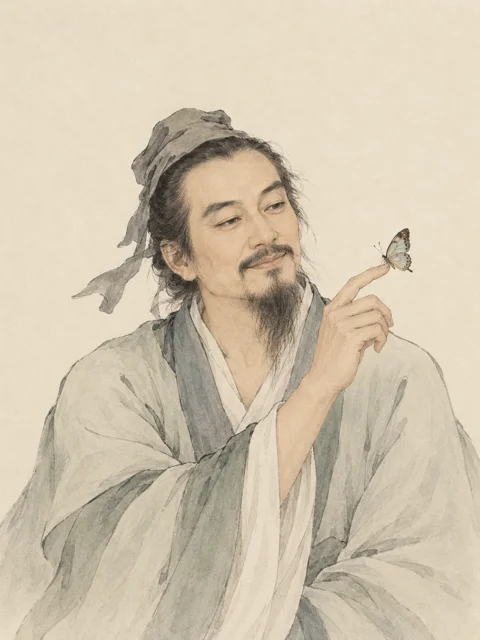
 AI 创作示意
GUANFU / en
庄子
AI 创作示意Chapter 8
版本按章对照,不代表逐句校勘对应。
中文原文(全三十三篇) / 庄子原典;维基文库贡献者整理
观复随文注释 · 36 条
駢拇脚拇趾与邻趾相连;駢读 pián枝指手旁生出的多余手指,出乎性哉,而侈多余、超出於德;附贅縣疣附生的赘肉瘤疣;縣通悬,出乎形哉,而侈於性。多方乎仁義而用之者,列於五藏心肝脾肺肾;藏同脏哉,而非道德之正也。是故,駢於足者,連无用之肉也;枝於手者,樹无用之指也;多方駢枝於五藏之情者,淫僻过度而偏离正道於仁義之行,而多方於聰明之用也。是故,駢於明者,亂五色,淫文章交错绚丽的纹彩,青黃黼黻古代礼服上的纹样之煌煌,非乎?而離朱传说视力极好的人是已。多於聰者,亂五聲宫、商、角、徵、羽,淫六律古代音律系统的阳声六律,金石絲竹、黃鍾大呂古代十二律中的两律之聲,非乎?而師曠春秋晋国著名乐师是已。枝於仁者,擢德塞性标举德行而堵塞自然本性,以收名聲,使天下簧鼔巧言煽动;此本夹有异文一作「鼓」,以奉不及之法,非乎?而曾指曾参,孔子弟子一作「魯」、史指史鱼,卫国大夫是已。駢於辯者,纍瓦、結繩、竄句,遊心於堅白同異名家辨析事物属性、异同的命题之間,而敝跬譽无用之言,非乎?而楊、墨杨朱、墨翟是已。故此皆多駢旁枝之道,非天下之至正也。
彼正正者,不失其性命之情,故合者不爲駢,而枝者不爲跂,長者不爲有餘,短者不爲不足。是故,鳧脛野鸭的小腿;鳧读 fú雖短,續之則憂,鶴脛雖長,斷一作「短」之則悲。故性長非所斷,性短非所續,无所去憂也。意仁義其非人情乎?彼仁人何其多憂也!且夫駢於拇者,決之則泣;枝於手者,齕咬断;读 hé之則啼。二者,或有餘於數,或不足於數,其於憂,一也。今世之仁人,蒿目忧劳不安地张望而憂世之患;不仁之人,決性命之情而饕贪求;读 tāo貴富。故意仁義其非人情乎!自三代以下者,天下何其囂囂也!且夫待鉤繩規矩而正者,是削其性也;待繩約膠漆而固者,是侵其德也;屈折禮樂,呴俞温言抚慰仁義,以慰天下之心者,此失其常然自然而恒常的本来状态也。天下有常然。常然者,曲者不以鉤,直者不以繩,圓者不以規,方者不以矩,附離不以膠漆,約束不以纆索绳索;纆读 mò。故天下誘然皆生,而不知其所以生,同焉皆得,而不知其所以得,故古今不二,不可虧也,則仁義又奚連連如膠漆纆索,而遊乎道德之間爲哉?使天下惑也!
夫小惑易方,大惑易性。何以知其然邪?自虞氏指舜招仁義以撓天下也,天下莫不奔命於仁義。是非以仁義易其性與?故嘗試論之:自三代以下者,天下莫不以物易其性矣。小人則以身殉牺牲自身去追逐利,士則以身殉名,大夫則以身殉家,聖人則以身殉天下。故此數子者,事業不同,名聲異號,其於傷性,以身爲殉,一也。臧與穀寓言中的两名牧羊人,二人相與牧羊,而俱亡其羊。問臧奚事,則挾筴夹着简册;筴此指书简讀書;問穀奚事,則博塞古代的博戏以遊。二人者,事業不同,其於亡羊,均也。伯夷死名於首陽伯夷、叔齐传说饿死之山之下,盜跖古代传说中的大盗死利於東陵之上。二人者,所死不同,其於殘生傷性,均也,奚必伯夷之是,而盜跖之非乎?天下盡殉也。彼其所殉,仁義也,則俗謂之君子;其所殉,貨財也,則俗謂之小人。其殉,一也,則有君子焉,有小人焉。若其殘生損性,則盜跖亦伯夷已,又惡取君子小人於其間哉?
且夫屬其性乎仁義者,雖通如曾、史,非吾所謂臧也;屬其性於五味,雖通如俞兒传说善于辨味的人,非吾所謂臧也;屬其性乎五聲,雖通如師曠,非吾所謂聰也;屬其性乎五色,雖通如離朱,非吾所謂明也。吾所謂臧善、好,非仁義之謂也,臧於其德而已矣;吾所謂臧者,非所謂仁義之謂也,任其性命之情而已矣;吾所謂聰者,非謂其聞彼也,自聞而已矣;吾所謂明者,非謂其見彼也,自見而已矣。夫不自見而見彼,不自得而得彼者,是得人之得而不自得其得者也,適人之適迎合他人所认为的适意而不自適其適者也。夫適人之適而不自適其適,雖盜跖與伯夷,是同爲淫僻也。余愧乎道德,是以上不敢爲仁義之操,而下不敢爲淫僻之行也。
观复随文注释 · AI 辅助独立整理,待持续人工校订。释义以本章语境为依据;存在异说或底本疑讹的地方另作提示。原文及版本来源保留如下。
参考: 本站所收原典:外篇 · 駢拇 ↗
原典公有领域;电子文本据维基文库贡献者,按 CC BY-SA 4.0 保留署名及相同方式共享;调整空白与排版。 · 查看原始版本
欢迎引用本站资源,分享道家与道教文化。引用时请注明出处“观复”,并附上所引用内容的原始页面链接,方便读者查阅。
观复白话释义(AI 辅助) / 观复 · AI 辅助独立整理
【白话释义|AI 辅助独立整理,未经人工学术审定】
脚趾并连、手生六指,虽然出于天性,相对于通常的形体却显得多余;身上附着赘肉、悬着肉瘤,虽然出于身体,相对于本来的机能也显得多余。把仁义的做法繁衍成许多门类,再刻意施行,虽然也发自内心,却不是道德的自然状态。因此,脚趾并连,是多出一块相连的肉;手生旁指,是多长一根指头。把内心的情感也弄得旁生枝节、彼此粘连,就是过分偏执于仁义的实行,把耳聪目明发展成纷繁的技巧。
所以,视觉上多生枝节,就会扰乱五色,沉溺于文饰,追求青黄花纹的灿烂,不是吗?离朱便是这种人。听觉上过度发展,就会扰乱五音,沉溺于音律,追求钟磬琴瑟和各种律调的声音,不是吗?师旷便是这种人。仁爱上旁生枝节,就会拔高德行、堵塞本性,以获取名声,使天下人鼓动争逐,奉行难以企及的标准,不是吗?曾参、史鱼便是这种人。辩论上多生枝节,就会像堆瓦、结绳一样拼凑言辞,窜连句子,把心思游荡在坚白、同异的论题之间,耗费精力求取细小的声誉,说些无用的话,不是吗?杨朱、墨翟便是这种人。所以这些都是多余的并连和旁枝,不是天下最合乎自然的正道。
真正合乎自然的正,不丧失性命的实际情状。因此,生来相连的,不算多余的并连;生来有旁指的,不算应当去掉的枝出;长的不算有余,短的不算不足。野鸭腿虽然短,给它接长就会使它痛苦;鹤腿虽然长,把它截短就会使它悲伤。所以天性长的不能硬截,天性短的不能硬接,本来并没有什么忧患需要这样消除。唉,仁义难道并不是人的自然情性吗?那些仁人怎么有那么多忧虑!脚趾并连,切开它就会痛哭;手上多指,咬断它也会啼叫。两者,一个在数目上多,一个在分开的数目上少,在痛苦上却一样。
如今的仁人忧心忡忡,为世间的祸患发愁;不仁的人割裂性命的本真,贪求富贵。因此,仁义恐怕并不符合人的自然情性吧!夏商周三代以来,天下怎么如此喧扰!必须依靠弯钩、墨绳、圆规、曲尺才弄得合标准,是削损天性;必须依靠绳索捆绑、胶漆粘合才牢固,是侵损自然的德性;屈曲地制作礼乐,殷勤地鼓吹仁义,用来抚慰天下人心,是丧失了本来恒常的状态。
天下本有自然的常态。所谓常态,是弯的不借弯钩,直的不借墨绳,圆的不借圆规,方的不借曲尺;相互附合不借胶漆,相互维系不借绳索。因此,天下万物自自然然地生长,而不知道自己为什么生长;共同各得其所,而不知道为什么能够如此。这样的道理古今无二,不能削损。仁义又为什么像胶漆绳索一样纠缠不休,在道德之间添设牵连呢?这只会使天下迷惑!
小的迷惑改变方向,大的迷惑改变本性。怎么知道如此?自从有虞氏标举仁义来扰动天下,天下人无不奔走于仁义的号令。这岂不是用仁义改变人的本性?试着讨论:夏商周三代以来,天下人无不用外物换掉本性。小人为利益牺牲自身,士为名声牺牲自身,大夫为家族牺牲自身,圣人为天下牺牲自身。这几种人事业不同,名号声誉不同,但在损伤本性、以身殉物这一点上,是一样的。
臧和穀两个人一起放羊,都把羊弄丢了。问臧当时做什么,他说拿着简册读书;问穀做什么,他说玩博塞游戏。两人做的事情不同,在丢羊这一点上却相同。伯夷为名声死在首阳山下,盗跖为利益死在东陵之上。两人所为而死的事情不同,在残害生命、损伤本性这一点上却相同,何必一定说伯夷对、盗跖错?天下人都在为外物牺牲自己。所殉的是仁义,世俗便称为君子;所殉的是财货,世俗便称为小人。同是以身殉物,却分出了君子、小人。若就残生损性而言,盗跖也同伯夷一样,又怎么从这里分出君子与小人?
再说,把本性系在仁义上,即使精通如曾参、史鱼,也不是我说的善;把本性系在五味上,即使精通如俞儿,也不是我说的善;把本性系在五音上,即使精通如师旷,也不是我说的聪;把本性系在五色上,即使精通如离朱,也不是我说的明。我所谓的善,不是指仁义,而是善于保有自己的自然德性;我所谓的善,不是通常所说的仁义,而是顺任自己性命的实际情状。我所谓的聪,不是听得清外在的声音,而是听得见自己的本真;我所谓的明,不是看得清外在的事物,而是看得见自己。
看不见自己,却只看外物;不能自得,却只求取得别人的所得,这就是取得别人所要的,而没有取得自己本应得到的;适应别人所觉得舒适的,而没有安适于自己的舒适。只求别人之适、不求自己之适,那么盗跖和伯夷,都同样陷于过度和偏离。我自觉对道德还心有惭愧,因此向上不敢标榜仁义的操守,向下也不敢放纵偏邪的行为。
校订说明:“骈拇”“枝指”等身体特征在本篇中用作讨论自然与人为的比喻,原文先言其余赘,继而反对强行截续,释义保留这一论证转折。“五藏”依文意解释为内在情感所在;“臧”在末段作善解,与放羊者姓名不同。“俞儿”传统多解释为善辨味者。“盗跖死利于东陵”属于本篇论说材料,不另作史实保证。
观复白话释义:AI 辅助依据古文独立编写,已进行文本覆盖核对,未经人工学术审定;原典来源及电子底本署名、许可见对应中文版本。 · 查看原始版本
Herbert A. Giles 英译(全三十三篇) / Herbert A. Giles(翟理斯),1889
Joined Toes.
[Translator’s note] Argument :—Virtues should be natural, not artificial; passive not active. [Chs. viii to xiii inclusive are illustrative of, or supplementary to, ch. vii .]
Joined toes and extra fingers are an addition to nature, though, functionally speaking, superfluous. Wens and tumours are an addition to the bodily form, though, as far as nature is concerned, superfluous. And similarly, to include charity and duty to one's neighbour among the functions of man's organism, is not true Tao .
[Translator’s note] The whole of this chapter is a violent tirade against the leading doctrines of Confucianism.
For just as joined toes are but useless lumps of flesh, and extra fingers but useless excrescences, so are any artificial additions to our internal economy but harmful adjuncts to real charity and duty to one's neighbour,
[Translator’s note] Which are the outcome of Tao .
and are moreover prejudicial to the right use of intelligence.
People with extra keenness of vision muddle themselves over the five colours, exaggerate the value of shades, and of distinctions of greens and yellows for sacrificial robes. Of such was Li Chu.
[Translator’s note] Who could see a pin's point at a distance of 1,000 li . He is mentioned by Mencius.
People with extra keenness of hearing muddle themselves over the five notes, exaggerate the tonic differences of the six pitch-pipes, and the various timbres of metal, stone, silk, and bamboo, of the Huang-chung , and of the Ta-lü . Of such was Shih K'uang.
[Translator’s note] The blind musician mentioned in ch. ii . The Huang-chung and the Ta-lü were two of the twelve bamboo tubes, or pitch-pipes, on which ancient Chinese music was based. Six were male or positive, and six female or negative. Hence they are spoken of collectively as six.
People who graft on charity, force themselves to display this virtue in order to gain reputation and to enjoy the applause of the world for that which is of no account. Of such were Tsêng and Shih.
[Translator’s note] Tsêng Shên, a famous disciple of Confucius, and Shih Yu, both noted for their high moral characters.
People who refine in argument do but pile up tiles or knot ropes in their maunderings over the hard and white, the like and the unlike, wearing themselves out over mere useless terms. Of such were Yang and Mih.
[Translator’s note] Yang Chu, a philosopher of the fourth century B.C. , whose "selfish" system was condemned by Mencius; and Mih Tzŭ, already mentioned in ch. ii .
Therefore every addition to or deviation from nature belongs not to the ultimate perfection of all.
[Translator’s note] Which is in Tao .
He who would attain to such perfection never loses sight of the natural conditions of his existence. With him the joined is not united, nor the separated apart, nor the long in excess, nor the short wanting. For just as a duck's legs, though short, cannot be lengthened without pain to the duck, and a crane's legs, though long, cannot be shortened without misery to the crane, so that which is long in man's moral nature cannot be cut off, nor that which is short be lengthened. All sorrow is thus avoided.
Intentional charity and intentional duty to one's neighbour are surely not included in our moral nature. Yet what sorrow these have involved. Divide your joined toes and you will howl: bite off your extra finger and you will scream. In one case there is too much, in the other too little; but the sorrow is the same. And the charitable of the age go about sorrowing over the ills of the age, while the non-charitable cut through the natural conditions of things in their greed after place and wealth. Surely then intentional charity and duty to one's neighbour are not included in our moral nature. Yet from the time of the Three Dynasties downwards what a fuss has been made about them!
Those who cannot make perfect without arc, line, compasses, and square, injure the natural constitu tion of things. Those who require cords to bind and glue to stick, interfere with the natural functions of things. And those who seek to satisfy the mind of man by hampering with ceremonies and music and preaching charity and duty to one's neighbour, thereby destroy the intrinsicality of things.
For such intrinsicality does exist, in this sense:—Things which are curved require no arcs; things which are straight require no lines; things which are round require no compasses; things which are rectangular require no squares; things which stick require no glue; things which hold together require no cords. And just as all things are produced, and none can tell how they are produced, so do all things possess their own intrinsic qualities and none can tell how they possess them. From time immemorial this has always been so, without variation. Why then should charity and duty to one's neighbour be as it were glued or corded on, and introduced into the domain of Tao , to give rise to doubt among mankind?
Lesser doubts change the rule of life; greater doubts change man's nature.
How do we know this? By the fact that ever since the time when Shun bid for charity and duty to one's neighbour in order to secure the empire, men have devoted their lives to the pursuit thereof. Is it not then charity and duty to one's neighbour which change the nature of man?
Therefore I have tried to show that from the time of the Three Dynasties it has always been the external which has changed the nature of man. If a mean man, he will die for gain. If a superior man, he will die for fame. If a man of rank, he will die for his ancestral honours. If a Sage, he will die for the world. The pursuits and ambitions of these men differ, but the injury to their natures involved in the sacrifice of their lives is the same.
Tsang and Ku were shepherds, both of whom lost their flocks. On inquiry, it appeared that Tsang had been engaged in reading, while Ku had gone to take part in some trials of strength. Their occupations had been different, but the result was in each case loss of the sheep.
Poh I died for fame at the foot of Mount Shou-yang.
[Translator’s note] See ch. vi .
Robber Chê died for gain on Mount T'ai.
[Translator’s note] Robber Chê has a chapter to himself, from which, though spurious, it may be gathered that he was a very remarkable personage in his day.
[Translator’s note] Mount T'ai has been mentioned in ch. i .
Their deaths were not the same, but the injury to their lives and natures was in each case the same. How then can we applaud the former and blame the latter?
And so, if a man dies for charity and duty to his neighbour the world calls him a noble fellow; but if he dies for gain, the world calls him a low fellow. The dying being the same, one is nevertheless called noble and the other low. But in point of injury to life and nature, the robber Chê and Poh I are one. Where then does the distinction of noble and low come in?
Were a man to apply himself to charity and duty towards his neighbour until he were the equal of Tsêng or Shih, this would not be what I mean by perfection. Or to flavours, until he were the equal of Yü Erh.
[Translator’s note] Probably identical with I Ya, the Soyer of China.
Or to sounds, until he were the equal of Shih K'uang. Or to colours, until he were the equal of Li Chu. What I mean by perfection is not what is meant by charity and duty to one's neighbour. It is found in the cultivation of Tao . And those whom I regard as cultivators of Tao are not those who cultivate charity and duty to one's neighbour. They are those who yield to the natural conditions of things. What I call perfection of hearing is not hearing others but oneself. What I call perfection of vision is not seeing others but oneself.
[Translator’s note] A saying attributed by Han Fei Tzŭ to Lao Tzŭ:—"To see oneself is to be clear of sight." See The Remains of Lao Tzŭ , p. 18.
For a man who sees not himself but others, takes not possession of himself but of others, thus taking what others should take and not what he himself should take.
[Translator’s note] Multi sunt, qui urbes, qui populos habuere in potestate, paucissimi, qui se.
Instead of being himself, he in fact becomes some one else. And if a man thus becomes some one else instead of himself, this is a fatal error of which both the robber Chê and Poh I can be equally guilty.
And so, conscious of my own deficiency in regard to Tao , I do not venture at my best to practise the principles of charity and duty to my neighbour, nor at my worst to fall into the fatal error above-mentioned.
原著及 Herbert A. Giles 历史译本公有领域;据 Project Gutenberg #59709,完整电子书及使用条款见本站资料来源。 · 查看原始版本
我的书签(此浏览器)
还没有书签。