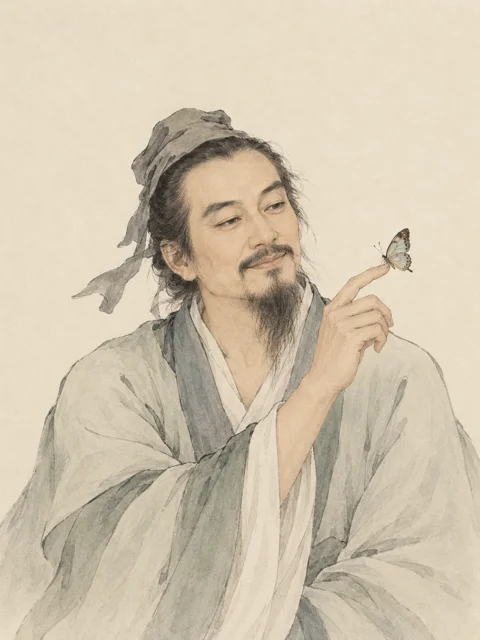
 AI 创作示意
GUANFU / zh-Hant
庄子
AI 创作示意外篇 · 達生
版本按章对照,不代表逐句校勘对应。
中文原文(全三十三篇) / 庄子原典;维基文库贡献者整理
观复随文注释 · 69 条
達生通达生命的实情之情者,不務生之所无以爲;達命之情者,不務知之所无奈何。養形必先之物,物有餘而形不養者有之矣;有生必先无離形,形不離而生亡者有之矣。生之來,不能却一作「卻」;其去,不能止。悲夫!世之人以爲養形足以存生,而養形果不足以存生,則世奚足爲哉?雖不足爲,而不可不爲者,其爲不免矣!夫欲免爲形者,莫如棄世。棄世則无累,无累則正平身心端正平和,正平則與彼更生,更生則幾矣。事奚足棄而生奚足遺?棄事則形不勞,遺生忘却对生命的执著則精不虧。夫形全精復,與天爲一。天地者,萬物之父母也,合則成體,散則成始。形精不虧,是謂能移;精而又精,反以相天顺助自然;相读 xiàng。
子列子問關尹传说中的关令尹喜曰:「至人潛行不窒阻滞、窒息,蹈火不熱,行乎萬物之上而不慄。請問何以至於此?」關尹曰:「是純氣之守保守纯一的精神与生命之气也,非知巧果敢之列。居,予語汝:凡有貌象聲色者,皆物也,(物與)物何以相遠?夫奚足以至乎先?是色而已,則物之。造乎不形,而止乎无所化:夫得是而窮之者,物焉得而止焉?彼將處乎不淫之度,而藏乎无端之紀,遊乎萬物之所終始。壹其性,養其氣,合其德,以通乎物之所造:夫若是者,其天守全,其神无郤没有缝隙;郤同隙,物奚自入焉?夫醉者之墜車,雖疾,不死,骨節與人同,而犯害與人異,其神全也,乘亦不知也,墜亦不知也,死生驚懼不入乎其胷中,是故遻遇、触犯;读 è一作「𨕣」物而不慴恐惧;读 shè一作「懼」。彼得全於酒而猶若是,而況得全於天乎?聖人藏於天,故莫之能傷也。」復讎者不折鏌、干莫邪、干将,两种宝剑,雖有忮心怨恨伤害之心者,不怨飄瓦自然飘落的屋瓦,是以天下平均。故无攻戰之亂,无殺戮之刑者,由此道也。不開人之天,而開天之天。開天者德生,開人者賊生。不厭其天,不忽於人,民幾乎以其眞。
仲尼適楚,出於林中,見痀僂驼背;读 gōu lóu者承蜩用黏竿捕蝉;蜩读 tiáo,猶掇之也。仲尼曰:「子巧乎!有道邪?」曰:「我有道也。五六月,累丸在竿上叠放小丸练习二而不墜,則失者錙銖细小的重量单位,喻极少;累三而不墜,則失者十一十分之一;累五而不墜,猶掇之也。吾處身也,若橛株拘断木、树桩一类不动之物;吾執臂也,若槁木之枝。雖天地之大,萬物之多,而唯蜩翼之知。吾不反不側,不以萬物易蜩之翼,何爲而不得?」孔子顧謂弟子曰:「用志不分,乃凝於神,其痀僂丈人之謂乎!」
顏淵問仲尼曰:「吾嘗濟乎觴深之淵,津人渡船的人操舟若神。吾問焉,曰:『操舟可學邪?』曰:『可。善游者數能很快学会;數读 shuò。若乃夫沒人善于潜水的人,則未嘗見舟而便操之也。』吾問焉,而不吾告。敢問:何謂也?」仲尼曰:「善游者數能,忘水也。若乃夫沒人之未嘗見舟而便操之也,彼視淵若陵,視舟之覆,猶其(車)却一作「卻」也。覆却一作「卻」萬方陳乎前,而不得入其舍,惡往而不暇?」以瓦注以瓦片作为赌注者巧,以鉤带钩,此处指贵重赌注注者憚,以黃金注者㱪一作「殙」,其巧一也,而有所矜顾惜、看重,則重外也。凡外重者內拙过分看重外物便内心失措。
田開之見周威公,威公曰:「吾聞祝腎學生。吾子與祝腎遊一作「游」,亦何聞焉?」田開之曰:「開之操拔篲扫帚;篲同彗以侍門庭,亦何聞於夫子?」威公曰:「田子无讓,寡人願聞之。」開之曰:「聞之夫子曰:『善養生者,若牧羊然,視其後者而鞭之。』」威公曰:「何謂也?」田開之曰:「魯有單豹者,巖居而水飲,不與民共利,行年七十而猶有嬰兒之色,不幸遇餓虎,餓虎殺而食之。有張毅者,高門、縣薄悬挂的帘箔,借指简陋之家,无不走也,行年四十而有內熱之病以死。豹養其內而虎食其外,毅養其外而病攻其內,此二子者,皆不鞭其後者也。仲尼曰:『无入而藏,无出而陽柴张扬、闭塞,古注有异解,立其中央,三者若得,其名必極。』」夫畏塗者,十殺一人,則父子兄弟相戒也,必盛卒徒而後敢出焉,不亦知乎!人之所取畏者,衽席床褥、寝席之上,飲食之間,而不知爲之戒者,過也!
祝宗人主持宗庙祭祀的官员玄端古代黑色礼服以臨牢筴圈养牲畜的栏圈,說彘猪;读 zhì曰:「汝奚惡死?吾將三月豢用谷物喂养牲畜一作「㹖」汝,十日戒,三日齊同斋,斋戒静心,藉白茅,加汝肩尻肩部与臀部乎彫一作「雕」俎祭祀陈列肉食的案具;读 zǔ之上,則汝爲之乎?」爲彘謀曰:「不如食以穅糟,而措一作「錯」之牢筴之中。」自爲謀,則苟生有軒冕之尊,死得於腞楯雕饰的灵车之上、聚僂棺椁一类的葬具之中,則爲之。爲彘謀則去之,自爲謀則取之,所異彘者,何也?
桓公田田猎;同畋於澤,管仲御,見鬼焉。公撫管仲之手,曰:「仲父何見?」對曰:「臣无所見。」公反,誒詒忧惧失神的样子爲病,數日不出。齊士有皇子告敖者,曰:「公則自傷,鬼惡能傷公?夫忿滀之氣,散而不反,則爲不足;上而不下,則使人善怒;下而不上,則使人善忘;不上不下,中身當心,則爲病。」桓公曰:「然則有鬼乎?」曰:「有。沈有履,竈有髻。戶內之煩壤,雷霆處之;東北方之下者,倍阿鮭蠪躍之;西北方之下者,則泆陽處之。水有罔象古代传说中的水怪,丘有峷一作「崒」,山有夔,野有彷徨,澤有委蛇此处为传说中的泽神名称。」公曰:「請問:委蛇之狀,何如?」皇子曰:「委蛇,其大如轂车轮中心穿轴的部分;读 gǔ,其長如轅车辕,紫衣而朱冠。其爲物也惡,聞雷、車之聲,則捧其首而立。見之者,殆乎霸。」桓公辴然大笑的样子;读 chěn而笑,曰:「此寡人之所見者也。」於是正衣冠,與之坐,不終日,而不知病之去也。
紀渻子寓言中养斗鸡的能手爲王養鬭雞。十日而問:「雞已乎?」曰:「未也,方虛憍浮躁骄傲;憍同骄而恃氣。」十日又問,曰:「未也,猶應嚮景声响与影子。」十日又問,曰:「未也,猶疾視而盛氣。」十日又問,曰:「幾矣!雞雖有鳴者,已无變矣,望之似木雞矣,其德全矣。異雞无敢應者,反走矣。」
孔子觀於呂梁古代险急的水流之名,縣水三十仞,流沫四十里,黿鼉大鳖与扬子鳄一类动物魚鼈之所不能游也,見一丈夫游之,以爲有苦而欲死也,使弟子並流而拯之。數百步而出,被髮行歌而游於塘下。孔子從而問焉,曰:「吾以子爲鬼,察子則人也。請問:蹈水有道乎?」曰:「亡,吾无道。吾始乎故出生的环境、惯习,長乎性,成乎命。與齊漩涡;读 jì俱入,與汩涌出的水流;读 gǔ一作「汨」偕出,從一作「得」水之道,而不爲私焉。此吾所以蹈之也。」孔子曰:「何謂『始乎故,長乎性,成乎命』?」曰:「吾生於陵而安於陵,故也。長於水而安於水,性也。不知吾所以然而然,命也。」
梓慶名庆的木工削木爲鐻悬挂钟磬的木架;读 jù,鐻成,見者驚猶鬼神。魯侯見而問焉,曰:「子何術以爲焉?」對曰:「臣,工人,何術之有?雖然,有一焉。臣將爲鐻,未嘗敢以耗氣也,必齊以靜心。齊三日,而不敢懷慶賞爵祿;齊五日,不敢懷非譽巧拙;齊七日,輒然忘吾有四枝形體也。當是時也,无公朝,其巧專而外滑外物的扰动;滑读 gǔ一作「骨」消,然後入山林,觀天性,形軀至矣,然後成見鐻,然後加手焉,不然則已,則以天合天以天然本性契合木材天性。器之所以疑神者,其是與?」
東野稷以御見莊公,進退中繩,左右旋中規。莊公以爲文弗過也,使之鉤百曲折往返多次,检验驾车技巧而反。顏闔遇之,入見曰:「稷之馬將敗。」公密而不應。少焉,果敗而反。公曰:「子何以知之?」曰:「其馬力竭矣,而猶求焉,故曰敗。」工倕传说中的巧匠旋而蓋(規)矩,指與物化,而不以心稽,故其靈臺心灵、精神一而不桎。忘足,屨鞋;读 jù之適也。忘要忘却腰部;要同腰,帶之適也。知忘是非,心之適也。不內變,不外從,事會之適也。始乎適而未嘗不適者,忘適之適也。
有孫休者,踵門亲自走到门前而詫子扁慶子,曰:「休居鄉不見謂不脩,臨難不見謂不勇,然而田原不遇歲,事君不遇世,賓於鄉里被乡里排斥;賓通摈,逐於州部,則胡罪乎天哉?休惡遇此命也?」扁子曰:「子獨一作「何」不聞夫至人之自行邪?忘其肝膽,遺其耳目,芒然彷徨乎塵垢之外,逍遙乎无事一作「爲」之業,是謂『爲而不恃,長而不宰』。今汝飾知以驚愚,脩身以明汙,昭昭乎若揭日月而行也。汝得全而形軀,具而九竅,无中道夭於聾盲跛蹇而比於人數,亦幸矣,又何暇乎天之怨哉?子往矣!」孫子出。扁子入,坐有間,仰天而歎。弟子問曰:「先生何爲歎乎?」扁子曰:「向者休來,吾告之以至人之德。吾恐其驚而(遂)至於惑也。」弟子曰:「不然。孫子之所言是邪?先生之所言非邪?非固不能惑是。孫子所言非邪?先生所言是邪?彼固惑而來矣,又奚罪焉?」扁子曰:「不然。昔者有鳥止於魯郊,魯君悅一作「說」之,爲具太牢以饗之,奏九韶以樂之。鳥乃始憂悲眩視,不敢飲食。此之謂以己養養鳥也。若夫以鳥養養鳥者,宜棲之深林,浮之江湖,食之以委蛇,則平陸而已矣。今休,款啓寡聞见识狭窄、所闻很少之民也,吾告以至人之德,譬之若載鼷小鼠;读 xī以車馬,樂鴳小鸟,通常指鹌鹑一类;读 yàn以鍾一作「鐘」鼓也,彼又惡能无驚乎哉?」
观复随文注释 · AI 辅助独立整理,待持续人工校订。释义以本章语境为依据;存在异说或底本疑讹的地方另作提示。原文及版本来源保留如下。
原典公有领域;电子文本据维基文库贡献者,按 CC BY-SA 4.0 保留署名及相同方式共享;调整空白与排版。 · 查看原始版本
欢迎引用本站资源,分享道家与道教文化。引用时请注明出处“观复”,并附上所引用内容的原始页面链接,方便读者查阅。
观复白话释义(AI 辅助) / 观复 · AI 辅助独立整理
【观复白话释义|AI 辅助·未经人工学术审定】
通晓生命实情的人,不去追求对于生命没有用处的东西;通晓命运实情的人,不勉强用智慧解决无可奈何的事。保养形体,必须先有物资,可是物资充足而形体未被养好的,仍然有;生命存在,必须不脱离形体,可是形体还在而生命已消失的,也仍然有。生命来到,不能推却;生命离去,不能留住。可悲啊!世人以为养好形体就足以保存生命,而养形果然不足以保存生命,那么世俗所追逐的还有什么值得做呢?虽然不值得执著,却又有不得不做的事,这些作为终究不能完全避免。若想免去为形体奔忙的拖累,莫如放下世俗事务。放下世俗就没有牵累,没有牵累就能端正平和,端正平和便同自然一道更新生命;能如此更新,就接近道了。
世事何妨放下,生命又何必念念不忘?放下事务,形体就不劳苦;忘却求生的执念,精神就不亏耗。形体完整,精神复归,便同自然成为一体。天地是万物的父母,聚合就形成身体,离散便成为另一变化的开端。形体精神不受亏损,才可以随变化迁移;精纯而又精纯,便返回本真,以顺应自然。
列子问关尹:“至人潜行水下不窒息,踏入火中不灼热,行于万物之上不恐惧。请问怎样能达到这种境界?”关尹说:“这是保守纯一之气的结果,并不属于聪明技巧、果决勇敢之类。坐下,我告诉你。凡是有形貌、形象、声音、颜色的,都是物;物与物之间又能有多么根本的悬隔?单靠物,哪里足以达到万物产生以前的根本?这些都只是有形的表现,只能把它们作为物来看待。达到无形的根源,安止于不随外物迁化的根本;得到这一点并穷尽它,外物又怎么能够阻碍他?他处在不过度的分寸里,藏身于找不到端绪的纲纪之中,游心于万物开始与终结之处。使本性专一,涵养自身之气,汇合自身之德,从而通向万物产生的根源。这样,他对天然本性的守护完整,精神没有缝隙,外物又从哪里侵入呢?
“醉酒的人从车上摔下,即使摔得厉害,也可能不死。他的骨节和别人一样,受到伤害的情况却不同,是因为精神没有被惊惧分裂。他上车时不自觉,摔下时也不自觉,死生惊恐没有进入胸中,因此撞上东西也不惊慌。他从酒中暂时得到这种完整,尚且如此,何况从自然得到完整呢?圣人藏身于自然,所以没有什么能伤害他。”
报仇的人不会折断杀人的镆铘、干将宝剑;即使心存怨怒的人,也不会怨恨偶然飘落的瓦片。依循这样的道理,天下便可平静均衡。没有攻战的混乱,没有杀戮的刑罚,正可以从这里实现。不去开发人为智巧所造成的“天”,而去开启自然自身的“天”。开启天然,德性便生长;开启人为,伤害便产生。不压抑天然,也不忽略人所处的现实,百姓便接近保存本真了。
孔子到楚国去,走出树林,看见一个驼背老人用竿粘蝉,轻松得像拾取东西。孔子说:“您真巧啊!有什么方法吗?”老人说:“我有办法。练习五六个月,在竿头叠起两颗小丸而不掉,失手就已经很少;叠起三颗不掉,失手约十分之一;叠起五颗不掉,粘蝉就如同拾取。我站定身体,像一截稳固的树桩;伸出手臂,像枯树的枝条。天地虽大,万物虽多,我所留意的只有蝉翼。我不转身,不侧目,不拿万物来替换对蝉翼的专注,怎么会捉不到呢?”孔子回头对弟子说:“心志专一不分散,便能凝聚到出神的境地,说的就是这位驼背老人吧!”
颜渊问孔子:“我曾渡过觞深的水潭,船夫驾船如神。我问:‘驾船能学会吗?’他说:‘能。善于游泳的人很快就能学会;至于会潜水的人,即使从没见过船,也能立即操纵。’我追问缘故,他却不再告诉我。敢问这是什么意思?”孔子说:“善于游泳的人很快能学会,是因为他把水忘了。至于潜水者没见过船就能驾船,是因为他看深潭如同陆地,看翻船如同车子倒退。翻覆倒退的各种情形出现在眼前,都不能进入他的内心,到哪里又不能从容呢?”拿瓦片作赌注,能够发挥技巧;拿带钩作赌注,就开始害怕;拿黄金作赌注,便昏乱失常。技巧本来一样,只因有所顾惜,就看重身外之物。凡是外物看得太重,内在的本领便发挥不出。
田开之见周威公。威公说:“我听说祝肾学习养生。您同祝肾交往,听到过什么?”田开之说:“我不过拿着扫帚在门庭服侍,哪里从先生那里听到了什么?”威公说:“田先生不必谦让,我愿意听。”田开之说:“我听先生说:‘善于养生的人,就像牧羊,见哪只落在后面,就鞭策哪只。’”威公问:“什么意思?”田开之说:“鲁国有个单豹,住在山岩间,喝山泉,不同别人争利,活到七十岁,脸色还像婴儿。不幸遇见饿虎,被虎杀死吃掉。另有个张毅,无论高门大户还是挂着薄帘的贫家,没有他不奔走交往的,到了四十岁,却因内热的病死去。单豹养好了内在,却让老虎吃掉外在形体;张毅顾好了外在交往,却让疾病侵袭内在。这两个人,都没有鞭策自己落后的那一部分。孔子说:‘不要一味深入藏匿,不要一味向外炫露,应安立在中间。能掌握这三方面的分寸,便可称得上达到极致。’”
人们害怕的道路,十个人经过有一个被杀,父子兄弟便互相告诫,必定聚集足够的随从才敢出发,不也很聪明吗?可是人真正招致危险的地方,往往正在床席和饮食之间,却不知道戒备,这就是过错。
主持祭祀的人穿着黑色礼服,来到猪圈前,劝猪说:“你为什么讨厌死?我会用三个月把你喂肥,祭前守戒十天,再斋戒三天,铺上白茅,把你的肩肉和臀肉放在雕饰的祭器上。这样,你愿意吗?”若替猪打算,就会说,不如给它吃糠糟,让它留在猪圈里。可是替自己打算,只要活着有车乘冠冕的尊荣,死后能安置在有纹饰的灵车和棺椁中,就愿意了。替猪谋划就舍弃的,替自己谋划却接受,自己同猪究竟有什么不同呢?
齐桓公在沼泽打猎,管仲驾车。桓公看见了鬼,按着管仲的手问:“仲父看见什么了吗?”管仲答:“臣什么也没有看见。”桓公回来后,恍惚惊惧,因而生病,几天不出门。齐国有个名叫皇子告敖的士人,说:“是君王自己伤害了自己,鬼怎么能伤害您?人郁积的气,散出去而不回来,就造成虚弱;上升而不下降,就容易发怒;下降而不上升,就容易忘事;既不上也不下,停在身体中央,堵在心口,就会生病。”桓公问:“那么,真有鬼吗?”他答:“有。泥水中有履,灶中有髻;门内尘土堆里有雷霆;东北低地有倍阿、鲑蠪跳跃,西北低地有泆阳居住;水里有罔象,丘陵有峷,山中有夔,旷野有彷徨,沼泽有委蛇。”桓公说:“请问委蛇是什么模样?”皇子说:“委蛇粗如车毂,长如车辕,穿紫衣,戴红帽。它这种东西厌恶雷声和车声,听见便捧着头站起来。看见它的人,大概要成就霸业。”桓公放声笑道:“这就是我所看见的!”于是整理衣冠,同他坐着谈话,不到一天,病不知不觉就好了。
纪渻子替国王训练斗鸡。十天后,国王问:“鸡训练好了吗?”他说:“没有,还只会虚张声势,倚仗血气。”十天后再问,他说:“没有,听见声音、看见影子还会立即反应。”又十天再问,他说:“没有,还瞪眼怒视,气势逼人。”再过十天问,他说:“差不多了。别的鸡虽然鸣叫,它已经没有变化。看起来像木头做的鸡,内在的力量完整了。别的鸡没有敢迎战的,反而转身逃走。”
孔子在吕梁观看瀑流,水从三十仞高处悬落,激起的流沫延伸四十里,连大鳖、鼍、鱼、龟都不能在那里游动。他却看见一个男子在水里游,以为这人有痛苦,想求死,便让弟子沿着水流去救。那人游了几百步就出水,披散着头发,唱着歌,在堤岸下漫步。孔子跟上去问:“我原以为你是鬼,仔细看才知道是人。请问在水中活动,有什么道术吗?”那人说:“没有,我没有道术。我从原有的习惯开始,长成自然的本性,最终顺任命。我跟着回旋的水一起进去,随着上涌的水一起出来,顺从水的运行,不夹杂自己的强求。这就是我在水中活动的办法。”孔子问:“什么叫从习惯开始,长成本性,最终顺任命?”那人说:“我生在陆地,安于陆地,这是原有的习惯;在水边长大,安于水,这是养成的本性;不知道为什么这样而自然这样,这就是命。”
木匠庆削木做悬挂钟磬的架子,做成以后,看见的人惊叹如鬼神制作。鲁侯问:“你用什么方法做出来的?”他答:“臣只是木匠,哪里有什么奇术?不过,有一点。我将要制作时,不敢随意耗散精神,必定斋戒,使心安静。斋戒三天,便不再想着庆赏爵禄;五天,便不再想着非议赞誉、技巧高下;七天,就连自己的四肢形体都忘了。这时,朝廷也从心中消失,技巧专一,外来的扰乱全消退。然后进入山林,观察木材天然的质地和形态,找到全然合适的,心中先见到成器的样子,才动手制作。若找不到,就停止。这就是以我天然的禀性,配合木材天然的禀性。器物之所以让人疑为神作,大概就在这里吧!”
东野稷以驾车本领求见庄公,进退合乎直线,左右转弯合乎圆规。庄公觉得,即使织出的花纹也不会比这更整齐,便叫他反复绕行一百次再回来。颜阖遇见他,入见庄公说:“东野稷的马会累垮。”庄公默然没有回答。过了一会儿,车马果然出了事,回来。庄公问:“你怎么知道?”颜阖说:“马的力气已经耗尽,他却还在要求它继续,所以我说会垮。”
巧匠倕随手画出的方圆就能胜过规矩,手指同器物的变化自然相合,不须用心反复计较,所以他的心灵专一而不受拘束。忘了脚,是鞋子舒适;忘了腰,是腰带舒适;心智忘掉是非,是内心舒适。不在内心自生纷扰,不盲从外在牵引,是应对事务的舒适。从舒适开始而始终舒适,便是连舒适本身也忘了的舒适。
有个孙休,到子扁庆子的门前诉苦说:“我住在乡里,没有人说我不修养;面对危难,没有人说我不勇敢。可是种田遇不上好年景,事奉国君遇不上好世道,在乡里受排斥,在州部被驱逐。我究竟得罪了上天什么,为什么碰上这样的命运?”扁子说:“你难道没有听说至人怎样行事吗?忘了肝胆,放下耳目,茫然自在地徘徊于尘垢之外,逍遥于无所强为的境地。这叫作‘有所成就而不自恃,养育成长而不主宰’。如今你修饰智慧来惊动愚人,修养自身来显出别人的污浊,明晃晃地,仿佛举着日月走路。你能够保全身体,九窍齐备,没有中途夭折,也没有聋盲跛足之患,还能列身于众人之中,已属幸运,哪里还有工夫怨天呢?你走吧!”
孙休出去。扁子入内,坐了一会儿,仰天叹息。弟子问:“先生为什么叹息?”扁子说:“刚才孙休来,我告诉他至人的德性,恐怕他吃惊,反倒陷入迷惑。”弟子说:“不会吧。如果孙休说得对,先生说得不对,不对的本不能迷惑对的;如果孙休说得不对,先生说得对,他本来就是带着迷惑来的,又有什么过失呢?”扁子说:“不是这样。过去有只鸟停在鲁郊,鲁君喜欢它,备牛羊猪三牲款待它,奏《九韶》使它快乐。鸟却忧愁悲伤,眼花缭乱,不敢吃喝。这就叫用养自己的办法养鸟。若按鸟的需要养鸟,就该让它栖息深林,浮游江湖,吃适合它的小生物,在平陆自在生活。如今孙休只是见识狭窄、听闻不多的人,我却告诉他至人的德性,就好比用车马载小老鼠,用钟鼓取悦小鸟,他又怎么能不受惊呢?”
【篇末疑难注记】“天守”“灵台”分别按天然本性的守护、内心理解。“不厌其天,不忽于人”句义有歧解,正文采用不压抑天然、不忽略人事的读法。粘蝉段“两丸”失误极少而“三丸”失误十分之一,原文数目本有衔接疑点,未擅改。“阳柴”按向外显露解释。“腞楯”“聚僂”为葬具相关称谓,具体形制待校。皇子告敖所列鬼名完整保留为人物的说法。“鐻”按悬钟磬的木架解释;“文弗过”按织纹亦不能更整齐解释。“委蛇”在最后养鸟段中作食物,具体物类难定,不与前文鬼名强行等同。
观复白话释义:AI 辅助依据古文独立编写,已进行文本覆盖核对,未经人工学术审定;原典来源及电子底本署名、许可见对应中文版本。 · 查看原始版本
Herbert A. Giles 英译(全三十三篇) / Herbert A. Giles(翟理斯),1889
The Secret of Life.
[Translator’s note] Argument :—The soul is from God—Man's body its vehicle—The soul quickening the body is life—Care of the internal and of the external must be simultaneous—In due nourishment of both is Tao .
[This chapter is supplementary to chapter iii.]
Those who understand the conditions of life devote no attention to things which life cannot accomplish. Those who understand the conditions of destiny devote no attention to things over which knowledge has no control.
For the due nourishment of our physical frames, certain things are needful. Yet where such things abound, the physical frame is not always nourished. For the preservation of life it is necessary that there should be no abandonment of the physical frame. Yet where the physical frame is not abandoned, life does not always remain.
Life comes, and cannot be declined. It goes, and cannot be stopped. But alas! the world thinks that to nourish the frame is enough to keep life. And if indeed it is not enough, what then is the world to do?
Although not enough, it must still be done. It cannot be neglected. For if one is to neglect the physical frame, better far to retire at once from the world. By renouncing the world, one gets rid of the cares of the world. The result is a natural level, which is equivalent to a re-birth. And he who is re-born is near.
[Translator’s note] To Tao .
But what inducement is there to renounce the affairs of men, to become indifferent to life?—In the first case, the physical body suffers no wear and tear; in the second, the vitality is left unharmed. And he whose physical frame is perfect and whose vitality is in its original purity,—he is one with God.
[Translator’s note] Mens sana in corpore sano.
Heaven and earth are the father and mother of all things. When they unite, the result is shape. When they disperse, the original condition is renewed.
[Translator’s note] As in the case of ordinary mortals.
But if body and vitality are both perfect, this state is called fit for translation .
[Translator’s note] In the Biblical sense, as applied to Enoch.
Such perfection of vitality goes back to the minister of God.
[Translator’s note] "Vitality" is the subtle essence, the immaterial informing principle which, united with matter, exhibits the phenomenon of life. The term has already occurred in ch. xi .
Lieh Tzŭ asked Kuan Yin,
[Translator’s note] A sage who by some is said to have flourished five or six hundred years before Lieh Tzŭ; by others, to have been an immediate disciple of Lao Tzŭ, and to have been entrusted by him with the publication of the Tao-Tê-Ching .
saying, "The perfect man can walk through solid bodies without obstruction. He can pass through fire without being burnt. He can scale the highest heights without fear. How does he bring himself to this?"
"It is because he is in a condition of absolute purity," replied Kuan Yin. "It is not cunning which enables him to dare such feats. Be seated, and I will tell you.
"All that has form, sound, and colour, may be classed under the head thing . Man differs so much from the rest, and stands at the head of all things, simply because the latter are but what they appear and nothing more. But man can attain to formlessness and vanquish death. And with that which is in possession of the eternal, how can mere things compare?
"Man may rest in the eternal fitness; he may abide in the everlasting; and roam from the beginning to the end of all creation. He may bring his nature to a condition of ONE ; he may nourish his strength; he may harmonize his virtue, and so put himself into partnership with God. Then, when his divinity is thus assured, and his spirit closed in on all sides, how can anything find a passage within?
[Translator’s note] He is beyond the reach of objective existences.
"A drunken man who falls out of a cart, though he may suffer, does not die. His bones are the same as other people's; but he meets his accident in a different way. His spirit is in a condition of security. He is not conscious of riding in the cart; neither is he conscious of falling out of it. Ideas of life, death, fear, etc., cannot penetrate his breast; and so he does not suffer from contact with objective existences. And if such security is to be got from wine, how much more is it to be got from God. It is in God that the Sage seeks his refuge, and so he is free from harm.
"An avenger does not snap in twain the murderous weapon; neither does the most spiteful man carry his resentment to a tile which may have hit him on the head. And by the extension of this principle, the empire would be at peace; no more confusion of war, no more punishment of death.
"Do not develop your artificial intelligence, but develop that intelligence which is from God. From the latter, results virtue; from the former, cunning. And those who do not shrink from the natural, nor wallow in the artificial,—they are near to perfection."
When Confucius was on his way to the Ch'u State, he came to a forest where he saw a hunchback catching cicadas as though with his hand.
[Translator’s note] It is still the delight of the Chinese gamin to capture the noisy "scissor-grinder" with the aid of a long bamboo tipped with bird-lime.
"How clever you are!" cried Confucius. "Have you any way of doing this?"
[Translator’s note] "Way," i.e. road, is the primary meaning of Tao .
"I have a way," replied the hunchback. "In the fifth and sixth moons I practise balancing two balls one on top of the other.
[Translator’s note] At the top of his pole.
If they do not fall, I do not miss many cicadas. When I can balance three balls, I only miss one in ten; and when five, then it is as though I caught the cicadas with my hand. My body is as motionless as the stump of a tree; my arms like dead branches. Heaven and earth and all creation may be around me, but I am conscious only of my cicada's wings. How should I not succeed?"
Confucius looked round at his disciples and said, "Singleness of purpose induces concentration of the faculties. Of such is the success of this hunchback."
Yen Yüan said to Confucius, "When I crossed over the Shang-shên rapid, the boatman managed his craft with marvellous skill. I asked him if handling a boat could be learnt. 'It can,' replied he. 'The way of those who know how to keep you afloat is more like sinking you. They row as if the boat wasn't there.'
"I enquired what this meant, but he would not tell me. May I ask its signification."
"It means," answered Confucius, "that such a man is oblivious of the water around him. He regards the rapid as though dry land. He looks upon an upset as an ordinary cart accident. And if a man can but be impervious to capsizings and accidents in general, whither should he not be able comfortably to go?
"A man who plays for counters will play well. If he stakes his girdle,
[Translator’s note] In which he keeps his loose cash.
he will be nervous; if yellow gold, he will lose his wits. His skill is the same in each case, but he is distracted by the value of his stake. And every one who attaches importance to the external, becomes internally without resource."
T'ien K'ai Chih had an audience of Duke Wei of Chou. The Duke asked him, saying, "I have heard that Chu Hsien is studying the art of life. As you are a companion of his, pray tell me anything you know about it."
"I do but ply the broom at his outer gate," replied T'ien K'ai Chih; "what should I know about my Master's researches?"
"Don't be so modest," said the Duke. "I am very anxious to hear about it."
"Well," replied T'ien, "I have heard my master say that keeping life is like keeping a flock of sheep. You look out for the laggards, and whip them up."
"What does that mean?" asked the Duke.
"In the State of Lu," said T'ien, "there was a man named Shan Pao. He lived on the mountains and drank water. All worldly interests he had put aside. And at the age of seventy, his complexion was like that of a child. Unluckily, he one day fell in with a hungry tiger who killed and ate him.
"There was also a man named Chang I, who frequented the houses of rich and poor alike. At the age of forty he was attacked by some internal disease and died.
"Shan Pao took care of his inner self, and a tiger ate his external man. Chang I took care of himself externally, but disease attacked him internally. These two individuals both omitted to whip up the laggards."
[Translator’s note] There is no particular record of the worthies mentioned above.
Confucius said, "Neither affecting obscurity, nor courting prominence, but unconsciously occupying the happy mean,—he who can attain to these three will enjoy a surpassing fame.
"In dangerous parts, where one wayfarer out of ten meets his death, fathers and sons and brothers will counsel each other not to travel without a sufficient escort. Is not this wisdom? And there where men are also greatly in danger, in the lists of passion, in the banquet hour, not to warn them is error indeed."
[Translator’s note] Physical precautions are not alone sufficient. Man's moral nature equally requires constant watchfulness and care.
The Grand Augur, in his ceremonial robes, approached the shambles and thus addressed the pigs:—
"How can you object to die? I shall fatten you for three months. I shall discipline myself for ten days and fast for three. I shall strew fine grass, and place you bodily upon a carved sacrificial dish. Does not this satisfy you?"
Then speaking from the pigs' point of view, he continued, "It is better perhaps after all to live on bran and escape the shambles...."
"But then," added he, speaking from his own point of view, "to enjoy honour when alive one would readily die on a war-shield or in the headsman's basket."
So he rejected the pigs' point of view and adopted his own point of view. In what sense then was he different from the pigs?
[Translator’s note] Even as a pig thinks of nothing but eating, so was the Grand Augur ready to sacrifice everything, life itself, for paltry fame.
When Duke Huan was out hunting, with Kuan Chung as his charioteer, he saw a bogy. Catching hold of Kuan Chung's hand, he asked him, saying, "What do you see?"
"I see nothing," replied Kuan Chung. But when the Duke got home he became delirious, and for many days was unable to go out.
There came a certain Huang Tzŭ Kao Ngao of the Ch'i State
[Translator’s note] "A sage of the Ch'i State,"—as the commentators usually say when in reality they know nothing about the individual.
and said, "Your Highness is self-injured. How could a bogy injure you? When the vital strength is dissipated in anger, and is not renewed, there is a deficiency. When its tendency is in one direction upwards, the result is to incline men to wrath. When its tendency is in one direction downwards, the result is loss of memory. When it remains stagnant, in the middle of the body, the result is disease."
"Very well," said the Duke, "but are there such things as bogies?"
"There are," replied Huang. "There is the mud spirit Li; the fire spirit Kao; Lei T'ing, the spirit of the dust-bin; P'ei O and Wa Lung, sprites of the north-east; Yi Yang of the north-west; Wang Hsiang of the water; the Hsin of the hills; the K'uei of the mountain; the P'ang Huang of the moor; the Wei I of the marsh."
[Translator’s note] The garb and bearing of the above beings are very fully described by commentators.
"And what may the Wei I be like?" asked the Duke.
"The Wei I," replied Huang, "is as broad as a cart-wheel and as long as the shaft. It wears purple clothes and a red cap. It is a sentient being, and whenever it hears the rumble of thunder, it stands up in a respectful attitude. Those who see this bogy are like to be chieftains among men."
The Duke laughed exultingly and said, "The very one I saw!" Thereupon he dressed himself and sat up; and ere the day had closed, without knowing it, his sickness had left him.
[Translator’s note] The above episode teaches that the evils which appear to come upon us from without, in reality have their origin within.
Chi Hsing Tzŭ was training fighting cocks for the prince.
[Translator’s note] Of Ch'i, says a commentator.
At the end of ten days the latter asked if they were ready. "Not yet," replied Chi; "they are in the stage of seeking fiercely for a foe."
Again ten days elapsed, and the prince made a further enquiry. "Not yet," replied Chi; "they are still excited by the sounds and shadows of other cocks."
Ten days more, and the prince asked again. "Not yet," answered Chi; "the sight of an enemy is still enough to excite them to rage."
But after another ten days, when the prince again enquired, Chi said, "They will do. Other cocks may crow, but they will take no notice. To look at them one might say they were of wood. Their virtue is complete. Strange cocks will not dare meet them, but will run."
[Translator’s note] Illustrating the value of internal concentration.
Confucius was looking at the cataract at Lü-liang. It fell from a height of thirty jen ,
[Translator’s note] 1 jen = 7 Chinese feet. What the ancient Chinese foot measured, it is impossible to say. For the height of the cataract it will be near enough to say 200 English feet.
and its foam reached forty li away. No scaly, finny creature could enter therein.
[Translator’s note] Meaning the rapids below.
Yet Confucius saw an old man go in, and thinking that he was suffering from some trouble and desirous of ending his life, bade a disciple run along the side to try and save him. The old man emerged about a hundred paces off, and with flowing hair went carolling along the bank. Confucius followed him and said, "I had thought, Sir, you were a spirit, but now I see you are a man. Kindly tell me, is there any way to deal thus with water?"
"No," replied the old man; "I have no way. There was my original condition to begin with; then habit growing into nature; and lastly acquiescence in destiny. Plunging in with the whirl, I come out with the swirl. I accommodate myself to the water, not the water to me. And so I am able to deal with it after this fashion."
"What do you mean," enquired Confucius, "by your original condition to begin with, habit growing into nature, and acquiescence in destiny?"
"I was born," replied the old man, "upon dry land, and accommodated myself to dry land. That was my original condition. Growing up on the water, I accommodated myself to the water. That was what I meant by nature.
[Translator’s note] Habit is second nature.
And doing as I did without being conscious of any effort so to do, that was what I meant by destiny."
[Translator’s note] Objective existences cannot injure him who puts his trust in God.
[Translator’s note] [This episode occurs twice , with textual differences, in the works of Lieh Tzŭ, chs. ii. and viii.]
Ch'ing, the chief carpenter,
[Translator’s note] Of the Lu State.
was carving wood into a stand for hanging musical instruments. When finished, the work appeared to those who saw it as though of supernatural execution. And the prince of Lu asked him, saying, "What mystery is there in your art?"
"No mystery, your Highness," replied Ch'ing; "and yet there is something.
"When I am about to make such a stand, I guard against any diminution of my vital power. I first reduce my mind to absolute quiescence. Three days in this condition, and I become oblivious of any reward to be gained. Five days, and I become oblivious of any fame to be acquired. Seven days, and I become unconscious of my four limbs and my physical frame. Then, with no thought of the Court present to my mind, my skill becomes concentrated, and all disturbing elements from without are gone. I enter some mountain forest. I search for a suitable tree. It contains the form required, which is afterwards elaborated. I see the stand in my mind's eye, and then set to work. Otherwise, there is nothing. I bring my own natural capacity into relation with that of the wood. What was suspected to be of supernatural execution in my work was due solely to this."
[Translator’s note] To obliteration of self in the infinite causality of God.
Tung Yeh Chi exhibited his charioteering skill before Duke Chuang.
[Translator’s note] "Of Lu," says one commentator. But another points out that Yen Ho ( infra ) is mentioned in chapter iv. as tutor to the son of Duke Ling of Wei, which would involve an anachronism.
Backwards and forwards he drove in lines which might have been ruled, sweeping round at each end in curves which might have been described by compasses.
The Duke, however, said that this was nothing more than weaving; and bidding him drive round and round a hundred times, returned home.
Yen Ho came upon him, and then went in and said to the Duke, "Chi's horses are on the point of breaking down."
The Duke remained silent, making no reply; and in a short time it was announced that the horses had actually broken down, and that Chi had gone away.
"How could you tell this?" said the Duke to Yen Ho.
"Because," replied the latter, "Chi was trying to make his horses perform a task to which they were unequal. Therefore I said they would break down."
[Translator’s note] Illustrating the strain which mortality daily puts upon the bodies and minds of all men.
Ch'ui the artisan could draw circles with his hand better than with compasses. His fingers seemed to accommodate themselves so naturally to the thing he was working at, that it was unnecessary to fix his attention. His mental faculties thus remained ONE , and suffered no hindrance.
To be unconscious of one's feet implies that the shoes are easy. To be unconscious of a waist implies that the girdle is easy. The intelligence being unconscious of positive and negative implies that the heart is at ease. No modifications within, no yielding to influences without,
[Translator’s note] But always following a natural course.
—this is ease under all conditions. And he who beginning with ease, is never not at ease, is unconscious of the ease of ease.
[Translator’s note] Such is the condition of oblivion necessary to the due development of our natural spontaneity.
A certain Sun Hsiu went to the house of Pien Ch'ing Tzŭ
[Translator’s note] Both unknown to fame.
and complained, saying, "In peace I am not considered wanting in propriety. In times of trouble I am not considered wanting in courage. Yet my crops fail; and officially I am not a success. From my village an outcast, I am an outlaw from my State. How have I offended against God that he should visit me with such a fate?"
"Have you not heard," replied Pien Tzŭ, "how the perfect man conducts himself? He is oblivious of his physical organisation. He is beyond the reach of sight and hearing. He moves outside the limits of this dusty world, rambling transcendentally in the domain of no-affairs. This is called acting but not from self-confidence, influencing but not from authority.
[Translator’s note] That is, acting not in consequence of self-confidence, but without reference to it; sc. naturally. Influencing, not because of authority, but gaining authority because of natural influence.
[Translator’s note] This quotation appears, though Chuang Tzŭ or whoever may be responsible for this episode does not say so, in chs. x. and li. of the Tao-Tê-Ching .
"But you, you make a show of your knowledge in order to startle fools. You cultivate yourself in contrast to the degradation of others. And you blaze along as though the sun and moon were under your arms.
[Translator’s note] These last three sentences will be found verbatim in ch. xx .
Whereas, that you have a whole body in a whole skin, and have not perished in mid career, dumb, blind, or halt, but actually hold a place among men, —this ought to be enough for you. Why rail at God? Begone!"
Sun Hsiu went away, and Pien Tzŭ went in and sat down. Shortly afterwards, he looked up to heaven and sighed; whereupon a disciple asked him what was the matter.
"When Hsiu was here just now," answered Pien Tzŭ, "I spoke to him of the virtue of the perfect man. I fear lest he be startled and so driven on to doubt."
"No, Sir," answered the disciple. "If he was right and you were wrong, wrong will never drive right into doubt. If, on the other hand, he was wrong and you were right, he brought his doubt with him, and you are not responsible."
"Not so," said Pien Tzŭ. "Of old, when a bird alighted outside the capital of Lu, the prince was delighted, and killed an ox to feed it and had the Chiu Shao played to entertain it. The bird, however, was timid and dazed and dared not to eat or drink. This was treating the bird like oneself. But to treat a bird as a bird would treat a bird, you must put it to roost in a deep forest, let it swim in river or lake, and feed at its ease on the plain. Now Sun Hsiu is a man of small understanding; and for me to speak to him of the perfect man is like setting a mouse to ride in a coach or a band of music to play to a quail. How should he not be startled?"
[Translator’s note] The above episode has already appeared in ch. xviii ., ad fin.
原著及 Herbert A. Giles 历史译本公有领域;据 Project Gutenberg #59709,完整电子书及使用条款见本站资料来源。 · 查看原始版本
我的书签(此浏览器)
还没有书签。