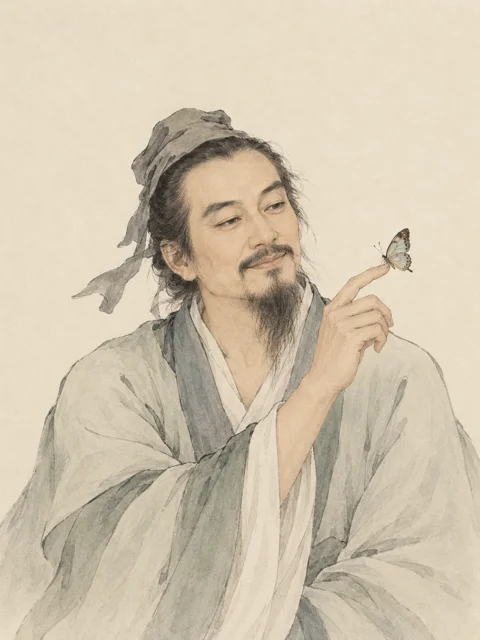
 AI 创作示意
GUANFU / zh-Hant
庄子
AI 创作示意杂篇 · 徐無鬼
版本按章对照,不代表逐句校勘对应。
中文原文(全三十三篇) / 庄子原典;维基文库贡献者整理
观复随文注释 · 79 条
徐无鬼寓言中的隐者因女商魏国臣子,引见徐无鬼者見魏武侯战国魏国君主,武侯勞之慰劳、慰问他,曰:「先生病矣,苦於山林之勞,故乃肯見於寡人。」徐无鬼曰:「我則勞於君,君有何勞於我?君將盈嗜欲,長好惡,則性命之情病矣。君將黜嗜欲,掔收紧、压制;读 qiān好惡,則耳目病矣。我將勞君,君有何勞於我?」武侯超然不對。少焉,徐无鬼曰:「嘗語君,吾相狗观察评判狗的优劣也,下之質,執飽而止,是狸德只求饱食的猫类之性也;中之質,若視日;上之質,若亡其一。吾相狗,又不若吾相馬也。吾相馬,直者中繩,曲者中鉤,方者中矩,圓者中規,是國馬也,而未若天下馬也。天下馬,有成材,若卹一作「䘏」若失,若喪其一,若是者,超軼絕塵奔跑极快,超越尘埃,不知其所。」武侯大悅而笑。徐无鬼出,女商曰:「先生獨何以說吾君乎?吾所以說吾君者,橫說之則以詩、書、禮、樂,從說之則以金板、六弢篇中所指兵书;弢同韬,奉事而大有功者,不可爲數,而吾君未嘗啓齒。今先生何以說吾君,使吾君悅若此乎?」徐无鬼曰:「吾直告之吾相狗馬耳。」女商曰:「若是乎?」曰:「子不聞夫越之流人流亡在外的人乎?去國數日,見其所知而喜;去國旬月,見所嘗見於國中者喜;及期年也,見似人者而喜矣。不亦去人滋久,思人滋深乎?夫逃虛空者,藜藋野生杂草;读 lí diào柱乎鼪鼬黄鼠狼一类的小兽之逕,踉位其空,聞人足音,跫然脚步声;跫读 qióng而喜矣,有況乎昆弟親戚之謦欬咳嗽、出声;读 qǐng kài其側者乎?久矣夫,莫以眞人之言謦欬吾君之側乎!」
徐无鬼見武侯,武侯曰:「先生居山林,食芧栗橡实与栗子;芧读 xù,厭蔥一作「葱」韭,以賓寡人,久矣夫!今老邪?其欲干求取酒肉之味邪?其寡人亦有社稷之福邪?」徐无鬼曰:「无鬼生於貧賤,未嘗敢飲食君之酒肉,將來勞君也。」君曰:「何哉?奚勞寡人?」曰:「勞君之神與形。」武侯曰:「何謂邪?」徐无鬼曰:「天地之養也一,登高不可以爲長,居下不可以爲短。君獨爲萬乘之主,以苦一國之民,以養耳目鼻口,夫神者不自許也。夫神者,好和而惡姦。夫姦,病也,故勞之。唯君所病之,何也?」武侯曰:「欲見先生,久矣。吾欲愛民而爲義偃兵停止用兵,其可乎?」徐无鬼曰:「不可。愛民,害民之始也。爲義偃兵,造兵之本也。君自此爲之,則殆不成。凡成,美惡器也。君雖爲仁義,幾且僞哉!形固造形,成固有伐,變固外戰。君亦必无盛鶴列整齐排列的兵士,像鹤群排列於麗譙高大的城楼之間,无徒驥於錙壇高筑的宫坛;词义有异说之宮,无藏逆於得,无以巧勝人,无以謀勝人,无以戰勝人。夫殺人之士民,兼人之土地,以養吾私與吾神者,其戰不知孰善?勝之惡乎在?君若勿已矣,脩胷中之誠,以應天地之情,而勿攖。夫民死已脫矣,君將惡乎用夫偃兵哉?」
黃帝將見大隗传说中的高士或神人乎具茨山名之山,方明爲御,昌㝢驂乘车上陪乘的人;驂读 cān,張若、謵朋前馬,昆閽、滑稽後車,至於襄城之野,七聖皆迷,无所問塗。適遇牧馬童子,問塗焉,曰:「若知具茨之山乎?」曰:「然。」「若知大隗之所存乎?」曰:「然。」黃帝曰:「異哉小童!非徒知具茨之山,又知大隗之所存。請問爲天下?」小童曰:「夫爲天下者,亦若此而已矣,又奚事焉?予少而自遊於六合上下四方之內。予適有瞀病目眩心乱的病;瞀读 mào,有長者教予曰:『若乘日之車,而遊於襄城之野。』今予病少痊,予又且復遊於六合之外。夫爲天下,亦若此而已,予又奚事焉?」黃帝曰:「夫爲天下者,則誠非吾子之事。雖然,請問爲天下?」小童辭。黃帝又問。小童曰:「夫爲天下者,亦奚以異乎牧馬者哉?亦去其害馬者而已矣。」黃帝再拜稽首叩头至地,稱「天師」而退。
知士无思慮之變則不樂,辯士无談說之序則不樂,察士无淩誶凌辱诘责;誶读 suì之事則不樂,皆囿於物被外物局限者也。招世之士興朝,中民之士榮官,筋力之士矜難,勇敢之士奮患,兵革之士樂戰,枯槁之士苦守节操的隐士宿名寄托、保守清高名声,法律之士廣治,禮教之士敬容,仁義之士貴際。農夫无草萊之事則不比,商賈无市井之事則不比。庶人有旦暮之業則勸,百工有器械之巧則壯。錢財不積則貪者憂,權勢不尤則夸者悲,勢物之徒樂變。遭時有所用,不能无爲也,此皆順比於歲,不物於易者也。馳其形性,潛之萬物,終身不反,悲夫!
莊子曰:「射者非前期而中,謂之善射。天下皆羿也,可乎?」惠子曰:「可。」莊子曰:「天下非有公是也,而各是其所是。天下皆堯也,可乎?」惠子曰:「可。」莊子曰:「然則儒、墨、楊、秉儒家、墨家、杨朱、名辩者公孙龙等,秉所指有异说四,與夫子爲五,果孰是邪?或者若魯遽者邪?其弟子曰:『我得夫子之道矣,吾能冬爨鼎烧火使鼎中水热;爨读 cuàn而夏造冰矣。』魯遽曰:『是直以陽召陽,以陰召陰,非吾所謂道也。吾示子乎吾道。』於是爲之調瑟,廢一於堂放一张瑟在堂上;廢通置,廢一於室,鼔一作「鼓」宮宮動弹宫音,引起另一瑟宫弦共鸣,鼔一作「鼓」角角動弹角音,引起同音弦共鸣,音律同矣。夫或改調,一弦於五音无當也,鼔一作「鼓」之,二十五弦皆動,未始異於聲,而音之君已。且若是者邪?」惠子曰:「今夫儒、墨、楊、秉,且方與我以辯,相拂以辭,相鎭以聲,而未始吾非也,則奚若矣?」莊子曰:「齊人蹢子弃置、寄放儿子;蹢通掷於宋者,其命閽守门人;读 hūn也不以完,其求鈃鍾也以束縛,其求唐子也而未始出域,有遺類矣。夫楚人寄而蹢閽者,夜半於无人之時,而與舟人鬭,未始離於岑,而足以造於怨也。」
莊子送葬,過惠子之墓,顧謂從者曰:「郢人楚都郢地的人堊白色粉土;读 è漫其鼻端若蠅翼,使匠石斲之。匠石運斤成風挥斧带风,形容技艺娴熟,聽而斲之,盡堊而鼻不傷,郢人立不失容。宋元君聞之,召匠石曰:『嘗試爲寡人爲之。』匠石曰:『臣則嘗能斲之。雖然,臣之質合作的对象、施技的目标死久矣。』自夫子之死也,吾无以爲質矣,吾无與言之矣。」
管仲有病,桓公問之曰:「仲父之病,病矣,可不謂云至於大病,則寡人惡乎屬國而可?」管仲曰:「公誰欲與?」公曰:「鮑叔牙春秋齐国大臣,管仲的朋友。」曰:「不可。其爲人絜廉,善士也。其於不己若者,不比之;又一聞人之過,終身不忘。使之治國,上且鉤乎君,下且逆乎民,其得罪於君也,將弗久矣。」公曰:「然則孰可?」對曰:「勿已,則隰朋春秋齐国大臣;隰读 xí可。其爲人也,上忘而下畔,愧不若黃帝,而哀不己若者。以德分人謂之聖,以財分人謂之賢。以賢臨人,未有得人者也。以賢下人,未有不得人者也。其於國,有不聞也;其於家,有不見也。勿已,則隰朋可。」
吳王浮于江,登乎狙猕猴一类动物之山。衆狙見之,恂然棄而走,逃於深蓁茂密的草丛。有一狙焉,委蛇攫𢮞抓取攀援,展示灵巧,見巧乎王。王射之,敏給搏捷矢。王命相者趨射之,狙執死。王顧謂其友顏不疑曰:「之狙也,伐其巧,恃其便,以敖予,以至此殛诛杀;读 jí也。戒之哉!嗟乎,无以汝色驕人哉!」顏不疑歸,而師董梧,以鋤其色消除骄傲的神色,去樂辭顯,三年而國人稱之。
南伯子綦隱几而坐,仰天而噓。顏成子(游)入見,曰:「夫(子)物之尤也,形固可使若槁骸,心固可使若死灰乎?」曰:「吾嘗居山穴之口矣,當是時也,田禾齐国田和;禾通和一覩我,而齊國之衆三賀之。我必先之,彼故知之。我必賣一作「𧶠」之,彼故鬻之卖出、宣扬;鬻读 yù。若我而不有之,彼惡得而知之?若我而不賣一作「𧶠」之,彼惡得而鬻之?嗟乎哉一作「我」,悲人之自喪者!吾又悲夫悲人者!吾又悲夫悲人之悲者!其後而日遠矣!」
仲尼之楚,楚王觴之,孫叔敖執爵而立,市南宜僚受酒而祭,曰:「古之人乎,於此言已!」曰:「丘也聞不言之言矣,未之嘗言,於此乎言之。市南宜僚弄丸,而兩家之難解。孫叔敖甘寢秉羽手持羽扇,而郢人投兵。丘願有喙三尺。」彼之謂不道之道,此之謂不言之辯。故德總乎道之所一,而言休乎知之所不知,至矣。道之所一者,德不能同也。知之所不能(知)者,辯不能舉也。名若儒墨,而凶矣。故海不辭東流,大之至也。聖人幷包天地,澤及天下,而不知其誰氏,是故生无爵,死无謚死后所加的称号;同谥一作「諡」,實不聚,名不立,此之謂大人。狗不以善吠爲良,人不以善言爲賢,而況爲大乎?夫爲大不足以爲大,而況爲德乎?夫大備矣,莫若天地,然奚求焉?而大備矣。知大備者,无求,无失,无棄,不以物易己也。反己而不窮,循古而不摩,大人之誠。
子綦有八子,陳諸前,召九方歅传说善相的人;歅读 yīn,曰:「爲我相吾子,孰爲祥?」九方歅曰:「梱也爲祥。」子綦矍一作「瞿」然喜曰:「奚若?」曰:「梱也,將與國君同食,以終其身。」子綦索然出涕,曰:「吾子何爲以至於是極也?」九方歅曰:「夫與國君同食,澤及三族,而況父母乎?今夫子聞之而泣,是禦福也。子則祥矣,父則不祥。」子綦曰:「歅,汝何足以識之!而梱祥邪?盡於酒肉入於鼻口矣,而何足以知其所自來?吾未嘗爲牧而牂母羊;读 zāng生於奧屋内深处;读 ào,未嘗好田而鶉生於宎屋角、深室;读 yǎo,若勿怪,何邪?吾所與吾子遊者,遊於天地。吾與之邀樂一作「食」於天,吾與之邀食於地。吾不與之爲事,不與之爲謀,不與之爲怪。吾與之乘天地之誠,而不以物與之相攖。吾與之一委蛇,而不與之爲事所宜。今也然有世俗之償焉。凡有怪徵者,必有怪行。殆乎,非我與吾子之罪,幾天與之也!吾是以泣也。」无幾何,而使梱之於燕,盜得之於道,全而鬻之則難,不若刖断足的刑罚;读 yuè之則易,於是乎刖而鬻之於齊,適當渠公守门的官役,古注释义略有不同之術一作「街」,然身肉食一作「食肉」者一作「而」終。
齧缺遇許由,曰:「子將奚之?」曰:「將逃堯。」曰:「奚謂邪?」曰:「夫堯,畜畜然勤勉施行仁爱的样子仁,吾恐其爲天下笑,後世其人與人相食與?夫民,不難聚也,愛之則親,利之則至,譽之則勸,致其所惡則散。愛利出乎仁義,捐仁義者寡,利仁義者衆。夫仁義之行,唯且无誠,且假夫禽貪禽兽般贪婪的人者器,是以一人之斷制利天下,譬之猶一覕短暂一瞥;读 piē也。夫堯知賢人之利天下也,而不知其賊天下也。夫唯外乎賢者知之矣。」
有暖姝自满于一孔之见者,有濡需苟且依附、安于局限者,有卷婁勤苦拘束、不得自由的样子者。所謂暖姝者,學一先生之言,則暖暖姝姝,而私自悅也,自以爲足矣,而未知未始有物也,是以謂暖姝者也。濡需者,豕蝨寄生在猪身上的虱子是也,擇疏鬣稀疏的鬃毛,自以爲廣宮大囿,奎蹄曲隈弯曲隐蔽之处,乳間股腳,自以爲安室利處,不知屠者之一旦鼔一作「鼓」臂、布草、操煙火,而己與豕俱焦也。此以域進,此以域退,此其所謂濡需者也。卷婁者,舜也。羊肉不慕蟻,蟻慕羊肉,羊肉羶也。舜有羶行像膻气招蚁般引人聚附的德行,百姓悅之,故三徙成都,至鄧之墟,而十有萬家。堯聞舜之賢,舉之童土光秃、不长草木的土地之地,曰:「冀得其來之澤。」舜舉乎童土之地,年齒長矣,聰明衰矣,而不得休歸,所謂卷婁者也。是以神人惡衆至,衆至則不比,不比則不利也。故无所甚親,无所甚疏,抱德煬和温养和气;煬读 yáng,以順天下,此謂眞人。於蟻棄知,於魚得計,於羊棄意。以目視目,以耳聽耳,以心復心。若然者,其平也繩,其變也循。古之眞人,以天待之,不以人入天。古之眞人,得之也生,失之也死,得之也死,失之也生。藥也,其實堇古代药名,不能据此作为用药依据也,桔梗也,雞壅芡实等古药名,诸注有异说也,豕零猪苓,古代药名也,是時爲帝者也,何可勝言?
句踐越王勾践也,以甲楯盔甲盾牌,代指甲士三千,棲於會稽。唯種文种,越国大夫也能知亡之所以存,唯種也不知其身之所以愁。故曰:鴟目有所適,鶴脛有所節,解之也悲。故曰:風之過,河也有損焉;日之過,河也有損焉。請只風與日,相與守河,而河以爲未始其攖也,恃源而往者也。故水之守土也審,影之守人也審,物之守物也審。故目之於明也殆,耳之於聰也殆,心之於殉也殆:凡能,其於府也殆。殆之成也不給改,禍之長也茲萃,其反也緣功,其果也待久,而人以爲己寶,不亦悲乎!故有亡國,戮民无已,不知問是也。故足之於地也踐,雖踐,恃其所不蹍未曾踩踏的地方,而後善博也;人之知也少,雖少,恃其所不知,而後知天之所謂也。知大一至大、浑然一体的道,知大陰,知大目,知大均,知大方,知大信,知大定,至矣。大一通之,大陰解之,大目視之,大均緣之,大方體之,大信稽之,大定持之。盡有天,循有照,冥有樞,始有彼。則其解之也,似不解之者;其知之也,似不知之也,不知而後知之。其問之也,不可以有崖,而不可以无崖。頡滑有實,古今不代,而不可以虧,則可不謂有大揚搉总括、概论;搉读 què乎?闔不亦問是已一作「矣」,奚惑然爲?以不惑解惑,復於不惑,是尚大不惑。
观复随文注释 · AI 辅助独立整理,待持续人工校订。释义以本章语境为依据;存在异说或底本疑讹的地方另作提示。原文及版本来源保留如下。
原典公有领域;电子文本据维基文库贡献者,按 CC BY-SA 4.0 保留署名及相同方式共享;调整空白与排版。 · 查看原始版本
欢迎引用本站资源,分享道家与道教文化。引用时请注明出处“观复”,并附上所引用内容的原始页面链接,方便读者查阅。
观复白话释义(AI 辅助) / 观复 · AI 辅助独立整理
【观复白话释义|AI 辅助·未经人工学术审定】
徐无鬼经女商引见魏武侯。武侯慰劳他说:“先生辛苦了!在山林劳苦,所以才肯来见我。”徐无鬼说:“我是来慰劳您的,您有什么可慰劳我的?您若满足嗜欲,增长好恶,生命本性就受损;若强行排斥嗜欲,压制好恶,耳目又受苦。因此我来慰劳您,您又有什么可慰劳我?”武侯怅然,没有回答。过了一会儿,徐无鬼说:“我跟您谈谈相狗吧。下等狗,只想着吃饱就罢了,像猫捕食的本性;中等狗,目光像注视太阳;上等狗,浑然像忘了自己。我相狗,还不如相马。相马时,直处合绳,曲处合钩,方处合矩,圆处合规,这是一国的良马,还算不上天下的良马。天下良马的资质完整,神情像忧愁,像有所失,像忘掉了自身;这样的马奔逸绝尘,快得不知去向。”武侯欢喜大笑。
徐无鬼出去,女商问:“先生用什么话取悦国君?我广泛讲《诗》《书》礼乐,深入讲《金板》《六韬》,奉事立功的事不计其数,国君却从没开口笑过。您怎样使他这么高兴?”徐无鬼说:“我只讲了相狗相马。”女商问:“就这样?”徐无鬼说:“你没听过越国流亡的人吗?离国几天,见到熟人就欢喜;离国一月,见到曾在国中见过的人就欢喜;离国一年,见到像故乡人的人就欢喜。离开人群越久,思念就越深。逃居空旷荒野的人,所住地方藜蒿丛生,只有黄鼠狼出入的路径,踉跄住在空处,听到人的脚步声,就欣然高兴,何况兄弟亲戚在身旁咳嗽说话呢?太久没有人用真实自然的话,在国君身旁说话了!”
徐无鬼再见武侯。武侯说:“先生住山林,吃橡实栗子,以葱韭充饥,久把我疏远在外。如今是老了吗?想求酒肉的滋味吗?还是我的社稷有福,得您光临?”徐无鬼说:“我生于贫贱,不敢贪求您的酒肉,是来慰劳您的。”武侯问:“慰劳什么?”答:“您的精神与形体。”武侯问缘故。徐无鬼说:“天地养育万物本来一样,站在高处不能使人本身变长,居在低处不能使人本身变短。您独为万乘之主,使一国百姓劳苦,来奉养自己的耳目鼻口,精神本身并不赞同。精神喜欢和谐,厌恶乖乱;乖乱就是病,所以来慰劳。不知您真正忧虑的是什么?”
武侯说:“我想见先生很久了。我想爱民,实行仁义,使战争停止,可以吗?”徐无鬼说:“不可以。刻意标榜爱民,可能正是害民的开端;以行义为名止战,可能正是造战的根源。您从这里着手,恐怕办不成。凡是既成的事业,都是美恶并存的器具。您虽做仁义的事,恐怕也接近伪饰!一种外在表现会招致另一种表现,成功会引起攻伐,争求变革会带来向外争战。您务必不要在华丽楼观间盛陈兵列,不要在高坛宫殿旁聚养骏马,不要在取得之中埋下违逆之心;不要凭巧术胜人,不要凭谋略胜人,不要凭战争胜人。杀别人的士民,兼并别人的土地,来奉养自身私欲与精神,这样的战争,又哪一方算善?获胜的好处在哪里?您若非要有所作为,就修治胸中的真诚,顺应天地的实情,不加扰动。百姓原可脱离死难,您又何必另外施行一套‘停止战争’的事业呢?”
黄帝要到具茨山见大隗,方明驾车,昌寓陪乘,张若、謵朋在马前引路,昆阍、滑稽在车后随行。到了襄城郊野,七位圣者都迷了路,无处问道。恰遇牧马童子,便问:“你知道具茨山吗?”答:“知道。”又问:“知道大隗住在哪里吗?”答:“知道。”黄帝说:“奇了,小孩!不只知道具茨山,还知道大隗所在。请问怎样治理天下?”童子说:“治理天下,也像我这样罢了,何必多事?我小时候在天地之内自在游行,后来得了目眩的病,一位长者教我:‘乘着日光的车,到襄城原野游行。’如今病稍好,又将游到天地之外。治理天下也不过这样,我又何必多事?”黄帝说:“治理天下确实不是你的事务,不过还是请教。”童子推辞,黄帝再问。童子说:“治理天下,同牧马有什么不同?只须除去伤害马的东西罢了。”黄帝两次拜伏叩头,称他“天师”,然后退去。
智谋之士,没有思虑变化就不快乐;辩说之士,没有安排言辞的机会就不快乐;明察之士,没有指责挑剔的事就不快乐。他们都受外物局限。招引世俗的人兴奋于朝廷,善于应合民众的人以官位为荣,强力的人以承担艰难为傲,勇敢的人遇患难便奋起,军事之士以战争为乐,枯槁隐士守着清名,法律之士推广治理,礼教之士讲究仪容,仁义之士重视交际。农夫没有开荒耕作便无所依,商人没有市井交易便无所依。庶人有早晚的工作就努力,百工有器具技艺就振奋。财物不积,贪者忧愁;权势不突出,夸耀者悲伤;依附势物的人喜欢变动。遇上时机有所用,便不能安于无为。这些人都追随时岁,不能把变化当作变化而超脱其外,驱使形体本性,沉没于万物,终身不返,可悲啊!
庄子说:“射箭的人,不是预先指定目标,却也把碰到的地方算作射中,就称善射;那么天下人人都是羿,可以吗?”惠子说:“可以。”庄子说:“天下没有一个共同认定的是,各自认自己的判断为是;那么天下人人都是尧,可以吗?”惠子说:“可以。”庄子说:“那么儒、墨、杨、秉四家,加上您是五家,到底谁对呢?或者像鲁遽那样?他的弟子说:‘我得到老师的道了,能在冬天把鼎烧热,在夏天造冰。’鲁遽说:‘这不过以阳召阳,以阴召阴,不是我说的道。我给你看我的道。’于是调好两张瑟,一张放堂上,一张放室内,弹这张的宫音,那张的宫弦就响;弹角音,另一张的角弦就响,因为音律相同。若又改调一根弦,使它不与五音中的某一个相当,弹它却使二十五弦都响,那就不只是同一种声音相应,而成为统摄众音的根本了。您是到了这样的境界吗?”惠子说:“如今儒、墨、杨、秉正同我辩论,用言辞互相抵触,用声势互相压倒,却从未使我认定自己错了,这又怎么样?”
庄子说:“有个齐人把儿子弃在宋国,派守门的人去找,却不让人手齐备;找钟类器物,却先把行动束缚住;寻找失落的孩子,却从不走出境内。这都属于遗漏了根本的一类。又有个楚人寄居时同守门人争执,到了半夜无人时还同船夫争斗;尚未离开岸边,就已足够招来怨恨。”
庄子送葬,经过惠子的墓,回头对随从说:“郢地有个人,鼻尖沾着薄如蝇翼的白泥,让匠石削去。匠石挥斧成风,任手削下,白泥全去,鼻子无伤;那人站着,神色不变。宋元君听说,召匠石来,说:‘试着给我做一次。’匠石说:‘臣从前确实能削。不过,能与我配合的那个人,已经死了很久。’自从惠先生死后,我也没有可以配合的对手,没有可以一起谈话的人了。”
管仲病了,齐桓公问:“仲父的病重了。我不能不问,若到病势危重时,国事托付给谁才好?”管仲问:“您想给谁?”桓公说:“鲍叔牙。”管仲说:“不行。他清洁廉正,是好士人,却不肯亲近不如自己的人;一听见别人的过错,一辈子不忘。让他治国,上会拘束国君,下会违逆百姓,得罪您的日子不会远。”桓公问谁可以。管仲说:“一定要选,隰朋可以。他对上不念权势,对下不弃百姓;惭愧自己不如黄帝,又怜惜不如自己的人。以德与人分享叫圣,以财与人分享叫贤。仗着贤能凌驾别人,没有能得人心的;以贤能自处人下,没有不得人心的。他在国事中有不必听闻的,在家事中有不必察看的。一定要选,隰朋可以。”
吴王乘船浮江,登上猴山。群猴见了,惊慌逃进深草丛。只有一只猴,转折腾跃,向王卖弄灵巧。王射它,它敏捷地抓住飞箭。王命随从一齐射,猴便被射死。王回头对朋友颜不疑说:“这只猴,夸耀技巧,倚恃敏捷,傲慢对我,以至被杀。戒备啊!不要用自己的神色才能骄人。”颜不疑回来,拜董梧为师,去除骄矜的神色,舍弃享乐,辞去显位。三年后,国人都称赞他。
南伯子綦靠几而坐,仰天长叹。颜成子游来见,说:“先生是出众的人,形体真能像枯骨,心真能像冷灰吗?”子綦说:“我曾住在山洞口,那时田禾一见我,齐国人便三次向他道贺。必是我先显露什么,他才察觉;必是我把自己摆出去,他才来购买。若我不自有其长,他怎能知道?若我不自我陈列,他怎能交易?唉,我悲哀那些自己丧失本真的人;又悲哀那些悲哀别人的人;又悲哀那些对悲哀别人再生悲哀的人!这样层层追逐,离本真就一天比一天远了。”
孔子到楚国,楚王设酒招待。孙叔敖持杯站着,市南宜僚接酒祭地,说:“古代那样的人,在这里可以谈谈了!”孔子说:“我听过不说话的言说,还没试着说过,如今就在这里说。市南宜僚只管弄丸,两家的祸难就化解;孙叔敖安然睡卧,手持羽扇,郢人便放下兵器。我真希望有三尺长的嘴,来说明这种境界!”那叫不以言说表达的道,这叫不靠言说的辩。因此,德归于道所统一之处,言语止于智慧所不知道之处,就到极点。道所统一的,不是分别的德目所能完全同化;智慧不能知的,不是辩论所能举出。若只以儒墨之类的名号相争,就危险了。
海不拒绝向东流的水,这是大到极处。圣人兼容天地,恩泽遍及天下,人却不知道他属于谁家。因此,生前无爵,死后无谥,不积聚财物,不建立名声,这叫大人。狗不因善叫就算好,人不因善说就算贤,何况算大人?刻意求大,还不足以为大,何况成德!广大完备,没有超过天地的,可天地求什么呢?自然就广大完备了。懂得这种完备的人,无求、无失、无弃,不拿外物交换自身。返回自身而不穷竭,顺循古道而不磨损,这就是大人的真实。
子綦有八个儿子,叫他们列在面前,请九方歅相看,问谁有福。九方歅说:“梱有福。”子綦惊喜,问怎样。答:“梱将终身与国君吃同样的饭。”子綦却神情萧索,流泪说:“我的儿子怎么到了这种极端境地!”九方歅说:“与国君同食,恩泽及于三族,何况父母?先生听了却哭,是拒绝福气。儿子吉祥,父亲倒不吉祥。”子綦说:“歅,你哪里懂!梱的吉祥,只尽于酒肉进入口鼻,又怎知从何而来?我不牧羊,母羊却在屋角出现;我不爱打猎,鹌鹑却在屋里出现,你不觉得奇怪吗?我同儿子游处,是游于天地;从天获得快乐,从地取得食物,不一起制造事务,不一起谋算,不一起追求怪异。我们顺乘天地的真实,不因外物彼此扰乱,一起自然从容,不刻意迎合世事。如今却忽然有世俗的报偿来临。有异常征兆,必有异常遭遇。危险啊!恐怕不是我和儿子的罪过,而是天要给他这样的事,所以我哭。”
不久,子綦派梱去燕国。强盗在路上捉住他,觉得完整地卖掉不容易,不如砍掉脚后卖作守门人容易。于是断了他的脚,卖到齐国,恰合渠公所需,终身得以吃肉。
啮缺遇到许由,问:“你去哪里?”答:“逃离尧。”问为什么。许由说:“尧那样忙忙地行仁,我怕他被天下取笑,后世还会人相食吧。人民不难聚集:爱他们便亲近,利他们便来到,誉他们便受鼓励,把他们厌恶的强加给他们便散去。爱与利从仁义名义中出来,舍弃仁义的少,利用仁义的多。施行仁义,往往没有真诚,反给贪婪的人借作器具。只靠一人的决断治理来利益天下,譬如匆匆一瞥,所见有限。尧知道贤人能利天下,却不知道也能害天下。只有不受崇贤观念拘束的人,才看得明白。”
有一类叫暖姝,有一类叫濡需,有一类叫卷娄。暖姝是学到一位老师的话,便温温然自我欣赏,觉得已够了,却不懂从未有物的根源,因此叫暖姝。濡需,像猪身上的虱子:选稀疏的鬃毛间居住,自以为是广宫大园;在蹄缝、皮肤褶皱、乳房之间、腿脚之侧安身,自以为是安全便利的屋舍。不知道屠夫一旦挥臂铺草,操起烟火,自己就同猪一起被烧。只在这一小范围里进退,就叫濡需。卷娄,指舜那样辛劳拘曲的人。羊肉不爱慕蚂蚁,蚂蚁爱慕羊肉,是羊肉有膻味;舜有吸引人的德行,百姓喜欢,所以三次迁居都形成城邑,到邓地时已有十万家。尧听说他的贤能,把他从荒土中举用,说:‘希望得到他到来带来的恩泽。’舜被举用时已年长,耳目衰退,却不能退休归家,这就叫卷娄。
所以神人不愿众人蜂拥而来;众人拥来,就难和合,不能和合,就生不利。因此不过分亲近谁,不过分疏远谁,抱守德性,温养和气,顺应天下,这叫真人。从蚂蚁逐膻想到舍弃逐利之智,从鱼得水领会合宜之计,从羊招蚁想到舍去招徕之意。让眼睛返回它本来的观看,让耳朵返回本来的听闻,让心返回本心。这样,平正如绳,变化顺循自然。古代真人以天然对待事物,不把人为加进天然。对于古代真人,有时得便生、失便死,有时得便死、失便生,不能执定。药物如乌头、桔梗、鸡壅、豕零,各在适宜时成为主药,这种随时而用,哪里说得尽!
勾践带着三千甲士困守会稽,文种知道亡国怎样转为存国,却不知道自身怎样因此招忧。所以说,猫头鹰的眼有其适用,鹤的腿有其合宜的长度,强行拆解便可悲。又说,风吹过河,河水会损耗;太阳照过河,河水也会损耗。姑且制止风吹日晒,一同守护河水;河水却不认为这些扰动能伤及其根本,因为它依靠源头不断流来。水守着土地,影守着人,物依着物,都各有必然联系。因此,眼过分求明有危险,耳过分求聪有危险,心追逐外物有危险;种种才能积聚于身心,也有危险。危险形成,来不及改;祸患增长,日益聚集。它的反噬缘于功劳,它的结果等待日久才出现,人却拿来当自己的宝贝,不也可悲吗?所以有国家灭亡,百姓不断遭戮,却不知道追问根由。
脚踏在地上,所踩地方虽小,却要依靠没有踩着的广大土地,才能安稳行走。人的已知很少,却依靠所不知道的,才能理解所谓自然。知道大一、大阴、大目、大均、大方、大信、大定,便到极处:以整体的一贯通,以幽深的自然化解,以广大眼光观看,以均衡顺随,以大道体会,以真实考核,以安定保持。万物穷尽处有自然,顺循处有照明,幽冥处有枢纽,发端处有根源。这样,理解像不理解,知道像不知道,经过承认不知才有真知。求问不能僵定边界,也不能漫无边界。变化曲折有其真实,古今相续而不替断,也不能任意减损;难道不能说其中有一个宏大的纲要?何不求问这个,何必迷惑!用不迷惑的根本化解迷惑,返回不迷惑,这才是更大的不惑。
【篇末疑难注记】相狗的“若视日”“若亡其一”依目光、浑然忘己暂释。“盛鹤列”“徒骥”等句所指有争议,正文按陈列兵马、供养观赏之物的语境处理。惠子辩论后的齐人、楚人两则原文讹脱疑点多,“蹢子”“求鈃钟”“求唐子”“寄而蹢阍”等尚难确解,正文给出可贯通的暂行释义,未另造情节补足。“隰朋上忘而下畔”按忘势、亲下解释。“渠公之术”保留为满足渠公需要的概括,不确定具体官职。“于蚁弃知、于鱼得计、于羊弃意”采用与前文虫鱼譬喻贯通的理解。“堇、鸡壅、豕零”古药物名称所指未必统一,正文保留部分古名,不提供用药指导。末段“大一”等七项与“尽有天”等句为暂行释读。关于尧舜、仁义、历史人物及预言性判断,均保留为本文叙述或人物主张。
〔补校:“请只风与日”中的“只”暂按“止”释读,意为制止风吹日晒;此句与河水有源而不惧损耗的比喻相连,仍待注疏核校。〕
观复白话释义:AI 辅助依据古文独立编写,已进行文本覆盖核对,未经人工学术审定;原典来源及电子底本署名、许可见对应中文版本。 · 查看原始版本
Herbert A. Giles 英译(全三十三篇) / Herbert A. Giles(翟理斯),1889
Hsü Wu Kuei.
[Translator’s note] Argument :— Tao is passionless—Immorality of the moral—Obstructions to natural virtue—The evils of action—Too much zeal—The outward and visible—The inward and spiritual—Illustrations.
Hsü Wu Kuei , introduced by Nü Shang, went to see Wu Hou of Wei.
[Translator’s note] A hermit, a minister, and a prince, respectively.
The Prince greeted him sympathisingly, and said, "You are suffering, Sir. You must have endured great hardships in your mountain life that you should be willing to leave it and visit me."
"It is I who should sympathise with your Highness, not your Highness with me," answered Hsü Wu Kuei. "If your Highness gives free play to passion and yields to loves and hates, then the natural conditions of your existence will suffer.
[Translator’s note] Internally.
And if your Highness puts aside passion and abjures loves and hates, then your senses of sight and hearing will suffer.
[Translator’s note] Externally.
It is I who should sympathise with your Highness, not your Highness with me."
The Prince was too astonished to reply; and after a while Hsü Wu Kuei continued, "I will try to explain to your Highness how I judge of dogs. The lowest in the scale will eat their fill and then stop, like a cat. Those of the middle class are as though staring at the sun. The highest class are as though they had parted with their own individuality.
"But I do not judge of dogs as well as I judge of horses. I judge of horses as follows. Their straightness
[Translator’s note] In running.
must be that of a line. Their curve must be that of an arc. Their squareness, that of the square. Their roundness, that of the compasses.
[Translator’s note] One commentator applies all this to the shape of the animals.
These are the horses of the State. They are not equal to the horses of the Empire. The horses of the Empire are splendid. They move as though anxious to get along, as though they had lost the way, as though they had parted with their own individuality. Thus, they outstrip all competitors, over the unstirred dust, out of sight!"
The Prince was greatly pleased and smiled. But when Hsü Wu Kuei went out, Nü Shang asked him, saying, "What can you have been saying to his Highness? Whenever I address him, it is either in a pacific sense, based upon the Canons of Poetry , History , Rites , and Music ; or in a belligerent sense, based upon the Golden Roster or the Six Plans of Battle .
[Translator’s note] Ancient military treatises.
I have transacted with great success innumerable matters entrusted to me, yet his Highness has never vouchsafed a smile. What can you have been saying to make him so pleased as all this?"
"I merely told him," replied Hsü Wu Kuei, "how I judged of dogs and horses."
"Was that all?" enquired Nü Shang, incredulously.
"Have you not heard," said Hsü Wu Kuei, "of the outlaw of Yüeh? After several days' absence from his State, he was glad to meet any one he had known there. After a month, he was glad to meet any one he had even seen there. And after a year, he was glad to meet any one who was in any way like to his fellow-countrymen. Is not this a case of absence from one's kind increasing the desire to be with them?
"Thus a man who had fled into the wilderness, where bishop-wort chokes the path of the weasel and stoat, now advancing, now stopping,—how he would rejoice if the footfall of a fellow-creature broke upon his ear. And how much more were he to hear the sound of a brother's, of a relative's voice at his side. Long it is, I ween, since his Highness has heard the voice of a pure man at his side!"
Hsü Wu Kuei went to visit the Prince. The latter said, "Living, Sir, up in the hills, and feeding upon berries or satisfying yourself with leeks, you have long neglected me. Are you now growing old? Or do you hanker after flesh-pots and wine? Or is it that mine is such a well-governed State?"
"I am of lowly birth," replied Hsü Wu Kuei. "I could not venture to eat and drink your Highness' meat and wine. I came to sympathise with your Highness."
"What do you mean?" cried the Prince? "What is there to sympathise about?"
"About your Highness' soul and body," replied Hsü Wu Kuei.
"Pray explain," said the Prince.
"Nourishment is nourishment," said Hsü Wu Kuei.
[Translator’s note] To a peasant as to a prince.
"Being high up does not make one high, nor does being low make one low. Your Highness is the ruler of a large State, and you oppress the whole population thereof in order to satisfy your sensualities. But your soul is not a party to this. The soul loves harmony and hates disorder. For disorder is a disease. Therefore I came to sympathise. How is it that your Highness alone is suffering?"
"I have long desired to see you," answered the Prince. "I wish to love my people, and by cultivation of duty towards one's neighbour to put an end to war. Can this be done?"
"It cannot," replied Hsü Wu Kuei. "Love for the people is the root of all evil to the people. Cultivation of duty towards one's neighbour in order to put an end to war is the origin of all fighting. If your Highness starts from this basis, the result can only be disastrous.
[Translator’s note] Why try to "do" anything?
"Everything that is made good, turns out bad.
[Translator’s note] The artificial is impermanent.
And although your Highness should make charity and duty to one's neighbour, I fear they would be spurious articles. For the inward intention would appear in the outward manifestation. The adoption of a fixed standard
[Translator’s note] I.e. of the personal standard of individuals. See pp. 305 , 306 .
would lead to complications. And revolutions within lead to fighting without. Surely your Highness would not make a bower into a battlefield, nor a shrine of prayer into a scene of warfare!
[Translator’s note] This, of course, refers to the mind.
"Have nothing within which is obstructive of virtue. Seek not to vanquish others in cunning, in plotting, in war. If I slay a whole nation and annex the territory in order to find nourishment for my passions and for my soul,—irrespective of military skill, wherein does the victory lie?
[Translator’s note] "What shall it profit a man, if he shall gain the whole world, and lose his own soul?"
"If your Highness will only abstain, that will be enough. Cultivate the sincerity that is within your breast, so as to be responsive to the conditions of your environment, and be not aggressive. The people will thus escape death;
[Translator’s note] From oppression.
and what need then to put an end to war?"
When the Yellow Emperor went to see Tao upon the Chü-tz'ŭ Mountain, Fang Ming was his charioteer, Ch'ang Yü sat on his right, Chang Jo and Hsi P'êng were his outriders, and K'un Hun and Hua Chi brought up the rear.
[Translator’s note] Commentators tear this passage to tatters.
On reaching the wilds of Hsiang-ch'êng,
[Translator’s note] The limit of the known.
these seven Sages lost their way and there was no one of whom to ask the road. By and by, they fell in with a boy who was grazing horses, and asked him, saying, "Do you know the Chü-tz'ŭ Mountain?"
"I do," replied the boy.
"And can you tell us," continued the Sages, "where Tao abides?"
"I can," replied the boy.
"This is a strange lad," cried the Yellow Emperor. "Not only does he know where the Chü-tz'ŭ Mountain is, but also where Tao abides! Come tell me, pray, how would you govern the empire?"
"I should govern the empire," said the boy, "just the same as I look after my horses. What else should I do?
"When I was a little boy and used to live within the points of the compass,
[Translator’s note] In Vanity Fair.
my eyes got dim of sight. An old man advised me to mount the chariot of the sun
[Translator’s note] I.e. of Intelligence.
and visit the wilds of Hsiang-ch'êng. My sight is now much better, and I continue to dwell without the points of the compass. I should govern the empire in just the same way. What else should I do?"
"Of course," said the Yellow Emperor, "government is not your trade. Still I should be glad to hear what you would do."
The boy declined to answer, but on being again urged, cried out, "What difference is there between governing the empire and looking after horses? See that no harm comes to the horses, that is all!"
Thereupon the Emperor prostrated himself before the boy; and addressing him as Divine Teacher, took his leave.
[Translator’s note] Divine Teacher means "inspired by God." The term used is that employed in modern times for the head or Pope of debased Taoism, often wrongly rendered as the "Master of Heaven."
If schemers have nothing to give them anxiety, they are not happy. If dialecticians have not their premisses and conclusion, they are not happy. If critics have none on whom to vent their spleen, they are not happy. Such men are the slaves of objective existences.
Those who attract the sympathies of the world, start new dynasties. Those who win the people's hearts, take high official rank. Those who are strong undertake difficulties. Those who are brave encounter dangers. Men of arms delight in war. Men of peace think of nothing but reputation. Men of law strive to improve the administration. Professors of ceremony and music cultivate deportment. Moralists devote themselves to the obligations between man and man.
Take away agriculture from the husbandman, and his classification is gone. Take away trade from the merchant, and his classification is gone. Daily work is the stimulus of the labourer. The skill of the artisan is his pride. If money cannot be made, the avaricious man is sad. If his power meets with a check, the boaster will repine. Ambitious men love change.
Thus, men are always doing something; inaction is to them impossible. They observe in this the same regularity as the seasons, ever without change. They hurry to destruction, dissipating in all directions their vital forces, alas! never to return.
Chuang Tzŭ said, "If archers who aimed at nothing and hit something were accounted good shots, everybody in the world would be another Yi.
[Translator’s note] See p. 308 .
Could this be so?"
"It could," replied Hui Tzŭ.
"If there was no general standard of right in the world," continued Chuang Tzŭ, "but each man had his own, then everybody would be a Yao. Could this be so?"
"It could," replied Hui Tzŭ.
"Very well," said Chuang Tzŭ. "Now there are the Confucianists, the Mihists, the schools of Yang
[Translator’s note] Yang Chu. See ch. viii .
and Ping,
[Translator’s note] Kung Sun Lung. See ch. xvii .
making with your own five in all. Pray which of these is right?
"Possibly it is a similar case to that of Lu Chü?
[Translator’s note] Of whom there is no record.
—A disciple said to him, 'Master, I have attained to your Tao . I can do without fire in winter: I can make ice in summer.'
"'You merely avail yourself of latent heat and latent cold,' replied Lu Chü. 'That is not what I call Tao . I will demonstrate to you what my Tao is.'
"Thereupon he tuned two lutes, and placed one in the hall and the other in the adjoining room. And when he struck the Kung note on one, the Kung note on the other sounded; when he struck the chio note on one, the chio note on the other sounded. This because they were both tuned to the same pitch.
"But if he changed the interval of one string, so that it no longer kept its place in the octave, and then struck it, the result was that all the twenty-five strings jangled together. There was sound as before, but the influence of the key-note was gone. Is this your case?"
"The Confucianists, the Mihists, and the followers of Yang and Ping," replied Hui Tzŭ, "are just now engaged in discussing this matter with me. They try to overwhelm me with argument or howl me down with noise. Yet they have not proved me wrong. Why then should you?"
"A man of the Ch'i State," replied Chuang Tzŭ, "sent away his son into the Sung State, to be a door-keeper, with maimed body.
[Translator’s note] Doorkeepers in ancient times were, for obvious reasons, deprived of their feet.
But a vase, which he valued highly, he kept carefully wrapped up.
[Translator’s note] Thus Hui Tzŭ sacrifices the greater to the less.
"He who would seek for a stray child, but will not leave his home, is like to lose him.
[Translator’s note] Thus restricted to his four antagonistic schools is Hui Tzŭ's search for Tao .
"If a man of Ch'u, who was sent away to be a door-keeper, began, in the middle of the night, when no one was about, to fight with the boatman, I should say that before his boat left the shore he would already have got himself into considerable trouble."
[Translator’s note] A maimed man (Hui Tzŭ) should avoid quarrels. His own share of Tao is insufficient even for himself.
Chuang Tzŭ was once attending a funeral, when he passed by the grave of Hui Tzŭ. Turning to his attendants, he said, "A man of Ying
[Translator’s note] Capital of the Ch'u state.
who had his nose covered with a hard scab, no thicker than a fly's wing, sent for a stone-mason to chip it off. The stone-mason plied his adze with great dexterity while the patient sat still and let him chip. When the scab was all off, the nose was found to be uninjured, the man of Ying never having moved a muscle.
"When Yüan, prince of Sung, heard of this, he summoned the stone-mason and said, 'Try to do the same for me.'
"'I used to be able to do it Sire,' replied the stone-mason, 'but my material has long since perished.'
"And I too, ever since he perished, have been without my material, having no one with whom I can speak."
[Translator’s note] A generous compliment to an old adversary.
[Translator’s note] "There was no one," says Lin Hsi Chung, "in all Chuang Tzŭ's generation who could understand him; neither is there any one now, at this late date, any more than there was then."
Kuan Chung being at the point of death, Duke Huan went to see him.
[Translator’s note] See p. 226 .
"You are ill, venerable Sir," said the Duke, "really ill. You had better say to whom, in the event of your getting worse, I am to entrust the administration of the State."
"Whom does your Highness wish to choose?" enquired Kuan Chung.
"Will Pao Yü do?" asked the Duke.
[Translator’s note] Kuan Chung and Pao Yü are the "Damon and Pythias" of China.
"He will not," said Kuan Chung. "He is pure, incorruptible, and good. With those who are not like himself, he will not associate. And if he has once heard of a man's wrong-doing, he never forgets it. If you employ him in the administration of the empire, he will get to loggerheads with his prince and to sixes and sevens with the people. It would not be long before he and your Highness fell out."
"Whom then can we have?" asked the Duke.
"There is no alternative," replied Kuan Chung; "it must be Hsi P'êng. He is a man who forgets the authority of those above him, and makes those below him forget his. Ashamed that he is not the peer of the Yellow Emperor,
[Translator’s note] In virtue.
he grieves over those who are not the peers of himself.
"To share one's virtue with others is called true wisdom. To share one's wealth with others is reckoned meritorious. To exhibit superior merit is not the way to win men's hearts. To exhibit inferior merit is the way. There are things in the State he does not hear; there are things in the family he does not see.
[Translator’s note] Purposely ignoring petty faults.
There is no alternative; it must be Hsi P'êng."
[Translator’s note] Of whom commentators give no further notice.
The prince of Wu took a boat and went to the Monkey Mountain, which he ascended. When the monkeys saw him, they fled in terror and hid themselves in the thicket. One of them, however, disported himself carelessly, as though showing off its skill before the prince. The prince took a shot at it; but the monkey, with great rapidity, seized the flying arrow with its hand. Then the prince bade his guards try, the result being that the monkey was killed.
[Translator’s note] The skill of the poor monkey availed nothing against the cloud of arrows discharged by the guards. On peut être plus fin qu'un autre, mais on ne peut pas être plus fin que tous les autres.
Thereupon the prince turned to his friend Yen Pu I, and said, "That monkey flaunted its skill and its dexterity in my face. Therefore it has come to this pass. Beware! Do not flaunt your superiority in the faces of others."
Yen Pu I went home, and put himself under the tuition of Tung Wu,
[Translator’s note] A professor of Tao .
with a view to get rid of such superiority. He put aside all that gave him pleasure and avoided gaining reputation. And in three years his praise was in everybody's mouth.
Tzŭ Chi of Nan-poh
[Translator’s note] See ch. iv .
was sitting leaning on a table. He looked up to heaven and sighed, at which juncture Yen Ch'êng Tzŭ entered and said, "How, Sir, can such an important person as yourself be in body like dry wood, in mind like dead ashes?"
[Translator’s note] Instead of exerting yourself for the benefit of mankind. The speaker, says one commentator, was "a disciple."
"I used to live in a cave on the hills," replied Tzŭ Chi. "At that time, T'ien Ho,
[Translator’s note] The famous founder of the later House of Ch'i.
because he once saw me, was thrice congratulated by the people of Ch'i. Now I must have given some indication by which he recognised me.
[Translator’s note] As a Sage.
I must have sold for him to buy. For had I not manifested myself, how would he have recognised me? Had I not sold, how could he have bought?
"Alas! I grieve over man's self-destruction.
[Translator’s note] As reputation comes, reality goes.
And then I grieve over one who grieves for another. And then I grieve over him who grieves over one who grieves for another! And so I get daily farther and farther away."
[Translator’s note] And become like dry wood, my soul absorbed into Tao .
When Confucius went to Ch'u, the prince entertained him at a banquet. Sun Shu Ao stood up with a goblet of wine in his hand, and I Liao of Shih-nan poured a libation, saying, "On such occasions as this, the men of old were wont to make some utterance."
"Mine," replied Confucius, "is the doctrine of wordless utterances. Shall I who make no utterances, make utterance now?
"I Liao of Shih-nan played with his ball, and the trouble of two houses was arranged.
[Translator’s note] A man of great strength who refused to aid in settling a State quarrel. He was a great ball player,—whatever that may have been.
Sun Shu Ao remained quietly in repose, and the men of Ying threw down their arms.
[Translator’s note] No one dared attack them, so powerful was the prestige of their minister.
I should want a three-foot tongue indeed!
[Translator’s note] To achieve more by talk than these two achieved by inaction.
"Theirs was the Tao of inaction. His was the argument of silence. Wherefore, for Tê
[Translator’s note] The manifestation of Tao .
to rest in undivided Tao ,
[Translator’s note] By which all things are One .
and for speech to stop at the unknowable,—this is perfection.
"With undivided Tao , Tê cannot be coincident.
[Translator’s note] The latter is multiform.
No argument can demonstrate the unknowable. Subdivision into Confucianists and Mihists only makes confusion worse confounded.
"The sea does not reject the streams which flow eastward into it. Therefore it is immeasurably great. The true Sage folds the universe in his bosom. His good influence benefits all throughout the empire, without respect to persons. Born without rank, he dies without titles. He does not take credit for realities.
[Translator’s note] But attributes it all to circumstances.
He does not establish a name.
[Translator’s note] For what he has done.
This is to be a great man.
"A dog is not considered a good dog because he is a good barker.
[Translator’s note] He must also bite.
A man is not considered a good man because he is a good talker. How much less in the case of greatness? And if doing great things is not enough to secure greatness, how much less shall it secure virtue?
"In point of greatness, there is nothing to be compared with the universe. Yet what does the universe seek in order to be great?
"He who understands greatness in this sense, seeks nothing, loses nothing, rejects nothing, never suffers injury from without. He takes refuge in his own inexhaustibility. He finds safety in according with his nature. This is the essence of true greatness."
Tzŭ Chi had eight sons. He ranged them before him, and summoning Chiu Fang Yin, said to him, "Examine my sons physiognomically, and tell me which will be the fortunate one."
"K'un," replied Chiu Fang Yin, "will be the fortunate one."
"In what sense?" asked the father, beaming with delight.
"K'un," said Chiu Fang Yin, "will eat at the table of a prince, and so end his days."
Thereupon Tzŭ Chi burst into tears and said, "What has my son done that this should be his fate?"
"Eating at the table of a prince," replied Chiu Fang Yin, "will benefit the family for three generations. How much more his father and mother! But for you, Sir, to go and weep is enough to turn back the luck from you. The son's fortune is good, but the father's bad."
"Yin," said Tzŭ Chi, "I should like to know what you mean by calling K'un fortunate. Wine and meat gratify the palate, but you do not say how these are to come.
"Supposing that to me, not being a shepherd, a lamb were born in the south-west corner of my hall; or that to me, not being a sportsman, quails were hatched in the north-east corner. If you did not call that uncanny, what would you call it?
"My sons and I do but roam through the universe. With them I seek the joys of heaven; with them I seek the fruits of earth. With them I engage in no business; with them I concoct no plots; with them I attempt nothing out-of-the-way. With them I mount upon the truth of the universe, and do not offer opposition to the exigencies of our environment. With them I accommodate myself naturally; but with them I do not become a slave to circumstances. Yet now the world is rewarding me!
"Every uncanny effect must be preceded by some uncanny cause. Alas! my sons and I have done nothing. It must be the will of God. Therefore I weep."
Shortly afterwards, when K'un was on his way to the Yen State, he was captured by brigands. To sell him as he was, would be no easy matter. To sell him without his feet would be easy enough. So they cut off his feet and sold him into the Ch'i State, where he became door-keeper to Duke Chü and had meat to his dinner for the rest of his life.
[Translator’s note] Commentators make terrible havoc here.
Yeh Ch'üeh meeting Hsü Yu, said to him, "Where are you going?"
"Away from Yao!" replied the latter.
"What do you mean?" asked Yeh Ch'üeh.
"Yao," said Hsü Yu, "thinks of nothing but charity. I fear he will become a laughing-stock to the world, and that in future ages men will eat one another.
[Translator’s note] See p. 296 .
"There is no difficulty in winning the people. Love them and they will draw near. Profit them and they will come up. Praise them and they will vie with one another. But introduce something they dislike, and they will be gone.
"Love and profit are born of charity and duty to one's neighbour. Those who ignore charity and duty to one's neighbour are few; those who make capital out of them are many.
"For the operation of these virtues is not disinterested. It is like lending gear to a sportsman.
[Translator’s note] With a view to share the game.
Wherefore, for one man to dogmatise for the good of the whole empire, is like splitting a thing at a single blow.
[Translator’s note] Without reference to method or the requirements of the case in point.
"Yao knows that good men benefit the empire. But he does not know that they injure it. Only those on a higher level than good men know this.
"There are nincompoops; there are parasites; there are enthusiasts.
"A man who learns from a single teacher, and then goes off exultant, satisfied with his acquirements though ignorant that there was a time when nothing existed,—such a one is a nincompoop.
"Parasites are like the lice on a pig's back. They choose bald patches, which are to them palaces and parks. The parts between the toes, the joints, the dugs, and the buttocks, are to them so many comfortable and convenient resting-places. They know not that one day the butcher will tuck up his sleeves and spread straw and apply fire, and that they will perish in the singeing of the pig. As they sow, so do they reap. This is to be a parasite.
"Of enthusiasts, Shun is an example. Mutton does not care for ants; it is the ants which care for the mutton. Mutton has a frowsy smell; and there is a frowsiness about Shun which attracts the people. Therefore it was that after three changes of residence, when he came to the Têng district, he had some hundred thousand families with him.
"Then Yao, hearing of his goodness, appointed him to a barren region, trusting, as he said, that Shun's arrival would enrich it. When Shun took up this appointment, he was already old, and his intellect was failing; yet he would not cease work and retire from office. He was, in fact, an enthusiast.
"So it is that the spiritual man dislikes a crowd. For where there is a crowd there is diversity, and where there is diversity advantage does not accrue. He is therefore neither very intimate, nor very distant. He clings to virtue and nourishes a spirit of harmony, in order to be in accord with his fellow-men. This is to be a divine man.
"Leave wisdom to ants. Strive for what fishes desire.
[Translator’s note] To be left alone in the water.
"Leave attractiveness to mutton. Use your eyes to contemplate, your ears to listen to, your mind to consider, their own internal workings. For him who can do these things, his level will be that of a line, his modifications in due and proper season.
"Therefore, the divine man trusts to the natural development of events. He does not strive to introduce the artificial into the domain of the natural. Accordingly, life is a gain and death a loss, or death is a gain and life a loss.
[Translator’s note] According to circumstances.
"For instance, drugs. They are characteristically poisonous. Such are Chieh-Kêng , Chi-Yung , and Shih-Ling . Circumstances, however, make of each a sovereign remedy. The list is inexhaustible.
[Translator’s note] Chieh-Kêng is the Platycodon grandiflorum . It is used by Chinese doctors as a tonic, astringent, and vermifuge.
"When Kou Chien encamped with three thousand armed warriors at Kuei-ch'i,
[Translator’s note] Leading the men of Wu to attack the Yüeh State.
only Chung
[Translator’s note] Wên Chung, minister of Yüeh.
saw that defeat would be followed by a rally. Yet he could not foresee the evil that was to come upon himself. Wherefore it has been said, 'An owl's eyes are adapted to their use. A crane's leg is of the length required. 'Twould be disastrous to shorten it.'
[Translator’s note] This illustration has been used in ch. viii , p. 101 .
"Thus it has been said, 'The wind blows and the river suffers. The sun shines and the river suffers.' But though wind and sun be both brought into relation with the river, it does not really suffer therefrom. Fed from its source, it still continues to flow on.
[Translator’s note] The Sage too has a source from which the nourishment of his soul is supplied.
"The relation between water and earth is determinate. The relation between a man and his shadow is determinate. The relation between thing and thing is determinate.
"The relation between eye and vision is baneful.
[Translator’s note] Because indeterminate.
The relation between ear and hearing is baneful. The relation between mind and object is baneful. The relation between all kinds of capacity and man's inner self is baneful. If such banefulness be not corrected, disasters will spring up on all sides. Retrogression is hard to achieve, and success long in coming. Yet alas! men regard such capacities as valuable possessions.
"The destruction of States and the ceaseless slaughter of human beings result from an inability to examine into this.
"The foot treads the ground in walking; nevertheless it is the ground not trodden on which makes up the good walk. A man's knowledge is limited; but it is upon what he does not know that he depends to extend his knowledge to the apprehension of God.
"Knowledge of the great One , of the great Negative, of the great Nomenclature, of the great Uniformity, of the great Space, of the great Truth, of the great Law,—this is perfection.
"The great One is omnipresent. The great Negative is omnipotent. The great Nomenclature is all-inclusive. The great Uniformity is all-assimilative. The great Space is all-receptive. The great Truth is all-exacting. The great Law is all-binding.
"The ultimate end is God. He is manifested in the laws of nature. He is the hidden spring. At the beginning, he was.
[Translator’s note] Had an objective existence.
This, however, is inexplicable. It is unknowable. But from the unknowable we reach the known.
"Investigation must not be limited, nor must it be unlimited.
[Translator’s note] It must be undertaken from the standpoint of the unconditioned.
In this vague undefinedness there is an actuality. Time does not change it. It cannot suffer diminution. May we not then call it our great Guide?
"Why not bring our doubting hearts to investigation thereof? And then, using certainty to dispel doubt, revert to a state without doubt, in which doubt is doubly dead?"
[Translator’s note] Doubt dispelled leaves conviction firmer still.
[Translator’s note] Lin Hsi Chung says that this essay begins with the subtle to end in the abstruse. "The force of language," adds he, "can no farther go!"
原著及 Herbert A. Giles 历史译本公有领域;据 Project Gutenberg #59709,完整电子书及使用条款见本站资料来源。 · 查看原始版本
我的书签(此浏览器)
还没有书签。