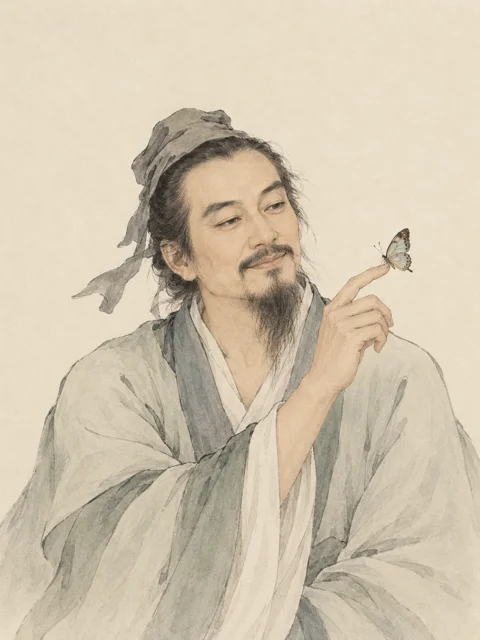
 AI 创作示意
GUANFU / zh-Hant
庄子
AI 创作示意杂篇 · 外物
版本按章对照,不代表逐句校勘对应。
中文原文(全三十三篇) / 庄子原典;维基文库贡献者整理
观复随文注释 · 64 条
外物自身以外的事物与际遇不可必不能期求必然如此,故龍逢誅,比干戮,箕子商末贤臣,传说佯狂避祸狂,惡來商纣王之臣死,桀、紂亡。人主莫不欲其臣之忠,而忠未必信,故伍員伍子胥,员读 yún流于江,萇弘周代大夫,传说死后血化碧玉死于蜀,藏其血三年而化爲碧。人親莫不欲其子之孝,而孝未必愛,故孝己传说中的孝子憂而曾參孔子弟子曾子悲。木與木相摩則然,金與火相守則流,陰陽錯行,則天地大絯阴阳纠结不和;絯读 gāi,於是乎有雷有霆,水中有火,乃焚大槐。有甚憂,兩陷而无所逃,螴蜳惶恐不安的样子不得成,心若縣於天地之間,慰暋郁闷烦乱沈一作「𣇻沉」屯,利害相摩,生火甚多。衆人焚和内心忧虑如火,损害和气,月固不勝火,於是乎有僓然而道盡。
莊周家貧,故往貣一作「貸」粟於監河侯掌管河务的官员称号。監河侯曰:「諾。我將得邑金封邑征收的税金,將貸子三百金,可乎?」莊周忿然作色,曰:「周昨來,有中道而呼者。周顧視車轍中,有鮒魚鲫鱼;鮒读 fù焉。周問之曰:『鮒魚來,子何爲者邪?』對曰:『我,東海之波臣水中之臣,鱼的自称也。君豈有斗升之水而活我哉?』周曰:『諾。我且南遊吳、越之王,激西江之水而迎子,可乎?』鮒魚忿然作色,曰:『吾失我常與平常相处、依存之物,此指水,我无所處。吾得斗升之水然活耳,君乃言此,曾不如(早)索我於枯魚之肆卖干鱼的店铺!』」
任公子寓言中的善钓者爲大鉤巨緇粗大的黑色钓绳,五十犗阉割过的牛;读 jiè以爲餌,蹲乎會稽,投竿東海,旦旦而釣,期年整整一年;期读 jī不得魚。已而大魚食之,牽巨鉤,錎沒陷入水下;錎读 xiàn而下騖一作「驚」,揚而奮鬐竖动鱼鳍;鬐读 qí,白波若山,海水震蕩,聲侔鬼神,憚赫震荡显赫的样子千里。任公子得若魚,離而腊之把肉制成干肉;腊读 xī,自制河以東,蒼梧已北,莫不厭若魚者。已而後世輇才见识浅小的人;輇读 quán諷說之徒,皆驚而相告也。夫揭竿纍一作「累」,趨灌瀆小水沟,守鯢鮒,其於得大魚,難矣。飾小說零碎浅薄的言论,并非现代小说,以干縣令求取高名美誉;县令古注有异解,其於大達,亦遠矣。是以未嘗聞任氏之風俗,其不可與經於世,亦遠矣。
儒以詩、禮發冢挖掘坟墓。大儒臚傳高声传话;臚读 lú曰:「東方作矣,事之何若?」小儒曰:「未解裙襦下裙与短袄,口中有珠。詩固有之,曰:『青青之麥,生於陵陂。生不布施,死何含珠爲?』」「接其鬢,擪按压;读 yè一作「壓」其顪下巴的胡须;读 huì,儒以金椎金属锤子控其頤,徐別其頰,无傷口中珠。」
老萊子传说中的楚国隐者之弟子出薪,遇仲尼,反以告,曰:「有人於彼,脩上一作「下」而趨下,末僂而後耳,視若營四海。不知其誰氏之子?」老萊子曰:「是丘也。召而來。」仲尼至。曰:「丘,去汝躬矜自身的骄矜,與汝容知外露的智巧,斯爲君子矣。」仲尼揖而退,蹙然改容,而問曰:「業可得進乎?」老萊子曰:「夫不忍一世之傷,而驁萬世之患,抑固窶贫乏、困迫;读 jù邪?亡其略弗及邪?惠以歡爲,驁終身之醜,中民之行進焉耳,相引以名,相結以隱。與其譽堯而非桀,不如兩忘而閉其所譽。反无非傷也,動无非邪也。聖人躊躇以興事,以每成功,奈何哉其載焉終矜爾?」
宋元君夜(半而)夢丈夫一作「人」被髮闚阿門侧门,曰:「予自宰路之淵,予爲清江使河伯之所。漁者余且寓言中的渔夫姓名;且读 jū得予。」元君覺,使人占之,曰:「此神龜也。」君曰:「漁者有余且乎?」左右曰:「有。」君曰:「令余且會朝。」明日,余且朝。君曰:「漁何得?」對曰:「且之網,得白龜焉,其圓五尺。」君曰:「獻若之龜。」龜至,君再欲殺之,再欲活之,心疑,卜之,曰:「殺龜以卜,吉。」乃刳龜剖开龟腹制作卜甲,七十二鑽多次钻灼龟甲占卜而无遺筴占算失误;筴同策。仲尼曰:「神龜能見夢於元君,而不能避余且之網,知能七十二鑽而无遺筴,不能避刳腸之患。如是,則知有所不知一作「困」,(而)神有所不及也。」雖有至知,萬人謀之。魚不畏網,而畏鵜鶘善捕鱼的水鸟;读 tí hú。去小知,而大知明,去善而自善矣。嬰兒生无石師固定的教师;石古注释作硕、大而能言,與能言者處也。
惠子謂莊子曰:「子言无用。」莊子曰:「知无用,而始可與言用矣。夫地非不廣且大也,人之所用,容足耳,然則廁足脚旁之地;廁读 cè而墊之挖陷下去致黃泉地下深处,人尚有用乎?」惠子曰:「无用。」莊子曰:「然則无用之爲用也,亦明矣。」
莊子曰:「人有能遊,且得不遊乎?人而不能遊,且得遊乎?夫流遁流荡放逸之志,決絕之行,噫,其非至知厚德之任與?覆墜而不反,火馳而不顧,雖相與爲君臣,時也,易世而无以相賤,故曰:至人不留行焉。夫尊古而卑今,學者之流也。且以狶韋氏之流,觀今之世,夫孰能不波?唯至人,乃能遊於世而不僻,順人而不失己。彼教不學,承意不彼。目徹爲明,耳徹爲聰,鼻徹爲顫鼻窍通而能辨气味;顫有异读异说,口徹爲甘,心徹爲知,知徹爲德。凡道,不欲壅,壅則哽,哽而不止則跈阻塞不通;读 niǎn,跈則衆害生。物之有知者,恃息,其不殷,非天之罪,天之穿之,日夜无降,人則顧塞其竇孔窍;读 dòu。胞有重閬宽阔空处;閬读 láng,心有天遊。室无空虛,則婦姑勃豀媳妇婆婆争吵。心无天遊,則六鑿耳目口鼻等感官孔窍相攘。大林丘山之善於人也,亦神者不勝。德溢乎名,名溢乎暴,謀稽乎誸,知出乎爭,柴生乎守,官事果乎衆宜。春雨日時,草木怒生,銚鎒锄草的农具;读 yáo nòu於是乎始脩,草木之到植者過半,而不知其然。靜然可以補病,眥𡟬篇中难词,古注多解为舒目宁静可以休老,寧可以止遽。雖然,若是,勞者之務也,非佚者之所,未嘗過而問焉。聖人之所以駴天下,神人未嘗過而問焉。賢人所以駴世,聖人未嘗過而問焉。君子所以駴國,賢人未嘗過而問焉。小人所以合時,君子未嘗過而問焉。演門有親死者,以善毀因居丧哀伤而形容憔悴,爵爲官師,其黨人毀而死者半。堯與許由天下,許由逃之。湯與務光,務光怒之。紀他聞之,帥弟子而踆於窾水,諸侯弔之。三年,申徒狄因以踣河投河;踣读 bó。荃捕鱼的竹器;同筌者所以在魚,得魚而忘荃。蹄捕兔的网罗者所以在兔,得兔而忘蹄。言者所以在意,得意而忘言领会意旨后不拘泥于言辞。吾安得夫忘言之人而與之言哉?」
观复随文注释 · AI 辅助独立整理,待持续人工校订。释义以本章语境为依据;存在异说或底本疑讹的地方另作提示。原文及版本来源保留如下。
参考: 本站所收原典:杂篇 · 外物 ↗
原典公有领域;电子文本据维基文库贡献者,按 CC BY-SA 4.0 保留署名及相同方式共享;调整空白与排版。 · 查看原始版本
欢迎引用本站资源,分享道家与道教文化。引用时请注明出处“观复”,并附上所引用内容的原始页面链接,方便读者查阅。
观复白话释义(AI 辅助) / 观复 · AI 辅助独立整理
【观复白话释义|AI 辅助·未经人工学术审定】
身外的事情,不能指望它一定得到某种结果。因此,关龙逢遭到诛杀,比干被害,箕子装疯,恶来死去,桀和纣也都亡了国。做君主的,没有不希望臣子忠诚的;可是忠诚的人未必受到信任,所以伍员的尸体被投入江中,苌弘死在蜀地,据说他的血收藏了三年,就化成了碧玉。做父母的,没有不希望儿子孝顺的;可是孝顺的儿子未必得到疼爱,所以孝己忧愁,曾参悲伤。
木头和木头相互摩擦,就会燃烧;金属与火相接,就会熔化;阴阳之气错乱运行,天地就大受震动,于是有雷鸣和霹雳,水中也会发出火来,烧毁大槐树。人若忧虑过重,就会陷在彼此冲突的处境里,无路可逃,惶惑不安,什么也做不成,心仿佛悬在天地之间。心神昏沉郁结,利害交相冲撞,就生出许多焚烧内心的火。一般人这样烧毁了自身的和气,那一点阴静之气本来就抵不过烈火,终于颓然崩溃,生命所依循的道路也就走到了尽头。
庄周家贫,去向监河侯借粮。监河侯说:“好。我将收到封邑的税金,到时候借给您三百金,可以吗?”庄周气得变了脸色,说:“我昨天来的时候,半路上听见有谁叫我。我回头一看,车辙里有条鲫鱼。我问它:‘鲫鱼,你在那里做什么?’它回答:‘我是东海水府的小臣。您可有一斗、一升的水,救救我的命吗?’我说:‘好。我将往南游说吴、越的国王,引西江的水来迎接你,可以吗?’鲫鱼气得变了脸色,说:‘我失掉了平日赖以生活的水,已经无处容身。只要一斗、一升水,我就能活下来,您却说出这样的话!那还不如早点到卖干鱼的铺子里找我!’”
任公子做了巨大的鱼钩,用粗黑绳作钓线,拿五十头阉牛当鱼饵,蹲坐在会稽山上,把钓竿投向东海。他天天垂钓,满一年也没有钓到鱼。后来,一条大鱼吞下鱼饵,拖住巨钩,直往深水里冲,又跃起奋张背鳍,掀出的白浪像山一样,海水震荡,声音如同鬼神,千里之外都为之惊骇。任公子钓到了这样的大鱼,把它切开,制成鱼干。从制河以东到苍梧以北,人们没有谁不吃这鱼吃到饱足的。后来,那些才识浅薄、喜欢谈说奇闻的人,才惊讶地互相传告这件事。若只举着小钓竿、缠着细钓线,奔走在沟渠里,守候鲵、鲫一类小鱼,要钓到大鱼就难了。修饰琐细言辞,求取县令赏识,离通达大道也还远着呢。所以,一个人从来没有听闻任氏这样的风范,要和他商量经世的大事,也相差很远。
有一伙儒生,竟用《诗》和礼的说辞来盗掘坟墓。大儒从上面传话说:“东方已经发亮,事情办得怎样了?”小儒说:“死者的裙衣还没解开,嘴里有颗珠子。《诗》里本来就说过:‘青青的麦子,长在山坡上。活着不肯周济别人,死后何必含着珠子?’”于是有人吩咐:“抓住他的鬓发,按住他的胡须!”儒生就拿金属锤子敲开死者的下巴,慢慢分开两颊,还特别小心,别把口中的珠子弄坏。
老莱子的弟子外出打柴,遇到仲尼,回来报告说:“那里有个人,上身修长,下身短促,背有些弯,耳朵靠后,目光仿佛要包揽四海。不知道他是哪一家的?”老莱子说:“那是孔丘。叫他过来。”仲尼到了,老莱子说:“丘,去掉你身体姿态上的矜持自负,除去你容貌上显露的聪明,这才称得上君子。”仲尼作揖退后,神情收敛,改容请问:“我的学业,还有可以进益的地方吗?”
老莱子说:“你不忍看见眼前一世的伤害,却把祸患留给万世,难道你本来就这样见识穷蹙吗?还是你的筹划没有顾及那么远?以施惠来博取欢心,把终身受辱的后果置之不顾,这不过是普通人所竞相追求的做法。他们用名声相互招引,用私情隐事相互联结。与其赞美尧而非议桀,不如把两人都忘掉,停止这一套赞誉。背离自然,没有不受伤害的;妄自动作,没有不偏失的。圣人慎重从容地应事,往往不把成功据为己有;你为什么反倒始终背负这些,自以为高明呢?”
宋元君夜里梦见一个披散头发的人,从偏门探头进来,说:“我从宰路深潭来,奉清江水神之命,出使到河伯那里,却被渔夫余且捉住了。”元君醒来,叫人占梦,占梦的人说:“这是神龟。”元君问:“渔夫中有叫余且的吗?”左右说:“有。”元君说:“叫余且来朝见。”第二天,余且入朝。元君问:“打鱼得到了什么?”余且回答:“我的网里捕到一只白龟,周围有五尺。”元君说:“把你的龟献上来。”
龟送来了,元君一再想杀它,又一再想放它活命,心中犹疑,便作占卜。卜辞说:“杀龟取甲来占卜,吉利。”于是剖开龟腹取甲,在甲上钻凿占卜七十二次,没有一次失准。仲尼说:“神龟能托梦显现于元君,却不能躲开余且的渔网;它的灵智能让七十二次占卜没有差错,却避不开被剖腹的祸患。这样看来,智慧也有不知道、办不到的地方,神灵也有能力达不到的地方。”即使具有最高的智慧,也经不起万人共同算计。鱼不懂得害怕渔网,却只知道怕鹈鹕。除去琐屑的小聪明,大智慧才显明;放下刻意求善的作为,才会自然归于善。婴儿生下来,并没有专门教他说话的老师,却能学会说话,是因为他和会说话的人生活在一起。
惠子对庄子说:“您的话没有用。”庄子说:“知道什么叫无用,才能跟他谈有用。大地难道不广阔吗?可是人实际踩着的,不过能容下两只脚的地方。假如把脚旁边的土地全都挖掉,一直挖到地下泉水,只留下立足的那一点,人还能利用它吗?”惠子说:“不能用了。”庄子说:“那么,所谓无用的东西所起的作用,也就很清楚了。”
庄子说:“一个人真能自由遨游,他难道会受困而不能遨游吗?一个人本来不能自由遨游,又岂能强使自己遨游呢?那放纵流荡的心志、与世决裂的行为,唉,难道是智慧至高、德行深厚的人所承担的事情吗?人陷入倾覆而不肯返回,像烈火一样疾驰而不回顾。即使彼此做了君臣,也只是一时的关系,时代变了,就不该再凭原来的身份互相轻贱。所以说,至人不把自己的行迹固定在一个位置上。
“尊崇古代、贬低当今,是一般学者的习气。假如以狶韦氏那个时代的眼光来看今天,谁能不受世事冲击而起波动呢?只有至人,能遨游于世而不偏离,顺应他人而不丧失自己。他的教化不靠人为仿效,他承接别人的心意而不受彼此分别所拘。眼睛通畅,便能看明;耳朵通畅,便能听清;鼻子通畅,便能辨别气味;口舌通畅,便能辨别滋味;心思通畅,便能明知;知觉通达,便成就德性。凡属运行的道路,都不能堵塞;堵塞就会梗阻,梗阻不停,就会受压滞留,种种祸害由此发生。
“有知觉的生物,靠气息生存。气息不能充足,不是自然的罪过。自然给人开通孔窍,使它们日夜运行而不停,人却反过来把这些孔窍堵住。腹腔需要宽敞,心灵也需要自然游动的空间。屋里没有空处,婆媳就会争吵;心里没有自然游动的余地,六处感知的孔窍就彼此争夺。大树林和山丘能使人感到舒适,也是因为人的精神承受不了尘俗的纷扰。
“德行超出常人,就产生名声;名声过盛,就招来侵扰。谋虑到了急迫时便陷于纠缠,智巧从争执中生出,闭塞从固守中形成,官府事务则要在众人各得其宜时才算完成。春雨及时降下,草木茂盛生长,锄草的工具也因此开始整治使用,被铲倒的草木超过一半,却不知道为什么会这样。安静能够调补疾病,休养能够安度衰老,宁定能够止住躁急。然而,这些仍是劳碌者努力追求的事务,真正安逸的人,连经过时也不去过问。圣人用来震动天下的作为,神人不曾过问;贤人用来震动世间的作为,圣人不曾过问;君子用来震动一国的作为,贤人不曾过问;小人用来迎合时势的作为,君子不曾过问。
“演门有个人死了亲人,因为居丧时特别能哀毁自身,被授予官师的爵职。他乡里的人竞相仿效,竟有一半因过度哀毁而死。尧把天下让给许由,许由逃开;汤把天下让给务光,务光对此发怒。纪他听说这些事情,带着弟子隐退到窾水一带,诸侯前去慰问;三年后,申徒狄也因这种激切的风气,投身河中。
“鱼筌是用来捕鱼的,捕到了鱼,就忘掉鱼筌;兔网是用来捉兔的,捉到了兔,就忘掉兔网。言语是用来表达意思的,领会了意思,就忘掉言语。我到哪里才能找到忘掉言语的人,和他谈一谈呢?”
【篇末疑难注记】“然”通“燃”。“螴蜳”“慰暋沈屯”“僓然”均属难解词,依上下文分别释为惶惑、昏沉郁结与颓然溃败;“月固不胜火”暂按阴静之气不能敌内火解释。“巨缁”指粗黑钓绳,“犗”指阉牛;“制河”为地名,保留原称。“脩上而趋下”原文有异文,人物体貌的解释待校。“驁万世之患”“相结以隐”“以每成功”等句语义、断句存在争议,正文取贯通本段的解释。“宰路”“清江”依原文水域名称处理;神龟、血化碧玉属于篇中叙事。“石师”暂释为固定、专门的老师。“颤”在鼻窍句中按辨闻气味解释;“六凿”泛指耳目等感知孔窍。“眥𡟬”字形、训义待校,暂按休养身心理解。“纪他”至“申徒狄”一节叙事关系简略,正文不补写原文未明言的死因或身份。
观复白话释义:AI 辅助依据古文独立编写,已进行文本覆盖核对,未经人工学术审定;原典来源及电子底本署名、许可见对应中文版本。 · 查看原始版本
Herbert A. Giles 英译(全三十三篇) / Herbert A. Giles(翟理斯),1889
Contingencies.
[Translator’s note] Argument :—The external uncertain—The internal alone without harm—Life and death are external—The soul only is under man's control—Folly of worldliness—Illustrations.
Contingencies are uncertain. Hence the decapitation of Lung Fêng, the disembowelment of Pi Kan, the enthusiasm of Chi Tzŭ, the death of Wu Lai, the flights of Chieh and Chou.
[Translator’s note] See pp. 40 , 72 . Wu Lai was an intriguing official who held office under the tyrant Chou Hsin.
No sovereign but would have loyal ministers; yet loyalty does not necessarily inspire confidence. Hence Wu Yüan found a grave in the river;
[Translator’s note] See p. 221 .
and Ch'ang Hung perished in Shu, his blood, after being preserved three years, turning into green jade.
No parent but would have filial sons; yet filial piety does not necessarily inspire love. Hence Hsiao Chi sorrowed, and Tsêng Shên grieved.
[Translator’s note] The first, prince of the House of Yin, was turned out of doors by his stepmother. The second, one of the disciples of Confucius and a rare pattern of filial piety, grieved because his mother was too old to hit him hard enough. See p. 100 .
Wood rubbed with wood produces fire. Metal exposed to fire will liquefy. If the Positive and Negative principles operate inharmoniously, heaven and earth are greatly disturbed. Thunder crashes, and with rain comes lightning, scorching up the tall locust-trees. One fears lest sky and land should collapse and leave no escape. Unable to lie perdu , the heart feels as though suspended between heaven and earth.
So in the struggle between peace and unrest, the friction between good and evil, much fire is evolved which consumes the inner harmony of man. But the mind is unable to resist fire. It is destroyed, and with it Tao comes to an end.
Chuang Tzŭ's family being poor, he went to borrow some corn from the prince of Chien-ho.
"Yes," said the prince. "I am just about collecting the revenue of my fief, and will then lend you three hundred ounces of silver. Will that do?"
At this Chuang Tzŭ flushed with anger and said, "Yesterday, as I was coming along, I heard a voice calling me. I looked round, and in the cart-rut I saw a stickleback.
"'And what do you want, stickleback?' said I.
"'I am a denizen of the eastern ocean,' replied the stickleback. 'Pray, Sir, a pint of water to save my life.'
"'Yes,' said I. 'I am just going south to visit the princes of Wu and Yüeh. I will bring you some from the west river. Will that do?'
"At this the stickleback flushed with anger and said, 'I am out of my element. I have nowhere to go. A pint of water would save me. But to talk to me like this,—you might as well put me in a dried-fish shop at once.'"
[Translator’s note] The above episode is condemned by Lin Hsi Chung on the score of style.
Jên Kung Tzŭ
[Translator’s note] A young noble of the Jen State. Comm.
got a huge hook on a big line, which he baited with fifty oxen. He squatted down at Kuei-chi, and cast into the eastern ocean. Every day he fished, but for a whole year he caught nothing. Then came a great fish which swallowed the bait, and dragging the huge hook dived down below. This way and that way it plunged about, erecting the dorsal fin. The white waves rolled mountain high. The great deep was shaken up. The noise was like that of so many devils, terrifying people for many miles around.
But when Jên Kung Tzŭ had secured his fish, he cut it up and salted it. And from Chih-ho eastwards, and from Ts'ang-wu northwards, there was none but ate his fill of that fish. Even among succeeding generations, gobemouches of the day recounted the marvellous tale.
To take a rod and line, and go to a pool, and catch small fry is a very different thing from catching big fish. And by means of a little show of ability to secure some small billet is a very different thing from really pushing one's way to the front. So that those who do not imitate the example of Jên Kung Tzŭ will be very far from becoming leaders in their generation.
[Translator’s note] Also spurious.
When some Confucianists were opening a grave in accordance with their Canons of Poetry and Rites , the master shouted out, "Day is breaking. How are you getting on with the work?"
"Not got off the burial-clothes yet," answered an apprentice. "There is a pearl in the mouth."
Now the Canon of Poetry says—
So seizing the corpse's brow with one hand, and forcing down its chin with the other, these Confucianists proceed to tap its cheeks with a metal hammer, in order to make the jaws open gently and not injure the pearl!
[Translator’s note] The above, pronounced by Lin Hsi Chung to be spurious, is aimed at the Confucianists, who are ready to commit any outrage on natural feeling so long as there is no violation of the details of their own artificial system.
A disciple of Lao Lai Tzŭ
[Translator’s note] A sage of the Ch'u State.
while out gathering fuel, chanced to meet Confucius. On his return, he said, "There is a man over there with a long body and short legs, round shoulders and drooping ears. He looks as though he were sorrowing over mankind. I know not who he can be."
"It is Confucius!" cried Lao Lai Tzŭ. "Bid him come hither."
When Confucius arrived, Lao Lai Tzŭ addressed him as follows:—
"Ch'iu! Get rid of your dogmatism and your specious knowledge, and you will be really a superior man."
Confucius bowed and was about to retire, when suddenly his countenance changed and he enquired, "Shall I then be able to enter upon Tao ?"
"The wounds of one generation being too much," answered Lao Lai Tzŭ, "you would take to yourself the sorrows of all time. Are you not weary? Is your strength equal to the task?
"To employ goodness as a passport to influence through the gratification of others, is an everlasting shame. Yet this is the common way of all, to lure people by fame, to bind them by ties of gratification.
"Better than extolling Yao and cursing Chieh is oblivion of both, keeping one's praises to oneself. These things react injuriously on self; the agitation of movement results in deflection.
"The true Sage is a passive agent. If he succeeds, he simply feels that he was provided by no effort of his own with the energy necessary to success."
Prince Yüan of Sung dreamed one night that a man with dishevelled hair peeped through a side door and said, "I have come from the waters of Tsai-lu. I am a marine messenger attached to the staff of the River God. A fisherman, named Yü Ch'ieh, has caught me."
When the prince awaked, he referred his dream to the soothsayers, who said, "This is a divine tortoise."
"Is there any fisherman," asked the prince, "whose name is Yü Ch'ieh?"
Being told there was, the prince gave orders for his appearance at court; and the next day Yü Ch'ieh had an audience.
"Fisherman," said the prince, "what have you caught?"
"I have netted a white tortoise," replied the fisherman, "five feet in semi-circumference."
"Bring your tortoise," said the prince. But when it came, the prince could not make up his mind whether to kill it or keep it alive. Thus in doubt, he had recourse to divination, and received the following response:—
Slay the tortoise for purposes of divination and good fortune will result.
So the tortoise was despatched. After which, out of seventy-two omens taken, not a single one proved false.
"A divine tortoise," said Confucius, "can appear to prince Yüan in a dream, yet it cannot escape the net of Yü Ch'ieh. Its wisdom can yield seventy-two faultless omens, yet it cannot escape the misery of being cut to pieces. Truly wisdom has its limits; spirituality, that which it cannot reach.
"In spite of the highest wisdom, there are countless snares to be avoided; If a fish has not to fear nets, there are always pelicans. Get rid of small wisdom, and great wisdom will shine upon you. Put away goodness and you will be naturally good. A child does not learn to speak because taught by professors of the art, but because it lives among people who can themselves speak."
Hui Tzŭ said to Chuang Tzŭ, "Your theme, Sir, is the useless."
"You must understand the useless," replied Chuang Tzŭ, "before you can discuss the useful.
"For instance, the earth is of huge proportions, yet man uses of it only as much as is covered by the sole of his foot. By and by, he turns up his toes and goes beneath it to the Yellow Spring. Has he any further use for it?"
"He has none," replied Hui Tzŭ.
"And in like manner," replied Chuang Tzŭ, "may be demonstrated the use of the useless.
"Could a man transcend the limits of the human," said Chuang Tzŭ, "would he not do so? Unable to do so, how should he succeed?
"The determination to retire, to renounce the world,—such alas! is not the fruit of perfect wisdom or immaculate virtue. From cataclysms ahead, these do not turn back; nor do they heed the approach of devouring flame. Although there are class distinctions of high and low, these are but for a time, and under the changed conditions of a new sphere are unknown.
[Translator’s note] In the transcendental state.
"Wherefore it has been said, 'The perfect man leaves no trace behind.'
"For instance, to glorify the past and to condemn the present has always been the way of the scholar.
[Translator’s note] Laudator temporis acti.
Yet if Hsi Wei Shih and individuals of that class
[Translator’s note] Sc. patriarchs.
were caused to re-appear in the present day, which of them but would accommodate himself to the age?
"Only the perfect man can transcend the limits of the human and yet not withdraw from the world, live in accord with mankind and yet suffer no injury himself. Of the world's teachings he learns nothing. He has that within which makes him independent of others.
"If the eye is unobstructed, the result is sight. If the ear is unobstructed the result is hearing. If the nose is unobstructed, the result is sense of smell. If the mouth is unobstructed, the result is sense of taste. If the mind is unobstructed, the result is wisdom. If wisdom is unobstructed, the result is Tê .
" Tao may not be obstructed. To obstruct is to strangle. This affects the base, and all evils spring into life.
"All sentient beings depend upon breath. If this does not reach them in sufficient quantity, it is not the fault of God. God supplies it day and night without cease, but man stops the passage.
"Man has for himself a spacious domain. His mind may roam to heaven. If there is no room in the house, the wife and her mother-in-law run against one another. If the mind cannot roam to heaven, the faculties will be in a state of antagonism. Those who would benefit mankind from deep forests or lofty mountains are simply unequal to the strain upon their higher natures.
[Translator’s note] It is for that reason they become hermits.
"Ill-regulated virtue ends in reputation. Ill-regulated reputation ends in notoriety. Scheming leads to confusion. Knowledge begets contentions. Obstinacy produces stupidity. Organised government is for the general good of all.
"Spring rains come in due season, and plants and shrubs burst up from the earth. Weeding and tending do not begin until such plants and shrubs have reached more than half their growth, and without being conscious of the fact.
"Repose gives health to the sick. Rubbing the eyelids removes the wrinkles of old age. Quiet will dispel anxieties. These remedies however are the resource only of those who need them. Others who are free from such ills pay no attention thereto.
"That which the true Sage marvels at in the empire, claims not the attention of the Divine man. That which the truly virtuous man marvels at in his own sphere, claims not the attention of the true Sage. That which the superior man marvels at in his State, claims not the attention of the truly virtuous man. How the mean man adapts himself to his age, claims not the attention of the superior man.
"The keeper of the Yen gate,
[Translator’s note] Of the capital of the Sung State.
having maltreated himself severely in consequence of the death of his parents, received a high official post.
[Translator’s note] In reward for his filial piety.
His relatives thereupon maltreated themselves, and some half of them died.
[Translator’s note] In the vain endeavour to secure like rewards.
"Yao offered the empire to Hsü Yu, but Hsü Yu fled. T'ang offered it to Wu Kuang, but Wu Kuang declined with anger.
[Translator’s note] See pp. 6 , 72 .
"When Chi T'o heard of Hsü Yu's flight, he took all his disciples with him and jumped into the river K'uan;
[Translator’s note] As a tribute to his eminent virtue.
upon which the various feudal princes mourned for three years,
[Translator’s note] They did not resign their fiefs at his example.
and Shên T'u Ti had the river filled up.
[Translator’s note] Fearing similar ill-advised acts. For names, see pp. 6 , 72 .
"The raison d'être of a fish-trap is the fish. When the fish is caught, the trap may be ignored. The raison d'être of a rabbit-snare is the rabbit. When the rabbit is caught the snare may be ignored. The raison d'être of language is an idea to be expressed. When the idea is expressed, the language may be ignored. But where shall I find a man to ignore language, with whom I may be able to converse?"
原著及 Herbert A. Giles 历史译本公有领域;据 Project Gutenberg #59709,完整电子书及使用条款见本站资料来源。 · 查看原始版本
我的书签(此浏览器)
还没有书签。