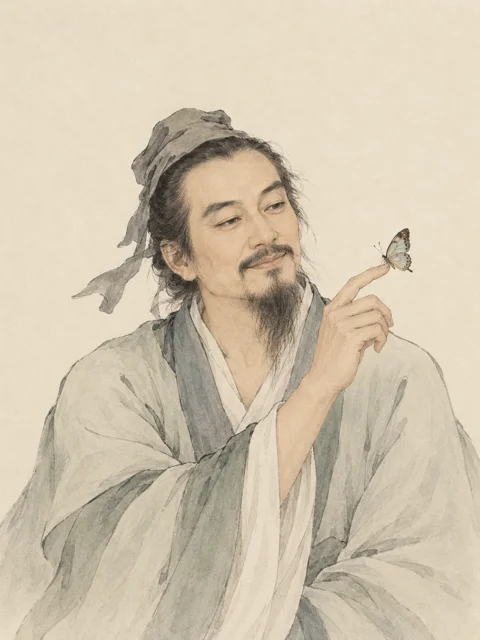
 AI 创作示意
GUANFU / zh-Hant
庄子
AI 创作示意杂篇 · 讓王
版本按章对照,不代表逐句校勘对应。
中文原文(全三十三篇) / 庄子原典;维基文库贡献者整理
观复随文注释 · 71 条
堯以天下讓許由传说拒绝尧让位的隐者,許由不受。又讓於子州支父传说中的隐者,子州支父曰:「以我爲天子,猶之可也。雖然,我適有幽憂之病深重忧郁的病,方且治之,未暇治天下也。」夫天下,至重也,而不以害其生,又況他物乎?唯无以天下爲者,可以託天下也。
舜讓天下於子州支伯,子州支伯曰:「予適有幽憂之病,(方且治之,)未暇治天下也。」故天下,大器也,而不以易生用生命交换,此有道者之所以異乎俗者也。
舜以天下讓善卷传说中的隐者,善卷曰:「余一作「予」立於宇宙之中,冬日衣皮毛,夏日衣葛絺葛布与细葛布;絺读 chī,春耕種,形足以勞動,秋收斂一作「歛」,身足以休食,日出而作,日入而息,逍遙於天地之間,而心意自得。吾何以天下爲哉?悲夫,子之不知余也!」遂不受。於是去而入深山,莫知其處。
舜以天下讓其友石戶之農传说中的隐者称号,石戶之農曰:「捲捲勤苦不息的样子乎后君主之爲人!葆力恃力、劳力之士也。」以舜之德,爲未至也。於是夫負,妻戴,攜子,以入於海,終身不反也。
大王亶父周族首领古公亶父;大读 tài居邠古地名,亦作豳;读 bīn,狄人古代北方部族之称攻之。事之以皮帛而不受,事之以犬馬而不受,事之以珠玉而不受。狄人之所求者,土地也。大王亶父曰:「與人之兄居而殺其弟,與人之父居而殺其子,吾不忍也。子皆勉居矣!爲吾臣,與爲狄人臣,奚以異?且吾聞之:『不以所用養用来养生的土地、财物害所養被养护的生命。』」因杖筴拄着手杖;筴通策一作「策」而去之,民相連而從之,遂成國於岐山之下。夫大王亶父,可謂能尊生以保全生命为重矣。能尊生者,雖貴富,不以養傷身一作「生」,雖貧賤,不以利累形。今世之人,居高官尊爵者,皆重失之;見利,輕亡其身,豈不惑哉!
越人三世弑臣杀君、子杀父的古称其君,王子搜患之,逃乎丹穴,而越國无君,求王子搜不得,從之丹穴。王子搜不肯出,越人薰之以艾,乘以玉輿饰玉的车。王子搜援綏登车时拉手的绳带;读 suí登車,仰天而呼曰:「君乎!君乎!獨不可以舍我乎?」王子搜非惡爲君也,惡爲君之患也。若王子搜者,可謂不以國傷生矣,此固越人之所欲得爲君也。
韓、魏相與爭侵地。子華子篇中向韩君进言的贤者見昭僖侯,昭僖侯有憂色。子華子曰:「今使天下書銘於君之前,書之言曰:『左手攫攫取、抓取;读 jué之則右手廢,右手攫之則左手廢,然而攫之者必有天下。』君能攫之乎?」昭僖侯曰:「寡人不攫也。」子華子曰:「甚善!自是觀之,兩臂重於天下也,身亦重於兩臂。韓之輕於天下亦遠矣,今之所爭者,其輕於韓又遠,君固愁身傷生,以憂戚不得也!」僖侯曰:「善哉!教寡人者衆矣,未嘗得聞此言也。」子華子可謂知輕重矣。
魯君聞顏闔得道之人也,使人以幣礼物,常指玉帛先焉。顏闔守陋閭简陋的里巷居处,苴布粗麻布;苴读 jū之衣,而自飯牛喂牛。魯君之使者至,顏闔自對之。使者曰:「此顏闔之家與?」顏闔對曰:「此闔之家也。」使者致幣。顏闔對曰:「恐聽者謬而遺使者罪,不若審之。」使者還,反審之,復來求之,則不得已。(故)若顏闔者,眞惡富貴也。故曰:「道之眞,以治身;其緒餘余剩、末节,以爲國家;其土苴尘垢、残余;读 tǔ jū,以治天下。」由此觀之,帝王之功,聖人之餘事也,非所以完身養生也。今世俗之君子,多危身棄生以殉物,豈不悲哉?凡聖人之動作也,必察其所以之,與其所以爲。今且有人於此,以隨侯之珠传说中的珍贵明珠,彈千仞极高处;仞为古长度单位之雀,世必笑之。是何也則?其所用者重,而所要者輕也。夫生者,豈特隨侯之重哉?
子列子窮,容貌有飢色。客有言之於鄭子陽郑国执政大臣者,曰:「列御寇,蓋有道之士也,居君之國而窮,君无乃爲不好士乎?」鄭子陽卽令官遺之粟。子列子見使者,再拜而辭。使者去,子列子入,其妻望之而拊心拍着胸口,表示悲伤,曰:「妾聞爲有道者之妻子,皆得佚樂。今有飢色,君過而遺先生食,先生不受,豈不命邪?」子列子笑謂之曰:「君非自知我也。以人之言而遺我粟,至其罪我也,又且以人之言。此吾所以不受也。」其卒,民果作難发动叛乱;难读 nàn而殺子陽。
楚昭王失國,屠羊說以屠羊为业、名说的人走而從於昭王。昭王反國,將賞從者,及屠羊說。屠羊說曰:「大王失國,說失屠羊。大王反國,說亦反屠羊。臣之爵祿已復矣,又何賞之有?」王曰:「强之。」屠羊說曰:「大王失國,非臣之罪,故不敢伏(其)誅。大王反國,非臣之功,故不敢當其賞。」王曰:「見之。」屠羊說曰:「楚國之法,必有重賞大功,而後得見。今臣之知不足以存國,而勇不足以死寇。吳軍入郢,說畏難而避寇,非故隨大王也。今大王欲廢法毀約而見說,此非臣之所以聞於天下也。」王謂司馬子綦曰:「屠羊說居處卑賤,而陳義甚高,子其爲我延之以三旌之位楚国显贵官位的称呼。」屠羊說曰:「夫三旌之位,吾知其貴於屠羊之肆也;萬鍾丰厚俸禄;鍾为古量器之祿,吾知其富於屠羊之利也。然豈(可)以貪爵祿,而使吾君有妄施之名乎?說不敢當,願復反吾屠羊之肆。」遂不受也。
原憲孔子弟子,字子思居魯,環堵四堵小墙围成的简陋住所之室,茨用茅草盖屋;读 cí以生草,蓬戶不完,桑以爲樞,而甕牖以破瓮口作窗;牖读 yǒu二室,褐以爲塞,上一作「下」漏下濕,匡坐端正地坐着而弦。子貢乘大馬,中紺而表素里面深青色、外面白色的服饰,軒車不容巷,往見原憲。原憲華冠古注多解为桦皮帽縰履穿着破旧的鞋;縰通躧,杖藜而應門。子貢曰:「嘻!先生何病?」原憲應之曰:「憲聞之:『无財謂之貧,學而不能行謂之病。』今憲,貧也,非病也。」子貢逡巡而有愧色。原憲笑曰:「夫希世而行,比周结党营私而友,學以爲人,教以爲己,仁義之慝邪恶、伪饰;读 tè,輿馬之飾,憲不忍爲也。」
曾子居衞,縕袍以旧絮填充的袍子;縕读 yùn无表,顏色腫噲浮肿的样子,手足胼胝手足劳作生出的厚茧,三日不舉火,十年不製衣,正冠而纓絕,捉衿而肘見拉正衣襟却露出肘部,納屨而踵決鞋后破裂,露出脚跟,曳縰而歌商頌《诗经》中的商代祭祀诗,聲滿天地,若出金石,天子不得臣,諸侯不得友。故養志者忘形,養形者忘利,致道者忘心矣。
孔子謂顏回曰:「回來,家貧居卑,胡不仕乎?」顏回對曰:「不願仕。回有郭外之田五十畝,足以給飦粥稠粥与稀粥;飦同饘;郭內之田十畝,足以爲絲麻;鼔一作「鼓」琴足以自娛,所學夫子之道者,足以自樂也。回不願仕。」孔子愀然變容,曰:「善哉,回之意!丘聞之:『知足者,不以利自累也。審自得者,失之而不懼。行脩於內者,无位而不怍惭愧;读 zuò。』丘誦之久矣,今於回而後見之,是丘之得也!」
中山公子牟謂瞻子曰:「身在江海之上一作「下」,心居乎魏闕宫门高阙,借指朝廷之下,奈何?」瞻子曰:「重生。重生則利輕。」中山公子牟曰:「雖知之,未能自勝也。」瞻子曰:「不能自勝則從,神无惡乎!不能自勝而强不從者,此之謂重傷。重傷之人,无壽類矣。」魏牟,萬乘之公子也,其隱巖穴也,難爲於布衣之士,雖未至乎道,可謂有其意矣。
孔子窮於陳、蔡之間,七日不火食,藜羹不糝野菜汤里连米粒都没有,顏色甚憊,而弦歌於室。顏回擇菜。子路、子貢相與言曰:「夫子再逐於魯,削迹於衞,伐樹於宋,窮於商、周,圍於陳、蔡。殺夫子者无罪,藉夫子侮辱、践踏先生;藉通籍者无禁。弦歌鼔一作「鼓」琴,未嘗絕音。君子之无恥也,若此乎?」顏回无以應,入告孔子。孔子推琴,喟然而歎曰:「由與賜,細人也!召而來,吾語之。」子路、子貢入。子路曰:「如此者,可謂一作「許」窮矣!」孔子曰:「是何言也?君子通於道之謂通,窮於道之謂窮。今丘抱仁義之道,以遭亂世之患,其何窮之爲?故內省而不窮於道,臨難而不失其德。天寒旣至,霜雪旣降,吾是以知松柏之茂也。陳、蔡之隘,於丘其幸乎!」孔子削然,反琴而弦歌;子路扢然奋起的样子;扢读 gǔ,執干盾牌而舞。子貢曰:「吾不知天之高也,地之下也!」古之得道者,窮亦樂,通亦樂;所樂非窮通也,道德於此,則窮通爲寒暑風雨之序矣。故許由虞一作「娛」於潁陽颍水之北,而共伯古代传说中的高士或国君得乎共首。
舜以天下讓其友北人无擇,北人无擇曰:「異哉,后之爲人也!居於畎畝田间;畎读 quǎn之中,而遊堯之門。不若是而已,又欲以其(辱)行漫我污辱我。吾羞見之。」因自投清泠之淵。
湯將伐桀,因卞隨传说拒绝商汤让位的隐者而謀,卞隨曰:「非吾事也。」湯曰:「孰可?」曰:「吾不知也。」湯又因務光传说中的隐者而謀,務光曰:「非吾事也。」湯曰:「孰可?」曰:「吾不知也。」湯曰:「伊尹何如?」曰:「强力忍詬忍受辱骂一作「垢」,吾不知其他也。」湯遂與伊尹謀伐桀,剋之,以讓卞隨,卞隨辭曰:「后之伐桀也謀乎我,必以我爲賊也;勝桀而讓我,必以我爲貪也。吾生乎亂世,而无道之人再來漫我以其辱行,吾不忍數聞也。」乃自投椆水而死。湯又讓務光,曰:「知者謀之,武者遂之,仁者居之,古之道也。吾子胡不立乎?」務光辭曰:「廢上,非義也。殺民,非仁也。人犯其難,我享其利,非廉也。吾聞之曰:『非其義者,不受其祿。无道之世,不踐其土。』況尊我乎?吾不忍久見也。」乃負石而自沈於廬水。
昔周之興,有士二人,處於孤竹古代国名,伯夷叔齐的故国,曰伯夷、叔齊。二人相謂曰:「吾聞西方有人,似有道者,試往觀焉。」至於岐陽,武王聞之,使叔旦周公旦往見之,與盟曰:「加富二等,就官一列,血牲以牲血盟誓而埋之。」二人相視而笑,曰:「嘻,異哉!此非吾所謂道也。昔者神農之有天下也,時祀盡敬而不祈喜;其於人也,忠信盡治而无求焉,樂與政爲政,樂與治爲治;不以人之壞,自成也;不以人之卑,自高也;不以遭時,自利也。今周見殷之亂而遽爲政,上謀而下行貨,阻兵凭借武力而保威,割牲而盟以爲信,揚行以悅衆,殺伐以要利,是推亂以易暴也。吾聞:古之士,遭治世,不避其任;遇亂世,不爲苟存。今天下闇,周德衰,其並乎周以塗吾身也,不如避之,以絜吾行。」二子北至於首陽之山,遂餓而死焉。若伯夷、叔齊者,其於富貴也,苟可得已,則必不賴高節戾行孤高不合世俗的行为。(獨樂其志,)不事於世,此二士之節也。
观复随文注释 · AI 辅助独立整理,待持续人工校订。释义以本章语境为依据;存在异说或底本疑讹的地方另作提示。原文及版本来源保留如下。
参考: 本站所收原典:杂篇 · 讓王 ↗
原典公有领域;电子文本据维基文库贡献者,按 CC BY-SA 4.0 保留署名及相同方式共享;调整空白与排版。 · 查看原始版本
欢迎引用本站资源,分享道家与道教文化。引用时请注明出处“观复”,并附上所引用内容的原始页面链接,方便读者查阅。
观复白话释义(AI 辅助) / 观复 · AI 辅助独立整理
【观复白话释义|AI 辅助·未经人工学术审定】
尧把天下让给许由,许由不接受。又让给子州支父。子州支父说:“让我做天子,也不是不可以。不过,我恰好患有深藏内里的忧病,正要治疗,没有空闲治理天下。”天下是极其重大的东西,他却不肯让它妨害自己的生命,何况别的东西呢?唯有不把占有天下当作追求的人,才可以把天下托付给他。
舜把天下让给子州支伯。子州支伯说:“我恰好患有深藏内里的忧病,正要治疗,没有空闲治理天下。”天下虽是极大的重器,却不能拿它来交换自己的生命,这就是有道之人与世俗之人不同的地方。
舜把天下让给善卷。善卷说:“我站在天地之间,冬天穿皮毛,夏天穿葛布;春天耕作播种,身体足以劳动;秋天收获储藏,自己足以安歇进食。太阳出来就劳作,太阳落下就休息,在天地之间自由自在,心里安适满足。我还要天下做什么?可悲啊,您竟不了解我!”于是没有接受,离开那里,进入深山,没有人知道他住在哪里。
舜把天下让给朋友石户之农。石户之农说:“这位君主为人,真是用心劳苦啊!还是个着力保全、经营自身的人。”他认为舜的德行尚未达到最高境地。于是丈夫背着东西,妻子头顶行李,带上孩子,一起走到海边隐居,终身没有回来。
大王亶父住在邠地,狄人来攻打。他献上皮革、丝帛,狄人不肯罢休;献上犬马,仍不罢休;献上珠玉,还是不罢休。狄人所要的是土地。大王亶父说:“我和人家的哥哥一起生活,却使他的弟弟战死;我和人家的父亲一起生活,却使他的儿子战死,我不忍心。你们都安心留在这里吧!做我的臣民和做狄人的臣民,有什么不同?而且我听说过:‘不能因为那些用来养活人的东西,反而害了所养活的人。’”于是拄着拐杖离去。百姓接连跟随他,终于在岐山脚下重新建立了国家。大王亶父可以说懂得尊重生命。懂得尊生的人,即使富贵,也不因奉养之物损伤身体;即使贫贱,也不因利益拖累形体。当今那些占据高官尊爵的人,都把失去官爵看得很重,见到利益,却轻易连自身性命也丢掉,难道不是糊涂吗?
越国人接连三代杀害他们的君主。王子搜怕受这种祸害,逃到丹穴。越国没有君主,人们寻找王子搜,开始找不到,后来追寻到丹穴。王子搜不肯出来,越人就用艾草烟熏他,准备玉饰的车子让他乘坐。王子搜拉着登车的绳索上车,仰天喊道:“君位啊!君位啊!难道偏偏不能放过我吗?”王子搜并非厌恶做君主,而是厌恶做君主带来的祸患。像他这样,可以说不肯为国家损害生命,而这本来正是越人想找到他来做君主的缘故。
韩国和魏国为被侵占的土地相争。子华子去见昭僖侯,见他面带忧色,便说:“假如把天下写成一份凭据放在您面前,上面说:‘左手拿取它,右手就会残废;右手拿取它,左手就会残废。但谁拿到它,谁就能拥有天下。’您会去拿吗?”昭僖侯说:“我不拿。”子华子说:“很好!由此看来,两条胳膊重于天下,而整个身体又重于两条胳膊。韩国比天下轻小得多,眼下所争的土地,比韩国又轻小得多。您却为了得不到它,忧愁苦恼,伤害自己的身体和生命!”僖侯说:“说得好!教导我的人很多,却从未听过这样的话。”子华子可以说懂得轻重。
鲁国君主听说颜阖是得道的人,派使者先带礼物去。颜阖住着简陋的屋舍,穿粗麻衣,正在亲自喂牛。使者来了,颜阖亲自接待。使者问:“这是颜阖的家吗?”颜阖回答:“这是我的家。”使者献上礼物。颜阖说:“恐怕您听错了人名,反而让使者受责罚,不如回去核实一下。”使者回去核实后,再来寻找,已经找不到他了。像颜阖这样,才是真不愿接受富贵。
所以说:“道的精真,用来修养自身;它的余绪,可以用来治理国家;它像糟粕一样的末余,可以用来治理天下。”这样看来,帝王的功业,只是圣人的余事,并不是保全身体、养护生命的根本。当今世俗的君子,常常使身体陷入危险,抛弃性命去追逐外物,岂不可悲!圣人凡有行动,必定考察行动要通向哪里,又为什么这样做。假如有人拿随侯之珠,去弹射千仞高处的鸟雀,世人一定笑他。为什么?因为所用的太贵重,所求的太轻微。生命的贵重,哪里只是随侯之珠所能相比的呢?
列子穷困,脸上显出饥色。有人对郑国的子阳说:“列御寇大概是个有道之士。他住在您的国境内却贫困至此,您恐怕会被说成不爱惜贤士吧?”子阳立刻命官吏给他送粮。列子见到使者,拜了两拜,辞谢不受。使者走了,列子回到屋里,妻子望着他,拍着胸口说:“我听说做有道之人的妻儿,都能安逸快乐。现在我们饿得面有饥色,国君顾念您,送粮食来,您却不收,这难道真是命吗?”列子笑着说:“国君并不是自己了解我。他听别人说,就送粮食给我;等到他要治我的罪,也会听别人的话。这就是我不接受的原因。”后来,百姓果然作乱,杀了子阳。
楚昭王失去国都,卖羊肉的屠羊说逃难时跟着昭王。昭王回国,准备奖赏随从流亡的人,也要赏屠羊说。屠羊说说:“大王失国,我也失掉了卖羊肉的生意;大王回国,我也回来卖羊肉。我的爵禄已经恢复了,还要什么赏赐?”昭王说:“一定要赏他。”屠羊说说:“大王失国,并不是我的罪过,所以我不敢承担诛罚;大王回国,也不是我的功劳,所以不敢接受赏赐。”昭王说:“让我见见他。”
屠羊说说:“楚国的法度,是有重大功劳、应受厚赏的人,才得以觐见。我既没有足以保全国家的智慧,也没有与敌人拼死作战的勇气。吴军进入郢都时,我因害怕灾难而逃避敌军,并不是特意随从大王。如今大王要废弃法度、破坏约定来见我,这不是我想凭借它闻名天下的事情。”昭王对司马子綦说:“屠羊说地位卑微,说出的道理却很高。你替我用三旌的高位邀请他。”屠羊说说:“三旌的地位,我知道比卖羊肉的铺子尊贵;万钟的俸禄,我知道比卖羊肉的收入丰厚。可是,怎么能因我贪图爵禄,让君主背上任意施赏的名声?我不敢承受,愿回自己的羊肉铺子去。”终于没有接受。
原宪住在鲁国,房屋四壁狭小,屋顶盖着未经修整的草,蓬草编的门也不完整,用桑木作门轴;两间屋的窗子用破瓮口做成,塞着粗布,上面漏雨,下面潮湿。他却端正地坐着,弹弦歌唱。子贡乘着高大的马驾的车,穿着里面深青、外面素白的衣服前来探望,轩车宽得进不了小巷。原宪戴着破旧的帽子,拖着破鞋,拄着藜杖出来应门。子贡说:“唉!先生怎么这样困病?”原宪回答:“我听说,没有财物叫贫,学了道理却不能实行才叫病。如今我是贫,不是病。”子贡迟疑退让,面露惭愧。原宪笑着说:“迎合世俗行事,结党营私交友,为了向人炫耀而学习,为了自己的利益而教人,假借仁义做坏事,用车马装点门面,这些我都不忍去做。”
曾子住在卫国,旧絮袍子破得露了里,脸色浮肿黯淡,手脚磨出厚茧;三天没生火做饭,十年没做新衣。正一正帽子,帽带就断了;拉一拉衣襟,肘部就露了出来;穿鞋时,脚跟又撑破了鞋。他拖着破鞋,歌唱《商颂》,声音充满天地,如金石之声。天子不能使他屈身称臣,诸侯不能凭势位要求与他交友。所以,涵养志向的人,能忘掉形体的困顿;养护形体的人,能忘掉利益;通达大道的人,连自己的用心也忘掉了。
孔子对颜回说:“回,来!你家里穷,住处又简陋,为什么不做官?”颜回回答:“我不愿做官。我在城外有五十亩田,足够供给粥饭;城内有十亩田,足够生产丝麻。弹琴足以自娱,从老师这里学到的道理,足以使我心中快乐。我不愿做官。”孔子肃然动容,说:“颜回的心志,真好啊!我听说:‘知道满足的人,不用利益拖累自己;明白内在自得的人,即使失去外物,也不会恐惧;品行修养在自己内心的人,没有职位也不惭愧。’我诵读这些话很久了,今天才在你身上真正见到,这是我的收获!”
中山公子牟对瞻子说:“我的身体在江海之上,心却留在朝廷的宫阙之下,怎么办?”瞻子说:“看重生命。生命重了,利益就轻了。”公子牟说:“道理虽然知道,却还不能克服自己。”瞻子说:“不能克服,就顺着目前的心情,别再使精神憎恶自己。既不能克服,又强迫自己不顺从,这叫双重伤害。受双重伤害的人,就不属于能够长寿的一类了。”魏牟是大国的公子,他要隐居山岩洞穴,比普通平民更难。虽然尚未达到道的境地,也可以说有了趋向它的心意。
孔子在陈、蔡之间陷入困境,七天吃不上熟食,野菜汤里连米粒也没有,脸色十分疲惫,却仍在屋里弹琴歌唱。颜回择菜时,子路、子贡互相议论说:“老师两次被鲁国驱逐,在卫国被禁绝行迹,在宋国遭到伐树之祸,在商、周之地受困,又被围在陈、蔡之间。杀老师的人不会被治罪,欺凌老师的人也无人禁止。他还弹琴歌唱,声音从未停过。君子竟可以这样不知羞耻吗?”颜回无言回答,进屋告诉孔子。
孔子推开琴,长叹说:“由和赐,见识太小了!叫他们进来,我跟他们说。”子路、子贡进来,子路说:“像这样,总可以叫作穷困了吧!”孔子说:“这是什么话!君子通达于道,才叫通达;在道上走不通,才叫穷困。现在我抱持仁义之道,只是遭遇乱世的灾难,何曾在道上穷困?所以,向内省察而不在道上困窘,面对危难而不丧失德行。严寒到了,霜雪降下,这才知道松柏依然茂盛。陈、蔡之间的困厄,对我说来或许是幸运!”孔子安然恢复常态,重新取琴弹唱;子路振奋起来,拿着盾牌跳舞;子贡说:“我从前真不知道天有多高,地有多深啊!”古代得道的人,困厄时快乐,通达时也快乐。他们所快乐的,并不是困厄或通达;道德存在于自身,困厄与通达就如寒暑风雨的次序变化。所以许由安乐于颍水之北,共伯自得于共首山。
舜把天下让给朋友北人无择。北人无择说:“这位君主为人,真奇怪!原本居住田野,却游走于尧的门下。如果只到这里也还罢了,现在又想拿自己的行为来玷污我。我羞于见他。”于是投身清泠深潭。
汤要攻打桀,向卞随商量。卞随说:“这不是我的事。”汤问:“谁可以商量?”他说:“我不知道。”汤又去和务光商量。务光说:“这不是我的事。”汤问:“谁可以商量?”他说:“我不知道。”汤问:“伊尹怎么样?”务光说:“他精力强健,能忍受耻辱,别的我不知道。”汤于是与伊尹谋划伐桀,战胜以后,把天下让给卞随。
卞随辞谢说:“君主伐桀时来与我商量,必定把我当成参与残害的人;战胜桀后又来让给我,必定把我当成贪图天下的人。我生在乱世,无道的人两次拿他可耻的行为来玷污我,我不忍反复听这些话。”于是投椆水而死。汤又把天下让给务光,说:“有智慧的人谋划,有勇武的人完成,有仁德的人居其位,这是古来的道理。您为什么不登位?”务光辞谢说:“废掉自己的君上,不合义;杀害百姓,不合仁;别人冒险犯难,我来享受利益,不合廉。我听说:‘不合道义的,不接受他的俸禄;无道的世道,不踏他的土地。’何况还要尊我为君!我不忍长久看下去了。”于是背着石头,沉入庐水。
从前周兴起的时候,有两个士人住在孤竹,叫伯夷、叔齐。两人相互说:“听说西方有人,好像是有道的人,试着去看看吧。”到了岐山之南,武王听说他们来了,派叔旦去见他们,要订立盟约,答应提高他们两等的俸禄,给他们安排官位,并按盟誓的仪式用牲血而埋牲。两人相视而笑,说:“唉,真奇怪!这不是我们所说的道。
“从前神农拥有天下,按时祭祀,尽心恭敬,却不祈求福庆;对待人民,尽到忠信,把事情治理妥当,却不向人民求取回报。乐于顺着政事之宜来施政,乐于顺着安定之势来治理。不利用别人的败坏成就自己,不借别人的卑下抬高自己,不凭碰到好时机谋取自己的利益。如今周看见殷混乱,便急着掌握政权:上面运用谋略,下面施行财货收买;依仗军队,保持威势;宰牲盟誓,拿这个当信实;宣扬行为,取悦众人;用杀伐来求取利益。这是推进祸乱,用新的暴行替换旧的暴政。我们听说,古代的士人逢治世,不逃避职责;遇乱世,不苟且求存。如今天下昏暗,周的德行衰败,与其依附周而污染自身,不如避开,保持品行的洁净。”两人向北到了首阳山,终于饿死在那里。
像伯夷、叔齐,对富贵若能辞却,就一定不肯依凭它;他们坚持高洁的节操,砥砺自己的行为,独自以心志自乐,不向世间求取事业。这就是这两位士人的节操。
【篇末疑难注记】本篇让位、避世、君臣等故事均依原作者叙述转述,不以此判定其历史真实性。“幽忧之病”病名未详,暂释深藏内里的忧病。“葆力”训义有争议,暂取用力保全、经营之意。“三釜”“三千钟”等量名及“三旌”等位号保留古称,不折算现代数值。“苴布”为粗麻布,“土苴”为糟粕末余。“华冠”结合贫困语境按破旧之冠理解,“縰履”“曳縰”按破履释。“削迹”“伐树”仅保留本篇所点出的遭遇,不增补其他传说。“共首”“清泠”“椆水”“庐水”保留地名。“血牲而埋之”依古盟誓仪式试释。结尾“则必不赖高节戾行”断句有歧义,正文按“不依赖富贵,而坚持高节”贯通,待校订。
观复白话释义:AI 辅助依据古文独立编写,已进行文本覆盖核对,未经人工学术审定;原典来源及电子底本署名、许可见对应中文版本。 · 查看原始版本
Herbert A. Giles 英译(全三十三篇) / Herbert A. Giles(翟理斯),1889
On Declining Power.
[Spurious.]
Yao offered to resign the empire to Hsü Yu, but the latter declined.
He then offered it to Tzŭ Chou Chih Fu, who said, "There is no objection to making me emperor. But just now I am suffering from a troublesome disease, and am engaged in trying to cure it. I have no leisure to look after the empire."
Now the empire is of paramount importance. Yet here was a man who would not allow it to injure his chance of life. How much less then would he let other things do so? Yet it is only he who would do nothing in the way of government who is fit to be trusted with the empire.
[Translator’s note] Those personages who have not been previously mentioned may be taken to be allegorical.
Shun offered to resign the empire to Tzŭ Chou Chih Poh. The latter said, "Just now I am suffering from a troublesome disease, and am engaged in trying to cure it. I have no leisure to look after the empire."
Now the empire is a great trust; but not to sacrifice one's life for it is precisely where the man of Tao differs from the man of the world.
Shun offered to resign the empire to Shan Chüan. Shan Chüan said, "I am a unit in the sum of the universe. In winter I wear fur clothes. In summer I wear grass-cloth. In spring I plough and sow, toiling with my body. In autumn I gather in the harvest, and devote myself to rest and enjoyment. At dawn I go to work; at sunset I leave off. Contented with my lot I pass through life with a light heart. Why then should I trouble myself with the empire? Ah, Sir, you do not know me."
So he declined, and subsequently hid himself among the mountains, nobody knew where.
Shun offered the empire to a friend, a labourer of Shih Hu.
"Sire," said the latter, "you exert yourself too much. The chief thing is to husband one's strength;"—meaning that in point of real virtue Shun had not attained.
Then, husband and wife, bearing away their household gods and taking their children with them, went off to the sea and never came back.
When T'ai Wang Shan Fu was occupying Pin, he was attacked by savages. He offered them skins and silk, but they declined these. He offered them dogs and horses, but they declined these also. He then offered them pearls and jade, but these too they declined. What they wanted was the territory.
"To live with a man's elder brother," said T'ai Wang Shan Fu,
[Translator’s note] Addressing his own people.
"and slay his younger brother; to live with a man's father and slay his son,—this I could not bear to do. Make shift to remain here. To be my subjects or the subjects of these savages, where is the difference? Besides I have heard say that we ought not to let that which is intended to nourish life become injurious to life."
[Translator’s note] Alluding to the "territory."
Thereupon he took his staff and went off. His people all followed him, and they founded a new State at the foot of Mount Ch'i.
Now T'ai Wang Shan Fu undoubtedly had a proper respect for life. And those who have a proper respect for life, if rich and powerful, do not let that which should nourish injure the body. If poor and lowly, they do not allow gain to involve them in physical wear and tear.
But the men of the present generation who occupy positions of power and influence, are all afraid of losing what they have got. Directly they see a chance of gain, away goes all care for their bodies. Is not that a cause for confusion?
In three successive cases the people of Yüeh had put their prince to death. Accordingly, Shou, the son of the last prince, was much alarmed, and fled to Tan Hsüeh, leaving the State of Yüeh without a ruler.
Shou was at first nowhere to be found, but at length he was traced to Tan Hsüeh. He was, however, unwilling to come forth, so they smoked him out with moxa. They had a royal carriage ready for him; and as Shou seized the cord to mount the chariot, he looked up to heaven and cried, "Oh! ruling, ruling, could I not have been spared this?"
It was not that Shou objected to be a prince. He objected to the dangers associated with such positions. Such a one was incapable of sacrificing life to the State, and for that very reason the people of Yüeh wanted to get him.
The States of Han and Wei were struggling to annex each other's territory when Tzŭ Hua Tzŭ went to see prince Chao Hsi. Finding the latter very downcast, Tzŭ Hua Tzŭ said, "Now suppose the representatives of the various States were to sign an agreement before your Highness, to the effect that although cutting off the left hand would involve loss of the right, while cutting off the right would involve loss of the left, nevertheless that whosoever would cut off either should be emperor over all,—would your Highness cut?"
"I would not," replied the prince.
"Very good," said Tzŭ Hua Tzŭ. "It is clear therefore that one's two arms are worth more than the empire. And one's body is worth more than one's arms, while the State of Han is infinitely less important than the empire. Further, what you are struggling over is of infinitely less importance than the State of Han. Yet your Highness is wearing out body and soul alike in fear and anxiety lest you should not get it."
"Good indeed!" cried the prince. "Many have counselled me, but I have never heard the like of this."
From which we may infer that Tzŭ Hua Tzŭ knew the difference between what was of importance and what was not.
The prince of Lu, hearing that Yen Ho had attained to Tao , despatched messengers with presents to open communications.
Yen Ho lived in a hovel. He wore clothes of coarse grass, and occupied himself in tending oxen.
When the messengers arrived, Yen Ho went out to meet them; whereupon they enquired, "Is this where Yen Ho lives?"
"This is Yen Ho's house," replied the latter.
The messengers then produced the presents; but Yen Ho said, "I fear you have made a mistake. And as you might get into trouble, it would be as well to go back and make sure."
This the messengers accordingly did. When however they returned, there was no trace to be found of Yen Ho. Thus it is that men like Yen Ho hate wealth and power.
Wherefore it has been said that the best part of Tao is for self-culture, the surplus for governing a State, and the dregs for governing the empire. From which we may infer that the great deeds of kings and princes are but the leavings of the Sage. For preserving the body and nourishing vitality, they are of no avail. Yet the superior men of to-day endanger their bodies and throw away their lives in their greed for the things of this world. Is not this pitiable?
The true Sage in all his actions considers the why and the wherefore. But there are those now-a-days who use the pearl of the prince of Sui to shoot a bird a thousand yards off.
[Translator’s note] A wonderfully brilliant gem, of a "ten chariot" illuminating power.
And the world of course laughs at them. Why? Because they sacrifice the greater to get the less. But surely life is of more importance even than the prince's pearl!
Lieh Tzŭ was poor. His face wore a hungry look.
A visitor one day mentioned this to Tzŭ Yang
[Translator’s note] Prime Minister.
of Chêng, saying, "Lieh Tzŭ is a scholar who has attained to Tao . He lives in your Excellency's State, and yet he is poor. Can it be said that your Excellency does not love scholars?"
Thereupon Tzŭ Yang gave orders that Lieh Tzŭ should be supplied with food. But when Lieh Tzŭ saw the messengers, he bowed twice and declined.
When the messengers had gone, and Lieh Tzŭ went within, his wife gazed at him, and beating her breast said, "I have heard that the wife and children of a man of Tao are happy and joyful. But see how hungry I am. His Excellency sent you food, and you would not take it. Is not this flying in the face of Providence?"
"His Excellency did not know me personally," answered Lieh Tzŭ with a smile. "It was because of what others said about me that he sent me the food. If then men were to speak ill of me, he would also act upon it. For that reason I refused the food."
Subsequently, there was trouble among the people of Chêng, and Tzŭ Yang was slain.
When Prince Chao of the Ch'u State lost his kingdom, he was followed into exile by his butcher, named Yüeh.
On his restoration, as he was distributing rewards to those who had remained faithful to him, he came to the name of Yüeh.
Yüeh, however, said, "When the prince lost his kingdom, I lost my butchery. Now that the prince has got back his kingdom, I have got back my butchery. I have recovered my office and salary. What need for further reward?"
On hearing this, the prince gave orders that he should be made to take his reward.
"It was not through my fault," argued Yüeh, "that the prince lost his kingdom, and I should not have taken the punishment. Neither was it through me that he got it back, and I cannot therefore accept the reward."
When the prince heard this answer, he commanded Yüeh to be brought before him. But Yüeh said, "The laws of the Ch'u State require that a subject shall have deserved exceptionally well of his prince before being admitted to an audience. Now my wisdom was insufficient to preserve this kingdom, and my courage insufficient to destroy the invaders. When the Wu soldiers entered Ying, I feared for my life and fled. That was why I followed the prince. And if now the prince wishes to set law and custom aside and summon me to an audience, this is not my idea of proper behaviour on the part of the prince."
"Yüeh," said the prince to Tzŭ Chi, his master of the horse, "occupies a lowly position; yet his principles are of the most lofty. Go, make him a San Ching."
"I am aware," replied Yüeh to the master of the horse, "that the post of San Ching is more honourable than that of butcher. And I am aware that the emolument is larger than what I now receive. Still, because I want preferment and salary, I cannot let my prince earn the reputation of being injudicious in his patronage. I must beg to decline. Let me go back to my butchery."
And he adhered to his refusal.
Yüan Hsien dwelt in Lu,—in a mud hut, with a grass-grown roof, an apology for a door, and two mulberry-trees for door-posts. The windows which lighted his two rooms were no bigger than the mouth of a jar, and were closed by a wad of old clothes. The hut leaked from above and was damp under foot; yet Yüan Hsien sat gravely there playing on the guitar.
Tzŭ Kung came driving up in a fine chariot, in a white robe lined with purple; but the hood of the chariot was too big for the street.
When he went to see Yüan Hsien, the latter came to the door in a flowery cap, with his shoes down at heel, and leaning on a stalk.
"Good gracious!" cried Tzŭ Kung, "whatever is the matter with you?"
"I have heard," replied Yüan Hsien, "that he who is without wealth is called poor, and that he who learns without being able to practise is said to have something the matter with him. Now I am merely poor; I have nothing the matter with me."
Tzŭ Kung was much abashed at this reply; upon which Yüan Hsien smiling continued, "To try to thrust myself forward among men; to seek friendship in mutual flattery; to learn for the sake of others; to teach for my own sake; to use benevolence and duty to one's neighbour for evil ends; to make a great show with horses and carriages,—these things I cannot do."
Tsêng Tzŭ lived in the Wei State. His wadded coat had no outside cloth. His face was bloated and rough. His hands and feet were horny hard. For three days he had had no fire; no new clothes for ten years. If he set his cap straight the tassel would come off. If he drew up his sleeve his elbow would poke through. If he pulled up his shoe, the heel would come off. Yet slipshod he sang the Sacrificial Odes of Shang , his voice filling the whole sky, as though it had been some instrument of metal or stone.
The Son of Heaven could not secure him as a minister. The feudal princes could not secure him as a friend. For he who nourishes his purpose becomes oblivious of his body. He who nourishes his body becomes oblivious of gain. And he who has attained Tao becomes oblivious of his mind.
"Come hither," said Confucius to Yen Hui. "Your family is poor, and your position lowly. Why not go into official life?"
"I do not wish to," replied Yen Hui. "I have fifty acres of land beyond the city walls, which are enough to supply me with food. Ten more within the walls provide me with clothes. My lute gives me all the amusement I want; and the study of your doctrines keeps me happy enough. I do not desire to go into official life."
"Bravo! well said!" cried Confucius with beaming countenance. "I have heard say that those who are contented do not entangle themselves in the pursuit of gain. That those who have really obtained do not fear the contingency of loss. That those who devote themselves to cultivation of the inner man, though occupying no position, feel no shame. Thus indeed I have long preached. Only now, that I have seen Yen Hui, am I conscious of the realisation of these words."
Prince Mou of Chung-shan said to Chan Tzŭ, "My body is in the country, but my heart is in town. What am I to do?"
"Make life of paramount importance," answered Chan Tzŭ, "and worldly advantage will cease to have weight."
"That I know," replied the Prince; "but I am not equal to the task."
"If you are not equal to this," said Chan Tzŭ, "then it were well for you to pursue your natural bent. Not to be equal to a task, and yet to force oneself to stick to it,—this is called adding one injury to another. And those who suffer such two-fold injury do not belong to the class of the long-lived."
Prince Mou of Wei was heir to the throne of a large State. For him to become a hermit among the hills was more difficult than for an ordinary cotton-clothed scholar. And although he had not attained to Tao , he may be said to have been on the way thither.
When Confucius was caught between the Ch'êns and the Ts'ais, he went seven days without proper food. He ate soup of herbs, having no rice. He looked very much exhausted, yet he sat within playing his guitar and singing to it.
Yen Hui was picking over the herbs, while Tzŭ Lu and Tzŭ Kung were talking together. One of them said, "Our Master has twice been driven out of Lu. They will have none of him in Wei. His tree was cut down in Sung. He got into trouble in Shang and Chou. And now he is surrounded by the Ch'êns and the Ts'ais. Whoever kills him is to be held guiltless. Whoever takes him prisoner is not to be interfered with. Yet all the time he goes on playing and singing without cease. Is this the right thing for a superior man to do?"
Yen Hui said nothing, but went inside and told Confucius, who laid aside his guitar and said with a loud sigh, "Yu and Tzŭ are ignorant fellows.
[Translator’s note] These were their personal names.
Bid them come, and I will speak to them."
When they entered Tzŭ Lu said, "We seem to have made a thorough failure."
"What do you mean?" cried Confucius. "The superior man who succeeds in Tao , has success. If he fails in Tao , he makes a failure. Now I, holding fast to the Tao of charity and duty towards one's neighbour, have fallen among the troubles of a disordered age. What failure is there in that?
"Therefore it is that by cultivation of the inner man there is no failure in Tao , and when danger comes there is no loss of virtue. It is the chill winter weather, it is frost, it is snow, which bring out the luxuriance of the pine and the fir.
[Translator’s note] See Lun Yü , ix, 27.
I regard it as a positive blessing to be thus situated as I am."
Thereupon he turned abruptly round and went on playing and singing.
At this Tzŭ Lu hastily seized a shield and began dancing to the music, while Tzŭ Kung said, "I had no idea of the height of heaven and of the depth of earth."
The ancients who attained Tao were equally happy under success and failure. Their happiness had nothing to do with their failure or their success. Tao once attained, failure and success became mere links in a chain, like cold, heat, wind, and rain. Thus Hsü Yu enjoyed himself at Ying-yang, and Kung Poh found happiness on the hill-top.
[Translator’s note] Whither he retired after a reign of 14 years.
Shun offered to resign the empire to his friend Pei Jen Wu Tsê.
"What a strange manner of man you are!" cried the latter. "Living in the furrowed fields, you exchanged such a life for the throne of Yao. And as if that was not enough, you now try to heap indignity upon me. I am ashamed of you."
Thereupon he drowned himself in the waters of Ch'ing-ling.
[Translator’s note] "But how about preservation of life?" asks Lin Hsi Chung with a sneer.
When T'ang was about to attack Chieh, he went to consult with Pien Sui.
"It is not a matter in which I can help you," said the latter.
"Who can?" asked T'ang.
"I do not know," replied Pien Sui.
T'ang then went to consult with Wu Kuang.
"It is not a matter in which I can help you," said the latter.
"Who can?" asked T'ang.
"I do not know," replied Wu Kuang.
"What do you think of I Yin?" asked T'ang.
"He forces himself," said Wu Kuang, "to put up with obloquy. Beyond this I know nothing of him."
So T'ang took I Yin into his counsels. They attacked Chieh, and vanquished him.
Then T'ang offered to resign the empire in favour of Pien Sui. But Pien Sui declined, saying, "When your Majesty consulted with me about attacking Chieh, you evidently looked on me as a robber.
[Translator’s note] Who would steal territory. But men of Tao wage no wars.
Now that you have vanquished him, and you offer to resign in my favour, you evidently regard me as covetous. I was born indeed in a disordered age. But for a man without Tao to thus insult me twice, is more than I can endure."
So he drowned himself in the river Chou.
Then T'ang offered to resign in favour of Wu Kuang, saying, "The wise plan, the brave execute, the good rest therein,—such was the Tao of the ancients. Why, Sir, should not you occupy the throne?"
But Wu Kuang declined, saying, "To depose a ruler is not to do one's duty to one's neighbour. To slay the people is not charity. For others to suffer these wrongs, while I enjoy the profits, is not honest. I have heard say that one should not accept a wage unless earned in accordance with right; and that if the world is without Tao , one should not put foot upon its soil, still less rule over it! I can bear this no longer."
Thereupon he took a stone on his back and jumped into the river Lu.
At the rise of the Chou dynasty there were two scholars, named Po I and Shu Ch'i, who lived in Ku-tu.
One of these said to the other, "I have heard that in the west there are men who are apparently in possession of Tao . Let us go and see them."
[Translator’s note] Meaning the men of Chou.
When they arrived at Ch'i-yang, Wu Wang
[Translator’s note] The writer meant Wên Wang, father of Wu Wang.
heard of their arrival and sent Shu Tan
[Translator’s note] Chou Kung.
to enter into a treaty with them. They were to receive emoluments of the second degree and rank of the first degree. The treaty was to be sealed with blood and buried.
At this the two looked at each other and smiled. "Ah!" said one of them, "this is strange indeed. It is not what we call Tao .
"When Shên Nung ruled the empire, he worshipped God without asking for any reward. Sometimes it was the law he put in force; sometimes it was his personal influence he brought to bear. He was loyal and faithful to his people without seeking any return. He did not build his success upon another's ruin, nor mount high by means of another's fall, nor seize opportunities to secure his own advantage.
"But now that the Chous, beholding the iniquities of the Yins, have taken upon themselves to govern, we have intrigues above and bribes below. Troops are mobilised to protect prestige. Victims are slaughtered to give good faith to a treaty. A show of virtue is made to amuse the masses. Fighting and slaughter are made the means of gain. Confusion has simply been exchanged for disorder.
"I have heard tell that the men of old, living in quiet times, never shirked their duties; but lighting upon troublous times, nothing could make them stay. The empire is now in darkness. The virtue of the Chous has faded. For the empire to be united under the Chous would be a disgrace to us. Better flee away and keep our actions pure."
Accordingly, these two philosophers went north to Mount Shou-yang, where they subsequently starved themselves to death.
Men like Poh I and Shu Ch'i, if wealth and honour came to them so that they could properly accept, would assuredly not have recourse to such heroic measures, nor would they be content to follow their own bent, without giving their services to their generation. Such was the purity of these two scholars.
原著及 Herbert A. Giles 历史译本公有领域;据 Project Gutenberg #59709,完整电子书及使用条款见本站资料来源。 · 查看原始版本
我的书签(此浏览器)
还没有书签。