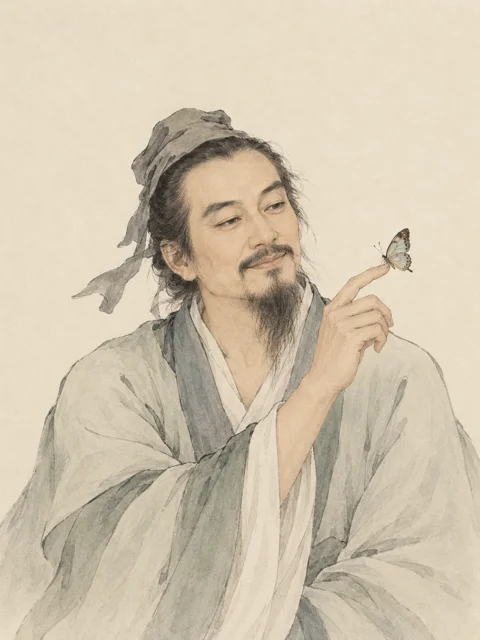
 AI 创作示意
GUANFU / zh-Hant
庄子
AI 创作示意杂篇 · 漁父
版本按章对照,不代表逐句校勘对应。
中文原文(全三十三篇) / 庄子原典;维基文库贡献者整理
观复随文注释 · 43 条
孔子遊乎緇帷林名;一说树木浓密如黑帷一作「惟」之林,休坐乎杏壇篇中孔子休息讲学的台地之上。弟子讀書,孔子弦歌鼔一作「鼓」琴,奏曲未半,有漁父渔翁;父读 fǔ者,下船而來,須一作「鬢」眉交白,被髮披散头发;被通披揄袂举起衣袖;读 yú mèi,行原以上,距陸而止,左手據膝,右手持頤下巴,以聽,曲終,而招子貢、子路二人俱對。客指孔子曰:「彼何爲者也?」子路對曰:「魯之君子也。」客問其族。子路對曰:「族孔氏。」客曰:「孔氏者,何治也?」子路未應,子貢對曰:「孔氏者,性服忠信,身行仁義,飾禮樂,選人倫分别、安排人伦关系,上以忠於世主,下以化(於)齊民普通百姓,將以利天下。此孔氏之所治也。」又問曰:「有土之君拥有封地的君主與?」子貢曰:「非也。」「侯王之佐與?」子貢曰:「非也。」客乃笑而還,行言曰:「仁則仁矣,恐不免其身,苦心勞形,以危其眞。嗚呼,遠哉,其分於道也!」
子貢還報孔子,孔子推琴而起,曰:「其聖人與?」乃下求之,至於澤畔。方將杖挐持着船桨;挐读 ráo而引其船,顧見孔子,還鄉转身朝向;鄉通向而立。孔子反走,再拜而進。客曰:「子將何求?」孔子曰:「曩者先生有緒言先前留下的话而去,丘不肖,未知所謂,竊待於下風,幸聞欬一作「咳」唾之音咳嗽之声,谦称对方的教言,以卒相丘帮助我;相读 xiàng也。」客曰:「嘻!甚矣,子之好學也!」孔子再拜而起,曰:「丘少而脩學,以至於今,六十九歲矣,无所得。聞至教,敢不虛心?」客曰:「同類相從,同聲相應,固天之理也。吾請釋吾之所有,而經子之所以。子之所以者,人事也。天子、諸侯、大夫、庶人,此四者自正,治之美也;四者離位,而亂莫大焉。官治其職,人憂其事,乃无所陵彼此不越分侵犯。故田荒室露,衣食不足,徵賦不屬赋税不能连续交纳,妻妾不和,長少无序,庶人之憂也。能不勝任,官事不治,行不清白,羣下荒怠,功美不有,爵祿不持,大夫之憂也。廷无忠臣,國家昏亂,工技不巧,貢職不美,春秋後倫春秋朝觐落于应有班次之后,不順天子,諸侯之憂也。陰陽不和,寒暑不時,以傷庶物,諸侯暴亂,擅相攘伐侵夺攻伐,以殘民人,禮樂不節,財用窮匱,人倫不飭不整治;飭读 chì,百姓淫亂,天子有司之憂也。今子,旣上无君侯有司之勢,而下无大臣職事之官,而擅飾禮樂,選人倫,以化齊民,不泰多事乎?且人有八疵八种人品过失,事有四患,不可不察也。非其事而事之,謂之揔揽管不属己的事;同总。莫之顧而進之,謂之佞以巧言求进。希意導言揣摩他人意旨而迎合说话,謂之諂逢迎取悦;读 chǎn。不擇是非而言,謂之諛不辨是非地赞同;读 yú。好言人之惡,謂之讒说坏话陷害别人。析交離親,謂之賊。稱譽詐僞,以敗惡人,謂之慝邪恶奸伪;读 tè。不擇善否,兩容顏適两面取悦、看脸色迎合,偷拔其所欲,謂之險。此八疵者,外以亂人,內以傷身,君子不友,明君不臣。所謂四患者:好經大事,變更易常,以挂功名,謂之叨贪求功名;專知擅事,侵人自用,謂之貪;見過不更,聞諫愈甚,謂之很固执不改;同狠;人同於己則可,不同於己,雖善不善,謂之矜自以为是、自夸。此四患也。能去八疵,无行四患,而始可教已。」
孔子愀然而歎,再拜而起,曰:「丘再逐於魯,削迹於衞,伐樹於宋,圍於陳、蔡。丘不知所失而離此四謗四次遭受的患难,非单指诽谤者,何也?」客悽然變容,曰:「甚矣,子之難語一作「悟」也!人有畏影惡迹而去之走者,舉足愈數而迹愈多,走愈疾而影不離身,自以爲尚遟一作「遲」,疾走不休,絕力而死。不知處陰以休影,處靜以息迹,愚亦甚矣!子審仁義之間,察同異之際,觀動靜之變,適受與之度,理好惡之情,和喜怒之節,而幾於不免矣!謹脩而身,愼守其眞,還以物與人,則无所累矣。今不脩之身而求之人,不亦外乎?」
孔子愀然,曰:「請問:何謂眞?」客曰:「眞者,精誠纯粹而真诚之至也。不精不誠,不能動人。故强哭者,雖悲,不哀。强怒者,雖嚴,不威。强親者,雖笑,不和。眞悲,无聲而哀。眞怒,未發而威。眞親,未笑而和。眞在內者,神動於外,是所以貴眞也。其用於人理也,事親則慈孝,事君則忠貞,飲酒則歡樂,處喪則悲哀。忠貞以功爲主,飲酒以樂爲主,處喪以哀爲主,事親以適爲主。功成之美,无一其迹不拘于一种固定形式矣。事親以適,不論所以矣。飲酒以樂,不選其具矣。處喪以哀,无問其禮矣。禮者,世俗之所爲也。眞者,所以受於天也,自然不可易也。故聖人法天貴眞,不拘於俗。愚者反此,不能法天而恤於人,不知貴眞,祿祿庸碌随俗的样子而受變於俗,故不足。惜哉,子之早湛於人僞沉溺在人为造作中,而晚聞大道也!」孔子又再拜而起,曰:「今者丘得過一作「遇」也,若天幸然。先生不羞,而比之服役,而身教之。敢問舍所在,請因受業,而卒學大道。」客曰:「吾聞之:『可與往者,與之至於妙道。不可與往者,不知其道,愼勿與之,身乃无咎。』子勉之,吾去子矣,吾去子矣!」乃刺船撑船而去,延緣沿着曲折水道前行葦間。
顏淵還車,子路授綏递上登车时抓住的带子,孔子不顧,待水波定,不聞挐音,而後敢乘。子路旁車而問曰:「由得爲役久矣,未嘗見夫子遇人如此其威也。萬乘之主,千乘之君,見夫子,未嘗不分庭伉禮各居半庭,以对等礼节相见,夫子猶有倨傲一作「敖」之容。今漁父杖挐逆立,而夫子曲要磬折弯腰屈身如磬;要通腰,言一作「再」拜而應,得无太甚乎?門人皆怪夫子矣,漁父何以得此乎?」孔子伏軾俯身靠在车前横木上而歎曰:「甚矣,由之難化也!湛於禮義,有間矣,而樸鄙粗陋无知之心,至今未去。進,吾語汝:夫遇長不敬,失禮也。見賢不尊,不仁也。彼非至人,不能下人;下人不精,不得其眞,故長傷身。惜哉,不仁之於人也,禍莫大焉,而由獨擅之!且道者,萬物之所由也。庶物,失之者死,得之者生;爲事,逆之則敗,順之則成。故道之所在,聖人尊之。今漁父之於道,可謂有矣,吾敢不敬乎?」
观复随文注释 · AI 辅助独立整理,待持续人工校订。释义以本章语境为依据;存在异说或底本疑讹的地方另作提示。原文及版本来源保留如下。
参考: 本站所收原典:杂篇 · 漁父 ↗
原典公有领域;电子文本据维基文库贡献者,按 CC BY-SA 4.0 保留署名及相同方式共享;调整空白与排版。 · 查看原始版本
欢迎引用本站资源,分享道家与道教文化。引用时请注明出处“观复”,并附上所引用内容的原始页面链接,方便读者查阅。
观复白话释义(AI 辅助) / 观复 · AI 辅助独立整理
【观复白话释义|AI 辅助·未经人工学术审定】
孔子游到缁帷树林,坐在杏坛上休息。弟子们读书,孔子弹琴歌唱。一曲还没有奏到一半,有位渔父下船走来,须眉皆白,披着头发,提起衣袖,沿着高地往上走,到了陆地停下来,左手撑着膝,右手托着下巴听琴。曲子结束,他招手叫子贡、子路过去。两人一起应答,渔父指着孔子问:“那位是做什么的?”子路说:“鲁国的君子。”渔父问他的姓氏,子路说:“姓孔。”渔父问:“孔氏以什么为业?”子路还没回答,子贡说:“孔氏本性奉行忠信,身体实践仁义,修整礼乐,辨别人伦;在上,尽忠当世君主;在下,教化普通百姓,想使天下得到好处。这就是孔氏所从事的。”渔父又问:“他是拥有封土的君主吗?”子贡说:“不是。”“是侯王的辅佐大臣吗?”子贡说:“不是。”渔父笑着转身,边走边说:“仁倒是仁了,只怕保全不了自身。苦心劳形,危害自己的本真。唉,他离道分隔得真远啊!”
子贡回来告诉孔子。孔子推开琴起身,说:“莫非是位圣人?”便走下杏坛去寻找,来到水边。渔父正要撑桨把船划走,回头看见孔子,便转身面对他站定。孔子退后,再拜上前。渔父问:“您要求什么?”孔子说:“刚才先生留下几句话就走了。我不贤,未能明白意思,愿谦恭地站在下风,听见先生哪怕咳嗽吐息般的声音,也请把对我的帮助说完。”渔父说:“啊,您真是好学!”孔子再拜起身,说:“我从年轻时修习学问,到今天已经六十九岁,仍没有所得。听到至高的教诲,怎敢不虚心?”
渔父说:“同类相随,同声相应,本就是自然的道理。让我把自己所懂的说出来,衡量一下您所从事的。您做的,是人间事务。天子、诸侯、大夫、庶民,这四者各自端正自身的位置,才是治理的良好状态;四者离开本位,没有比这更大的混乱。官员治理本职,人人操心自己的事务,彼此才不会侵犯。
“田地荒废,房屋漏雨,衣食不足,赋税交不上,妻妾不和,长幼失序,这是庶民的忧虑。才能不足以任职,官事办不好,行为不清白,部属懈怠,不能建立好的功绩,守不住爵位俸禄,这是大夫的忧虑。朝廷没有忠臣,国家昏乱,工匠技艺不精,贡品不佳,春秋朝觐落在人后,不顺从天子,这是诸侯的忧虑。阴阳失调,寒暑不合时令,损伤万物;诸侯暴乱,擅自相互侵夺攻伐,残害人民;礼乐失度,财用匮乏,人伦不整,百姓行为放纵混乱,这是天子和主管官员的忧虑。如今您上无君侯、官长的权势,下无大臣办事的官位,却自行修饰礼乐,分别人伦,教化百姓,不是太多事了吗?
“而且,人有八种毛病,做事有四种祸患,不能不明察。不是自己该做的事,却要去做,叫作揽事;别人没有理会自己,却硬要上前说话,叫作佞进;揣摩别人的意思,顺势引出迎合的话,叫作谄媚;不选择是非,一味说好听的话,叫作阿谀;喜欢说人的坏处,叫作谗毁;拆散交情,离间亲人,叫作贼害;用虚假的称誉,败坏、丑化别人,叫作阴慝;不分善恶,两面迎合,暗中拔取自己想要的东西,叫作险诈。这八种毛病,对外扰乱他人,对内伤害自身,君子不和这种人交友,明君不让这种人做臣子。
“所谓四种祸患:喜欢经营大事,改变常规,借此攫取功名,叫作叨;自以为有智,独揽事情,侵犯别人,一意自用,叫作贪;看见过失不改,听到劝谏反而变本加厉,叫作狠;别人和自己相同就认可,不同于自己,即使是好的也说不好,叫作矜。这就是四患。能去掉八疵,不再做出四患的行为,才开始可以接受教导。”
孔子肃然叹息,再拜起身说:“我两次被鲁国驱逐,在卫国被禁绝行迹,在宋国遇到树被砍伐的威胁,又被围在陈、蔡。我不知道失误在哪里,却遭到这四番毁辱,为什么?”渔父神色凄然,说:“您真难以开导!有个人害怕自己的影子,厌恶自己的脚印,想跑开甩掉它们。可是脚抬得越频繁,脚印越多;跑得越快,影子也不离身。他以为自己还跑得太慢,就不停地猛跑,终于力尽而死。他不知道,待在阴处就能使影子隐去,安静不动就能停止留下脚印,真是愚笨得厉害!
“您细分仁义的区别,详察同异的界限,观察动静的变化,衡量取与的尺度,整理好恶的情绪,调和喜怒的节制,却已经几乎不能保全自己!谨慎修养您自身,小心守住自己的本真,把外物还给外物,把他人的事情留给他人,就不再受拖累。现在不在自身修养,反而到别人那里求取,不是向外驰逐了吗?”
孔子神情严肃,问:“请问,什么叫真?”渔父说:“真,是精纯诚实达到极处。不精纯、不真诚,就不能感动人。勉强装哭,即使做出悲伤样子,也没有真正的哀感;勉强发怒,即使显得严厉,也没有威势;勉强亲热,即使满面笑容,也不和悦。真正悲痛,不出声也使人感到哀伤;真正愤怒,尚未发作就有威势;真正亲爱,尚未微笑就已和洽。本真在内,精神就感动于外,所以真值得重视。
“把它用在人伦上,侍奉亲人便慈爱孝顺,侍奉君主便忠诚坚贞,饮酒便欢乐,居丧便悲哀。忠贞以完成事情为主,饮酒以得到欢乐为主,居丧以真有哀情为主,侍奉亲人以使亲人安适为主。成就功业的美好途径,不能只限定为一种;使亲人安适,不拘一种做法;饮酒求欢乐,不挑剔器具;居丧重哀情,不追问礼数是否齐备。礼,是世俗制定出来的;真,是从自然禀受的,出于自然,不能任意改变。所以圣人效法自然,重视本真,不拘泥世俗。愚人相反,不能效法自然,却忧心旁人的眼光;不知道贵真,庸庸碌碌,被习俗改变,所以总不满足。可惜啊,您早早沉溺于人为造作,却这么晚才听到大道!”
孔子又再拜起身,说:“今天我能遇到先生,好像得到上天的幸运。先生不以我为可羞,把我放在身边服役,亲自教导我。请问您的住处在哪里?我愿随从受教,终究把大道学好。”渔父说:“我听说:‘可以同行的人,就和他一起到达玄妙的道;不能同行、不懂这条道的人,谨慎些,不要把道相授,自身才没有过失。’您努力吧,我离开您了,我离开您了!”于是撑船远去,沿着芦苇间的水道缓缓前行。
颜渊把车调回,子路递上登车的绳带,孔子都不理会,直到水波平静,听不到桨声,才敢上车。子路站在车旁问:“我服侍老师很久,从没看见老师待人这样敬畏。万乘天子、千乘诸侯见老师,都与老师分庭相抗,以平等礼数相待,老师还带着自尊高傲的神情。如今渔父撑着桨,面对面站在那里,老师却弯腰像磬一样,屡次下拜应答,难道不太过了吗?弟子们都觉得奇怪,渔父为什么能得到这样对待?”
孔子伏在车前横木上叹息说:“由真是难以教化!你学习礼义已经很久,粗陋浅薄的心到现在还没除去。靠近些,我告诉你:遇到年长者不恭敬,是失礼;见到贤者不尊重,是不仁。不是德行至高的人,就不能真正谦处人下;谦下不精诚,就不能领会对方的本真,因此长久伤害自身。可惜啊,不仁对人的祸害没有比这更大的,你却偏偏占住这一点!再说,道是万物所遵循的。万物失去它就死,得到它就生;做事违逆它就失败,顺着它就成功。所以道在哪里,圣人就尊重哪里。如今渔父对于道,可以说有所体会,我怎敢不敬?”
【篇末疑难注记】“缁帷”为林名,另有“缁惟”异文;“杏坛”按篇中地点保留,不补入后世遗址说。“揔”暂释越职揽事。“称誉诈伪,以败恶人”语法有歧义,正文取借虚假称誉败坏别人的解释。“春秋后伦”按朝觐落后于应有次序释。“还以物与人”按把外事还归其所属理解。“彼非至人,不能下人”指能真诚谦下者须有高明修养,正文据此贯通。篇中孔子年龄、受困经历及与渔父相见的故事,均依本篇叙述转述。
观复白话释义:AI 辅助依据古文独立编写,已进行文本覆盖核对,未经人工学术审定;原典来源及电子底本署名、许可见对应中文版本。 · 查看原始版本
Herbert A. Giles 英译(全三十三篇) / Herbert A. Giles(翟理斯),1889
The Old Fisherman.
[Spurious.]
Confucius , travelling in the Black Forest, rested awhile at Apricot Altar. His disciples sat down to their books, and he himself played upon the lute and sang.
Half way through the song, an old fisherman stepped out of a boat and advanced towards them. His beard and eyebrows were snowy white. His hair hung loose, and he flapped his long sleeves as he walked over the foreshore. Reaching firm ground, he stood still, and with left hand on his knee and right hand to his ear, listened.
When the song was finished, he beckoned to Tzŭ Kung and Tzŭ Lu, both of whom went to him. Then pointing with his finger, he enquired, saying, "What is that man doing here?"
"He is the Sage of Lu," replied Tzŭ Lu.
"Of what clan?" asked the old man.
"Of the K'ung family," replied Tzŭ Lu.
"And what is his occupation?" said the old man.
"He devotes himself," replied Tzŭ Lu, "to loyalty and truth. He practises charity and duty towards his neighbour. He regulates ceremonies and music. He distinguishes the relationships of man. He is loyal to his prince above, a reformer of the masses below. Thus he will be of great service to the whole empire. Such is his occupation."
"Is he a ruler of a State?" asked the old man.
"He is not," said Tzŭ Kung.
"A minister?" said the old man.
"No," said Tzŭ Kung.
Then the old man laughed and walked away, saying, "Charity is charity, yet I fear he will not escape the wear of mind and tear of body which imperil the original purity of man. How far, alas, has he wandered from the true path!"
[Translator’s note] From Tao .
Tzŭ Kung went back and told Confucius, who, laying aside his lute, arose and said, "This man is a Sage!"
Thereupon he followed the old man down the shore, catching him up just as he was drawing in his boat with his staff. Perceiving Confucius, the old man turned round to receive him, at which Confucius stepped back and prostrated himself twice before advancing.
"What do you want, Sir?" asked the fisherman.
"Just now, venerable Sir," replied Confucius, "you left without finishing your remarks. In my stupidity I cannot make out what you mean. Therefore I have come in the humble hope of hearing any words with which you may deign to help me."
"Well," said the old man, "you are certainly anxious to learn."
At this Confucius prostrated himself twice, and when he got up said, "Yes, I have been a student from my youth upwards until now, the sixty-ninth year of my age. Yet I have never heard the true doctrine, which I am now ready to receive without bias."
"Like species follow like," answered the old man. "Like sounds respond to like.
[Translator’s note] See p. 283 , and the experiment of the two lutes, p. 319 .
This is a law of nature. I will now with your leave apply what I know to what you occupy yourself with,—the affairs of men.
"The Son of Heaven, the princes, the ministers, and the people,—if these four fulfil their proper functions, the result is good government. If they quit their proper places, the result is unutterable confusion. When the officials mind their duties and the people their business, neither is injured by the other.
"Barren land, leaky roofs, want of food and clothing, inability to meet taxation, quarrels of wives and concubines, no precedence between young and old,—such are the sorrows of the people.
"Capacity unequal to one's duties, and inability to carry on routine work, absence of clean-handed ness, and carelessness among subordinates, lack of distinction and want of preferment,—such are the sorrows of ministers.
"The Court without loyal ministers and the State in rebellion, the artisan unskilful and the tribute unsatisfactory, the periodical levées unattended and the Son of Heaven displeased,—such are the sorrows of the princes.
"The two great principles of nature working inharmoniously, heat and cold coming at irregular seasons so that men and things suffer, the princes rebellious and fighting among themselves so that the people perish, music and ceremonies ill regulated, wealth dissipated, the relationships of man disregarded, the masses sunk in immorality,—such are the sorrows which fall to the share of the Son of Heaven.
"But now you, Sir, occupying neither the more exalted position of ruler nor performing the subordinate functions of minister, nevertheless take upon yourself to regulate music and ceremonies and to distinguish the relationships of man, in order to reform the masses. Are you not travelling out of your own sphere?
"Further, men have eight blemishes, and there are four things which obstruct business. These should be investigated.
"Meddling with matters which do not matter to you, is prying.
"To push one's way in, regardless of neglect, is to be forward.
"To adapt one's thoughts and arrange one's words, is sycophancy.
"To applaud a person, right or wrong, is flattery.
"To love speaking evil of others, is slander.
"To sever friendships and break ties, is mischievousness.
"To praise people falsely with a view to injure them, is malice.
"To give ready assent with a view to worm out the wishes of others, good and bad alike, is to be a hypocrite.
"These eight blemishes cause a man to throw others into confusion and bring injury upon himself. The superior man will not have him for a friend; the enlightened prince will not employ him as his minister.
"To love the conduct of great affairs, and to introduce change into established order with a view to gain reputation,—this is ambition.
"To strive to get all into one's own hands, and to usurp what should be at the disposal of others,—this is greed.
"To know one's faults but not to correct them, to receive admonition but only to plunge deeper,—this is obstinacy.
"To suffer those who are like oneself, but as for those unlike not to credit them with the virtues they really possess,—this is bigotry.
"Such are the four things which obstruct business. And only he who can put aside the above eight and abstain from the above four is fit for instruction."
At this Confucius heaved a sigh of distress. Then having twice prostrated himself, he arose and said, "Twice was I driven from Lu. I was tabooed in Wei. My tree was cut down in Sung. I was surrounded by the Ch'êns and the Ts'ais. I know not what my fault is that I should have suffered these four persecutions."
"Dear me!" said the old man in a vexed tone, "How slow of perception you are.
"There was once a man who was so afraid of his shadow and so disliked his own footsteps that he determined to run away from them. But the oftener he raised his feet the more footsteps he made, and though he ran very hard his shadow never left him. From this he inferred that he went too slowly, and ran as hard as he could without resting, the consequence being that his strength broke down and he died. He was not aware that by going into the shade he would have got rid of his shadow, and that by keeping still he would have put an end to his footsteps. Fool that he was!
"Now you occupy yourself with charity and duty to one's neighbour. You examine into the distinction of like and unlike, the changes of motion and rest, the canons of giving and receiving, the emotions of love and hate, and the restraint of joy and anger. Yet you cannot avoid the calamities you speak of.
"Reverently care for your body. Carefully pre serve your natural purity. Leave externals to others. Then you will not be involved. But as it is, instead of improving yourself you are trying to improve other people. Surely this is dealing with the external."
"Then may I enquire," said Confucius in a tone of distress, "what is the original purity?"
"Our original purity," replied the fisherman, "is the perfection of truth unalloyed. Without this, we cannot influence others. Hence, those who weep to order, though they mourn, do not grieve. Those who assume anger, though violent, do not inspire awe. Those who affect friendship, though they smile, are not in unison."
"Real mourning grieves in silence. Real anger awes without expression. Real friendship is unison without the aid of smiles. Our emotions are dependent upon the original purity within; and accordingly we hold the latter in esteem.
"If applied to human affairs, then in serving our parents we are filial, in serving our prince we are loyal, in the banquet hour we are merry, in the hour of mourning we are sad.
"The object of loyalty is successful service; of a banquet, mirth; of mourning, grief; of serving parents, gratifying their wishes. If the service is accomplished, it matters not that no trace remain.
[Translator’s note] In the way of kudos to the accomplisher.
If parents be gratified, it matters not how. If a banquet results in mirth, the accessories are of no importance. If there be real grief in mourning, it matters not what ceremonies may be employed.
"Ceremonial is the invention of man. Our original purity is given to us from God. It is as it is, and cannot be changed. Wherefore the true Sage models himself upon God, and holds his original purity in esteem. He is independent of human exigencies. Fools, however, reverse this. They cannot model themselves upon God, and have to fall back on man. They do not hold original purity in esteem. Consequently they are ever suffering the vicissitudes of mortality, and never reaching the goal. Alas! you, Sir, were early steeped in deceit, and are late in hearing the great doctrine."
Confucius, having again prostrated himself twice, arose and said,
"It has been a godsend to meet you, Sir, to-day. Pray allow me to follow you as your servant, that I may benefit by your teaching. I venture to ask where you live that I may enter upon my duties and learn the great doctrine."
"I have heard," replied the old man, "that if a man is a fit companion, one may travel with him into the uttermost depths of Tao . But that if he is not a fit companion, and does not know Tao , one must avoid his company, that no harm may befall. Excuse me, I must leave you." Thereupon he pushed off his boat, and disappeared among the reeds.
"Yen Yüan then brought up the chariot, and Tzŭ Lu offered the hand-cord to Confucius. But the latter paid no attention. He waited until the ripples on the water had smoothed down and the sound of the punt-pole had died away, before he ventured to get up.
Tzŭ Lu, who was at the side of the chariot, enquired saying, "Master, I have been in your service now for a long time, yet never did I see you treat any man like this. In the presence of a ruler of ten thousand or a thousand chariots, I have never seen you treated other than with great respect, while you yourself would wear a haughty air. Yet before this old fisherman, leaning on his punt-pole, you cringe and bow and prostrate yourself twice before answering. Is not this too much? The disciples do not know what to make of it. Why this behaviour to an old fisherman?"
"Yu!" cried Confucius, resting on the bar of the chariot; "it is difficult to make anything of you. You have long studied ceremonies and duty to your neighbour, yet you have not succeeded in getting rid of the old evil nature. Come here, and I will tell you.
"To meet an elder without respect is want of ceremony. To see a Sage and not to honour him, is not to be in charity with man. Unless you are in charity with man, you cannot humble yourself before a fellow-creature. And unless you can honestly do this, you can never attain to that state of original purity; but the body will constantly suffer. Alas! there is no greater evil than not to be in charity with man. Yet in such a plight, O Yu, are you.
"Further. Tao is the source of all creation. Men have it, and live. They lose it, and die. Affairs in antagonism thereto, fail; in accordance therewith, succeed. Therefore, wherever Tao abides, there is the reverence of the true Sage. And as this old fisherman may be said to possess Tao , could I venture not to respect him?"
原著及 Herbert A. Giles 历史译本公有领域;据 Project Gutenberg #59709,完整电子书及使用条款见本站资料来源。 · 查看原始版本
我的书签(此浏览器)
还没有书签。