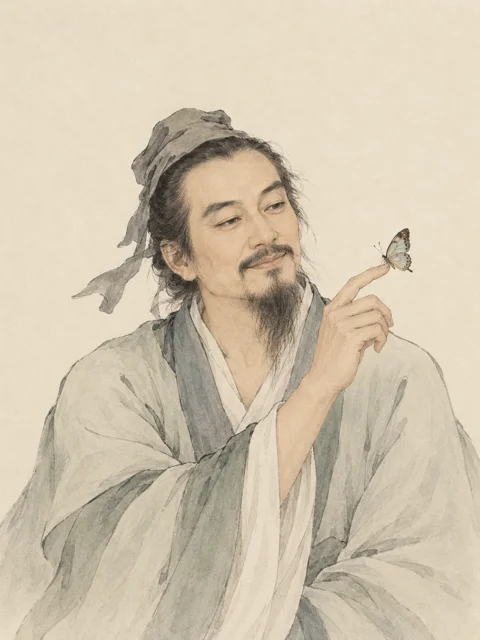
 AI 创作示意
GUANFU / zh-Hant
庄子
AI 创作示意德充符
版本按章对照,不代表逐句校勘对应。
中文原文(全三十三篇) / 庄子原典;维基文库贡献者整理
观复随文注释 · 56 条
魯有介独足者,指受过断足刑的人一作「兀」者王駘寓言中的独足得道者,從之遊者,與仲尼相若。常季孔子弟子,事迹不详問於仲尼,曰:「王駘,介一作「兀」者也,從之遊者,與夫子中分魯;立不教,坐不議;虛而往,實而歸。固有不言之教,无形无外在言教形式而心成者邪?是何人也?」仲尼曰:「夫子,聖人也,丘也直後而未往耳!丘將以爲師,而況不若丘者乎?奚假魯國,丘將引天下而與從之。」常季曰:「彼介一作「兀」者也,而王先生,其與庸亦遠矣。若然者,其用心也獨若之何?」仲尼曰:「死生亦大矣,而不得與之變,雖天地覆墜,亦將不與之遺,審乎无假不依凭外物,而不與物遷,命物之化,而守其宗也。」常季曰:「何謂也?」仲尼曰:「自其異者視之,肝膽楚、越相距遥远的两国,喻差异悬隔也。自其同者視之,萬物皆一也。夫若然者,且不知耳目之所宜,而遊心乎德之和。物視其所一,而不見其所喪,視喪其足,猶遺土也。」常季曰:「彼爲己,以其知得其心,以其心得其常心。物何爲最之别人为何聚集归附他;最有聚义哉?」仲尼曰:「人莫鑑照镜子、映照於流水,而鑑於止水静止不流的水。唯止,能止衆止。受命於地,唯松柏獨也在,冬夏青青;受命於天,唯舜獨也正,幸能正生,以正衆生。夫保始之徵,不懼之實,勇士一人,雄入於九軍泛指大军。將求名而能自要者,而猶若是,而況官天地,府萬物,直寓六骸头、身与四肢,象耳目,一知之所知,而心未嘗死者乎?彼且擇日而登假升至、达到至境;假读 gé,人則從是也,彼且何肯以物爲事乎?」
申徒嘉寓言中的独足者,介一作「兀」者也,而與鄭子產郑国政治家公孙侨同師於伯昏无人寓言中的得道者。子產謂申徒嘉曰:「我先出則子止,子先出則我止。」其明日,又與合堂同席而坐。子產謂申徒嘉曰:「我先出則子止,子先出則我止。今我將出,子可以止乎?其未邪?且子見執政掌权的执政大臣而不違,子齊執政乎?」申徒嘉曰:「先生之門,固有執政焉如此哉?子而悅一作「說」子之執政,而後人者也。聞之曰:『鑑明則塵垢不止,止則不明也。久與賢人處則无過。』今子之所取大者,先生也,而猶出言若是,不亦過乎?」子產曰:「子旣若是矣,猶與堯爭善。計子之德,不足以自反邪?」申徒嘉曰:「自狀其過,以不當亡者衆;不狀其過,以不當存者寡。知不可奈何而安之若命,唯有德者能之。遊於羿之彀中弓箭能够射及的范围,中央者,中地也,然而不中者,命也。人以其全足,笑吾不全足者,衆矣,我怫然生气不悦的样子;怫读 fú而怒,而適先生之所,則廢然怒气消散的样子而反,不知先生之洗我以善邪?吾與夫子遊,十九年矣,而未嘗知吾介一作「兀」者也。今子與我遊於形骸之內,而子索我於形骸之外,不亦過乎?」子產蹵然局促不安的样子,改容更貌,曰:「子无乃稱!」
魯有介一作「兀」者叔山无趾寓言中的受刖刑者,踵見以脚跟支撑行走来拜见仲尼。仲尼曰:「子不謹,前旣犯患若是矣,雖今來,何及矣?」无趾曰:「吾唯不知務而輕用吾身,吾是以亡足。今吾來也,猶有尊足者比双足更可贵的内在德性存,吾是以務全之也。夫天无不覆,地无不載,吾以夫子爲天地,安知夫子之猶若是也!」孔子曰:「丘則陋矣!夫子胡不入乎?請講以所聞。」无趾出。孔子曰:「弟子勉之!夫无趾,介一作「兀」者也,猶務學,以(復)補前行之惡,而況全德之人乎?」无趾語老聃曰:「孔丘之於至人,其未邪?彼何賓賓频频奔走、忙碌的样子以學子爲?彼且蘄以諔詭奇异;諔读 chù幻怪之名聞,不知至人之以是爲己桎梏脚镣手铐,喻精神束缚邪一作「也」?」老聃曰:「胡不直使彼以死生爲一條,以可不可爲一貫者,解其桎梏,其可乎?」无趾曰:「天刑精神受拘束如遭自然之刑之,安可解?」
魯哀公問於仲尼,曰:「衞有惡人此指容貌丑陋的人焉,曰哀駘它寓言中的丑貌而有德者。丈夫與之處者,思而不能去也;婦人見之,請於父母曰『與爲人妻,寧爲夫子妾』者,十數而未止也。未嘗有聞其唱倡导、率先发言者也,常和人而已矣。无君人之位以濟乎人之死,无聚祿以望人之腹,又以惡駭天下,和而不唱,知不出乎四域,且而雌雄合乎前,是必有異乎人者也。寡人召而觀之,果以惡駭天下。與寡人處,不至以月數,而寡人有意乎其爲人也;不至乎期年满一年;期读 jī,而寡人信之。國无宰主政之臣,寡人傳國焉。悶然而後應,氾若而一作「而若」辭。寡人醜乎,卒授之國。无幾何也,去寡人而行。寡人卹一作「䘏」焉,若有亡也,若无與樂是國也。是何人者也?」仲尼曰:「丘也嘗使於楚矣,適見豚小猪一作「㹠」子食於其死母者,少焉眴若惊惧回视的样子,皆棄之而走,不見己一作「已」焉爾,不得類焉爾。所愛其母者,非愛其形也,愛使其形者也。戰而死者,其人之葬也,不以翣棺旁扇形的丧葬饰物;读 shà資,刖古代断足之刑;读 yuè者之屨鞋;读 jù,无爲愛之,皆无其本矣。爲天子之諸御供侍奉君主的宫女,不爪翦,不穿耳,取妻者止於外,不得復使。形全,猶足以爲爾,而況全德之人乎?今哀駘它,未言而信,无功而親,使人授己國,唯恐其不受也,是必才全天赋本性完整而不受外扰而德不形内在德性不刻意显露者也。」哀公曰:「何謂才全?」仲尼曰:「死生、存亡、窮達、貧富、賢(與)不肖、毀譽、飢渴、寒暑,是事之變,命之行也,日夜相代乎前,而知不能規乎其始者也,故不足以滑和扰乱内心的和谐;滑读 gǔ,不可入於靈府心灵、精神的居所。使之和豫通,而不失於兌悦乐,使日夜无郤,而與物爲春与万物相处温和如春,是接而生時乎一作「於」心者也,是之謂才全。」「何謂德不形?」曰:「平者,水停之盛也,其可以爲法也,內保之而外不蕩也。德者,成和之脩也。德不形者,物不能離也。」哀公異日以告閔子孔子弟子闵子骞,曰:「始也,吾以南面而君天下,執民之紀,而憂其死,吾自以爲至通矣。今吾聞至人之言,恐吾无其實,輕用吾身,而亡吾國。吾與孔丘,非君臣也,德友而已矣!」
闉跂支離无脤寓言中跛足、曲身、缺唇者一作「脈」說衞靈公,靈公悅一作「說」之,而視全一作「其」人,其脰脖颈;读 dòu肩肩细小、短促的样子。甕㼜大癭寓言中颈瘤肿大如瓮者說齊桓公,桓公悅一作「說」之,而視全一作「其」人,其脰肩肩。故德有所長,而形有所忘。人不忘其所忘,而忘其所不忘,此謂誠忘。故聖人有所遊,而知爲孽,約爲膠,德爲接,工爲商。聖人不謀,惡用知?不斲砍削;读 zhuó,惡用膠?无喪,惡用德?不貨,惡用商?四者,天鬻天地的养育;鬻读 yù也。天鬻(也)者,天食也。旣受食於天,又惡用人?有人之形,无人之情。有人之形,故羣於人。无人之情,故是非不得於身。眇乎小哉,所以屬於人也;謷高远、自得的样子;读 áo乎大哉,獨成其天。
惠子謂莊子曰:「人故无情此指不以好恶损伤本性乎?」莊子曰:「然。」惠子曰:「人而无情,何以謂之人?」莊子曰:「道與之貌,天與之形,惡得不謂之人?」惠子曰:「旣謂之人,惡得无情?」莊子曰:「是非吾所謂情也。吾所謂无情者,言人之不以好惡內傷其身,常因自然,而不益生人为增益、强求生命也。」惠子曰:「不益生,何以有其身?」莊子曰:「道與之貌,天與之形,无以好惡內傷其身。今子外乎子之神,勞乎子之精,倚樹而吟,據槁梧枯木几案而瞑。天選子之形,子以堅白名家关于坚硬、白色的辨论鳴。」
观复随文注释 · AI 辅助独立整理,待持续人工校订。释义以本章语境为依据;存在异说或底本疑讹的地方另作提示。原文及版本来源保留如下。
参考: 本站所收原典:德充符 ↗
原典公有领域;电子文本据维基文库贡献者,按 CC BY-SA 4.0 保留署名及相同方式共享;调整空白与排版。 · 查看原始版本
欢迎引用本站资源,分享道家与道教文化。引用时请注明出处“观复”,并附上所引用内容的原始页面链接,方便读者查阅。
观复白话释义(AI 辅助) / 观复 · AI 辅助独立整理
【白话释义|AI 辅助独立整理,未经人工学术审定】
鲁国有个被砍去一只脚的人,叫王骀,跟随他学习的人,与跟随孔子的人一样多。常季问孔子:“王骀是独足的人,追随者却能同先生平分鲁国。他站着不讲学,坐着不议论,来学的人却空虚而来、充实而归。真有不用言语的教导、不显露形式便能使人内心得到成就的事情吗?他究竟是什么样的人?”孔子说:“这位先生是圣人,我不过落在后面,还没有前去拜访。我还要以他为师,何况不如我的人!哪里只限于鲁国,我要引导天下的人一道跟从他。”
常季说:“他是一个独足的人,却足以做先生的老师,可见与常人相去很远。这样的人,究竟怎样用心?”孔子说:“死生是大事,却不能改变他。即使天地倾覆,也不能使他丧失内在所守。他明白无所依待的真实,不随外物迁移;把事物的变化看作自然的命运,而守住根本。”常季问:“这是什么意思?”孔子说:“从差异看,即使同在一身的肝和胆,也像楚国、越国一样遥远;从共同处看,万物都浑然为一。这样的人,连耳目所喜好的享受都不放在心上,而把心安游于德性的和谐。他看事物所相通的一面,不着眼于自己失去的东西;看待失去一只脚,就像遗落一块泥土。”
常季说:“他修养自己,用智慧契合本心,又由本心获得常定之心。别人为什么都聚集到他身边?”孔子说:“人不拿流动的水照影,而拿静止的水照影。只有自身安定,才能使寻求安定的人也安定下来。草木受命于大地,只有松柏能保持自己的本性,冬夏常青;人受命于天,只有舜能特别端正自己,幸而端正自己的生命,又使众人的生命得到端正。守住本初所表现出的征验,便是真正的无惧。一个勇士能独自闯入大军,那还是为了求名而勉励自己,尚且能做到这样;何况把天地当作广大的活动之所,把万物纳入胸中,只把身体看作暂时的居处,把耳目看作感知的形具,贯通所知而内心始终生生不息的人呢?他将择时达到更高的境界,人们自然跟从他,他又哪里肯把操劳外物当成自己的事业!”
申徒嘉也是一个被砍去脚的人,与郑国的子产同拜伯昏无人为师。子产对申徒嘉说:“我先出去,你就留下;你先出去,我就留下。”第二天,两人又在同一堂室、同一席上坐着。子产又说:“我先出去,你就留下;你先出去,我就留下。如今我要出去了,你能留下吗?还是不肯?你见了执政者还不避让,难道要同执政者平起平坐?”申徒嘉说:“先生门下,难道还有这样一种执政身份的区别吗?你是自得于自己的执政地位,把别人放在后面。我听说:‘镜子明亮,尘垢便不会停留;尘垢停留,镜子就不明亮。长久与贤人相处,就会减少过错。’如今你所尊重的大贤是先生,却还说这样的话,岂不是过错?”
子产说:“你已经落到这个样子,还想同尧争高下。衡量自己的德行,难道还不足以反省吗?”申徒嘉说:“陈述自己的过错,却认为不该受损的人很多;不为自己的过错辩解,认为不必强求保全的人很少。知道无可奈何而安之若命,只有有德者能做到。在羿弯弓射击的范围内活动,那正是容易被射中的地方;居然未被射中,也只能说是命。别人凭自己双足健全来笑我缺足,这样的人很多。我原本愤愤不平,见到先生之后,便平静地回来,不知道是不是先生用至善洗净了我的怒气。我同先生相处十九年,我早已忘了自己是一个独足的人。如今你我以形体相遇,你本应在形体之外理解我,却还拿形体来评判我,岂不是过错?”子产局促不安,改变神色说:“你不必再说了。”
鲁国有个被砍去脚的人,叫叔山无趾,靠脚后跟走着来见孔子。孔子说:“你从前不谨慎,已经犯错受害,到了这种地步。如今虽来求学,还来得及什么呢?”无趾说:“我从前不懂得重要的事,轻率对待自身,所以失去了脚。如今来这里,是因为还有比脚更可贵的东西存在,我要努力保全它。天没有不覆盖的,地没有不承载的。我把先生看作天地,哪里知道先生也这样看我!”孔子说:“是我浅陋了!先生为什么不进来?请让我们讨论所听到的道理。”无趾离开了。孔子说:“弟子们要勉励自己!无趾受了断足之刑,尚且努力求学,以补救从前行为的过失,何况德行未受亏损的人!”
无趾对老聃说:“孔丘距离至人的境界,还差得远吧?他为什么一再学你那一套?他还想追求神奇怪异的名声,不知道至人把这些当作束缚自己的刑具吗?”老聃说:“何不直接让他把死生看作相通的一条,把可与不可看作一贯的整体,以解除束缚,这样可以吗?”无趾说:“他受到的是天生心见的束缚,哪里容易解开!”
鲁哀公问孔子:“卫国有个容貌丑陋的人,名叫哀骀它。男人同他相处,便思慕他,舍不得离开;女子见了他,向父母请求‘与其嫁给别人做妻子,宁可做他的妾’的,有十多个,还不止。没有听说他主动倡说过什么,他总是应和别人。他没有统治别人的地位,不能救人于死亡;也没有积聚的俸禄,不能满足别人的肚子;偏又丑得惊人。他只应和而不倡导,知识也没有超出通常的范围,男女却都聚集到他面前,这必定有异于常人的地方。
“我把他召来一看,果然丑得惊人。他和我相处,还不到一个月,我就开始留意、喜爱他的为人;不到一年,我便信任他。国内缺少主持政务的大臣,我要把国家交托给他。他沉默许久才答应,神情淡泊,仿佛还要推辞。我感到惭愧,终于把国事交给他。没有多久,他却离开我走了。我忧伤怅惘,像失去了什么,又像没有人能同我分享这个国家的欢乐。他究竟是什么人?”
孔子说:“我曾出使楚国,恰好看到一群小猪在死去的母猪身上吃奶。过了一会儿,它们惊惶起来,纷纷离开,因为母亲已经不再回应它们,不再有同类活着的气息。小猪爱母亲,不是爱它的外形,而是爱使形体活着的东西。战死的人,下葬时不再用原本装饰其生前仪容的物件;脚被砍掉的人,也不再珍爱鞋子,因为所依托的根本已经失去了。选来侍奉天子的宫女,不让她们剪损指甲、穿伤耳朵;新婚男子暂留在外,不再派去服役。仅仅身体完整,尚且受到这样的珍惜,何况德性完整的人!如今哀骀它尚未说话,就受人信任;尚无功绩,就被人亲近;使人愿把国家交给他,只怕他不接受。这一定是内在禀赋完足、德性又不显露于外的人。”
哀公问:“什么叫禀赋完足?”孔子说:“死生、存亡、穷困与显达、贫穷与富裕、贤与不肖、诋毁与赞誉、饥渴与寒暑,这些都是事情的变化、命运的运行,日夜轮流出现,人的智力不能穷究其起点。因此,不要让它们扰乱内在的和谐,不让它们侵入心灵的居处。使心和悦通畅,不失喜悦;日夜都没有间断,同外物相接时如春天温润,让适时的生机在心中发生,这就叫禀赋完足。”哀公问:“什么叫德性不显露?”孔子说:“平静,是水安定的最高状态,可以作为准则;内部保有平衡,外面便不摇荡。德,是成就和谐的修养。德性不刻意显露,万物反而不能离开他。”
后来,哀公告诉闵子:“起初,我居君位、统治国家,把握百姓的纲纪,担忧他们的死亡,自以为已经十分通达。现在听了至人的话,才怕自己没有真正的德性,轻率对待自身,因而丧失国家。我与孔丘,已经不只是君臣,而是以德相交的朋友!”
一个身体弯曲、行动不便、嘴唇残缺的人去游说卫灵公,灵公很喜欢他,再看形体健全的人,反觉得那些人的脖子细小。另一个脖子上长着瓮一般大瘿瘤的人去游说齐桓公,桓公很喜欢他,再看形体健全的人,也觉得他们的脖子细小。所以德性有所长,形貌就会被忘掉。人们不忘本应忘掉的外形,却忘了不应忘掉的内在,这才是真正的错忘。
因此圣人有自己的精神游处,明白机智会招祸,约束会成为黏人的胶,刻意的施德会成为攀结,工巧会成为买卖。圣人不谋算,何用机智?不斫削,何用胶合?没有本真的丧失,何用刻意施德来补救?不把自己当货物,何用交易?超脱这四种人为的牵累,便是自然的养育。自然养育,就是取食于天。既然已经接受自然的滋养,又何须人为增添?他有人的形体,却没有通常那种伤害自己的情欲。有人的形体,所以同人群相处;没有那些情欲,所以是非不能侵害自身。很小很小的,是他与人类形体相属的那一面;极大极大的,是他独自成全天性的那一面。
惠子对庄子说:“人本来可以没有情吗?”庄子说:“可以。”惠子说:“人没有情,怎么还能叫人?”庄子说:“道给他容貌,天给他形体,怎么不能叫人?”惠子说:“既然叫人,怎么会没有情?”庄子说:“这不是我所说的情。我所说的无情,是指人不因喜好和厌恶而从内部伤害自己,常顺着自然,不刻意增益生命。”惠子说:“不增益生命,怎么维持身体?”庄子说:“道给他容貌,天给他形体,只要别让好恶从内部伤害它。如今你却让精神驰逐于外,使精力劳累;倚着树吟咏,靠着枯木几案闭眼苦思。天给你这样一个身体,你却只拿‘坚’与‘白’的辩论来争鸣!”
校订说明:本篇“介/兀”随上下文释为受断足刑或独足者,不能据寓言反推具体人物的真实遭遇。“申徒嘉”末段源文“游于形骸之内/索我于形骸之外”语意有争议,以上按责备以形骸评人的整体语境连贯释出;“自状其过”两句、“翣资”“肩肩”“天鬻”亦有不同训释。人物外貌描写保留古文论证材料,其重点为德性不依外形而定。
〔补校:“未尝知吾介”承接申徒嘉自述,暂以申徒嘉忘却自身独足为释;古文省主语,另有以老师不在意其缺足为释的读法。〕
观复白话释义:AI 辅助依据古文独立编写,已进行文本覆盖核对,未经人工学术审定;原典来源及电子底本署名、许可见对应中文版本。 · 查看原始版本
Herbert A. Giles 英译(全三十三篇) / Herbert A. Giles(翟理斯),1889
The Evidence of Virtue Complete.
[Translator’s note] Argument :—Correspondence between inward virtue and outward influence—The virtuous man disregards externals—The possession of virtue causes oblivion of outward form—Neglect of the human—Cultivation of the divine.
In the State of Lu there was a man, named Wang T'ai, who had had his toes cut off. His disciples were as numerous as those of Confucius.
Ch'ang Chi
[Translator’s note] One of the latter.
asked Confucius, saying, "This Wang T'ai has been mutilated, yet he divides with you, Sir, the teaching of the Lu State. He neither preaches nor discusses; yet those who go to him empty, depart full. He must teach the doctrine which does not find expression in words ;
[Translator’s note] The doctrine of Tao . These words occur in chs. ii and xliii of the Tao-Tê-Ching . See The Remains of Lao Tzŭ , p. 7.
and although his shape is imperfect, his mind is perhaps complete. What manner of man is this?"
"He is a prophet," replied Confucius, "whose instruction I have been late in seeking. I will go and learn from him. And if I,—why not those who are not equal to me? And I will take with me, not the State of Lu only, but the whole world."
"The fellow has been mutilated," said Ch'ang Chi, "and yet people call him Master . He must be very different from the ordinary run. But how does he use his mind in this sense?"
"Life and Death are all powerful," answered Confucius, "but they cannot affect it .
[Translator’s note] The mind, or soul, which is immortal. See ch. iii .
Heaven and earth may collapse, but that will remain. If this is found to be without flaw, it will not share the fate of all things. It can cause other things to change, while preserving its own constitution intact."
"How so?" asked Ch'ang Chi.
"From the point of view of difference," replied Confucius, "we distinguish between the liver and the gall, between the Ch'u State and the Yüeh State. From the point of view of sameness, all things are ONE . Such is the position of Wang T'ai. He does not trouble about what reaches him through the senses of hearing and sight, but directs his whole mind towards the very climax of virtue. He beholds all things as though ONE , without observing their discrepancies. And thus the discrepancy of his toes is to him as would be the loss of so much mud."
"He devotes himself in fact to himself," said Ch'ang Chi, "and uses his wisdom to perfect his mind, until it becomes perfect. But how then is it that people make so much of him?"
[Translator’s note] His virtue being wholly, as it were, of a selfish order.
"A man," replied Confucius, "does not seek to see himself in running water, but in still water. For only what is itself still can instil stillness into others.
"The grace of earth has reached only to pines and cedars;—winter and summer alike they are green. The grace of God has reached to Yao and to Shun alone;—the first and foremost of all creation. Happily they were able to regulate their own lives and thus regulate the lives of all mankind.
"By nourishment of physical courage, the sense of fear may be so eliminated that a man will, single-handed, brave a whole army. And if such a result can be achieved in search of fame, how much more by one who extends his sway over heaven and earth and influences all things; and who, lodging within the confines of a body with its channels of sight and sound, brings his knowledge to know that all things are ONE , and that his soul endures for ever! Besides, he awaits his appointed hour, and men flock to him of their own accord. He makes no effort to attract them."
[Translator’s note] That men thus gather around him is the outward sign or evidence of his inward virtue complete.
Shên T'u Chia had had his toes cut off. Subsequently, he studied under Poh Hun Wu Jen at the same time as Tzŭ Ch'an of the Chêng State. The latter said to him, "When I leave first, do you remain awhile. When you leave first, I will remain behind."
[Translator’s note] Tzŭ Ch'an was a model minister of the sixth century B.C. Under his guidance the people of the Chêng State became so virtuous that doors were not locked at night, nor would any one pick up lost articles left lying in the road. He was hardly likely to be ashamed of walking out with a mutilated criminal.
Next day, when they were again together in the lecture-room, Tzŭ Ch'an said, "When I leave first, do you remain awhile. When you leave first, I will remain. I am now about to go. Will you remain or not? I notice you show no respect to a Minister of State. Perhaps you think yourself my equal?"
"Dear me!" replied Shên T'u Chia, "I didn't know we had a Minister of State in the class. Perhaps you think that because you are one you should take precedence over the rest. Now I have heard that if a mirror is perfectly bright, dust and dirt will not collect on it. That if they do, it is because the mirror was not bright. He who associates for long with the wise will be without fault. Now you have been improving yourself at the feet of our Master, yet you can utter words like these. Is not the fault in you?"
"You are a fine fellow, certainly," retorted Tz ŭ Ch'an, "you will be emulating the virtue of Yao next. To look at you, I should say you had enough to do to attend to your own shortcomings!"
[Translator’s note] A sneer at his want of toes.
"Those who disguise their faults," said Shên T'u Chia, "so as not to lose their toes, are many in number. Those who do not disguise their faults, and so fail to keep them, are few. To recognise the inevitable and to quietly acquiesce in Destiny, is the achievement of the virtuous man alone. He who should put himself in front of the bull's-eye when Hou I
[Translator’s note] A Chinese Tell.
was shooting, would be hit. If he was not hit, it would be destiny. Those with toes who laugh at me for having no toes are many. This used to make me angry. But since I have studied under our Master, I have ceased to trouble about it. It may be that our Master has so far succeeded in purifying me. At any rate I have been with him nineteen years without being aware of the loss of my toes. Now you and I are engaged in studying the internal. Do you not then commit a fault by thus dragging me back to the external?"
At this Tzŭ Ch'an began to fidget, and changing countenance, begged Shên T'u Chia to say no more.
There was a man of the Lu State who had been mutilated,—Shu Shan No-toes . He came walking on his heels to see Confucius; but Confucius said, "You did not take care, and so brought this misfortune upon yourself. What is the use of coming to me now?"
"In my ignorance," replied No-toes, "I made free with my body and lost my toes. But I come with something more precious than toes which I now seek to keep. There is no man, but Heaven covers him: there is no man, but Earth supports him;—and I thought that you, sir, would be as Heaven and Earth. I little expected to hear these words from you."
"I must apologise," said Confucius. "Pray walk in and let us discuss." But No-toes walked out.
"There!" said Confucius to his disciples. "There is a criminal without toes who seeks to learn in order to make atonement for his previous misdeeds. And if he, how much more those who have no misdeeds for which to atone?"
No-toes went off to Lao Tzŭ and said, "Is Confucius a sage, or is he not? How is it he has so many disciples? He aims at being a subtle dialectician, not knowing that such a reputation is regarded by real sages as the fetters of a criminal."
"Why do you not meet him with the continuity of life and death, the identity of can and can not ," answered Lao Tzŭ, "and so release him from these fetters?"
"He has been thus punished by God," replied No-toes. "It would be impossible to release him."
[Translator’s note] A sneer at Confucius. No-toes himself had only been punished by man.
Duke Ai of the Lu State said to Confucius, "In the Wei State there is a leper, named Ai T'ai T'o. The men who live with him like him and make no effort to get rid of him. Of the women who have seen him, many have said to their parents, Rather than be another man's wife, I would be his concubine.
"He never preaches at people, but puts himself into sympathy with them. He wields no power by which he may protect men's bodies. He has at his disposal no appointments by which to gratify their hearts. He is loathsome to a degree. He sympathises, but does not instruct. His knowledge is limited to his own State. Yet males and females alike all congregate around him.
"So thinking that he must be different from ordinary men, I sent for him, and saw that he was indeed loathsome to a degree. Yet we had not been many months together ere my attention was fixed upon his conduct. A year had not elapsed ere I trusted him thoroughly; and as my State wanted a Prime Minister, I offered the post to him. He accepted it sullenly, as if he would much rather have declined. Perhaps he didn't think me good enough for him! At any rate, he took it; but in a very short time he left me and went away. I grieved for him as for a lost friend, and as though there were none left with whom I could rejoice. What manner of man is this?
"When I was on a mission to the Ch'u State," replied Confucius, "I saw a litter of young pigs sucking their dead mother. After a while they looked at her, and then they all left the body and went off. For their mother did not look at them any more, nor did she any more seem to be of their kind. What they loved was their mother; not the body which contained her, but that which made the body what it was.
"When a man is killed in battle, his arms are not buried with him.
[Translator’s note] He has no further use for weapons.
A man whose toes have been cut off does not value a present of boots. In each case the function of such things is gone.
"The concubines of the Son of Heaven do not cut their nails or pierce their ears.
[Translator’s note] For fear of injuring their persons.
He who has a marriageable daughter keeps her away from menial work. To preserve her beauty is quite enough occupation for her. How much more so for a man of perfect virtue?
[Translator’s note] Who should trouble himself only about the internal.
"Now Ai T'ai T'o says nothing, and is trusted. He does nothing, and is sought after. He causes a man to offer him the government of his own State, and the only fear is lest he should decline. Truly his talents are perfect and his virtue without outward form!"
"What do you mean by his talents being perfect?" asked the Duke.
"Life and Death," replied Confucius, "existence and non-existence, success and non-success, poverty and wealth, virtue and vice, good and evil report, hunger and thirst, warmth and cold,—these all revolve upon the changing wheel of Destiny. Day and night they follow one upon the other, and no man can say where each one begins. Therefore they cannot be allowed to disturb the harmony of the organism, nor enter into the soul's domain. Swim however with the tide, so as not to offend others. Do this day by day without break, and live in peace with mankind. Thus you will be ready for all contingencies, and may be said to have your talents perfect."
"And virtue without outward form; what is that?"
"In a water-level," said Confucius, "the water is in a most perfect state of repose. Let that be your model. The water remains quietly within, and does not overflow. It is from the cultivation of such harmony that virtue results. And if virtue takes no outward form, man will not be able to keep aloof from it."
[Translator’s note] Mankind will be regenerated thereby, in the same way that evenness is imparted by the aid of water to surfaces, although the water is all the time closed up and does not overflow.
Some days afterwards Duke Ai told Min Tzŭ,
[Translator’s note] One of Confucius' disciples.
saying, "When first I took the reins of government in hand, I thought that in caring for my people's lives I had done all my duty as a ruler. But now that I have heard what a perfect man is, I fear that I have not been succeeding, but foolishly using my body and working destruction to my State. Confucius and I are not prince and minister, but merely friends with a care for each other's moral welfare."
A certain hunchback, named Wu Ch'un, whose heels did not touch the ground, had the ear of Duke Ling of Wei. The Duke took a great fancy to him; and as for well-formed men, he thought their necks were too short.
Another man, with a goitre as big as a large jar, had the ear of Duke Huan of Ch'i. The Duke took a great fancy to him; and as for well-formed men, he thought their necks were too thin.
Thus it is that virtue should prevail and outward form be forgotten. But mankind forgets not that which is to be forgotten, forgetting that which is not to be forgotten. This is forgetfulness indeed! And thus with the truly wise, wisdom is a curse, sincerity like glue, virtue only a means to acquire, and skill nothing more than a commercial capacity. For the truly wise make no plans, and therefore require no wisdom. They do not separate, and therefore require no glue. They want nothing, and therefore need no virtue. They sell nothing, and therefore are not in want of a commercial capacity. These four qualifications are bestowed upon them by God and serve as heavenly food to them. And those who thus feed upon the divine have little need for the human. They wear the forms of men, without human passions. Because they wear the forms of men, they associate with men. Because they have not human passions, positives and negatives find in them no place. Infinitesimal indeed is that which makes them man: infinitely great is that which makes them divine!
Hui Tzŭ said to Chuang Tzŭ, "Are there then men who have no passions?"
Chuang Tzŭ replied, "Certainly."
"But if a man has no passions," argued Hui Tzŭ, "what is it that makes him a man?"
" Tao ," replied Chuang Tzŭ, "gives him his expression, and God gives him his form. How should he not be a man?"
"If then he is a man," said Hui Tzŭ, "how can he be without passions?"
"What you mean by passions," answered Chuang Tzŭ, "is not what I mean. By a man without passions I mean one who does not permit good and evil to disturb his internal economy, but rather falls in with whatever happens, as a matter of course, and does not add to the sum of his mortality."
[Translator’s note] The play of passion would tend to create conditions which otherwise would not exist.
"But whence is man to get his body," asked Hui Tzŭ, "if there is to be no adding to the sum of mortality?"
[Translator’s note] This is of course a gibe. Hui Tzŭ purposely takes Chuang Tzŭ's words à double entente .
" Tao gives him his expression," said Chuang Tzŭ, "and God gives him his form. He does not permit good and evil to disturb his internal economy. But now you are devoting your intelligence to externals, and wearing out your mental powers. You prop yourself against a tree and mutter, or lean over a table with half-closed eyes.
[Translator’s note] Chang Tzŭ puts his last sentence into doggerel, the more effectively to turn the tables against Hui Tzŭ, whose paradoxical theories he is never tired of ridiculing. See ch. ii .
原著及 Herbert A. Giles 历史译本公有领域;据 Project Gutenberg #59709,完整电子书及使用条款见本站资料来源。 · 查看原始版本
我的书签(此浏览器)
还没有书签。