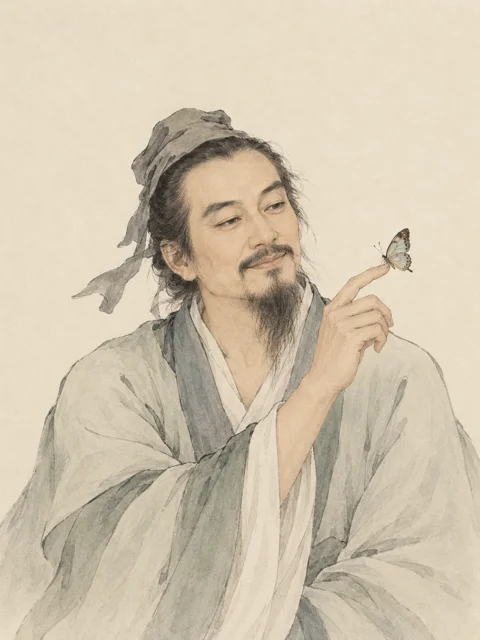
 AI 创作示意
GUANFU / zh-Hant
庄子
AI 创作示意外篇 · 馬蹄
版本按章对照,不代表逐句校勘对应。
中文原文(全三十三篇) / 庄子原典;维基文库贡献者整理
观复随文注释 · 34 条
馬,蹄可以踐霜雪,毛可以禦風寒,齕草啃草;齕读 hé飲水,翹足而陸跳跃,此馬之眞性也,雖有義臺路寢高台正殿;义有异文,无所用之。及至伯樂传说善于识马、驯马的人,曰:「我善治馬。」燒之剔之烙印、修剪马毛,刻之雒烙印;读 luò之,連之以羈馽马络头与绊马足的绳,編之以皁棧马槽与马棚,馬之死者十二三十分之二三矣。飢之渴之,馳之驟之,整之齊之,前有橛飾马口的嚼子及其装饰之患,而後有鞭筴鞭子与马杖;筴同策之威,而馬之死者已過半矣。陶者曰:「我善治埴黏土;读 zhí,圓者中規符合圆规的标准;中读 zhòng,方者中矩。」匠人曰:「我善治木,曲者中鉤,直者應繩。」夫埴木之性,豈欲中規矩鉤繩哉?然且世世稱之曰:「伯樂善治馬,而陶匠善治埴木。」此亦治天下者之過也。
吾意善治天下者不然。彼民有常性,織而衣,耕而食,是謂同德;一而不黨,命曰天放任其天然,自由舒展。故至德之世,其行塡塡稳重踏实的样子,其視顚顚目光专一的样子。當是時也,山无蹊隧小路,澤无舟梁船与桥梁,萬物羣生,連屬其鄉,禽獸成羣,草木遂長,是故禽獸可係羈而遊,鳥鵲之巢可攀援而闚。夫至德之世,同與禽獸居,族與萬物並,惡乎知君子小人哉?同乎无知,其德不離,同乎无欲,是謂素樸,素樸而民性得矣。及至聖人,蹩躠勉强用力的样子一作「躄」爲仁,踶跂刻意振作、企求的样子爲義,而天下始疑矣;澶漫放纵无节的样子爲樂,擿一作「摘」僻繁琐曲折地制作爲禮,而天下始分矣。故純樸不殘,孰爲犧樽雕成兽形的礼用酒器?白玉不毀,孰爲珪璋礼仪用的玉器?道德不廢,安取仁義?情性一作「性情」不離,安用禮樂?五色不亂,孰爲文采?五聲不亂,孰應六律?
夫殘樸以爲器,工匠之罪也;毀道德以爲仁義,聖人之過也。夫馬,陸居則食草飲水,喜則交頸相靡互相摩擦,怒則分背相踶互相踢踏;踶读 dì,馬知已此矣。夫加之以衡枙车辕横木与马颈轭一作「扼」,齊之以月題马额上的月形饰物,而馬知介倪侧眼窥视、闉枙一作「扼」、騺一作「鷙」曼、詭銜设法吐出或摆脱马嚼、竊轡挣脱缰绳,故馬之知而能至盜者,伯樂之罪也。夫赫胥氏传说中的上古帝王之時,民居不知所爲,行不知所之,含哺口中含着食物而熙,鼓腹而遊,民能以此矣。及至聖人屈折禮樂以匡天下之形,縣企悬起而使人企望一作「跂」仁義以慰天下之心,而民乃始踶跂好知,爭歸於利,不可止也,此亦聖人之過也。
观复随文注释 · AI 辅助独立整理,待持续人工校订。释义以本章语境为依据;存在异说或底本疑讹的地方另作提示。原文及版本来源保留如下。
参考: 本站所收原典:外篇 · 馬蹄 ↗
原典公有领域;电子文本据维基文库贡献者,按 CC BY-SA 4.0 保留署名及相同方式共享;调整空白与排版。 · 查看原始版本
欢迎引用本站资源,分享道家与道教文化。引用时请注明出处“观复”,并附上所引用内容的原始页面链接,方便读者查阅。
观复白话释义(AI 辅助) / 观复 · AI 辅助独立整理
【白话释义|AI 辅助独立整理,未经人工学术审定】
马的蹄子可以踩霜踏雪,毛可以抵御风寒,吃草、喝水,抬起脚就在地上奔驰,这就是马真实的天性。即使有高大的台阁、堂皇的宫室,对它也没有什么用。等到伯乐出现,说:“我善于调教马。”于是烧灼它的毛,修削它的蹄,刻伤它,给它烙上标记,用笼头绊索把它牵连起来,编排在马槽和马厩里,马便死了十分之二三。再让它挨饿、受渴,逼它疾驰奔跑,训练队列整齐;前面有嚼口、额饰的拘束,后面有鞭策的威胁,马死的已经超过一半。
陶工说:“我善于处理黏土,圆的合乎圆规,方的合乎曲尺。”木匠说:“我善于处理木材,弯的合乎钩,直的合乎墨绳。”黏土和木材的本性,难道自己想要符合规、矩、钩、绳吗?可是世世代代仍称赞说:“伯乐善于治马,陶工木匠善于治土治木。”这也就是治理天下的人所犯的过错。
我认为,真正善于治理天下的人,不是这样。百姓有自己的常性:织布穿衣,种田吃饭,这叫共同的自然德性;浑然一体,不分朋党,这叫天性的自由舒展。因此,在德性最完整的时代,人走路稳重,目光专一质朴。那时候,山中没有穿行的道路,水泽没有船和桥;万物群聚生长,各自的居处相连;禽兽成群,草木顺遂生长。因此,可以牵着禽兽一道游行,也可以攀树看看鸟鹊的巢。德性最完整的时代,人同禽兽居住,与万物并列为伴,哪里知道君子、小人的分别?大家同样没有机诈之知,便不离本德;同样没有贪欲,这就叫素朴。素朴,百姓的天性便得到实现。
等到圣人出现,费力踮脚地推行仁义,天下才开始疑惑;又放纵铺张地制作音乐,拘泥繁琐地制作礼仪,天下才开始分离。所以,完整的原木不被砍坏,谁能做出祭祀的雕饰酒器?白玉不被毁凿,谁能做出圭璋?道德不被废弃,哪里需要另外标举仁义?人的自然情性不被分离,哪里用得着礼乐?五色不被错杂,谁能制造绚丽文采?五音不被变乱,谁又去调合繁复的六律?
损伤原木来做器具,是工匠的罪;损坏自然道德来制造仁义,是圣人的过错。马在陆地生活,吃草喝水,高兴时交颈相互摩擦,生气时背向对方相互踢蹬,马本来的知能不过如此。给它加上车衡和颈轭,用月牙形的额饰整束,它就学会斜眼窥伺、扭颈抗拒、挣扎抵赖、吐动嚼口、偷脱缰绳。所以马竟聪明到会作假欺瞒,这是伯乐的罪。
在赫胥氏的时代,百姓安居而不刻意求做什么,行走也不刻意求到哪里;含着食物快乐自得,吃饱肚子自在游玩,人们的生活能力和愿望不过如此。等到圣人屈曲制作礼乐,用来匡正天下人的外在行为,高高悬起仁义,用来抚慰天下人的内心,百姓才开始踮脚企慕、喜好智巧,争着追逐利益,无法停止。这也是圣人的过错。
校订说明:“义台路寝”“翘足而陆”“介倪、闉枙、騺曼”等有异训,按马的自然生活与受制后的反抗来释。“赫胥氏”所代表的上古社会是本篇的理想化叙述。篇中“圣人之过”针对人为制度侵损自然的论辩立场,保留其尖锐措辞,不改成一般管理建议。
观复白话释义:AI 辅助依据古文独立编写,已进行文本覆盖核对,未经人工学术审定;原典来源及电子底本署名、许可见对应中文版本。 · 查看原始版本
Herbert A. Giles 英译(全三十三篇) / Herbert A. Giles(翟理斯),1889
Horses' Hoofs.
[Translator’s note] Argument :—Superiority of the natural over the artificial—Application of this principle to government.
Horses have hoofs to carry them over frost and snow; hair, to protect them from wind and cold. They eat grass and drink water, and fling up their heels over the champaign. Such is the real nature of horses. Palatial dwellings are of no use to them.
One day Poh Loh
[Translator’s note] A Chinese Rarey, of somewhat legendary character.
appeared, saying, "I understand the management of horses."
So he branded them, and clipped them, and pared their hoofs, and put halters on them, tying them up by the head and shackling them by the feet, and disposing them in stables, with the result that two or three in every ten died. Then he kept them hungry and thirsty, trotting them and galloping them, and grooming, and trimming, with the misery of the tasselled bridle before and the fear of the knotted whip behind, until more than half of them were dead.
The potter says, "I can do what I will with clay. If I want it round, I use compasses; if rectangular, a square."
The carpenter says, "I can do what I will with wood. If I want it curved, I use an arc; if straight, a line."
But on what grounds can we think that the natures of clay and wood desire this application of compasses and square, of arc and line? Nevertheless, every age extols Poh Loh for his skill in managing horses, and potters and carpenters for their skill with clay and wood. Those who govern the empire make the same mistake.
Now I regard government of the empire from quite a different point of view.
The people have certain natural instincts;—to weave and clothe themselves, to till and feed themselves. These are common to all humanity, and all are agreed thereon. Such instincts are called "Heaven-sent."
And so in the days when natural instincts prevailed, men moved quietly and gazed steadily. At that time, there were no roads over mountains, nor boats, nor bridges over water. All things were produced, each for its own proper sphere. Birds and beasts multiplied; trees and shrubs grew up. The former might be led by the hand; you could climb up and peep into the raven's nest. For then man dwelt with birds and beasts, and all creation was one. There were no distinctions of good and bad men. Being all equally without knowledge, their virtue could not go astray. Being all equally without evil desires, they were in a state of natural integrity, the perfection of human existence.
But when Sages appeared, tripping people over charity and fettering with duty to one's neighbour, doubt found its way into the world. And then with their gushing over music and fussing over ceremony, the empire became divided against itself.
[Translator’s note] Music and ceremonies are important factors in the Confucian system of government.
Were the natural integrity of things left unharmed, who could make sacrificial vessels? Were white jade left unbroken, who could make the regalia of courts? Were Tao not abandoned, who could introduce charity and duty to one's neighbour? Were man's natural instincts his guide, what need would there be for music and ceremonies? Were the five colours not confused, who would practise decoration? Were the five notes not confused, who would adopt the six pitch-pipes?
[Translator’s note] See chs. viii and x .
Destruction of the natural integrity of things, in order to produce articles of various kinds,—this is the fault of the artisan. Annihilation of Tao in order to practise charity and duty to one's neighbour,—this is the error of the Sage.
Horses live on dry land, eat grass and drink water. When pleased, they rub their necks together. When angry, they turn around and kick up their heels at each other. Thus far only do their natural dispositions carry them. But bridled and bitted, with a plate of metal on their foreheads, they learn to cast vicious looks, to turn the head to bite, to resist, to get the bit out of the mouth or the bridle into it. And thus their natures become depraved,—the fault of Poh Loh.
In the days of Ho Hsü
[Translator’s note] A legendary ruler of old.
the people did nothing in particular when at rest, and went nowhere in particular when they moved. Having food, they rejoiced; having full bellies, they strolled about. Such were the capacities of the people. But when the Sages came to worry them with ceremonies and music in order to rectify the form of government, and dangled charity and duty to one's neighbour before them in order to satisfy their hearts,—then the people began to develop a taste for knowledge and to struggle one with the other in their desire for gain. This was the error of the Sages.
[Translator’s note] The simplicity of style, and general intelligibility of this chapter have raised doubts as to its genuineness. But as Lin Hsi Chung justly observes, its sympathetic tone in relation to dumb animals, stamps it, in spite of an undue proportion of word to thought, as beyond reach of the forger's art.
原著及 Herbert A. Giles 历史译本公有领域;据 Project Gutenberg #59709,完整电子书及使用条款见本站资料来源。 · 查看原始版本
我的书签(此浏览器)
还没有书签。