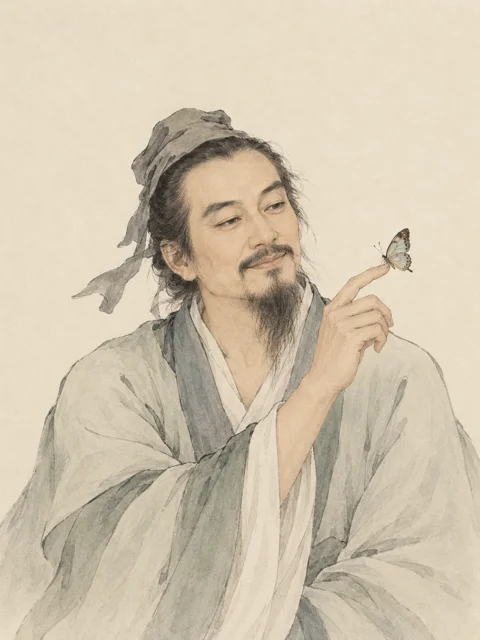
 AI 创作示意
GUANFU / zh-Hans
庄子
AI 创作示意逍遙遊 · 白话释义
版本按章对照,不代表逐句校勘对应。
中文原文(全三十三篇) / 庄子原典;维基文库贡献者整理
观复随文注释 · 180 条
北冥北方的大海,冥通“溟”有魚,其名爲鯤鲲,kūn,寓言中的巨鱼。鯤之大,不知其幾千里也,化而爲鳥,其名爲鵬鹏,péng,由鲲变成的巨鸟。鵬之背,不知其幾千里也,怒而飛奋力振翅飞起,其翼若垂天之雲天边大片的云。是鳥也,海運海动风起之时,則將徙迁移於南冥南方的大海。南冥者,天池天然的大池,这里指大海也。齊諧记载奇异故事的书者,志怪记载奇异之事者也。諧之言曰:「鵬之徙於南冥也,水擊翅膀拍击水面三千里,摶tuán,盘旋而上扶搖自下而上的旋风而上者九萬里,去以六月息乘着六月的大风离去者也。」野馬田野间像奔马般浮动的雾气也,塵埃也,生物之以息相吹生物用气息相互吹拂也。天之蒼蒼深蓝色,其正色本来的颜色邪?其遠而无所至極邪?其視下也鹏从高空向下看,亦若是則已矣。且夫水之積也不厚,則負大舟托起大船也无力。覆杯水於坳堂堂上低凹的地方,坳读 ào之上,則芥细小的草叶爲之舟,置杯焉則膠搁浅不动,水淺而舟大也。風之積也不厚,則其負大翼也无力,故九萬里,則風斯在下矣,而後乃今这样之后才,培風凭借、乘着风,背負青天,而莫之夭閼yāo è,阻挡、遏止者,而後乃今將圖南计划向南飞行。
蜩tiáo,蝉與鷽鳩xué jiū,一种小鸟笑之曰:「我決起奋起飞翔,决读 xuè而飛,槍qiāng,碰到、触及榆枋榆树和枋树,時則不至,而控於地落回地上而已矣,奚以之九萬里而南爲何必飞上九万里再往南去呢?」適莽蒼到近郊去者,三湌而反吃三顿饭就返回,腹猶果然肚子饱饱的样子;適百里者,宿舂糧前一夜舂米备粮,舂读 chōng;適千里者,三月聚糧花三个月准备路粮。之二蟲这两个小动物,指蝉和小鸟,又何知?小知不及大知小见识比不上大见识,小年不及大年短寿比不上长寿。奚以知其然也?朝菌寿命很短的菌类不知晦朔农历月末和月初,蟪蛄huì gū,一种寿命短的蝉不知春秋。此小年也。楚之南有冥靈传说中的长寿之物者,以五百歲爲春,五百歲爲秋;上古有大椿传说中的长寿大树,椿读 chūn者,以八千歲爲春,八千歲爲秋。而彭祖传说中的长寿人物乃今以久特聞因长寿而特别闻名,衆人匹之与他相比,不亦悲乎!
湯商朝的开国君主商汤之問棘传说中商汤请教的贤者也是已就是这样。窮髮草木不生的偏远地方之北,有冥海者,天池也。有魚焉,其廣數千里,未有知其脩同“修”,长者,其名爲鯤。有鳥焉,其名爲鵬,背若太山高大的山,也写作“泰山”,翼若垂天之雲,摶扶搖羊角像羊角般盘旋的旋风而上者九萬里,絕雲氣穿过云层,負青天,然後圖南,且適南冥也。斥鴳chì yàn,一种小鸟笑之曰:「彼且奚適到哪里去也?我騰躍而上,不過數仞古代长度单位,约七八尺而下,翺翔蓬蒿野草,泛指草丛之間,此亦飛之至也。而彼且奚適也?」此小大之辯小与大的区别也。故夫知效一官才智能胜任一个官职,行比一鄉品行得到一乡人的认可,德合一君德行得到君主认可,而徵一國得到一国人的信任者,其自視也,亦若此矣,而宋榮子战国思想家,通常认为是宋钘猶然含笑的样子笑之。且舉世而譽之,而不加勸更加奋勉,舉世而非之,而不加沮jǔ,沮丧、气馁,定乎內外之分自身修养与外界评价的区别,辯乎榮辱之境荣与辱的界限,斯已矣。彼其於世,未數數然shuò shuò rán,急切追求的样子也,雖然,猶有未樹还未达到完全自由的境界也。夫列子古代思想家列御寇御風乘风而行,泠然líng rán,轻盈美好的样子善也,旬有五日十五天而後反。彼於致福求取福泽者,未數數然也。此雖免乎行,猶有所待有所依赖,这里指依靠风者也。若夫乘天地之正顺应天地自然的规律,而御六氣之辯阴、阳、风、雨、晦、明的变化,以遊无窮者,彼且惡乎待还依赖什么呢,恶读 wū哉?故曰:「至人无己境界完善的人不执着于自我,神人无功精神高妙的人不居功自傲,聖人无名圣人不追求名声。」
堯传说中的古代圣王讓天下於許由传说中拒绝接受尧让位的隐士,曰:「日月出矣,而爝火jué huǒ,火把的光不息,其於光也,不亦難乎?時雨应时而下的雨降矣,而猶浸灌灌溉,其於澤也,不亦勞乎?夫子立而天下治,而我猶尸之占据这个位置,吾自視缺然觉得自己有所不足,請致天下把天下让给对方。」許由曰:「子治天下,天下旣已治也,而我猶代子,吾將爲名乎?名者,實之賓实际的附属,指名声依附于实际也,吾將爲賓乎?鷦鷯jiāo liáo,一种小鸟巢於深林,不過一枝;偃鼠鼹鼠一类的小兽飲河,不過滿腹。歸休乎君请您回去,不必再提了,予无所用天下爲!庖人厨师。庖,páo雖不治庖,尸祝祭祀中代表受祭者及主持祝祷的人不越樽俎zūn zǔ,祭祀用的酒器和盛肉的器具而代之矣。」
肩吾寓言中的人物問於連叔与肩吾对话的人物曰:「吾聞言於接輿传说中的楚国隐士,大而无當说得宏大却不切实际,往而不反越说越远,没个收束。吾驚怖其言,猶河漢银河而无極也,大有逕庭相差很远,不近人情焉。」連叔曰:「其言謂何哉?」「曰:『藐miǎo,遥远姑射gū yè,传说中的山名之山,有神人居焉,肌膚若冰雪,淖約chuò yuē,柔美的样子若處子未出嫁的女子,不食五穀,吸風飲露,乘雲氣,御飛龍,而遊乎四海之外。其神凝精神凝聚专一,使物不疵癘cī lì,疾病、灾害,而年穀熟庄稼丰收。』吾以是狂,而不信也。」連叔曰:「然。瞽gǔ,盲人者无以與乎文章花纹和色彩之觀,聾者无以與乎鍾鼓之聲。豈唯形骸人的身体有聾盲哉?夫知亦有之人的见识也会有聋盲般的局限。是其言也,猶時女也这话说的正像你。之人也,之德也,將旁礴萬物与万物融为一体,以爲一世蘄乎亂求得治理,乱在这里指“治”,孰弊弊忙碌劳累的样子焉以天下爲事?之人也,物莫之傷,大浸大洪水稽天漫到天际,形容洪水极大而不溺,大旱金石流金石熔化,形容极热、土山焦而不熱,是其塵垢秕穅bǐ kāng,瘪谷和糠皮,比喻微末之物,將猶陶鑄造就、塑成堯、舜者也,孰肯以物爲事?」宋人資章甫贩卖古代的一种礼帽而適諸越到越地去,越人斷髮文身剪短头发,在身上刺绘花纹,无所用之。堯治天下之民,平海內之政,往見四子四位得道者藐姑射之山,汾水之陽汾水北岸,窅然yǎo rán,怅然若失的样子喪其天下忘却自己拥有天下这件事焉。
惠子惠施,庄子的朋友,常与他辩论謂莊子曰:「魏王魏国君主貽yí,赠送我大瓠hù,葫芦之種,我樹之种植它成,而實五石果实能容五石,石读 dàn,是容量单位。以盛水漿,其堅不能自舉葫芦皮太薄,承受不住水的重量也。剖之以爲瓢,則瓠落huò luò,宽大空廓的样子无所容。非不呺然xiāo rán,空而大的样子大也,吾爲其无用而掊pǒu,击破之。」莊子曰:「夫子固拙於用大不善于使用大的东西矣。宋人有善爲不龜手防止手冻裂,龟通“皲”,读 jūn之藥者,世世以洴澼絖píng pì kuàng,漂洗丝絮爲事。客聞之,請買其方药方百金。聚族而謀曰:『我世世爲洴澼絖,不過數金。今一朝而鬻技yù jì,出售技艺百金,請與之。』客得之,以說吳王游说吴王,说读 shuì。越有難越国发动战事,吳王使之將让他带兵。冬,與越人水戰,大敗越人,裂地而封之划分土地封赏他。能不龜手,一也;或以封有人凭它得到封赏,或不免於洴澼絖,則所用之異也。今子有五石之瓠,何不慮以爲大樽把葫芦缀结起来,做成水上浮具,而浮乎江湖?而憂其瓠落无所容,則夫子猶有蓬之心见识不通达、不开窍也夫!」
惠子謂莊子曰:「吾有大樹,人謂之樗chū,臭椿,文中指不适合做木材的树,其大本粗大的树干擁腫疙瘩盘结、不平直而不中繩墨木工用来取直的墨线,其小枝卷曲而不中規矩画圆、画方的工具,立之塗同“途”,道路,匠者不顧。今子之言,大而无用,衆所同去舍弃也。」莊子曰:「子獨不見狸狌lí shēng,野猫一类的小兽乎?卑身压低身子而伏,以候敖者游走的小动物,東西跳梁跳跃蹿动,不避高下,中於機辟捕兽的机关、陷阱,死於罔罟wǎng gǔ,捕捉禽兽的网。今夫犛牛máo niú,体型大的牛,其大若垂天之雲,此能爲大矣,而不能執鼠捕捉老鼠。今子有大樹,患其无用,何不樹之於无何有之鄉空无所有、不受拘束的地方,廣莫之野广阔空旷的原野,彷徨自在地徘徊、漫步乎无爲不带功利目的地活动其側,逍遙乎寢臥其下?不夭斤斧不被斧头砍伤,物无害者,无所可用,安所困苦又有什么困苦呢哉?」
观复随文注释 · AI 辅助整理。已覆盖《逍遥游》全文,按词语附注,以简短词义帮助阅读,主要采用常见解释。
原典属公有领域。电子文本据维基文库贡献者整理版本,按 CC BY-SA 4.0 保留署名及相同方式共享;本页调整排版、移出异文说明,并重新编写随文释义。
原文底本 ↗ · 《庄子翼》卷一 ↗ · 《庄子内篇注》卷一 ↗
本页校排与异文说明
底本夹入正文的“一作”文字移至此处:扶/抉、鷽/學、槍/搶、太/泰、境/竟、有/又、秕/粃、犛/斄。正文均保留斜线前的底本文字;“培風背,負青天”重新断句为“培風,背負青天”;“之德也”保留文字,移除底本外层括号。底本原始数据保留备查。
原典公有领域;电子文本据维基文库贡献者,按 CC BY-SA 4.0 保留署名及相同方式共享;调整空白与排版。 · 查看原始版本
欢迎引用本站资源,分享道家与道教文化。引用时请注明出处“观复”,并附上所引用内容的原始页面链接,方便读者查阅。
观复白话释义(AI 辅助) / 观复 · AI 辅助独立整理
【白话释义|AI 辅助独立整理,未经人工学术审定】
北方的大海里有一条鱼,名叫鲲。鲲的巨大,不知道有几千里。它变化成鸟,名叫鹏;鹏的背,也不知道有几千里长。它奋起飞翔时,展开的翅膀像悬在天边的云。这只鸟遇到海气运动、风起的时候,就要迁往南方的大海。南海就是天然的大池。《齐谐》是一部记载奇异事物的书。书上说:“鹏迁往南海时,拍击水面激起三千里的波涛,凭借旋风盘旋上升到九万里高处,乘着六月的大风离去。”空中像奔马一样浮动的游气、细小的尘埃,都是生物的气息吹动而成的。天空苍苍茫茫,那是它真正的颜色吗?还是因为它太远,看不到尽头才这样?鹏从高空向下看,大概也不过是这样吧。
积水不深,就没有力量托起大船。把一杯水倒在堂上低洼的地方,一根小草便可以当作船;放进一只杯子,杯子却搁住了,因为水浅而船大。风积聚得不够厚,也没有力量托起巨大的翅膀。所以鹏飞到九万里高处,下面才有足够的风;有了这样的条件,它才可以凭借风力,背负青天,没有什么能阻碍它,然后才打算向南飞去。
蝉和小斑鸠嘲笑它说:“我们一下子奋起飞翔,碰到榆树、檀树就停下;有时候飞不到,落在地上也就算了。何必飞上九万里高空再往南去呢?”到近郊去,带上三顿饭,当天往返,肚子还饱饱的;到百里之外,要花一夜舂米备粮;到千里之外,要积攒三个月的粮食。这两只小虫鸟又懂得什么?见识小的赶不上见识大的,寿命短的赶不上寿命长的。怎么知道是这样?朝生暮死的菌类不知道一个月的始末,短命的寒蝉不知道一年中的春秋。这就是寿命短的。楚国南方有一种叫冥灵的生物,以五百年为一个春天,五百年为一个秋天;上古有一种叫大椿的树,以八千年为一个春天,八千年为一个秋天。彭祖如今仅仅因为活得长而闻名,众人还都想赶上他,岂不可悲?
商汤向棘询问的,也是这件事:在草木不生的极北之地以北,有一片大海,是天然的大池。那里有一条鱼,宽有几千里,长度没有人知道,名叫鲲。又有一只鸟,名叫鹏,背像泰山,翅膀像悬在天边的云。它凭借如羊角般盘旋的旋风,上升到九万里高处,穿过云层,背负青天,然后打算向南,去往南海。小泽里的鴳雀嘲笑它说:“它究竟要到哪里去?我奋力跳起来飞,也不过飞上几丈就落下,在蓬草、蒿草之间往来,这已经是飞翔的极限了。它究竟还要到哪里去呢?”这就是小和大的分别。
因此,那些才智足以胜任一个官职,品行足以得到一乡称许,德行足以合一位君主的心意,能力足以取信一国的人,看待自己,也像这些小鸟一样。宋荣子却笑他们。他即使受到全世界的赞誉,也不因此更加奋勉;受到全世界的非议,也不因此沮丧。他认清自身与外物的区别,分清荣誉与耻辱的界限,不过如此。他对世间名利并不急切追求。虽然这样,他还有未能完全树立起来的境界。列子乘风而行,轻盈美妙,十五天才回来。他对于求福,也不急切追逐。这样虽然免去了步行,却仍然有所依赖。至于顺应天地的常理,驾驭阴、阳、风、雨、晦、明这六气的变化,游于无穷境界的人,还要依赖什么呢?所以说:“修养达到极致的人不执着于自我,神妙的人不执着于功业,圣人不执着于名声。”
尧要把天下让给许由,说:“太阳和月亮已经出来,火把却还不熄灭,要同日月争光,岂不困难?及时雨已经降下,却还不停地浇灌,想继续润泽田地,岂不徒劳?先生如果居于君位,天下就会安定,我却仍然占着这个位置。想到自己,我实在觉得不足,请让我把天下交给你。”许由说:“你治理天下,天下已经安定;我还来代替你,难道是为了名声吗?名声只是实际的附属物,我难道要追求这个附属物吗?鹪鹩在深林里筑巢,不过占一根树枝;小鼠到河边饮水,不过喝满肚子。请你回去安心做君主吧,天下对我没有什么用!厨师即使不做饭,主持祭祀的人也不会越过酒器和祭品去代替他。”
肩吾问连叔:“我听接舆说了一番话,大得没有边际,一说就收不回来。我听了很惊骇,那些话如同银河一般无穷无尽,和我们熟悉的事相差太远,不合常人的情理。”连叔问:“他说的是什么?”肩吾说:“他说:‘在遥远的姑射山上,住着一位神人,肌肤像冰雪,体态柔美如少女,不吃五谷,吸清风、饮露水,乘云气,驾飞龙,游于四海之外。他精神凝定,就能使万物不受灾病,年年五谷丰登。’我觉得这是荒唐话,不相信。”
连叔说:“原来如此。对于瞎子,没法同他谈论色彩文饰的美;对于聋子,没法同他谈论钟鼓的声音。难道只有身体会聋、会瞎吗?人的认识也会有聋盲。那番话所针对的,也正是你这样的人。那位神人的德性包容万物而浑然为一,世人还忙着向他求取治理天下的办法,他哪里会劳碌不停地把治理天下当作自己的事!这样的人,没有外物能伤害他:大水高达天际,他也不被淹没;大旱使金石熔化、土山焦裂,他也不觉得灼热。他身上落下的尘垢、糠秕,都足以造就尧、舜那样的人物,他又哪里肯把应付外物当作自己的事业!”
有个宋国人贩运礼帽到越国去,越人剪短头发、身上刺花,根本用不上这些帽子。尧治理天下百姓,使四海之内政事安定;后来到汾水北面、遥远的姑射山去拜见四位高士,便恍然若失,把自己拥有天下这件事也忘了。
惠子对庄子说:“魏王送给我大葫芦的种子。我种下去,结出的葫芦能容五石。用它盛水,葫芦皮又不够坚实,承受不了水的重量;把它剖开做瓢,又大得空空荡荡,没有适合放进去舀水的容器。它不是不大,可是我觉得它没有用,就把它砸了。”庄子说:“先生实在不善于使用大的东西。宋国有个人善于配制防止手冻裂的药,他家世世代代以漂洗丝絮为生。有位客人听说这件事,愿出一百金买他的药方。他便召集族人商量:‘我们世代漂洗丝絮,所得不过几金;现在一旦卖掉药方,就能得一百金,请把它卖给他吧。’客人得到药方,便去游说吴王。越国前来进攻,吴王让他带兵。冬天同越人在水上作战,他大败越军,于是得到封地。同样能防止手冻裂,有人凭它得到封赏,有人却始终只能漂洗丝絮,这是使用方法不同。现在你有容得下五石的大葫芦,为什么不把它系成大的浮具,在江河湖泊上漂游,却发愁它大得无处可容呢?先生的心思还是像蓬草一样堵塞啊!”
惠子对庄子说:“我有一棵大树,人们叫它樗。树干臃肿弯曲,不合绳墨取直的要求;小枝盘曲,不合圆规、曲尺的要求。它长在路旁,木匠也不看一眼。现在你的话,大而无用,大家都一样地不理会。”庄子说:“你难道没有看见过野猫和黄鼠狼吗?它们伏低身子,等着出来游走的小动物;东跳西窜,不管高低,却会踏中捕兽的机关,死在罗网里。再看那牦牛,大得像天边的云。这可以算大,却不能捉老鼠。现在你有这样一棵大树,担心它没有用,为什么不把它种在什么也没有的地方、辽阔空旷的原野上,悠闲地徘徊在它旁边,自在地躺卧在它下面?它不会遭到刀斧砍伐,也没有什么要去伤害它。正因为没有世俗所要的用途,又会有什么困苦呢?”
校订说明:原文夹有“一作……”等异文,已按正文常见读法连贯释出;“六月息”取六月大风说,“冥灵”不强定为龟或树,“大樽”按可浮水的大型浮具理解。“之德也”为源文括注,随上下文一并解释。
观复白话释义:AI 辅助依据古文独立编写,已进行文本覆盖核对,未经人工学术审定;原典来源及电子底本署名、许可见对应中文版本。 · 查看原始版本
Herbert A. Giles 英译(全三十三篇) / Herbert A. Giles(翟理斯),1889
Transcendental Bliss.
[Translator’s note] Argument :—Space infinite—Time infinite—Relativity of magnitudes, physical and moral—The magnitude absolute—Usefulness as a test of value—The usefulness of the useless.
In the northern ocean there is a fish, called the Leviathan, many thousand li in size. This leviathan changes into a bird, called the Rukh, whose back is many thousand li in breadth. With a mighty effort it rises, and its wings obscure the sky like clouds.
At the equinox, this bird prepares to start for the southern ocean, the Celestial Lake. And in the Record of Marvels we read that when the rukh flies southwards, the water is smitten for a space of three thousand li around, while the bird itself mounts upon a typhoon to a height of ninety thousand li , for a flight of six months' duration.
Just so are the motes in a sunbeam blown aloft by God. For whether the blue of the sky is its real colour, or only the result of distance without end, the effect to the bird looking down would be just the same as to the motes.
[Translator’s note] Distance being relative. The rukh at an altitude of 90,000 li (three li to a mile) is no more than a mote in a sunbeam a few feet from the ground.
If there is not sufficient depth, water will not float large ships. Upset a cupful into a small hole, and a mustard-seed will be your boat. Try to float the cup, and it will stick, from the disproportion between water and vessel.
So with air. If there is not a sufficient depth, it cannot support large birds. And for this bird a depth of ninety thousand li is necessary; and then, with nothing save the clear sky above, and no obstacle in the way, it starts upon its journey to the south.
A cicada laughed, and said to a young dove, "Now, when I fly with all my might, 'tis as much as I can do to get from tree to tree. And sometimes I do not reach, but fall to the ground midway. What then can be the use of going up ninety thousand li in order to start for the south?"
He who goes to Mang-ts'ang,
[Translator’s note] A short distance into the country.
taking three meals with him, comes back with his stomach as full as when he started. But he who travels a hundred li must grind flour enough for a night's halt. And he who travels a thousand li must supply himself with provisions for three months. Those two little creatures,—what should they know? Small knowledge has not the compass of great knowledge any more than a short year has the length of a long year.
How can we tell that this is so? The mushroom of a morning knows not the alternation of day and night. The chrysalis knows not the alternation of spring and autumn. Theirs are short years.
But in the State of Ch'u there is a tortoise whose spring and autumn are each of five hundred years' duration. And in former days there was a large tree which had a spring and autumn each of eight thousand years' duration. Yet, P'êng Tsu
[Translator’s note] The Methusaleh of China. His age has not been agreed upon by Chinese writers, but the lowest computation gives him a life of eight hundred years.
is still, alas! an object of envy to all.
It was on this very subject that the Emperor T'ang
[Translator’s note] B.C. 1766.
spoke to Chi, as follows:—"At the barren north there is a great sea, the Celestial Lake. In it there is a fish, several thousand li in breadth, and I know not how many in length. It is called the Leviathan. There is also a bird, called the Rukh, with a back like Mount T'ai,
[Translator’s note] China's most famous mountain, situated in the province of Shantung.
and wings like clouds across the sky. Upon a typhoon it soars up to a height of ninety thousand li , beyond the clouds and atmosphere, with only the clear sky above it. And then it directs its flight towards the south pole.
"A quail laughed, and said: Pray, what may that creature be going to do? I rise but a few yards in the air, and settle again after flying around among the reeds. That is the most I can manage. Now, where ever can this creature be going to?"
[Translator’s note] The repetition of this story, coupled with its quotation from the Record of Marvels , is considered to give an air of authenticity to Chuang Tzŭ's illustration, which the reader might otherwise suppose to be of his own invention.
Such, indeed, is the difference between small and great. Take, for instance, a man who creditably fills some small office, or who is a pattern of virtue in his neighbourhood, or who influences his prince to right government of the State,—his opinion of himself will be much the same as that quail's. The philosopher Yung laughs at such a one. He, if the whole world flattered him, would not be affected thereby, nor if the whole world blamed him would he lose his faith in himself. For Yung can distinguish between the intrinsic and the extrinsic, between honour and shame,—and such men are rare in their generation. But even he has not established himself.
[Translator’s note] Beyond the limits of an external world. His achievements are after all only of the earth, earthy.
There was Lieh Tzŭ again.
[Translator’s note] A personage of whom nothing is really known. He is considered by the best authorities to have been of Chuang Tzŭ's own creation. This, however, did not prevent some enterprising scholar, probably of the Han dynasty, from discovering a treatise which still passes under Lieh Tzŭ's name.
He could ride upon the wind, and travel whithersoever he wished, staying away as long as fifteen days. Among mortals who attain happiness, such a man is rare. Yet although Lieh Tzŭ was able to dispense with walking, he was still dependent upon something.
[Translator’s note] Sc. the wind.
But had he been charioted upon the eternal fitness of Heaven and Earth, driving before him the elements as his team while roaming through the realms of For-Ever,—upon what, then, would he have had to depend?
[Translator’s note] That is, nourished upon the doctrines of inaction, the continuity of life and death, etc., which will be dealt with in later chapters.
Thus it has been said, "The perfect man ignores self ; the divine man ignores action ; the true Sage ignores reputation ."
[Translator’s note] His—for the three are one—is a bliss "beyond all that the minstrel has told." Material existences melt into thin air; worldly joys and sorrows cease for him who passes thus into the everlasting enjoyment of a transcendental peace.
The Emperor Yao
[Translator’s note] B.C. 2356. His reign, coupled with that of Shun who succeeded him, may be regarded as the Golden Age of China's history. See p. 8 .
wished to abdicate in favour of Hsü Yu,
[Translator’s note] A worthy hermit.
saying, "If, when the sun and moon are shining, you persist in lighting a torch, is not that a misapplication of fire? If, when the rainy season is at its height, you still continue to water the ground, is not this a waste of labour? Now, sir, do you assume the reins of government, and the empire will be at peace. I am but a dead body, conscious of my own deficiency. I beg you will ascend the throne."
"Ever since you, sire, have directed the administration," replied Hsü Yu, "the empire has enjoyed tranquillity. Supposing, therefore, that I were to take your place now, should I gain any reputation thereby? Besides, reputation is but the shadow of reality; and should I trouble myself about the shadow? The tit, building its nest in the mighty forest, occupies but a single twig. The tapir slakes its thirst from the river, but drinks enough only to fill its belly. To you, sire, belongs the reputation: the empire has no need for me. If a cook is unable to dress his funeral sacrifices, the boy who impersonates the corpse may not step over the wines and meats and do it for him."
[Translator’s note] This illustrates rejection of reputation by the true Sage. See ch. vii .
Chien Wu said to Lien Shu,
[Translator’s note] Both fictitious personages.
"I heard Chieh Yü utter something unjustifiably extravagant and without either rhyme or reason.
[Translator’s note] This was an individual, named Lu T'ung, who feigned madness in order to escape an official career. For his interview with Confucius, see ch. iv , ad fin.
I was greatly startled at what he said, for it seemed to me boundless as the Milky Way, though very improbable and removed from the experiences of mortals."
"What was it?" asked Lien Shu.
"He declared," replied Chien Wu, "that on the Miao-ku-shê mountain
[Translator’s note] Which is as fabulous as the story.
there lives a divine man whose flesh is like ice or snow, whose demeanour is that of a virgin, who eats no fruit of the earth, but lives on air and dew, and who, riding on clouds with flying dragons for his team, roams beyond the limits of mortality. This being is absolutely inert. Yet he wards off corruption from all things, and causes the crops to thrive. Now I call that nonsense, and do not believe it."
"Well," answered Lien Shu, "you don't ask a blind man's opinion of a picture, nor do you invite a deaf man to a concert. And blindness and deafness are not physical only. There is blindness and deafness of the mind, diseases from which I fear you yourself are suffering. The good influence of that man fills all creation. Yet because a paltry generation cries for reform, you would have him condescend to the details of an empire!
[Translator’s note] Not seeing that the greater contains the less.
"Objective existences cannot harm him. In a flood which reached to the sky, he would not be drowned. In a drought, though metals ran liquid and mountains were scorched up, he would not be hot. Out of his very dust and siftings you might fashion two such men as Yao and Shun. And you would have him occupy himself with objectives!"
[Translator’s note] Illustrating the inaction of the divine man.
A man of the Sung State carried some sacrificial caps into the Yüeh State, for sale. But the men of Yüeh used to cut off their hair and paint their bodies, so that they had no use for such things. And so, when the Emperor Yao, the ruler of all under heaven and pacificator of all within the shores of ocean, paid a visit to the four sages of the Miao-ku-shê mountain, on returning to his capital at Fên-yang, the empire existed for him no more.
[Translator’s note] This illustrates the rejection of self by the perfect man. Yao had his eyes opened to the hollowness and uselessness of all mortal possessions. He ceased, therefore, to think any more of himself, and per consequens of the empire.
Hui Tzŭ
[Translator’s note] A celebrated schoolman, contemporary with and antagonistic to Chuang Tzŭ. For an account of his theories, see ch. xxxiii .
said to Chuang Tzŭ, "The Prince of Wei gave me a seed of a large-sized kind of gourd. I planted it, and it bore a fruit as big as a five-bushel measure. Now had I used this for holding liquids, it would have been too heavy to lift; and had I cut it in half for ladles, the ladles would have been ill adapted for such purpose. It was uselessly large, so I broke it up."
"Sir," replied Chuang Tzŭ, "it was rather you who did not know how to use large things. There was a man of Sung who had a recipe for salve for chapped hands, his family having been silk-washers for generations. Well, a stranger who had heard of it, came and offered him 100 oz. of silver for this recipe; whereupon he called together his clansmen and said, 'We have never made much money by silk-washing. Now, we can make 100 oz. in a single day. Let the stranger have the recipe.'
"So the stranger got it, and went and informed the Prince of Wu who was just then at war with the Yüeh State. Accordingly, the Prince used it in a naval battle fought at the beginning of winter with the Yüeh State, the result being that the latter was totally defeated.
[Translator’s note] They suffered from chapped hands, while their rivals of the Wu State were protected by their patent salve.
The stranger was rewarded with territory and a title. Thus, while the efficacy of the salve to cure chapped hands was in both cases the same, its application was different. Here, it secured a title; there, a capacity for washing silk.
"Now as to your five-bushel gourd, why did you not make a boat of it, and float about over river and lake? You could not then have complained of its not holding anything! But I fear you are rather woolly inside."
[Translator’s note] Like it. This, of course, is a sneer. Hui Tzŭ could not see that the greatness of a thing depends upon the greatness of its application.
Hui Tzŭ said to Chuang Tzŭ, "Sir, I have a large tree, of a worthless kind. Its trunk is so irregular and knotty that it cannot be measured out for planks; while its branches are so twisted as to admit of no geometrical subdivision whatever. It stands by the roadside, but no carpenter will look at it. And your words, sir, are like that tree;—big and useless, not wanted by anybody."
"Sir," rejoined Chuang Tzŭ, "have you never seen a wild cat, crouching down in wait for its prey? Right and left it springs from bough to bough, high and low alike,—until perchance it gets caught in a trap or dies in a snare. On the other hand, there is the yak with its great huge body. It is big enough in all conscience, but it cannot catch mice.
[Translator’s note] The adaptability of a thing is oft-times its bane. The inability of the yak to catch mice saves it from the snare which is fatal to the wild cat.
"Now if you have a big tree and are at a loss what to do with it, why not plant it in the domain of non-existence,
[Translator’s note] Beyond the limits of our external world. Referring to the conditions of mental abstraction in which alone true happiness is to be found.
whither you might betake yourself to inaction by its side, to blissful repose beneath its shade?
[Translator’s note] "Why does the horizon hold me fast, with my joy and grief in this centre?"— Emerson.
There it would be safe from the axe and from all other injury; for being of no use to others, itself would be free from harm."
[Translator’s note] Illustrating the advantage of being useless. That which is small and useful is thus shown to be inferior to that which is large and useless.
原著及 Herbert A. Giles 历史译本公有领域;据 Project Gutenberg #59709,完整电子书及使用条款见本站资料来源。 · 查看原始版本
我的书签(此浏览器)
还没有书签。