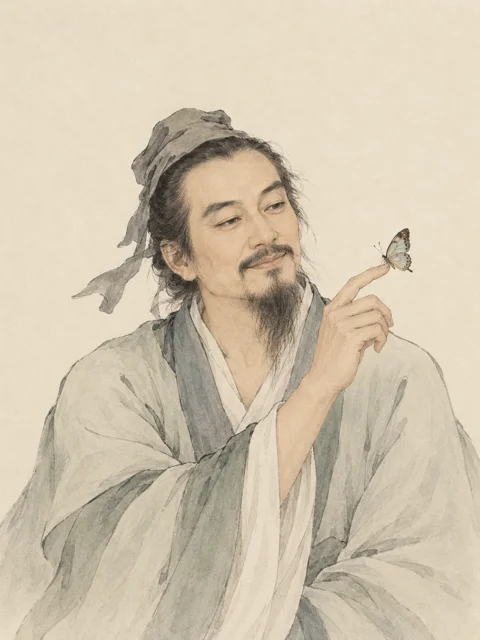
 AI 创作示意
GUANFU / zh-Hans
庄子
AI 创作示意外篇 · 胠篋 · 白话释义
版本按章对照,不代表逐句校勘对应。
中文原文(全三十三篇) / 庄子原典;维基文库贡献者整理
观复随文注释 · 48 条
將爲胠篋从旁打开箱子;胠读 qū探囊掏取袋中财物發匱打开柜子之盜而爲守備,則必攝收紧、捆紧緘縢封缄捆扎的绳索,固扃鐍门闩与锁钥;读 jiōng jué,此世俗之所謂知也。然而巨盜至,則負匱揭篋举起、扛起箱子擔囊而趨,唯恐緘一作「鍼」縢扃鐍之不固也。然則向一作「鄕」之所謂知者,不乃爲大盜積者也?
故嘗試論之:世俗所謂知者,有不爲大盜積者乎?所謂聖者,有不爲大盜守者乎?何以知其然邪?昔者齊國,鄰邑相望,雞狗之音相聞,罔罟捕鱼捕兽的网之所布,耒耨翻土除草的农具;读 lěi nòu之所刺,方二千餘里,闔四境一作「竟」之內,所以立宗廟社稷土地神与谷神,亦代指国家,治邑屋州閭鄉曲古代基层聚落的名称者,曷嘗不法聖人哉?然而田成子田常,春秋齐国掌权大夫,一旦殺齊君而盜其國,所盜者,豈獨其國邪?并一作「並」與其聖知之法而盜之。故田成子,有乎盜賊之名,而身處堯、舜之安,小國不敢非,大國不敢誅,十二世古文中的世代计数,不宜径作确年有齊國,則是不乃竊齊國,并一作「並」與其聖知之法,以守其盜賊之身乎?
嘗試論之:世俗之所謂至知者,有不爲大盜積者乎?所謂至聖者,有不爲大盜守者乎?何以知其然邪?昔者龍逢关龙逢,传说因谏夏桀被杀斬,比干传说因谏纣王被剖心剖,萇弘周代大夫,传说遭杀害肔一作「胣」,子胥伍子胥,春秋吴国大臣靡,故四子之賢,而身不免乎戮。故跖之徒,問於跖曰:「盜亦有道乎?」跖曰:「何適而无有道邪?夫妄意猜测、揣度室中之藏,聖也;入先,勇也;出後,義也;知可否,知也;分均,仁也。五者不備,而能成大盜者,天下未之有也。」由是觀之,善人不得聖人之道,不立;跖不得聖人之道,不行。天下之善人少,而不善人多,則聖人之利天下也少,而害天下也多。故曰:「脣竭嘴唇缺失;竭通揭則齒寒,魯酒薄而邯鄲圍借无端牵连的旧闻说明祸患相因,聖人生而大盜起。」
掊擊抨击、打破;掊读 pǒu聖人,縱舍盜賊,而天下始治矣。夫川竭而谷虛,丘夷而淵實,聖人已死,則大盜不起,天下平而无故矣。聖人不死,大盜不止。雖重聖人而治天下,則是重利盜跖也。爲之斗斛古代量粮食的容器与单位以量之,則并一作「並」與斗斛而竊之;爲之權衡秤锤与秤杆以稱之,則并一作「並」與權衡而竊之;爲之符璽符信与印玺,作为权力凭证以信之,則并一作「並」與符璽而竊之;爲之仁義以矯之,則并一作「並」與仁義而竊之。何以知其然邪?彼竊鉤衣带上的钩扣者誅,竊國者爲諸侯,諸侯之門而義士一作「仁義」存焉,則是非竊仁義聖知邪?故逐於大盜,揭諸侯,竊仁義,并一作「並」斗斛權衡符璽之利者,雖有軒冕高官的车服,代指爵禄之賞,弗能勸,斧鉞刑具,代指诛杀的威权之威,弗能禁。此重利盜跖而使不可禁者,是乃聖人之過也。故曰:「魚不可脫於淵,國之利器有力的统治手段不可以示人。」
彼聖人者,天下之利器也,非所以明天下也。故絕聖棄知,大盜乃止;擿玉抛弃玉石;擿读 zhì毀珠,小盜不起;焚符破璽,而民朴鄙质朴无华;掊斗折衡,而民不爭;殫(殘)天下之(聖)法,而民始可與論議。擢亂六律,鑠絕熔毁断绝竽瑟吹奏、弹奏的两种乐器,塞瞽曠盲乐师师旷;瞽读 gǔ之耳,而天下始人含其聰矣。滅文章,散五采,膠離朱之目,而天下始人含其明矣。毀絕鉤繩,而棄規矩,攦折断;读 lì工倕传说中的巧匠;倕读 chuí之指,而天下始人有其巧矣。故曰:「大巧若拙。」削曾、史之行,鉗楊、墨之口,攘棄仁義,而天下之德始玄同深层的同一而无分别矣。彼人含其明,則天下不鑠矣;人含其聰,則天下不累矣;人含其知,則天下不惑矣;人含其德,則天下不僻矣。彼曾、史、楊、墨、師曠、工倕、離朱者,皆外立其德,而以爚亂炫耀扰乱;爚读 yuè天下者也,法之所无用也。
子獨不知至德之世乎?昔者容成氏、大庭氏、伯皇氏、中央氏、栗陸氏、驪畜氏、軒轅氏、赫胥氏、尊盧氏、祝融氏、伏戲氏、神農氏,當是時也,民結繩文字未普及时以绳结记事而用之,甘其食,美其服,樂其俗,安其居,鄰國相望,雞狗之音相聞,民至老死而不相往來。若此之時,則至治已。今遂至使民延頸舉踵,曰:「某所有賢者」,贏糧背负干粮而趣之,則內棄其親,而外去其主之事,足跡接乎諸侯之境,車軌結乎千里之外,則是上好知之過也。
上誠好知而无道,則天下大亂矣。何以知其然邪?夫弓弩、畢弋捕鸟的网与系绳之箭、機變之知多,則鳥亂於上矣;鉤餌、罔一作「網」罟、罾笱捕鱼的网与竹笼;读 zēng gǒu之知多,則魚亂於水矣;削格、羅落、罝罘捕兽的网;读 jū fú之知多,則獸亂於澤矣;知詐漸毒、頡滑诡辩、巧辩堅白名家关于坚硬、白色的辨论、解垢同異之變多,則俗惑於辯矣。故天下每每大亂,罪在於好知。故天下皆知求其所不知,而莫知求其所已知者,皆知非其所不善,而莫知非其所已善者,是以大亂。故上悖日月之明,下爍山川之精,中墮四時之施,喘一作「惴」耎之蟲,肖翹细小飞动的生物之物,莫不失其性。甚矣,夫好知之亂天下也,自三代以下者是已!舍夫種種淳厚朴实的样子之民,而悅夫役役奔走劳碌的样子之佞,釋夫恬淡无爲,而悅夫啍啍多言争辩的样子之意,啍啍已亂天下矣!
观复随文注释 · AI 辅助独立整理,待持续人工校订。释义以本章语境为依据;存在异说或底本疑讹的地方另作提示。原文及版本来源保留如下。
参考: 本站所收原典:外篇 · 胠篋 ↗
原典公有领域;电子文本据维基文库贡献者,按 CC BY-SA 4.0 保留署名及相同方式共享;调整空白与排版。 · 查看原始版本
欢迎引用本站资源,分享道家与道教文化。引用时请注明出处“观复”,并附上所引用内容的原始页面链接,方便读者查阅。
观复白话释义(AI 辅助) / 观复 · AI 辅助独立整理
【白话释义|AI 辅助独立整理,未经人工学术审定】
为了防备撬箱、探袋、开柜的盗贼,人们一定要收紧绳结,牢固门闩和锁钥,这就是世俗所谓的聪明。然而大盗一来,却把柜子背走、箱子提走、口袋挑走,只怕绳结门锁不够牢固。那么,先前所谓的聪明,岂不恰好替大盗积攒财物?
所以试着问:世俗所谓的智慧,有哪一种不可能替大盗积存东西?所谓的圣明,有哪一种不可能替大盗守护东西?怎么知道这样?从前齐国,邻邑彼此相望,鸡狗的声音互相听得见;撒网捕鱼、耕田锄地的范围,有方圆两千多里。全国境内,设立宗庙社稷、治理城邑村落和地方组织,哪一样不效法圣人的制度?然而田成子有一天杀了齐君,窃取了齐国。他所偷的,难道只有国家吗?连同圣人智者制定的法度,也一并偷走了。所以田成子虽有盗贼的名声,自身却享有尧舜一样的安稳:小国不敢指责,大国不敢讨伐,其后人十二代占有齐国。这难道不是窃取齐国,又把圣智的法度一并窃取,用来保全自己这个盗贼吗?
再试着问:世俗所谓的最高智慧,有哪一种不可能替大盗积存?所谓的最高圣明,有哪一种不可能替大盗守护?怎么知道这样?从前关龙逢被杀,比干被剖心,苌弘被剖腹,伍子胥的尸身被抛弃毁坏。这四个人如此贤明,自身却免不了杀戮。所以盗跖的徒众问盗跖:“做盗贼也有道吗?”盗跖说:“到哪里会没有道!凭空推测屋里的财物藏在哪里,这是圣;进去抢劫走在最前面,这是勇;退出时留在最后面,这是义;知道可不可以下手,这是智;分赃均匀,这是仁。五样不齐备,却能成为大盗,天下还没有这样的人。”
由此看来,好人不得到圣人的道,便不能立身;盗跖不得到圣人的道,也不能行事。天下好人少,坏人多,那么圣人给天下带来的利益就少,带来的祸害反而多。所以说:“嘴唇干裂失去遮护,牙齿就受寒;鲁国的酒薄,赵国的邯郸却受围;圣人出现,大盗也随之兴起。”
摧破圣人的权威,放下对盗贼的刻意管制,天下才可能开始安定。河川干了,山谷也就空了;山丘平了,深渊也就填满了。圣人死去,大盗便不再兴起,天下平静而无事。圣人不消失,大盗便不停息。越是尊重圣人来治理天下,就越是在加厚盗跖的利益。制造斗斛来量物,大盗就把斗斛连同所量的东西一起窃取;制造秤锤秤杆来称物,大盗就把衡量的权力一起窃取;制造符契印玺来取信,大盗就把凭信的权力一起窃取;设立仁义来矫正人,大盗就把仁义一起窃取。
怎么知道如此?偷一个带钩的人遭处死,偷一个国家的人却成为诸侯,诸侯门下又有仁义之士。这不正是把仁义、圣智都偷走了吗?所以,追随大盗、窃居诸侯之位,窃取仁义,又一并占有斗斛、权衡、符玺的利益,这样的人,即使有高官厚禄的赏赐,也不能劝他改变;即使有斧钺刑杀的威严,也不能禁止他。这种使盗跖获利更多、以至无法禁止的结果,正是圣人的过错。所以说:“鱼不能离开深水,国家赖以获利制人的利器,不可拿来展示给人。”
圣人正是天下的利器,不是应当向天下炫示的东西。因此,断绝对圣人的崇奉,舍弃机巧之知,大盗才会止息;掷弃玉器,毁掉珠宝,小盗才不兴起;烧掉符契,打破印玺,百姓就归于质朴;击破斗斛,折断衡器,百姓就不争夺;废除天下这些圣智法度,才可以开始同百姓平心论说。
扰散六律,熔毁、断绝竽瑟,堵住师旷的耳朵,天下人才会各自保有自己的听觉;消除文饰,散去五彩,粘住离朱的眼睛,天下人才会各自保有自己的视觉;毁掉钩绳,丢开规矩,掰开工倕善巧的手指,天下人才会各有自己的能力。所以说:“最高的巧,像是笨拙。”削去曾参、史鱼所标榜的行为,钳住杨朱、墨翟的嘴,摒除外加的仁义,天下人的德性才会幽深地相通。
人各自保有视觉,天下便不被炫目之物灼乱;人各自保有听觉,天下便不被音声牵累;人各自保有知能,天下便不迷惑;人各自保有德性,天下便不偏离。曾参、史鱼、杨朱、墨翟、师旷、工倕、离朱这些人,都把自己的长处树立在外,用耀眼的标准扰乱天下,这不是合宜的法度所需要的。
你难道不知道德性最完整的时代吗?从前容成氏、大庭氏、伯皇氏、中央氏、栗陆氏、骊畜氏、轩辕氏、赫胥氏、尊卢氏、祝融氏、伏羲氏、神农氏的时代,百姓以结绳记事,觉得自己的食物甘美、自己的衣服好看,喜欢自己的风俗,安于自己的居处。邻国相互望得见,鸡狗声音相互听得见,百姓却直到老死也不往来。像这样的时代,治理就达到最高境界了。
如今竟使百姓伸长脖子、踮起脚,说:“某地有贤人!”于是背上粮食赶去;在内抛下父母,在外离开侍奉君主的事务,足迹接连踏遍诸侯疆界,车辙交错延伸到千里之外。这就是在上者喜好智巧的过错。
在上者如果一味喜好智巧而不合于道,天下便会大乱。怎么知道如此?弓弩、捕鸟网、系绳箭和各种机关的巧法多了,鸟便在天空惊乱;鱼钩、鱼饵、网罟、抬网、鱼笼的巧法多了,鱼便在水中惊乱;栅栏、陷阱、兽网的巧法多了,兽便在泽中惊乱;智诈险毒、纠缠坚白、分解同异的论辩变化多了,世俗便被辩说迷惑。
所以天下屡屡大乱,过错在于喜好机巧之知。天下人都知道追求自己不知道的,却不知道反省自己已经知道的;都知道否定自己以为不好的,却不知道反省自己已经认定为好的,因此大乱。向上,违背日月的光明;向下,耗损山川的精气;处在中间,又毁坏四时的正常施行。细弱蠕动的虫类、微小飞翔的生物,没有不丧失本性的。喜好智巧扰乱天下,实在太严重了!夏商周三代以来就是这样:舍弃敦厚质朴的百姓,喜爱奔忙机巧的谄佞;放下恬淡无为,喜爱喋喋不休的主张。喋喋不休,已经把天下弄乱了!
校订说明:本篇以毁器、塞耳、胶目等激烈修辞批判将才智制度化、垄断化的后果,释义忠实保留原有论辩,不将其改写为现实行动建议。“鲁酒薄而邯郸围”是连带祸患的典故,原文未展开因果,故不补入不同传说。“田成子”与田氏十二世事迹是原文叙述,史实与世数另需核校。“削格”“颉滑”“解垢”等词有异训,按捕兽器具、扰乱论辩的语境处理。
〔补校:“圣人已死”保留论辩中的激烈修辞,是本文对圣人权威与盗贼关系的议论。〕
观复白话释义:AI 辅助依据古文独立编写,已进行文本覆盖核对,未经人工学术审定;原典来源及电子底本署名、许可见对应中文版本。 · 查看原始版本
Herbert A. Giles 英译(全三十三篇) / Herbert A. Giles(翟理斯),1889
Opening Trunks.
[Translator’s note] Argument :—All restrictions artificial, and therefore deceptive—Only by shaking off such fetters, and reverting to the natural, can man hope to attain.
The precautions taken against thieves who open trunks, search bags, or ransack tills, consist of securing with cords and fastening with bolts and locks. This is what the world calls wit.
But a strong thief comes who carries off the till on his shoulders, with box and bag to boot. And his only fear is that the cords and locks should not be strong enough!
Therefore, what the world calls wit, simply amounts to assistance given to the strong thief.
And I venture to state that nothing of that which the world calls wit, is otherwise than serviceable to strong thieves; and that nothing of that which the world calls wisdom is other than a protection to strong thieves.
How can this be shown?—In the State of Ch'i a man used to be able to see from one town to the next, and hear the barking and crowing of its dogs and cocks.
[Translator’s note] So near were they. This sentence has been incorporated in ch. LXXX of the Tao-Tê-Ching . See The Remains of Lao Tzŭ , p. 50.
The area covered by the nets of fishermen and fowlers, and pricked by the plough, was a square of two thousand and odd li .
[Translator’s note] Of which three go to a mile, roughly. This statement is intended to convey an idea of prosperity.
And within its four boundaries not a temple or shrine was dedicated, nor a district or hamlet governed, but in accordance with the rules laid down by the Sages.
Yet one morning
[Translator’s note] B.C. 481.
T'ien Ch'êng Tzŭ slew the Prince of Ch'i, and stole his kingdom. And not his kingdom only, but the wisdom-tricks which he had got from the Sages as well; so that although T'ien Ch'êng Tzŭ acquired the reputation of a thief, he lived as comfortably as ever did either Yao or Shun. The small States did not venture to blame, nor the great States to punish him; and so for twelve generations his descendants ruled over Ch'i.
[Translator’s note] Commentators have failed to explain away this last sentence. On the strength of an obvious anachronism, some have written off the whole chapter as a forgery; but the general style of argument is against this view.
Was not this stealing the State of Ch'i and the wisdom-tricks of the Sages as well in order to secure himself from the consequences of such theft?
This amounts to what I have already said, namely that nothing of what the world esteems great wit is otherwise than serviceable to strong thieves, and that nothing of what the world calls great wisdom is other than a protection to strong thieves.
Let us take another example. Of old, Lung Fêng was beheaded, Pi Kan was disembowelled, Chang Hung was sliced to death, Tzŭ Hsü was chopped to mince-meat.
[Translator’s note] The first two have been already mentioned in ch. iv . Chang Hung was minister to Prince Ling of the Chou dynasty. Tzŭ Hsü was a name of the famous Wu Yüan, prime minister of the Ch'u State, whose corpse is said to have been sewn up in a sack and thrown into the river near Soochow.
All these four were Sages, but their wisdom could not preserve them from death.
[Translator’s note] In fact, it rather hastened their ends.
An apprentice to Robber Chê asked him saying, "Is there then Tao in thieving?"
"Pray tell me of something in which there is not Tao ," Chê replied. "There is the wisdom by which booty is located. The courage to go in first, and the heroism of coming out last. There is the shrewdness of calculating success, and justice in the equal division of the spoil. There has never yet been, a great robber who was not possessed of these five."
Thus the doctrine of the Sages is equally indis pensable to good men and to Chê. But good men are scarce and bad men plentiful, so that the good the Sages do to the world is little and the evil great.
Therefore it has been said, "If the lips are gone, the teeth will be cold." It was the thinness of the wine of Lu which caused the siege of Han Tan.
[Translator’s note] The prince of Ch'u held an assembly, to which the princes of Lu and Chao brought presents of wine. That of Lu was poor stuff, while the wine of Chao was rich and generous. Because, however, the Master of the Cellar to the prince of Ch'u failed to get a bribe of wine from the prince of Chao, he maliciously changed the presents; and the prince of Ch'u, displeased at what he regarded as an insult, shortly after laid siege to Han Tan, the chief city of Chao.
It was the appearance of Sages which caused the appearance of great robbers.
Drive out the Sages and leave the robbers alone,—then only will the empire be governed. As when the stream ceases the gully dries up, and when the hill is levelled the chasm is filled; so when Sages are extinct, there will be no more robbers, but the empire will rest in peace.
On the other hand, unless Sages disappear, neither will great robbers disappear; nor if you double the number of Sages wherewithal to govern the empire will you do more than double the profits of Robber Chê.
If pecks and bushels are used for measurement, they will also be stolen.
[Translator’s note] There will simply be something more to steal.
If scales and steelyards are used for weighing, they will also be stolen. If tallies and signets are used for good faith, they will also be stolen. If charity and duty to one's neighbour are used for rectification, they will also be stolen.
How is this so?—One man steals a purse, and is punished. Another steals a State, and becomes a Prince. But charity and duty to one's neighbour are integral parts of princedom. Does he not then steal charity and duty to one's neighbour together with the wisdom of the Sages?
So it is that to attempt to drive out great robbers
[Translator’s note] Who steal States.
is simply to help them to steal principalities, charity, duty to one's neighbour, together with measures, scales, tallies, and signets. No reward of official regalia and uniform will dissuade, nor dread of sharp instruments of punishment will deter such men from their course. These do but double the profits of robbers like Chê, and make it impossible to get rid of them,—for which the Sages are responsible.
Therefore it has been said, "Fishes cannot be taken away from water: the instruments of government cannot be delegated to others."
[Translator’s note] These words were uttered by Lao Tzŭ. So say Han Fei Tzŭ and Huai Nan Tzŭ. They have been incorporated in ch. xxxvi of the Tao-Tê-Ching .
In the wisdom of Sages the instruments of government are found. This wisdom is not fit for enlightening the world.
Away then with wisdom and knowledge, and great robbers will disappear! Discard jade and destroy pearls, and petty thieves will cease to exist. Burn tallies and break signets, and the people will revert to their natural integrity. Split measures and smash scales, and the people will not fight over quantities. Utterly abolish all the restrictions of Sages, and the people will begin to be fit for the reception of Tao .
Confuse the six pitch-pipes, break up organs and flutes, stuff up the ears of Shih K'uang,—and each man will keep his own sense of hearing to himself.
Put an end to decoration, disperse the five categories of colour, glue up the eyes of Li Chu,—and each man will keep his own sense of sight to himself.
Destroy arcs and lines, fling away square and compasses, snap off the fingers of Kung Ch'ui,—
[Translator’s note] A famous artisan who could draw an exact circle with his unaided hand.
and each man will use his own natural skill.
Wherefore the saying, "Great skill is as clumsiness."
[Translator’s note] Extremes meet. These words are attributed to Lao Tzŭ by Huai Nan Tzŭ, and are incorporated in ch. xlv of the Tao-Tê-Ching .
Restrain the actions of Tsêng and Shih, stop the mouths of Yang and Mih, get rid of charity and duty to one's neighbour,—and the virtue of the people will become one with God.
If each man keeps to himself his own sense of sight, the world will escape confusion. If each man keeps to himself his own sense of hearing, the world will escape entanglements. If each man keeps his knowledge to himself, the world will escape doubt. If each man keeps his own virtue to himself, the world will avoid deviation from the true path.
Tsêng, Shih, Yang, Mih, Shih K'uang, Kung Ch'ui, and Li Chu, all set up their virtue outside themselves and involve the world in such angry discussions that nothing definite is accomplished.
Have you never heard of the Golden Age,—
[Translator’s note] This question must be addressed to the reader.
the days of Yung Ch'êng, Ta T'ing, Poh Huang, Chung Yang, Li Lu, Li Hsü, Hsien Yüan, Hê Hsü, Tsun Lu, Chu Yung, Fu Hsi, and Shên Nung?
[Translator’s note] Ancient rulers, several of whom have already been mentioned.
Then the people used knotted cords.
[Translator’s note] As a means of intercommunication. The details of the system have not, however, come down to us.
They were contented with what food and raiment they could get. They lived simple and peaceful lives. Neighbouring districts were within sight, and the cocks and dogs of one could be heard in the other, yet the people grew old and died without ever interchanging visits.
In those days, government was indeed perfect. But nowadays any one can excite the people by saying, "In such and such a place there is a Sage."
Immediately they put together a few provisions and hurry off, neglecting their parents at home and their master's business abroad, filing in unbroken line through territories of Princes, with a string of carts and carriages a thousand li in length. Such is the evil effect of an exaggerated desire for knowledge among our rulers. And if rulers aim at knowledge and neglect Tao , the empire will be overwhelmed in confusion.
How can it be shown that this is so?—Bows and cross-bows and hand-nets and harpoon-arrows, involve much knowledge in their use; but they carry confusion among the birds of the air. Hooks and bait and nets and traps, involve much knowledge in their use; but they carry confusion among the fishes of the deep. Fences and nets and snares, involve much knowledge in their use; but they carry confusion among the beasts of the field. In the same way the sophistical fallacies of the hard and white and the like and the unlike of schoolmen involve much knowledge of argument; but they overwhelm the world in doubt.
Therefore it is that whenever there is great confusion, love of knowledge is ever at the bottom of it. For all men strive to grasp what they do not know, while none strive to grasp what they already know; and all strive to discredit what they do not excel in, while none strive to discredit what they do excel in. The result is overwhelming confusion.
Thus, above, the splendour of the heavenly bodies is dimmed; below, the energy of land and water is disturbed; while midway the influence of the four seasons is destroyed. There is not one tiny creature which moves on earth or flies in air but becomes other than by nature it should be. So overwhelming is the confusion which desire for knowledge has brought upon the world ever since the time of the Three Dynasties downwards! The simple and the guileless have been set aside; the specious and the false have been exalted. Tranquil inaction has given place to a love of disputation; and by disputation has confusion come upon the world.
原著及 Herbert A. Giles 历史译本公有领域;据 Project Gutenberg #59709,完整电子书及使用条款见本站资料来源。 · 查看原始版本
我的书签(此浏览器)
还没有书签。