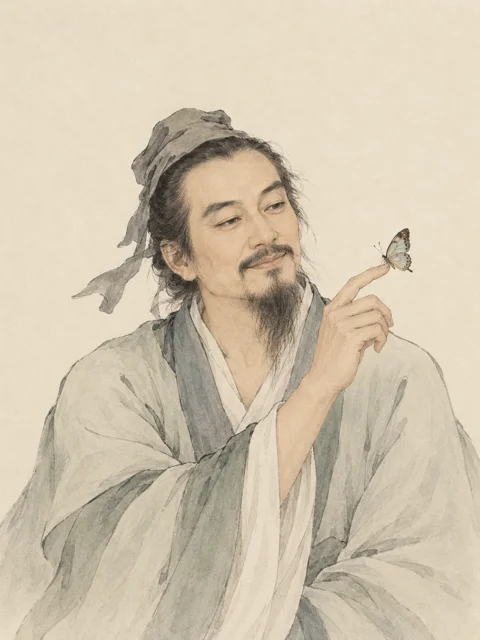
 AI 创作示意
GUANFU / zh-Hans
庄子
AI 创作示意杂篇 · 則陽 · 白话释义
版本按章对照,不代表逐句校勘对应。
中文原文(全三十三篇) / 庄子原典;维基文库贡献者整理
观复随文注释 · 64 条
則陽姓彭名阳,字则阳遊於楚,夷節篇中向楚王推荐彭阳的人言之於王,王未之見,夷節歸。彭陽見王果,曰:「夫子何不談一作「譚」我於王?」王果曰:「我不若公閱休寓言中的隐者。」彭陽曰:「公閱休,奚爲者邪?」曰:「冬則擉鼈刺取鳖;擉读 chuò于江,夏則休乎山樊山边、山林。有過而問者,曰:『此予宅也。』夫夷節已不能,而況我乎?吾又不若夷節。夫夷節之爲人也,无德而有知,不自許,以之神其交炫耀其交往的神妙,固顚冥沉迷昏惑乎富貴之地,非相助以德,相助消也。夫凍者假衣於春,暍者中暑的人;暍读 yē反冬乎冷風。夫楚王之爲人也,形尊而嚴,其於罪也,无赦如虎,非夫佞人、正德,其孰能橈折服、劝止;读 náo焉?故聖人,其窮也,使家人忘其貧;其達也,使王公忘(其)爵祿而化卑;其於物也,與之爲娛矣;其於人也,樂物之通,而保己焉;故或不言而飲人以和使人感受、浸润于和气,與人並立而使人化;父子之宜,彼其乎歸居,而一閒其所施。其於人心者,若是其遠也,故曰『待公閱休』。」
聖人達綢繆纠结纷繁的事物,周盡一體矣,而不知其然,性也。復命搖作,而以天爲師,人則從而命之也。憂乎知,而所行恆无幾時,其有止也,若之何?生而美者,人與之鑑,不告則不知其美於人也;若知之,若不知之,若聞之,若不聞之,其可喜也終无已,人之好之亦无已,性也。聖人之愛人也,人與之名,不告則不知其愛人也;若知之,若不知之,若聞之,若不聞之,其愛人也終无已,人之安之亦无已,性也。舊國舊都,望之暢然。雖使丘陵草木之緡,入之者十九,猶之暢然,況見見聞聞者也,以十仞之臺縣衆閒者也!冉相氏得其環中圆环中心,喻不执两端的境界以隨成,與物无終无始,无幾无時。日與物化者,一不化者也,闔嘗舍之?夫師天而不得師天,與物皆殉,其以爲事也,若之何?夫聖人,未始有天,未始有人,未始有始,未始有物,與世偕行而不替,所行之備而不洫败损、枯竭;读 xù,其合之也,若之何?湯得其司御,門尹登恆商汤的辅臣,篇中借作人名,爲之傅之,從師而不囿不受固定成见拘限,得其隨成,爲之司其名。之名、嬴法,得其兩見,仲尼之盡慮,爲之傅之。容成氏传说中的古代高士曰:「除日无歲,无內无外。」
魏瑩魏惠王,名罃;此本写瑩與田侯牟齐国君主,牟为篇中记名約,田侯牟背之,魏瑩怒,將使人刺之。犀首公孙衍,战国魏国大臣聞而恥之,曰:「君爲萬乘之君也,而以匹夫從讎。衍請受甲二十萬,爲君攻之,虜其人民,係其牛馬,使其君內熱發於背,然後拔其國,忌也出走,然後抶鞭打;读 chì其背,折其脊。」季子聞而恥之,曰:「築十仞之城,城者旣十仞矣,則又壞之,此胥靡受刑服劳役的人之所苦也。今兵不起七年矣,此王之基也。衍,亂人,不可聽也。」華子聞而醜之,曰:「善言伐齊者,亂人也。善言勿伐者,亦亂人也。謂『伐之與不伐,亂人也』者,又亂人也。」君曰:「然則若何?」曰:「君求其道而已矣。」惠子聞之,而見戴晉人寓言中的魏国贤者。戴晉人曰:「有所謂蝸者,君知之乎?」曰:「然。」「有國於蝸之左角者曰觸氏寓言中住蜗牛左角的小国,有國於蝸之右角者曰蠻氏寓言中住蜗牛右角的小国,時相與爭地而戰,伏尸數萬,逐北追击败逃者,旬有五日而後反。」君曰:「噫,其虛言與?」曰:「臣請爲君實之。君以意在四方上下,有窮乎?」君曰:「无窮。」曰:「知遊心於无窮,而反在通達之國,若存若亡乎?」君曰:「然。」曰:「通達之中有魏,於魏中有梁,於梁中有王,王與蠻氏有辯乎?」君一作「王」曰:「无辯。」客出,而君惝然失意茫然的样子若有亡也。客出,惠子見。君曰:「客,大人也,聖人不足以當之。」惠子曰:「夫吹管也,猶有嗃响亮的吹管声;读 hè也。吹劒首剑柄端的小孔者,吷极微弱的气声;读 xuè而已矣。堯、舜,人之所譽也。道堯、舜於戴晉人之前,譬猶一吷也。」
孔子之楚,舍於蟻丘之漿蚁丘卖浆水的店舍。其鄰有夫妻臣妾登極者。子路曰:「是稯稯忙碌聚集的样子,何爲者邪?」仲尼曰:「是聖人僕也。是自埋於民,自藏於畔,其聲銷,其志无窮,其口雖言,其心未嘗言,方且與世違,而心不屑與之俱,是陸沈隐于人世,如在陆上沉没者也。是其市南宜僚邪?」子路請往召之。孔子曰:「已矣!彼知丘之著於己也,知丘之適楚也,以丘爲必使楚王之召己也,彼且以丘爲佞人也。夫若然者,其於佞人也,羞聞其言,而況親見其身乎?而何以爲存?」子路往視之,其室虛矣。
長梧封人长梧地方守疆界的官员問子牢曰:「君爲政焉,勿鹵莽粗疏草率;同鲁莽;治民焉,勿滅裂耕作不细、不顾完整。昔予爲禾,耕而鹵莽之,則其實亦鹵莽而報予;芸除草;同耘而滅裂之,其實亦滅裂而報予。予來年變齊,深其耕而熟耰耕后碎土平田;读 yōu之,(其禾繁以滋,)予終年厭飧饱食;厭通餍一作「飱」。」莊子聞之,曰:「今人之治其形,理其心,多有似封人之所謂,遁其天,離其性,滅其情,亡其神,以衆爲故。鹵莽其性者,欲惡之孽,爲性萑葦蒹葭各种芦苇类杂草,始萌以扶吾形,尋擢吾性,並潰漏發,不擇所出,瘭一作「漂」疽疮疽类疾病;读 biāo jū、疥癕、內熱、溲膏尿液浑浊如脂的病症描述是也。」
柏一作「栢」矩學於老聃,曰:「請之天下遊。」老聃曰:「已矣!天下猶是也。」又請之,老聃曰:「汝將何始?」曰:「始於齊。」至齊,見辜人遭罪刑的人焉,推而强之,解朝服而幕之为他覆盖衣物,號天而哭之,曰:「子乎子乎!天下有大菑,子獨先離之遭受它;離通罹!曰:『莫爲认为没有造作的主宰盜,莫爲殺人。榮辱立,然後覩所病。貨財聚,然後覩所爭。』今立人之所病,聚人之所爭,窮困人之身,使无休時,欲无至此,得乎?古之君人者,以得爲在民,以失爲在己,以正爲在民,以枉爲在己,故一形有失其形者,退而自責。今則不然,匿爲物而愚不識,大爲難而罪不敢,重爲任而罰不勝,遠其塗而誅不至。民知力竭,則以僞繼之,日出多僞,士民安取不僞?夫力不足則僞,知不足則欺,財不足則盜。盜竊之行,於誰責而可乎?」
蘧伯玉卫国贤大夫,名瑗,行年六十,而六十化,未嘗不始於是之,而卒詘之否定、折服它以非也。未知今之所謂是之,非五十九非也?萬物有乎生,而莫見其根,有乎出,而莫見其門。人皆尊其知之所知,而莫知恃其知之所不知而後知,可不謂大疑乎?已乎已乎,且无所逃。此所謂然與,然乎?
仲尼問於太史大弢、伯常蹇一作「騫」、狶韋,曰:「夫衞靈公飲酒湛樂沉溺享乐,不聽國家之政,田獵畢弋捕鸟的网与系绳之箭,不應諸侯之際,其所以爲靈公者,何邪?」大弢曰:「是因是也。」伯常蹇一作「騫」曰:「夫靈公有妻三人,同濫而浴。史鰌卫国大夫史鱼;鰌读 qiū奉御而進所,搏幣而扶翼。其慢,若彼之甚也,見賢人,若此其肅也,是其所以爲靈公也。」狶韋曰:「夫靈公也,死,卜葬於故墓,不吉;卜葬於沙丘,而吉,掘之數仞,得石槨石制外棺焉,洗而視之,有銘焉,曰:『不馮其子不依赖自己的后代;馮通凭,靈公奪而埋之。』夫靈公之爲靈也,久矣。之二人,何足以識之?」
少知問於太公調曰:「何謂丘里乡里、聚落之言?」太公調曰:「丘里者,合十姓百名,而以爲風俗也,合異以爲同,散同以爲異。今指馬之百體而不得馬,而馬係於前者,立其百體,而謂之馬也。是故丘山積卑而爲高,江河合水而爲大,大人合幷而爲公。是以自外入者,有主而不執有所主宰却不固执;由中出者,有正而不距有所准则却不拒绝变化;四時殊氣,天不賜,故歲成;五官殊職,君不私,故國治;文武,大人不賜,故德備;萬物殊理,道不私,故无名,无名故无爲,无爲而无不爲。時有終始,世有變化,禍福淳淳相继流转的样子;至有所拂者,而有所宜;自殉殊面,有所正者,有所差;比于大澤,百材皆度;觀乎大山,木石同壇。此之謂丘里之言。」
少知曰:「然則謂之道,足乎?」太公調曰:「不然。今計物之數,不止於萬,而期曰萬物者,以數之多者,號而讀之也。是故,天地者,形之大者也;陰陽者,氣之大者也;道者,爲之公。因其大,以號而讀之,則可也。已有之矣,乃將得比哉?則若以斯辯,譬猶狗馬,其不及,遠矣。」
少知曰:「四方之內,六合之裏,萬物之所生,惡起?」太公調曰:「陰陽相照,相蓋相治,四時相代,相生相殺,欲惡去就,於是橋起兴起;橋通矫,雌雄片合雌雄相互配合,於是庸有;安危相易,禍福相生,緩急相摩,聚散以成。此名實之可紀,精之可志也。隨序之相理,橋運之相使,窮則反,終則始,此物之所有,言之所盡,知之所至,極物而已。覩道之人,不隨其所廢,不原其所起,此議之所止。」
少知曰:「季眞提出无人为主宰说的古代人物之『莫爲』,接子提出有所使然说的古代人物之『或使假定有某种主宰使万物如此』,二家之議,孰正於其情,孰徧於其理?」太公調曰:「雞鳴狗吠,是人之所知。雖有大知,不能以言讀其所自化,又不能以意其所將爲。斯而析之,精至於无倫,大至於不可圍。或之使,莫之爲,未免於物,而終以爲過。或使則實,莫爲則虛。有名有實,是物之居;无名无實,在物之虛。可言可意,言而愈疏。未生不可忌,已死不可徂一作「阻」,死生非遠也,理不可覩。或之使,莫之爲,疑之所假。吾觀之本,其往无窮;吾求之末,其來无止。无窮、无止,言之无也,與物同理。或使、莫爲,言之本也,與物終始。道不可有,有不可无。道之爲名,所假而行。或使、莫爲,在物一曲局部、一隅之见,夫胡爲於大方大道、全面的道理?言而足,則終日言而盡道;言而不足,則終日言而盡物。道,物之極,言默言说与沉默不足以載。非言非默,議有所極。」
观复随文注释 · AI 辅助独立整理,待持续人工校订。释义以本章语境为依据;存在异说或底本疑讹的地方另作提示。原文及版本来源保留如下。
参考: 本站所收原典:杂篇 · 則陽 ↗
原典公有领域;电子文本据维基文库贡献者,按 CC BY-SA 4.0 保留署名及相同方式共享;调整空白与排版。 · 查看原始版本
欢迎引用本站资源,分享道家与道教文化。引用时请注明出处“观复”,并附上所引用内容的原始页面链接,方便读者查阅。
观复白话释义(AI 辅助) / 观复 · AI 辅助独立整理
【观复白话释义|AI 辅助·未经人工学术审定】
则阳游历楚国,夷节向楚王推荐他,楚王还没接见,夷节就回去了。则阳,也就是彭阳,见王果说:“先生为什么不向楚王推荐我?”王果说:“我不如公阅休。”彭阳问:“公阅休是怎样的人?”王果说:“冬天在江里刺鳖,夏天在山边休息。过路人问他,他说:‘这里就是我的家。’夷节已经做不到,何况我?我又不如夷节。夷节有智巧而没有真实的德,不安于自身,用智巧使交往显得神妙,本就沉迷在富贵中。他同人相交,不是用德相助,而是互相耗损。冻着的人等到春天才借衣,热病的人等到冬天才回冷风中取凉,都不合时宜。楚王仪态尊严,待罪人像虎一样不宽赦;不是极善谄媚的人,就是德性端正的人,谁能使他转变呢?
“圣人困穷时,使家人忘掉贫穷;通达时,使王公忘掉爵禄,自化为谦卑。他同万物相处,自然相乐;同人相处,乐于事物通达,又保守自身。所以有时不说话,就让别人饮到和气;只是并肩站着,就让别人变化。像父子相处各得其宜那样,他返回日常生活,不经意地施展一次,便能产生影响。他对人心的作用,如此深远,所以我说,等公阅休吧。”
圣人通达纷繁纠结的关系,周遍穷尽万物一体,却不刻意知道为什么如此,这是本性使然。回归生命的禀赋而活动,以自然为师,别人随后才给他加上名称。若困在智虑里,所实行的没有多久就停住,怎么办?天生美貌的人,别人给镜子照,不告诉他,他未必知道自己比别人美。不管他知不知道、听没听说,他可爱的样子始终存在,别人喜欢他也无止境,这是天性。圣人爱人,别人给他这样的名称;不告诉他,他未必知道自己在爱人。不管知不知道、听没听说,他爱人始终不停,别人安于他的相处也始终不停,这是天性。
故乡故都,远望就心情舒畅;即使山丘草木遮蔽,旧地十之八九已被覆盖,走进去仍觉舒畅。何况还能见到从前所见、听到从前所闻呢?这种不因外物改变而失去的真实,仿佛高出众人十仞的台。冉相氏得到循环中心,随顺自然成就,与物一同无终无始,不限定细小分际与时段。天天随物变化,所凭的却是统一而不变的根本,何曾离开过它?若口称以天为师,却不能真正师天,反同万物一道奔逐,所做的事又会如何?圣人不预先划出天、人、开始、事物的分别,同世界一起运行而不衰替,所行周备而不损耗,他如何与一切相合?汤得到了掌管辅导的人门尹登恒,令其辅佐;从师而不受拘束,随事物的自然成就,为之掌理名分。至于那些执名、持法的人,能把两面都看见;仲尼竭尽思虑,也为这种通达提供辅助。容成氏说:‘除去一天天的日子,便没有所谓年;没有内,也就没有外。’
魏惠王同齐田侯牟订约,田侯牟背约,魏惠王大怒,准备派人刺杀他。犀首听了,觉得这种办法可耻,说:“您是万乘之君,却用普通人的报仇手段。公孙衍愿领二十万甲士,为您攻齐,俘虏人民,系走牛马,使他们国君焦灼得背上发病,再攻破其国,让他逃走,然后鞭背折脊。”季子听了,觉得可耻,说:“筑十仞高城,已筑到十仞又拆掉,这是服劳役的人最痛苦的事。如今七年没有兴兵,这是王业的基础。公孙衍是扰乱的人,不能听。”华子听了,又觉得不好,说:“善于说攻齐的,是扰乱的人;善于说不攻的,也是扰乱的人;说‘攻与不攻的议论都是扰乱’的,也还是扰乱的人。”王问:“那么怎么办?”华子说:“君王只须寻求道。”
惠子听说,推荐戴晋人来见。戴晋人问王:“有种叫蜗牛的,您知道吗?”王说知道。戴晋人说:“蜗牛左角上有国,叫触氏;右角上有国,叫蛮氏。两国时常争地交战,死者数万,追赶败兵,十五天才回来。”王说:“啊,这是虚构的话吧?”戴晋人说:“请让我为您说到实处。您的心思放到四方上下,觉得有穷尽吗?”王说:“无穷。”戴晋人问:“知道游心于无穷,再回看人所通达的这一片地域,是不是若有若无?”王说是。戴晋人说:“这片地域中有魏国,魏国中有梁城,梁城中有您。您同蜗牛角上的蛮氏,还有多大区别?”王说:“没有区别。”客人出去,王恍然若有所失。惠子进见,王说:“客人真是大人,圣人的称号也不足以相当。”惠子说:“吹管还能发出较大的声音,吹剑首小孔只有细细一声。尧舜是人们称誉的,在戴晋人面前谈尧舜,也好比那细细的一声罢了。”
孔子去楚国,在蚁丘卖浆的人家住宿。邻家夫妻、仆役侍妾,一起忙碌着登上高处。子路问:“这些聚在一起的人,是做什么的?”孔子说:“其中是隐身为仆的圣人。他把自己埋在百姓中,藏在田野边,声名消歇,志意无穷;嘴虽说话,内心却不作分别的言说。他正同世俗相违,内心不肯跟着世俗一起走,是在陆地上沉隐的人。大概是市南宜僚吧。”子路请求去叫他。孔子说:“罢了!他知道我已看出他,知道我到楚国来,会以为我必让楚王召见他,还会把我当作谄佞的人。像他这样的人,对谄佞者连听其言都羞,何况亲见其人?又有什么办法使他留下?”子路去看,屋里已空了。
长梧守疆的人对子牢说:“您执政,不要草率;治理百姓,不要粗疏破碎。从前我种禾,耕得马虎,收成就以马虎回报我;除草粗疏,果实也以粗疏回报我。第二年我改变办法,深耕细耙,禾苗繁茂,全年吃得饱。”庄子听了说:“如今的人治理身体、调理内心,多像守疆人说的那种粗率做法:逃离天然,背离本性,毁损真情,丧失精神,以众人的做法为成规。粗率对待本性,欲望厌恶的孽芽便像芦苇蒹葭一样丛生。刚萌发时仿佛在扶养形体,随即拔伤本性;继而一起溃漏发作,不择出口,就成了疮疽疥痈、内热、尿液膏浊等病。”
柏矩向老聃学习,说:“请允许我到天下游历。”老聃说:“罢了,天下都还是这样。”柏矩再请,老聃问:“你从哪里开始?”答:“齐国。”到齐国,他见一具被处刑者的尸身,走上前扶正,脱下朝服盖住,呼天大哭说:“你啊,你啊!天下有大灾,你独先遭遇!人们说,‘别偷盗,别杀人。’可是荣耀耻辱树立以后,才显出人所忧苦的;财货聚积以后,才显出人所争夺的。如今设立使人忧苦的,聚积使人争夺的,使人困顿不堪、没有休息,还想没人到你这一步,可能吗?
“古代君主,把得到的功归于民,把失误归于自己;把正归于民,把歪曲归于自己。因此,只要一人形体受损,就退而自责。现在却不是这样:把规则藏得幽深,又责愚人不识;把事弄得极难,又怪人不敢;加上重担,又罚人不能胜任;把路定得遥远,又诛人达不到。百姓智力用尽,便只好用虚伪接续,一天生出许多虚伪,士民怎么能不虚伪?力量不足便伪装,智识不足便欺骗,财物不足便盗窃。盗窃这样的行为,究竟责备谁才合适呢?”
蘧伯玉活到六十岁,经历六十次变化,每次都是先认定对,最终却又否定为错。谁知道如今认定的对,不会也是过去五十九次错误中的一种?万物有其生,却看不见根;有其出,却看不见门。人人尊重已经知道的,却不知道,要依靠自己所不知道的,才可能有所知,这难道不是大迷惑?罢了,罢了!也无处可逃。所谓如此,果真如此吗?
孔子问太史大弢、伯常骞、狶韦:“卫灵公沉湎酒乐,不听国政;田猎网鸟,不应诸侯交际。为什么仍称灵公?”大弢说:“就是因这些情况而得此名。”伯常骞说:“灵公有三个妻妾,同在一个浴池洗澡。史鳅奉命进来,灵公就赶紧拿衣物遮身,肃敬相待。他放纵到那样,见贤者又能恭敬到这样,这就是称灵公的缘由。”狶韦说:“灵公死后,占卜葬在旧墓,不吉;占卜葬在沙丘,吉。挖下数仞,得一具石椁,洗净看见铭文:‘不依凭自己的儿子,灵公将夺取此处安葬。’灵公之所以称灵,早已有了。那两位,哪里足以明白!”
少知问太公调:“什么叫丘里之言?”太公调说:“乡里,是把十姓百名的人聚合起来,形成风俗;把不同合为共同,又在共同中分出不同。若逐一指点马的百体,却未必因此得到整匹马;那系在眼前的马,则百体共同成立,才叫马。因此丘山积低成为高,江河汇水成为大,大人兼容并包而成为公正。由外进入内心的,有所主宰却不执著;从内发出的,有其端正却不排拒。四时气候不同,天不偏赐,才成一年;五官职掌不同,君不偏私,国才治理;文武各有作用,大人不偏厚,德才完备;万物条理不同,道不偏私,所以不能固定在一个名称上。无固定之名,便无强为;无强为,便无不成就。
“时节有终始,世道有变化,祸福交互流转;对这一面有所抵触的,对另一面有所适宜。各自追随不同方面,有所正也有所差。像大泽,各种材木都能容纳;像大山,木石处在同一基础上。这就叫丘里之言。”少知问:“那么称它为道,足够了吗?”太公调说:“不够。计算事物种类,不止一万,却统称万物,是借一个表示多的数来命名。天地是形体中的广大者,阴阳是气中的广大者,道则是它们共同的根源。因为广大,借名号称说,可以;若因此以为已经据有了道,就能同它相称吗?照这种分别方法去说,好比只拿狗马这样具体之物说明一切,距离太远了。”
少知问:“四方以内、上下六合之中,万物的发生,从哪里起?”太公调说:“阴阳相互映照,相互覆盖、制约;四时相互替代,相生相杀;欲恶去就由此兴起,雌雄分别相合,生育便不断发生。安危互换,祸福相生,缓急相磨,聚散成形。这些是名与实可以记录、精细情形可以记认的。循次序相互调理,凭运动相互推动,穷尽就返,终了又始,这是事物中存在的,是言语所能说尽、知识所能达到的,不过穷究物而已。见道的人,不追逐它怎样废止,也不固求它从哪里发端,这就是议论该停的地方。”
少知问:“季真的‘没有谁在主宰’,接子的‘有某种东西使然’,两家的议论,谁合实情,谁周全于理?”太公调说:“鸡鸣狗吠,是人所知道的。即使大智,也不能用言语彻底说明它自行变化的根由,更不能凭思意预知它将怎样变化。从这里分析,小可精微到无可比类,大可广大到无法包围。‘有谁使然’和‘没有谁作为’,都还没摆脱具体事物的范围,最后仍有偏失。说有谁使然,是认定一个实有;说无谁作为,是认定一个空无。有名有实,是物所居的范围;无名无实,是物的空缺。可以说、可以想,却越说离道越远。
“未生时不能阻止其生,已死时不能挽回其死。死生离人并不远,其中道理却不能完全看见。‘有谁使然’‘无谁作为’,都是疑惑借以表达的说法。我追察根本,往前无穷;我寻究末端,来处无止。说无穷无止,是就没有边际而言,仍同事物在一层道理上。说有谁使然、无谁作为,是谈论根本,仍跟随万物终始而起分别。道不能被当作一个可占有的有,已有的存在也不能任意抹成无。‘道’这个名称,是借来通行表达的。有谁使然、无谁作为,都只停在万物的一个角落,对广大整体有什么作用呢?言语若足够,整天说便能说尽道;言语若不够,整天说也只说到物。道是万物的究极,言语与沉默都不足以承载。超出言与默的对立,议论才达到它的极限。”
【篇末疑难注记】“则阳”“彭阳”依本文按同一人处理。“父子之宜”后数句句读不明,正文按自然相处、无意施化理解。“汤得其司御”至“仲尼之尽虑”一段存在人名、断句与语义疑点,正文给出连贯暂释;“之名、嬴法”未擅自认定为确定的历史人物。“魏莹”“田侯牟”“忌”涉及原文称谓不一,正文以魏王、齐方之君行文,未补入外部年表。“夫妻臣妾登极”含义难定,保留忙碌登高的暂释。“辜人”按受刑死者解释。“同滥而浴”“搏币而扶翼”按浴池与取衣肃敬的情境处理,具体动作待校。卫灵公石椁铭文是狶韦在篇中的说法,保留其传说性质。“丘里”按乡里共同体解释。“道不可有,有不可无”有多种释法,正文按不可实物化、不可抹消存在理解。所述身体疾病与欲恶关联,是篇中养生论说,未作现代医学断言。
观复白话释义:AI 辅助依据古文独立编写,已进行文本覆盖核对,未经人工学术审定;原典来源及电子底本署名、许可见对应中文版本。 · 查看原始版本
Herbert A. Giles 英译(全三十三篇) / Herbert A. Giles(翟理斯),1889
Tsê Yang.
[Translator’s note] Argument :—Influence of virtue concealed—The true Sage a negative quantity—The great, the small, the infinite—Crime and Capital—Rulers and their vices—What is Society? Predestination or Chance? Illustrations.
When Tsê Yang visited the Ch'u State, I Chieh
[Translator’s note] An official of Ch'u.
spoke of him to the prince; but the latter refused an audience.
Upon I Chieh's return, Tsê Yang went to see Wang Kuo,
[Translator’s note] A local Sage.
and asked him to obtain an interview with the prince.
"I am not so fitted for that," replied Wang Kuo, "as Kung Yüeh Hsiu."
[Translator’s note] A hermit.
"What sort of a man is he?" enquired Tsê Yang.
"In winter," said Wang Kuo, "he catches turtles on the river. In summer, he reposes in some mountain copse. If any passers-by ask of him, he tells them, "This is my home." Where I Chieh could not succeed, still less should I. I am not equal even to him.
"He is a man without virtue, but possessed of knowledge. Were it not for an air of arrogance, he would be very popular with his superiors. But help without virtue is a hindrance. Shivering people borrowing clothes in the coming spring! Hot people thinking of last winter's icy blast!
"The prince of Ch'u is dignified and severe. In punishing, he is merciless as a tiger. Only a very practised or a very perfect man could influence him.
"The true Sage, when in obscurity, causes those around him to forget their poverty. When in power, he causes princes to forget ranks and emoluments, and to become as though of low estate. He rejoices exceedingly in all creation. He exults to see Tao diffused among his fellow-men, while suffering no loss himself.
[Translator’s note] Tao is a constant quantity. It can be shared, but cannot be divided.
"Thus, although silent, he can instil peace; and by his mere presence cause men to be to each other as father and son. From his very return to passivity comes this active influence for good. So widely does he differ in heart from ordinary men. Wherefore I said, 'Wait for Kung Yüeh Hsiu.'
"The true Sage is free from all embarrassments. All things are to him as One . Yet he knows not that this is so. It is simply nature. In the midst of action he remains the same. He makes God his guide, and men make him theirs. He grieves that wisdom carries one but a short distance, and at times comes altogether to a deadlock.
"To a beauty, mankind is the mirror in which she sees herself. If no one tells her she is beautiful, she does not know that she is so. But whether she knows it or whether she does not know it, whether she hears it or whether she does not hear it, her joy will never cease, neither will mankind ever cease to take pleasure therein. It is nature.
"The love of a Sage for his fellows likewise finds expression among mankind. Were he not told so, he would not know that he loved his fellows. But whether he knows it or whether he does not know it, whether he hears it or whether he does not hear it, his love for his fellows is without end, and mankind cease not to repose therein.
"The old country, the old home, gladden a wanderer's eyes. Nay, though nine-tenths of it be a howling wilderness, still his eye will be glad. How much more to see sight and hear hearing, from a lofty dais suspended in their very midst!"
[Translator’s note] The joy of the wanderer is as that of the mind returning to a consciousness only of itself.
Jen Hsiang Shih reached the centre and attained.
[Translator’s note] The centre at which all Infinities converge. See p. 18 . This individual was a legendary ruler of old.
He recognised no beginning, no end, no quantity, no time. Daily modified together with his environ ment, as part of One he knew no modification. Why not rest in this?
To strive to follow God and not to succeed is to display an activity fatal to itself. How can success ever be thus achieved?
The true Sage ignores God. He ignores man. He ignores a beginning. He ignores matter. He moves in harmony with his generation and suffers not. He takes things as they come and is not overwhelmed. How are we to become like him?
T'ang appointed his Equerry, Mên Yin Têng Hêng, to be his tutor, listening to his counsels but not being restricted by them. He got Tao for himself and a reputation for his tutor. But the reputation was a violation of principle, and landed him in the domain of alternatives.
[Translator’s note] Instead of One . No ingenuity of commentator has here succeeded in making sense.
As a tutor, Confucius pushed care and anxiety to an extreme limit.
Yung Ch'êng Shih
[Translator’s note] Lao Tzŭ's tutor.
said, "Take away days, and there would be no years. No inside, no outside."
Prince Hui of Wei had made a treaty with prince Wei of Ch'i, which the latter broke.
Thereupon prince Hui was wroth, and was about to send a man to assassinate him. But the Captain-General heard of this, and cried out in shame, "Sire, you are ruler over a mighty State, yet you would seek the vengeance of a common man. Give me two hundred thousand warriors, and I will do the work for you. I will take his people prisoners, and carry off their oxen and horses. I will make the heat of the prince's mind break out on his back. Then I will seize his country, and he will flee. Then you can wring his neck as you please."
When Chi Tzŭ heard this, he cried out in shame and said, "If you are building a ten-perch wall, and when the wall is near completion, destroy it, you inflict great hardship on the workmen.
[Translator’s note] Alluding to the corvée system of public works. The speaker was an official of Wei.
Now for seven years the troops have not been called out. That is, as it were, your Highness' foundation work. Listen not to the Captain-General. He is a mischievous fellow."
When Hua Tzŭ
[Translator’s note] Also an official of Wei.
heard this, he was very indignant and said, "He who argued in favour of punishing the Ch'i State was a mischievous fellow. And he who argued against punishing the Ch'i State was a mischievous fellow. And he who says that either of the above is a mischievous fellow, is a mischievous fellow himself."
"Where then shall I find what to do?" enquired the prince.
"In Tao alone," said Hua Tzŭ.
When Hui Tzŭ heard this, he introduced Tai Chin Jen to the prince.
[Translator’s note] A Sage of the Liang State. For Hui Tzŭ, see p. 8 .
"There is a creature called a snail," said Tai Chin Jen. "Does your Highness know what I mean?"
"I do," replied the prince.
"There is a kingdom on its left horn," continued Tai Chin Jen, "ruled over by Aggression , and another on its right horn, ruled over by Violence . These two rulers are constantly fighting for territory. In such cases, corpses lie about by thousands, and one party will pursue the other for fifteen days before returning."
"Whew!" cried the prince. "Surely you are joking."
"Sire," replied Tai Chin Jen, "I beg you to regard it as fact. Does your Highness recognise any limit to space?"
"None," said the prince, "It is boundless."
"When, therefore," continued Tai Chin Jen, "the mind descends from the contemplation of boundless space to the contemplation of a kingdom with fixed boundaries, that kingdom must seem to be of dimensions infinitesimally small?"
"Of course," replied the prince.
"Well then," said Tai Chin Jen, "in a kingdom with fixed boundaries
[Translator’s note] Meaning the then empire of the Chous.
there is the Wei State. In the Wei State there is the city of Liang. In the city of Liang there is a prince. In what does that prince differ from Violence?"
[Translator’s note] In his pettiness.
"There is no difference," said the prince.
Thereupon Tai Chin Jen took his leave, and the prince remained in a state of mental perturbation, as though he had lost something.
When Tai Chin Jen had gone, Hui Tzŭ presented himself, and the prince said, "Our friend is truly a great man. Sages are not his equal."
"If you blow through a tube," replied Hui Tzŭ, "the result will be a note. If you blow through the hole in a sword-hilt, the result will be simply whssh . Yao and Shun have been belauded by mankind; yet compared with Tai Chin Jen they are but whssh ."
When Confucius went to Ch'u, he stopped at a restaurant on Mount I. The servant to a man and his wife who lived next door, got up on top of the house.
"Whatever is he doing up there?" asked Tzŭ Lu.
"He is a Sage," replied Confucius, "under the garb of a menial. He buries himself among the people.
[Translator’s note] So as to get into closer relation with them.
He effaces himself at the wayside. Fame, he has none; but his perseverance is inexhaustible. Though his mouth speaks, his heart speaks not. He has turned his back upon mankind, not caring to abide amongst them. He has drowned himself on dry land. I think 'tis I Liao of Shih-nan."
[Translator’s note] See p. 325 .
Tzŭ Lu asked to be allowed to go and call him; but Confucius stopped him, saying, "No. He knows that I know what he is. He knows that I have come to Ch'u to recommend him to the prince. And he looks on me as a toady. Under the circumstances, as he would scorn to hear the words of a toady, how much more would he scorn to see him in the flesh! How could you keep him?"
Tzŭ Lu went to see, but the house was empty.
The border-warden of Ch'ang-wu said to Tzŭ Lao,
[Translator’s note] Ch'in Lao, or Ch'in Chang, a disciple of Confucius.
"A prince in his administrative details must not lack thoroughness; in his executive details he must not be inefficient. Formerly, in my ploughing I lacked thoroughness, and the results also lacked thoroughness. In my weeding I was inefficient, and the results were also inefficient. By and by, I changed my system. I ploughed deep, and weeded carefully, the result being an excellent harvest, more than I could get through in a year."
Chuang Tzŭ, upon hearing this, observed, "The men of to-day in their self-regulation and their self-organisation are mostly as the Border-warden has described. They put their Godhead out of sight. They abandon their natural dispositions. They get rid of all feeling. They part with their souls, carried away by the fashion of the hour.
"Those who lack thoroughness in regard to their natural dispositions suffer an evil tribe to take the place thereof.
[Translator’s note] The physical senses.
These grow up rank as reeds and rushes, at first of apparent value to the body, but afterwards to destroy the natural disposition. Then they break out, at random, like sores and ulcers carrying off pent-up humours."
Poh Chü was studying under Lao Tzŭ. "Let us go," said he, "and wander over the world."
[Translator’s note] One commentator says Poh Chü was a "criminal," probably from his sympathetic remarks in the context.
"No," replied Lao Tzŭ, "the world is just as you see it here."
But as he again urged it, Lao Tzŭ said, "Where would you go to begin with?"
"I would begin," answered Poh Chü, "by going to the Ch'i State. There I would view the dead bodies of their malefactors. I would push them to make them rise. I would take off my robes and cover them. I would cry to God and bemoan their lot, as follows:—'O sirs, O sirs, there was trouble upon earth, and you were the first to fall into it!'
"I would say, 'Perhaps you were robbers, or perhaps murderers?' ... Honour and disgrace were set up, and evil followed. Wealth was accumulated, and contentions began. Now the evil which has been set up and the contentions which have accumulated, endlessly weary man's body and give him no rest. What escape is there from this?
[Translator’s note] This might almost have come from The Curse of Capital , (Aveling) or from one of Mr. Hyndman's discourses.
"The rulers of old set off all success to the credit of their people, attributing all failure to themselves. All that was right went to the credit of their people, all that was wrong they attributed to themselves. Therefore, if any matter fell short of achievement, they turned and blamed themselves.
"Not so the rulers of to-day. They conceal a thing and blame those who cannot see it. They impose dangerous tasks and punish those who dare not undertake them. They inflict heavy burdens and chastise those who cannot bear them. They ordain long marches and slay those who cannot make them.
"And the people, feeling that their powers are inadequate, have recourse to fraud. For when there is so much fraud about,
[Translator’s note] In the rulers.
how can the people be otherwise than fraudulent? If their strength is insufficient, they will have recourse to fraud. If their knowledge is insufficient, they will have recourse to deceit. If their means are insufficient, they will steal. And for such robbery and theft, who is really responsible?"
When Chü Poh Yü
[Translator’s note] See p. 49 .
reached his sixtieth year, he changed his opinions. What he had previously regarded as right, he now came to regard as wrong. But who shall say whether the right of to-day may not be as wrong as the wrong of the previous fifty-nine years?
[Translator’s note] See p. 365 .
Things are produced around us, but no one knows the whence. They issue forth, but no one sees the portal. Men one and all value that part of knowledge which is known. They do not know how to avail themselves of the unknown in order to reach knowledge. Is not this misguided?
[Translator’s note] Men value the phenomena of which the senses make them conscious, but not the phenomena of the senses themselves.
Alas! alas! the impossibility of escaping from this state results in what is known as elective affinity.
[Translator’s note] Adaptation to the suitable; being as one is because more adapted to that than to something to which one is not adapted. See ch. ii , where this idea is first broached.
Confucius asked the historiographers Ta T'ao, Poh Ch'ang Ch'ien, and Hsi Wei, saying, "Duke Ling was fond of wine and given up to pleasure, and neglected the administration of his State. He spent his time in hunting, and did not cultivate the goodwill of the other feudal princes. How was it he came to be called Ling ?"
[Translator’s note] The name Ling means "knowing," which may be taken in two senses.
"For those very reasons," replied Ta T'ao.
"The Duke," said Poh Ch'ang Ch'ien, "had three wives. He was having a bath together with them when Shih Ch'in, summoned by his Highness, entered the apartment. Thereupon the Duke covered himself and the ladies. So outrageously did he behave on the one hand, and yet so respectful was he towards a virtuous man. Hence he was called Ling ."
"When the Duke died," said Hsi Wei, "divination showed that it would be inauspicious to bury him in the old family burying-ground, but auspicious to bury him at Sha-ch'iu. And upon digging a grave there, several fathoms deep, a stone coffin was found, which, being cleaned, yielded the following inscription:— Posterity cannot be trusted. Duke Ling will seize this for his tomb.
"As a matter of fact, Duke Ling had been named Ling long before. What should these two persons know about it?"
[Translator’s note] As evidenced by the inscription, the Duke had been so named long before, in the Book of Fate.
Shao Chih asked T'ai Kung Tiao, saying, "What is meant by society?"
[Translator’s note] The first name signifies Small Knowledge . Of the second personage there is no record.
"Society," replied T'ai Kung Tiao, "is an agreement of a certain number of families and individuals to abide by certain customs. Discordant elements unite to form a harmonious whole. Take away this unity and each has a separate individuality.
"Point at any one of the many parts of a horse, and that is not a horse, although there is the horse before you. It is the combination of all which makes the horse.
"Similarly, a mountain is high because of its individual particles. A river is large because of its individual drops. And he is a just man who regards all parts from the point of view of the whole.
"Thus, in regard to the views of others, he holds his own opinion, but not obstinately. In regard to his own views, while conscious of their truth, he does not despise the opinions of others.
"The four seasons have different characteristics, but God shows no preference for either, and therefore we have the year complete.
[Translator’s note] With results which could not be otherwise achieved.
The functions of the various classes of officials differ; but the sovereign shows no partiality, and therefore the empire is governed. There are the civil and the military; but the truly great man shows no preference for either, and therefore their efficacy is complete. All things are under the operation of varying laws; but Tao shows no partiality and therefore it cannot be identified.
[Translator’s note] As the given part of anything.
Not being able to be identified, it consequently does nothing. And by doing nothing all things can be done.
"Seasons have their beginnings and their ends. Generations change and change. Good and evil fortune alternate, bringing sorrow here, happiness there.
[Translator’s note] Nunc mihi, nunc alio, benigna.
He who obstinately views things from his own standpoint only, may be right in one case and wrong in another. Just as in a great jungle all kinds of shrubs are found together; or as on a mountain you see trees and stones indiscriminately mixed,—so is what we call society."
"Would it not do then," asked Shao Chih, "if we were to call this Tao ?"
"It would not," replied T'ai Kung Tiao. "All creation is made up of more than ten thousand things. We speak of creation as the Ten Thousand Things merely because it is a convenient term by which to express a large number. In point of outward shape the universe is vast. In point of influence the Positive and Negative principles are mighty. Yet Tao folds them all in its embrace. For convenience' sake the bond of society is called great. But how can that which is thus conditioned
[Translator’s note] By having a name.
be compared with Tao ? There is as wide a difference between them as there is between a horse and a dog."
"Whence then," enquired Shao Chih, "comes the vitality of all things between the four points of the compass, between heaven above and earth beneath?"
"The Positive and Negative principles," answered T'ai Kung Tiao, "influence, act upon, and regulate each other. The four seasons alternate with, give birth to, and destroy one another. Hence, loves and hates, and courses rejected and courses adopted. Hence too, the intercourse of the sexes.
"States of peril and safety alternate. Good and evil fortune give birth to one another. Slowness and speed are mutually exclusive. Collection and dispersion are correlates. The actuality of these may be noted.
[Translator’s note] There is the name and the embodiment.
The essence of each can be verified. There is regular movement forward, modified by deflection into a curve. Exhaustion leads to renewal. The end introduces a new beginning. This is the law of material existences. The force of language, the reach of knowledge, cannot pass beyond the bounds of such material existences. The disciple of Tao refrains from prying into the states after or before. Human speculation stops short of this."
"Chi Chên," said Shao Chih, "taught Chance ; Chieh Tzŭ taught Predestination .
[Translator’s note] "Two Sages." Comm.
In the speculations of these two schools, on which side did right lie?"
"The cock crows," replied T'ai Kung Tiao, "and the dog barks. So much we know. But the wisest of us could not say why one crows and the other barks, nor guess why they crow or bark at all.
"Let me explain. The infinitely small is inappreciable; the infinitely great is immeasurable. Chance and Predestination must refer to the conditioned. Consequently, both are wrong.
"Predestination involves a real existence.
[Translator’s note] Of a God.
Chance implies an absolute absence of any principle. To have a name and the embodiment thereof,—this is to have a material existence. To have no name and no embodiment,—of this one can speak and think; but the more one speaks the farther off one gets.
"The unborn creature cannot be kept from life.
[Translator’s note] So powerful is its "will to live."
The dead cannot be tracked. From birth to death is but a span; yet the secret cannot be known. Chance and Predestination are but à priori solutions.
"When I seek for a beginning, I find only time infinite. When I look forward to an end, I see only time infinite. Infinity of time past and to come implies no beginning and is in accordance with the laws of material existences. Predestination and Chance give us a beginning, but one which is compatible only with the existence of matter.
[Translator’s note] And not with the time before matter was.
" Tao cannot be existent. If it were existent, it could not be non-existent. The very name of Tao is only adopted for convenience' sake. Predestination and Chance are limited to material existences. How can they bear upon the infinite?
"Were language adequate, it would take but a day to fully set forth Tao . Not being adequate, it takes that time to explain material existences. Tao is something beyond material existences. It cannot be conveyed either by words or by silence. In that state which is neither speech nor silence, its transcendental nature may be apprehended."
[Translator’s note] "With this essay in China," says Lin Hsi Chung, "what need to fetch Buddhist books from the West?"
原著及 Herbert A. Giles 历史译本公有领域;据 Project Gutenberg #59709,完整电子书及使用条款见本站资料来源。 · 查看原始版本
我的书签(此浏览器)
还没有书签。