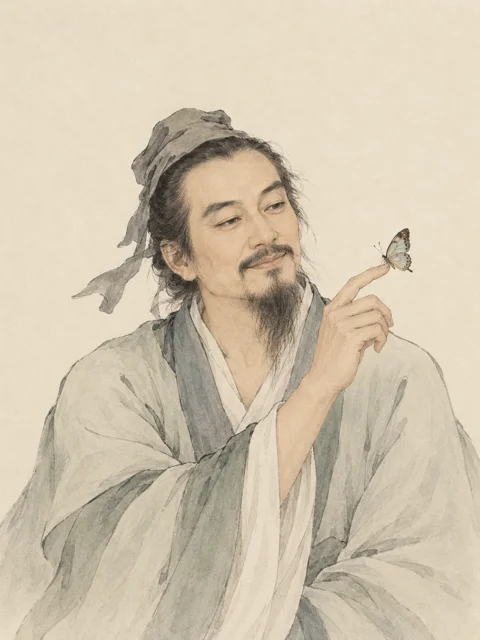
 AI 创作示意
GUANFU / zh-Hans
庄子
AI 创作示意杂篇 · 列禦寇 · 白话释义
版本按章对照,不代表逐句校勘对应。
中文原文(全三十三篇) / 庄子原典;维基文库贡献者整理
观复随文注释 · 59 条
列御寇列子,名御寇之齊,中道而反,遇伯昏瞀人寓言中的得道者。伯昏瞀人曰:「奚方而反?」曰:「吾驚焉。」曰:「惡乎驚?」曰:「吾嘗食於十漿十家卖浆水、食物的店,而五漿先饋优先赠送饮食。」伯昏瞀人曰:「若是,則汝何爲驚已?」曰:「夫內誠不解,形諜成光内在德性外露为光彩;諜字有异说,以外鎭人心,使人輕乎貴老,而䪡其所患。夫漿人,特爲食羹之貨、多餘之贏,其爲利也薄,其爲權也輕,而猶若是,而況於萬乘之主乎,身勞於國,而知盡於事!彼將任我以事,而效我以功,吾是以驚。」伯昏瞀人曰:「善哉!觀乎汝處己一作「已」,人將保汝归附、聚集在你周围矣!」无幾何而往,則戶外之屨滿矣。伯昏瞀人北面而立,敦杖竖立手杖蹙之乎頤下巴,立有間,不言而出。儐一作「賓」者接待宾客的人以告列子,列子提屨,跣赤脚;读 xiǎn而走,暨一作「曁」乎門,曰:「先生旣來,曾不發藥开导、规劝乎?」曰:「已矣!吾固告汝曰『人將保汝』,果保汝矣。非汝能使人保汝,而汝不能使人无保汝也,而焉用之感豫出異有意感动别人,显出自己的特殊也?必且有感,搖而本才一作「性」,又无謂也。與汝遊者,又莫汝告也。彼所小言,盡人毒也。莫覺莫悟,何相孰也?巧者勞,而知者憂,无能者无所求,飽食而遨遊,汎若不繫之舟不系缆绳、任其漂游的船,虛而遨遊者也。」
鄭人緩篇中郑国人的名字也,呻吟此处指吟诵读书裘氏之地,衹一作「祇」三年,而(緩)爲儒,河潤九里河水滋润两旁,喻学业惠及家族,澤及三族。使其弟墨。儒墨相與辯,其父助翟墨翟,借指墨家。十年而緩自殺。其父夢之曰:「使而子爲墨者,予也。闔胡嘗視其良?旣爲秋柏一作「栢」之實矣!」夫造物者之報人也,不報其人,而報其人之天,彼故一作「固」使彼。夫人以己爲有以異於人,以賤其親,齊人之井飲者,相捽互相扭打;捽读 zuó也,故曰:今之世皆緩也。自是,有德者以不知也,而況有道者乎?古者謂之遁天之刑违背自然所招致的惩罚。聖人安其所安,不安其所不安;衆人安其所不安,不安其所安。
莊子曰:「知道,易;勿言,難。知而不言,所以之天也;知而言之,所以之人也。古之人,天而不人。」
朱泙漫寓言中学习屠龙术的人學屠龍於支離益,單千金之家耗尽千金家财;單通殚,三年技成,而无所用其巧。聖人以必不必,故无兵;衆人以不必必之,故多兵。愼一作「順」於兵,故行有求兵,恃之則亡。小夫之知,不離苞苴包裹的礼物,常指馈赠贿赂、竿牘竹简书信,敝精神乎蹇淺局促浅陋,而欲兼濟導物,太一形虛。若是者,迷惑于宇宙,形累不知太初万物的本始。彼至人者,歸精神乎无始,而甘瞑乎无何有之鄉。水流乎无形,發泄乎大清。悲哉乎,汝爲知在豪毛一作「末」,而不知大寧至大的安宁!
宋人有曹商者,爲宋王使秦。其往也,得車數乘。王悅之,益車百乘。反於宋,見莊子,曰:「夫處窮閭阨巷,困窘織屨,槁項黃馘脖颈枯瘦、面黄肌瘦者,商之所短也。一悟萬乘之主,而從車百乘者,商之所長也。」莊子曰:「秦王有病,召醫,破癕痈疮;同痈潰痤肿疮;读 cuó者,得車一乘;舐痔者,得車五乘;所治愈下,得車愈多。子豈治其痔邪?何得車之多也?子行矣!」
魯哀公問乎顏闔曰:「吾以仲尼爲貞幹支柱、骨干,國其有瘳病愈,喻国政改善乎?」曰:「殆哉岌一作「圾」乎!仲尼方且飾羽而畫,從事華辭华美的言辞,以支爲旨把枝节当作要旨,忍性以視民,而不知不信,受乎心,宰乎神,夫何足以上民?彼宜汝與?予頤與?誤而可矣。今使民離實學僞,非所以視民也。爲後世慮,不若休之。難治也。」施於人而不忘,非天布自然无私的施予也,商賈不齒。雖以事齒之,神者弗齒。爲外刑者,金與木也;爲內刑者,動與過也。宵人小人,古注亦作小民之離外刑者,金木訊之;離內刑者,陰陽食之。夫免乎外內一作「內外」之刑者,唯眞人能之。
孔子曰:「凡人心,險於山川,難於知天。天猶有春秋冬夏旦暮之期,人者厚貌深情外貌敦厚而内情深隐,故有貌愿而益外貌恭谨却心存骄慢;益有异解,有長若不肖,有順懁急躁;读 xuān而達,有堅而縵,有緩而釬,故其就義若渴者,其去義若熱。故君子,遠使之而觀其忠,近使之而觀其敬,煩使之而觀其能,卒然突然;卒通猝問焉而觀其知,急與之期而觀其信,委之以財而觀其仁,告之以危而觀其節,醉之以酒而觀其則,雜之以處而觀其色。九徵九种观察考验人的方法至,不肖人得矣。」正考父宋国大夫,孔子的先祖,一命一次授官、晋爵而傴弯腰;读 yǔ,再命而僂,三命而俯,循牆而走,孰敢不軌?如而夫者,一命而呂鉅,再命而於車上儛,三命而名諸父直呼叔伯之名,表示傲慢,孰協唐、許唐尧与许由?
賊莫大乎德有心,而心有眼,及其有眼也而內視,內視而敗矣。凶德有五,中德执持内在德行而自好;古注有异解爲首。何謂中德?中德也者,有以自好也,而吡诋毁;此处读 pǐ其所不爲者也。窮有八極,達有三必,形有六府。美、髯、長、大、壯、麗、勇、敢,八者俱過人也,因以是窮。緣循、偃佒谦退、不自显的样子、困畏,不若人,三者俱通達。知慧外通,勇動多怨,仁義多責,達生之情者傀广大独立的样子;读 guī,達於知者肖,達大命者隨,達小命者遭。
人有見宋王者,錫車十乘,以其十乘驕稺一作「穉」莊子。莊子曰:「河上有家貧,恃緯蕭编织蒿草为席而食者,其子沒於淵,得千金之珠。其父謂其子曰:『取石來鍛之!』夫千金之珠,必在九重之淵而驪龍传说中的黑龙;驪读 lí頷下下巴下面。子能得珠者,必遭其睡也。使驪龍而寤,子尚奚微之有哉?』今宋國之深,非直九重之淵也;宋王之猛,非直驪龍也。子能得車者,必遭其睡也。使宋王而寤,子爲䪡粉夫!」
或聘於莊子,莊子應其使曰:「子見夫犧牛用作祭祀的牛乎?衣以文繡,食以芻菽草与豆,指精心饲料,及其牽而入於太廟,雖欲爲孤犢无拘束的小牛,其可得乎?」
莊子將死,弟子欲厚葬之。莊子曰:「吾以天地爲棺槨,以日月爲連璧相连的玉璧,古代葬饰,星辰爲珠璣,萬物爲齎送送葬的物品;齎读 jī。吾葬一作「喪」具豈不備邪?何以加此?」弟子曰:「吾恐烏鳶乌鸦与鸢鸟;鳶读 yuān之食夫子也。」莊子曰:「在上爲烏鳶食,在下爲螻蟻食,奪彼與此,何其偏也!」
以不平平,其平也不平。以不徵徵拿未经验证者作验证标准,其徵也不徵。明者,唯爲之使,神者徵之。夫明之不勝神也,久矣,而愚者恃其所見,入於人,其功外也,不亦悲乎?
观复随文注释 · AI 辅助独立整理,待持续人工校订。释义以本章语境为依据;存在异说或底本疑讹的地方另作提示。原文及版本来源保留如下。
原典公有领域;电子文本据维基文库贡献者,按 CC BY-SA 4.0 保留署名及相同方式共享;调整空白与排版。 · 查看原始版本
欢迎引用本站资源,分享道家与道教文化。引用时请注明出处“观复”,并附上所引用内容的原始页面链接,方便读者查阅。
观复白话释义(AI 辅助) / 观复 · AI 辅助独立整理
【观复白话释义|AI 辅助·未经人工学术审定】
列御寇到齐国去,半路返回,遇见伯昏瞀人。伯昏瞀人问:“怎么走到半路就回来了?”列子说:“我害怕了。”问:“怕什么?”列子说:“我曾在十家卖浆食的店里吃东西,其中五家都先给我送来吃食。”伯昏瞀人说:“这样,你为什么害怕呢?”列子说:“内心的实情还没有消解,便从形貌上泄露出来,显成光彩,从外表震慑别人的心,使人轻忽尊贵者与老人,反倒优先礼遇我,这便招来了祸患。卖浆食的人,不过经营一点饭食羹汤,求少许余利,利益微薄,权势轻小,尚且这样,何况大国的君主!他们身体为国事劳苦,智力被事务耗尽,一定会把事情交给我,用功效来考责我,所以我怕。”伯昏瞀人说:“好啊!不过看你对待自己的样子,人们还是会聚集归附你!”
过了不久,伯昏瞀人去列子那里,门外已摆满来客的鞋。他面北站着,把手杖竖起,抵近下巴,站了一会儿,一言不发地走了。接待客人的人告诉列子,列子提着鞋,赤脚跑到门口,说:“先生既然来了,怎么不给我留下一点治病的药石之言?”伯昏瞀人说:“算了!我本来就告诉过你,人们会聚集归附你,果然如此。这并非你能主动使人归附,而是你不能使人不来归附。你何必用那些感动人心、使人欣悦的表现来显出自己的异处?这样必然不断招来外物感触,动摇你本来的才性,已经无须再多说了。和你交游的人,也没有谁告诉你这些。他们那些细碎的言语,尽是伤人的毒。没有觉察,没有醒悟,你们又怎能相互成就?技巧多的人劳累,智虑多的人忧愁;无意炫能的人没有所求,吃饱后自由遨游,像没有系缆的船漂浮,虚空着心而游行。”
郑国有个叫缓的人,在裘氏地方吟诵求学,只过三年便成了儒者。他的影响就像河水润泽九里,恩泽及于三族,却使弟弟转而学墨。儒、墨两家互相辩论,父亲帮助信奉墨翟的一方。十年后,缓自杀了。他的父亲在梦中见到他,缓说:“使您的儿子成为墨者的,是我。您为什么不曾到我的坟墓看看?那里已经结出秋柏的果实了!”造物者回应人的行为,并不回应人的自我标榜,而是回应他天然的本性;正是自然变化使事情如此。人自以为有不同于别人的地方,便轻贱自己的亲人,就像齐人在井边取水,为争先而相互揪扭。所以说,当今世上的人都像缓一样。由此看来,有德的人尚且要去掉自以为知,何况有道的人呢?古人把这种背离自然而自取的痛苦,称为“逃遁天性所受的刑罚”。圣人安处于本来可安的自然之境,不安于本不可安的造作;一般人却安于本不可安的造作,不安于本来可安的自然之境。
庄子说:“认识道容易,不把它说出来难。知道而不执意言说,是趋向自然;知道便忙于言说,是趋向人为。古人顺乎自然,不刻意造作。”
朱泙漫向支离益学习杀龙的本领,花尽家中千金,三年学成,却没有地方施展这种技巧。圣人把自己以为必然的看作未必如此,所以不生争斗;一般人把本来未必如此的,强认作必然,所以争斗很多。即使小心对待争斗,一旦行为趋向于求取武力,依赖它,就会灭亡。
见识狭小的人,知识离不开送礼的包裹、往来的书信,把精神耗在艰涩浅陋的事情上,却想普遍济助、引导万物,通达浑一无形的大道。这样的人迷失于宇宙,被形体与外物拖累,不懂万物的本初。至人则把精神归返于没有起始的根源,安然歇息于一无所有的境地;精神如水,流向无形,又舒展开来,通于广大清明。可悲啊,你的聪明只落在毫毛般的细微处,却不知道广大的安宁!
宋国有个曹商,替宋王出使秦国。去时得到几辆车,秦王喜欢他,又加赐一百辆。他回到宋国,见庄子说:“住在贫穷的里巷,困窘地编鞋度日,脖子枯瘦、脸色焦黄,这是我不擅长的;一番话就使大国君主醒悟,身后随从一百辆车,这才是我的长处。”庄子说:“秦王有病,召来医生,替他刺破痈疮、挤去脓血的,得一辆车;替他舔痔疮的,得五辆车。治的部位越下贱,得的车越多。你难道替他治了痔疮吗?怎么得到这么多车?你走吧!”
鲁哀公问颜阖:“我用仲尼作为国家的主干,国家会好起来吗?”颜阖说:“危险得很!仲尼正忙着装饰羽毛、涂绘文彩,从事华美的言辞,把枝节当宗旨,抑制天性来示范给百姓,却不知道这种做法不能取得真实信任。这些东西盘踞于心,支配精神,哪里足以居于百姓之上?他能使您安宜吗?能奉养您吗?恐怕误导您倒是可以。让百姓离开真实、学习虚伪,不是示范于民的方法。替后世考虑,不如停下来,否则将难以治理。”
对别人施惠却念念不忘,不是自然无心的施予,连商贾也不屑于这样的人。即使从事务功绩上有人认可他,精神通达的人也不认可。外在的刑罚,是金属刑具、木制刑具;内在的刑罚,是妄动与过失。浅陋的人遭受外刑,就被金木刑具拷打;遭受内刑,就被阴阳失调侵蚀。能免除内外两种刑罚的,只有真人。
孔子说:“人心比山川险恶,比认识天象更难。天还有春夏秋冬、早晚的定期,人却把真情藏在厚重的外貌后面。因此,有外貌谨厚而内心骄盈的,有外表出众却不贤的,有神情柔顺急切而内心通达的,有外表坚强而内心松弛的,有外貌迟缓而内心急躁强悍的。有的人趋向道义像口渴求水一样急,离开道义却又像逃避灼热一样急。
“所以君子派他去远处,观察他的忠诚;让他在近处办事,观察他的恭敬;交给他繁多事务,观察他的能力;突然发问,观察他的见识;约定急迫的期限,观察他的守信;把财物交给他,观察他的仁厚;告诉他有危险,观察他的节操;让他饮酒至醉,观察他的准则;使他处在复杂混杂的交往中,观察他的神态情欲。这九种考察都做到了,不贤的人就能被发现。”
正考父第一次受命任官,便弯下身;第二次受命,腰更曲;第三次受命,更低头俯身,沿着墙边小心走路。谁敢不遵循他的规范?至于另一类人,第一次受命就趾高气扬,第二次就在车上跳舞,第三次就直呼叔伯的名字。两类人中,谁才合于唐尧、许由的风范?
伤害没有比在德行上怀有刻意之心更大的;心一刻意,就生出偏见的眼睛,再拿这种眼光向内自我审视,便会败坏自身。凶险的德有五种,其中以内心自得自美为首。什么叫这样的德?就是有一套自以为好的东西,便诋毁自己不去做的事情。
困穷有八种极端的条件,通达有三种容易致成的做法,形体有六处感知的府藏。容貌美好、胡须漂亮、身材高、体格大、身体强壮、仪态华丽、勇猛、果敢,这八样都超出常人,反倒会因此陷入困境。顺从依循、俯仰曲就、畏缩退让,显得不如别人,这三种却都容易在世俗中通达。智慧向外通逐,勇于行动会招来许多怨恨,标举仁义会招来许多责求。通达生命实情的人宽大不拘,通达智巧的人却细小局促;明白大命的人顺随整体变化,拘于小命的人则只知偶然遭遇。
有人拜见宋王,被赐十辆车,就凭这十辆车在庄子面前骄傲卖弄。庄子说:“河边有户穷人,靠编织蒿草器物糊口。他的儿子潜入深水,得到一颗价值千金的珠子。父亲说:‘拿石头来,把它砸碎!价值千金的珠子,一定在九重深渊、黑龙的下巴下面。你能拿到珠子,一定是碰上它睡着了。假使黑龙醒着,你哪里还能剩下什么!’如今宋国朝廷的深险,不止九重深渊;宋王的凶猛,不止黑龙。你能得到车,一定也是碰上他睡着的时候。假使宋王醒来,你就要被碾成粉末!”
有人来聘请庄子。庄子回答使者说:“你见过祭祀用的牛吗?给它穿上有花纹的绣衣,喂它草料和豆子。等它被牵进太庙,即使想再做一头无人管顾的小牛,还办得到吗?”
庄子将死,弟子想厚葬他。庄子说:“我拿天地作棺椁,日月作成对的玉璧,星辰作珍珠,万物作送葬的礼物。我的葬具难道不齐全吗?还能增加什么?”弟子说:“我们怕乌鸦和鸢吃老师的遗体。”庄子说:“在地上,被乌鸦、鸢吃;埋在地下,被蝼蛄、蚂蚁吃。从那些鸟嘴里夺下来,送给这些虫子,为什么这样偏心?”
用不公平的标准去求公平,所得的公平仍不公平;拿不足为证的东西作验证,那种验证也不能成立。只凭聪明辨察的人,反而被所辨察的东西役使;精神通达的人,才能从整体上得到印证。聪明辨察比不上精神通达,已经很久了。愚人却依仗自己所看见的,陷入人为的分别,把工夫全花在外面,岂不可悲?
【篇末疑难注记】“形谍成光”“䪡其所患”字义不明,依才能外露而招祸的上下文试释。“保汝”按聚集、归附解释。“缓”故事中的梦中说话者、弟弟转学墨家的原因及“其良”所指均有歧义;正文暂以缓托梦、良通垄墓读解。“遁天之刑”指背离天性而自受的惩罚。“愼于兵,故行有求兵”文义不顺,正文作谨慎而仍求助争斗的读法,待校。“太一形虚”与前后句衔接不明,暂归入小知妄求广大无形之道的描述。“彼宜汝与?予颐与?”训读有争议,依安宜、奉养试释。“貌愿而益”“长若不肖”“缓而釬”均为难句,本文尽量保留外貌与内情不一的结构。“中德”按内心自美、自是理解;原文称“凶德有五”,实际只解释一种,不补造其余四种。“形有六府”原文亦未展开,暂泛释感知孔窍。“傀”“肖”“大命”“小命”的解释仍待校订。篇中人物言行及对孔子的评论均为原作者安排的叙事与发言。
观复白话释义:AI 辅助依据古文独立编写,已进行文本覆盖核对,未经人工学术审定;原典来源及电子底本署名、许可见对应中文版本。 · 查看原始版本
Herbert A. Giles 英译(全三十三篇) / Herbert A. Giles(翟理斯),1889
Lieh Tzŭ.
[Translator’s note] Argument :—Outward manifestation of inward grace—Its dangers—Self-esteem—Its errors—Inscrutability of Tao —Artificiality of Confucius—Tests of virtue—Chuang Tzŭ declines office—His death.
When Lieh Tzŭ
[Translator’s note] Lieh Yü K'ou, a name well known in connection with Tao . But it is extremely doubtful if such a man ever lived. His record is not given by the historian Ssŭ-ma Ch'ien, and he may well have been no more than an allegorical personage created by Chuang Tzŭ for purposes of illustration. It was however thought necessary under the Han dynasty to supply his "Works"; and the treatise thus provided still passes under his name, though generally regarded as a forgery. See pp. 4 , 5 .
went to Ch'i, half way there he turned round and came back. Falling in with Poh Hun Wu Jen, the latter said, "How is it you are so soon back again?"
"I was afraid," replied Lieh Tzŭ.
"Afraid of what?" asked Poh Hun Wu Jen.
"Out of ten restaurants at which I ate," said Lieh Tzŭ, "five would take no payment."
"And what is there to be afraid of in that?" enquired Poh Hun Wu Jen.
"The truth within not being duly assimilated," replied Lieh Tzŭ, "a certain brightness is visible externally. And to conquer men's hearts by force of the external is to induce in oneself a disregard for authority and age which is the precursor of trouble.
"A restaurant keeper is one who lives by retailing soup. When his returns are counted up, his profit is but small, and his influence is next to nothing. But if such a man could act thus, how much more the ruler of a large State? His bodily powers worn out in the duties of his position, his mental powers exhausted by details of administration, he would entrust me with the government and stimulate me by reward. That is what I was afraid of."
"Your inner lights are good," replied Poh Hun Wu Jen; "but if you remain stationary at this point, the world will still gather around you."
[Translator’s note] Contrary to Tao .
Shortly afterwards Poh Hun Wu Jen went to visit Lieh Tzŭ, and lo! his court-yard was filled with boots.
[Translator’s note] Of the visitors come to hear him. These were left outside the door, in accordance with an ancient custom mentioned in the Book of Rites . See p. 368 .
Poh Hun Wu Jen stood there awhile, facing the north, his cheek all wrinkled by resting it on his staff. Then, without a word, he departed.
Upon this being announced to Lieh Tzŭ,
[Translator’s note] By the servant whose duty it was to receive guests.
he seized his shoes and ran out barefoot.
[Translator’s note] In his hurry.
When he reached the outer gate, he called aloud, "Master! now that you have come, will you not give me medicine?"
"It is all over!" cried Poh Hun Wu Jen. "I told you that the world would gather around you. It is not that you can make people gather around you. You cannot prevent them from doing so. Of what use would my instruction be? Exerting influence thus unduly over others, you are by them influenced in turn. You disturb your natural constitution, and are of no further account.
[Translator’s note] In the original, these lines rhyme.
"The shrewd grow weary, the wise grieve. Those who are without abilities have no ambitions. With full bellies they roam happily about, like drifting boats, not caring whither they are bound."
There was a man of the Chêng State, named Huan. He pursued his studies at a place called Ch'iu-shih. After three years only, he had graduated as a Confucianist; and like a river which fertilises its banks to a distance of nine li , so did his good influence reach into three families.
[Translator’s note] His father's, his mother's, and his wife's.
He caused his younger brother to graduate as a Mihist. But inasmuch as in the question of Confucianism versus Mihism,
[Translator’s note] The philosophy of Mih Tzŭ, who taught the doctrine of universal love, etc. See pp. 17 , 440 .
the father took the side of the Mihist, at the end of ten years Huan committed suicide.
Then the father dreamed that Huan appeared to him and said, "It was I who caused your son to become a Mihist. Why give all the credit to him who is but as the fruit of an autumn pine?"
[Translator’s note] Various interpretations of this simile are given: none satisfactory. E.g. (1) Like a dry cone. (2) Which another has planted and reared.
Verily God does not reward man for what he does, but for what he is.
[Translator’s note] I.e. for the natural, not for the artificial.
And it was in this sense that the younger brother was caused to become a Mihist.
[Translator’s note] He was naturally so inclined.
Whereas a man who should regard his distinctive abilities as of his own making, without reference to his parents, would be like the man of Ch'i who dug a well and then wanted to keep others away from it.
[Translator’s note] Forgetting that God put the spring there in the first instance.
Hence the saying that the men of to-day are all Huans.
Wherefore it follows that men of true virtue are unconscious of its possession. How much more then the man of Tao ? This is what the ancients called escaping the vengeance of God.
[Translator’s note] Which would be incurred by aping his goodness.
The true Sage rests in that which gives rest, and not in that which does not give rest. The world rests in that which does not give rest, and not in that which does give rest.
[Translator’s note] The natural and the artificial.
Chuang Tzŭ said, "To know Tao is easy. The difficulty lies in the elimination of speech. To know Tao without speech appertains to the natural. To know Tao with speech appertains to the artificial. The men of old were natural, not artificial.
"Chu P'ing Man spent a large patrimony in learning under Chih Li I how to kill dragons.
[Translator’s note] To acquire Tao . There is no record of the persons mentioned.
By the end of three years he was perfect, but there was no direction in which he could show his skill.
[Translator’s note] Tao cannot be put into practice.
"The true Sage regards certainties as uncertainties; therefore he is never up in arms.
[Translator’s note] In a state of mental disturbance.
Men in general regard uncertainties as certainties; therefore they are constantly up in arms. To accustom oneself to arms causes one to fly to arms on every provocation; and to trust to arms is to perish."
"The intelligence of the mean man does not rise beyond bribes and letters of recommendation. His mind is be-clouded with trivialities. Yet he would penetrate the mystery of Tao and of creation, and rise to participation in the One . The result is that he is confounded by time and space; and that trammelled by objective existences, he fails to reach apprehension of that age before anything was.
"But the perfect man,—he carries his mind back to the period before the beginning. Content to rest in the oblivion of nowhere, passing away like flowing water, he is merged in the clear depths of the infinite.
"Alas! man's knowledge reaches to the hair on a hair, but not to eternal peace."
A man of the Sung State, named Ts'ao Shang, acted as political agent for the prince of Sung at the court of the Ch'in State. When he went thither, he had a few carriages; but the prince of Ch'in was so pleased with him that he added one hundred more.
On his return to Sung, he visited Chuang Tzŭ and said, "As for living in poverty in a dirty hovel, earning a scanty subsistence by making sandals, with shrivelled face and yellow ears,—this I could not do. Interviewing a powerful ruler, with a retinue of a hundred carriages,—that is my forte."
"When the prince of Ch'in is sick," replied Chuang Tzŭ, "and he summons his physician to open a boil or cleanse an ulcer, the latter gets one carriage. The man who licks his piles gets five. The more degrading the work, the greater the number of carriages given. You, Sir, must have been attending to his piles to get so many carriages. Begone with you!"
[Translator’s note] "Not," says Lin Hsi Chung, "from the pen of Chuang Tzŭ."
Duke Ai of Lu asked Yen Ho, saying, "Were I to make Confucius a pillar of my realm, would the State be profited thereby?"
"It would be most perilous!" replied Yen Ho. "Confucius is a man of outward show and of specious words. He mistakes the branch for the root.
[Translator’s note] Accessories for fundamentals.
He seeks to impress the people by an overbearing demeanour, the hollowness of which he does not perceive. If he suits you, and you entrust him with the welfare of the State, it will only be by mistake that he will succeed.
[Translator’s note] This passage is variously interpreted.
"To cause the people to leave the true and study the false does not so much affect the people of to-day as those of coming generations. Wherefore it is better not to have Confucius.
"The difficulty of governing lies in the inability to practise self-effacement. Man does not govern as God does.
[Translator’s note] Regardless of self.
"Merchants and traders are altogether out of the pale.
[Translator’s note] Of Tao .
Or if chance ever brings them within it, their rights are never freely admitted.
"External punishments are inflicted by metal and wood. Internal punishments are inflicted by anxiety and remorse. Fools who incur external punishment are treated with metal or wood. Those who incur internal punishment are devoured by the conflict of emotions. It is only the pure and perfect man who can succeed in avoiding both."
Confucius said, "The heart of man is more dangerous than mountains and rivers, more difficult to understand than Heaven itself. Heaven has its periods of spring, summer, autumn, winter, day time and night. Man has an impenetrable exterior, and his motives are inscrutable. Thus some men appear to be retiring when they are really forward. Others have abilities, yet appear to be worthless. Others are compliant, yet gain their ends. Others take a firm stand, yet yield the point. Others go slow, yet advance quickly.
"Those who fly to duty towards their neighbour as though thirsting after it, drop it as though something hot. Thus the loyalty of the superior man is tested by employing him at a distance, his respectfulness by employing him near at hand. His ability, by troublesome missions. His knowledge, by unexpected questions. His trustworthiness, by specification of time limits. His integrity by entrusting him with money. His fidelity, by dangerous tasks. His decorum, by filling him with wine. His morality, by placing him in disreputable surroundings. Under the application of these nine tests, the inferior man stands revealed.
"Chêng K'ao Fu, on receiving his first appointment, bowed his head. On receiving his second appointment, he hunched his back. On receiving his third appointment, he fell upon his face, walking away at the side of the path.
[Translator’s note] Instead of in the middle as any blustering braggart would have done.
Who would not try to be like him?
"Yet ordinary men, on their first appointment, become self-important. On their second, they give themselves airs in their chariots. On their third, they call their own fathers by their personal names.
[Translator’s note] As we should say, "by their Christian names." The term "fathers" includes uncles.
Which of them can be compared with Hsü Yu of old?
"There is nothing more fatal than intentional virtue, when the mind looks outwards.
[Translator’s note] Spontaneity is the essence of real virtue.
For by thus looking outwards, the power of introspection is destroyed.
"There are five sources of injury to virtue.
[Translator’s note] Eyes, nose, mouth, ears, and thought.
Of these, that which aims at virtue is the chief. What is it to aim at virtue? Why a man who aims at virtue practises what he approves and condemns what he does not practise.
"There are eight causes of failure, three certain elements of success. There are six sources of strength and weakness.
"Beauty, a long beard, size, height, robustness, grace, courage, daring,—these eight, in which men surpass their fellows, are therefore passports to failure.
"Modesty, compliance, humility,—these three are sure roads to success.
"Wisdom manifests itself in the external.
[Translator’s note] Whereby the internal suffers.
Courage makes itself many enemies. Charity and duty towards one's neighbour incur many reproaches.
[Translator’s note] Three sources of weakness.
"To him who can penetrate the mystery of life, all things are revealed. He who can estimate wisdom at its true value,
[Translator’s note] Sc. at nothing.
is wise. He who comprehends the Greater Destiny, becomes himself part of it.
[Translator’s note] Of the great scheme of the universe, seen and unseen.
He who comprehends the Lesser Destiny, resigns himself to the inevitable."
[Translator’s note] Referring to life as ordinarily regarded by mortals. Three sources of strength.
A man who had been to see the prince of Sung and had been presented with ten chariots, was putting on airs in the presence of Chuang Tzŭ.
"At Ho-Shang," said the latter, "there was a poor man who supported his family by plaiting rushes. One day his son dived into the river and got a pearl worth a thousand ounces of silver. The father bade him fetch a stone and smash it to pieces, explaining that he could only have got such a pearl very deep down from under the nose of the dragon, which must have been asleep. And he said he was afraid that when the dragon waked, the boy would have a poor chance.
[Translator’s note] If found with it in his possession.
"Now the State of Sung is deeper than a deep river, and the prince of Sung is fiercer than a dragon. To get these chariots, you must have caught him asleep. And when he wakes, you will be ground to powder."
Some prince having invited Chuang Tzŭ to enter his service, Chuang Tzŭ said in reply to the envoy, "Sir, have you ever noticed a sacrificial ox? It is bedecked with ribbons and fares sumptuously. But when it comes to be slaughtered for the temple, would it not gladly exchange places with some neglected calf?"
[Translator’s note] Quoted, with variants, by the historian Ssŭ-ma Ch'ien, in his biographical notice of Chuang Tzŭ. See Introduction .
When Chuang Tzŭ was about to die, his disciples expressed a wish to give him a splendid funeral. But Chuang Tzŭ said, "With Heaven and Earth for my coffin and shell; with the sun, moon, and stars as my burial regalia; and with all creation to escort me to the grave,—are not my funeral paraphernalia ready to hand?"
"We fear," argued the disciples, "lest the carrion kite should eat the body of our Master"; to which Chuang Tzŭ replied, "Above ground I shall be food for kites; below I shall be food for mole-crickets and ants. Why rob one to feed the other?
[Translator’s note] With this may be compared the reply of Diogenes on a similar occasion. When the old cynic asked to be left unburied, his friends objected that he would be eaten by dogs and birds.
[Translator’s note] "Place my staff near me," said Diogenes, "that I may drive them away."
[Translator’s note] "How will you manage that?" enquired the friends. "You will not be conscious."
[Translator’s note] "What then will it matter to me to be torn by beasts," cried Diogenes, "if I am not conscious of it?"
"If you adopt, as absolute, a standard of evenness which is so only relatively, your results will not be absolutely even. If you adopt, as absolute, a criterion of right which is so only relatively, your results will not be absolutely right. Those who trust to their senses become slaves to objective existences. Those alone who are guided by their intuitions find the true standard. So far are the senses less reliable than the intuitions. Yet fools trust to their senses to know what is good for mankind, with alas! but external results."
[Translator’s note] As the genuine text of the Spring and Autumn ends with the appearance of the ch'i lin (or kilin ) and the death of Confucius, so have disciples of Chuang Tzŭ agreed that the genuine text of Chuang Tzŭ comes to a fitting close at the death-bed of their great Master.
[Translator’s note] The final chapter is but a summary of the whole, compiled by the early editors of the work.
原著及 Herbert A. Giles 历史译本公有领域;据 Project Gutenberg #59709,完整电子书及使用条款见本站资料来源。 · 查看原始版本
我的书签(此浏览器)
还没有书签。