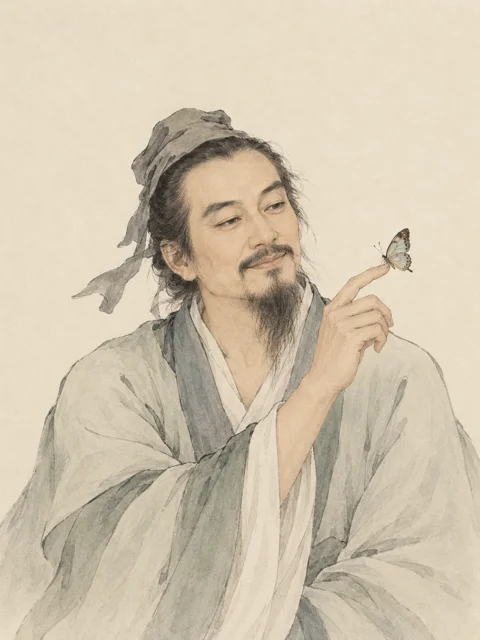
 AI 创作示意
GUANFU / zh-Hans
庄子
AI 创作示意人間世 · 白话释义
版本按章对照,不代表逐句校勘对应。
中文原文(全三十三篇) / 庄子原典;维基文库贡献者整理
观复随文注释 · 81 条
顏回孔子弟子,字子渊見仲尼孔子的字,請行。曰:「奚之?」曰:「將之衞。」曰:「奚爲焉?」曰:「回聞:衞君此处一般解释为卫国君主,其年壯,其行獨行事专断,輕用其國,而不見其過。輕用,民死,死者以國,量乎澤,若蕉枯草,喻死者众多,民其无如矣。回嘗聞之夫子曰:『治國去之,亂國就之,醫門多疾。』願以所聞思其則,庶幾其國有瘳病愈,喻政治得到改善;读 chōu乎?」仲尼曰:「譆!若殆往而刑耳!夫道,不欲雜,雜則多,多則擾,擾則憂,憂而不救。古之至人,先存諸己,而後存諸人。所存於己者未定,何暇至於暴人之所行?且若亦知夫德之所蕩,而知之所爲出乎哉?德蕩乎名,知出乎爭。名也者,相軋互相倾轧也;知也者,爭之器也。二者凶器,非所以盡行也。且德厚信矼诚信笃实;矼读 qiāng,未達人氣,名聞不爭,未達人心,而彊以仁義繩墨木工准绳,喻约束人的规矩之言,術暴人之前者,是以人惡有其美也,命之曰菑人给别人招致灾害;菑同灾。菑人者,人必反菑之。若殆爲人菑夫!且苟爲悅賢而惡不肖,惡用而求有以異?若唯无詔,王公必將乘人,而鬭其捷,而目將熒之,而色將平之,口將營之,容將形之,心且成之,是以火救火,以水救水,名之曰益多,順始无窮。若殆以不信厚言,必死於暴人之前矣!且昔者桀殺關龍逢传说因谏夏桀而遇害的臣子,紂殺王子比干商纣王之臣,相传因谏遇害,是皆脩其身,以下傴拊俯身抚恤人之民,以下拂其上者也,故其君因其脩以擠之排挤、陷害他,是好名者也。昔者堯攻叢支一作「枝」、胥敖,禹攻有扈,國爲虛厲废墟与厉鬼,形容国破人亡,身爲刑戮,其用兵不止,其求實无已,是皆求名實者也。而獨不聞之乎:名實者,聖人之所不能勝也,而況若乎?雖然,若必有以也,嘗以語我來。」顏回曰:「端而虛端正而谦虚,勉而一勤勉而专一,則可乎?」曰:「惡!惡可?夫以陽爲充孔揚,釆一作「采」色不定,常人之所不違,因案人之所感,以求容與其心,名之曰『日漸之德』不成,而況大德乎?將執而不化,外合而內不訾,其庸詎可乎?」「然則我內直而外曲内心正直,外表随俗,成而上比。內直者,與天爲徒。與天爲徒者,知天子之與己,皆天之所子,而獨以己言,蘄乎而人善之,蘄乎而人不善之邪?若然者,人謂之童子,是之謂與天爲徒。外曲者,與人之爲徒也。擎跽曲拳举笏长跪、弯身屈膝的礼节,人臣之禮也,人皆爲之,吾敢不爲邪?爲人之所爲者,人亦无疵焉,是之謂與人爲徒。成而上比者,與古爲徒。其言雖教讁之,實也古之有也,非吾有也。若然者,雖直,不爲病,是之謂與古爲徒。若是,則可乎?」仲尼曰:「惡!惡可?太一作「大」多政法而不諜,雖固,亦无罪;雖然,止是耳矣夫,胡可以及化?猶師心以自己的成见为准则者也。」顏回曰:「吾无以進矣,敢問其方?」仲尼曰:「齋,吾將語若。有而爲,(之)其易邪?易之者,暤一作「暭」天不宜。」顏回曰:「回之家貧,唯不飲酒不茹葷吃葱蒜等辛味蔬菜者,數月矣。若一作「如」此,則可以爲齋乎?」曰:「是祭祀之齋,非心齋排除成见、使心虚静的修养也。」回曰:「敢問心齋?」仲尼曰:「若一志,无聽之以耳而聽之以心,无聽之以心而聽之以氣。聽止於耳,心止於符与既有认识相符合。氣也者,虛而待物者也。唯道集虛。虛者,心齋也。」顏回曰:「回之未始得使,實自回也;得使之也,未始有回也,可謂虛乎?」夫子曰:「盡矣!吾語若:若能入遊其樊,而无感其名,入則鳴,不入則止,无門无毒,一宅而寓於不得已,則幾矣。絕迹易,无行地難。爲人使,易以僞;爲天使,難以僞。聞以有翼飛者矣,未聞以无翼飛者也;聞以有知知者矣,未聞以无知知者也。瞻彼闋者,虛室生白空室生明,喻虚心则明达,吉祥止止;夫且不止,是之謂坐馳身体静坐而心念奔驰。夫徇耳目內通,而外於心知,鬼神將來舍,而況人乎?是萬物之化也,禹、舜之所紐也,伏羲一作「戲」、几蘧一作「遽」之所行終,而況散焉者乎?」
葉公子高楚国大夫沈诸梁將使於齊,問於仲尼曰:「王使諸梁也甚重,齊之待使者,蓋將甚敬而不急。匹夫猶未可動也,而況諸侯乎?吾甚慄之。子常語諸梁也曰:『凡事,若小若大,寡不道以懽成。事若不成,則必有人道之患;事若成,則必有陰陽之患忧惧过度导致的身心失调。若成,若不成,而後无患者,唯有德者能之。』吾食也執粗而不臧,爨烧火做饭;读 cuàn无欲清之人。今吾朝受命而夕飲冰,我其內熱與?吾未至乎事之情,而旣有陰陽之患矣,事若不成,必有人道之患,是兩也,爲人臣者不足以任之。子其有以語我來?」仲尼曰:「天下有大戒重大的法则或约束二:其一命也,其一義也。子之愛親,命也,不可解於心;臣之事君,義也,无適而非君也:无所逃於天地之間,是之謂大戒。是以夫事其親者,不擇地而安之,孝之至也;夫事其君者,不擇事而安之,忠之盛也;自事其心者,哀樂不易施乎前,知其不可奈何而安之若命,德之至也。爲人臣子者,固有所不得已,行事之情而忘其身,何暇至於悅生而惡死?夫子其行,可矣!丘請復以所聞:凡交,近則必相靡以信,遠則必忠之以言。言必或傳之。夫傳兩喜兩怨一作「怒」之言,天下之難者也。夫兩喜必多溢美过分夸大的赞美之言,兩怨一作「怒」必多溢惡过分夸大的恶评之言。凡溢之,類妄,妄則其信之也莫,莫則傳言者殃。故法言可作为准则的话曰:『傳其常情,无傳其溢言,則幾乎全。』且以巧鬭力者,始乎陽,常卒乎陰,泰至則多奇巧;以禮飲酒者,始乎治,常卒乎亂,泰至則多奇樂。凡事亦然,始乎諒诚信,常卒乎鄙卑鄙、争竞;其作始也簡,其將畢也必巨。言者,風波也;行者,實喪也。夫風波易以動,實喪易以危,故忿設无由,巧言偏辭,獸死不擇音,氣息茀然气息急促的样子,於是並生心厲;剋核苛刻追究太至,則必有不肖之心應之,而不知其然也。苟爲不知其然也,孰一作「熟」知其所終?故法言曰:『无遷令擅自改变所受命令,无勸成强求事情成功。』過度益也,遷令、勸成,殆事。美成在久,惡成不及改,可不愼與?且夫乘物以遊心,託不得已以養中保养内心的平和,至矣,何作爲報也?莫若爲致命如实传达使命,此其難者。」
顏闔鲁国贤者將傅做太子的老师衞靈公太一作「大」子,而問於蘧伯玉卫国大夫,名瑗,曰:「有人於此,其德天殺生性残暴嗜杀,與之爲无方,則危吾國;與之爲有方,則危吾身;其知適足以知人之過,而不知其所以過。若然者,吾奈一作「柰」之何?」蘧伯玉曰:「善哉問乎!戒之!愼之!正汝一作「女」身哉!形莫若就,心莫若和。雖然,之二者有患。就不欲入,和不欲出。形就而入,且爲顚爲滅,爲崩爲蹶;心和而出,且爲聲爲名,爲妖爲孽。彼且爲嬰兒,亦與之爲嬰兒;彼且爲无町畦田界,喻行为的规矩,亦與之爲无町畦;彼且爲无崖,亦與之爲无崖;達之,入於无疵。汝不知夫螳蜋乎?怒其臂以當車轍,不知其不勝任也,是其才之美者也。戒之!愼之!積伐不断夸耀自己的才能而美者,以犯之,幾矣!汝不知夫養虎者乎?不敢以生物與之,爲其殺之之怒也;不敢以全物與之,爲其決之之怒也。時其飢飽,達其怒心。虎之與人異類,而媚養己者,順也;故其殺者,逆也。夫愛馬者,以筐盛矢粪便,以蜄大蛤壳;读 shèn盛溺尿,读 niào;適有蚊虻一作「蚉䖟」僕緣,而拊之不時,則缺銜咬坏马口中的嚼子、毀首、碎胷。意有所至,而愛有所亡,可不愼邪?」
匠石名石的木匠之齊,至乎曲轅,見櫟社樹被用作土地神社树的栎树,其大蔽牛,絜用绳围量;读 xié之百圍,其高臨山十仞古代长度单位而後有枝,其可以爲舟者旁十數。觀者如市,匠伯不顧,遂行不輟。弟子厭觀之,走及匠石,曰:「自吾執斧斤以隨夫子,未嘗見材如此其美也。先生不肯視,行不輟,何邪?」曰:「已矣!勿言之矣!散木不合木工取材标准的树木也!以爲舟則沈一作「沉」,以爲棺槨則速腐,以爲器則速毀,以爲門戶則液樠木材渗出脂液,以爲柱則蠹,是不材之木也,无所可用,故能若是之壽。」匠石歸,櫟社見夢曰:「汝一作「女」將惡乎比予哉?若將比予於文木有用、可取材的树木邪?夫柤梨橘柚果蓏木本果实与草本瓜果之屬,實熟則剝則辱,大枝折,小枝泄,此以其能苦其生者也。故不終其天年而中道夭,自掊擊於世俗者也。物莫不若是。且予求无所可用,久矣,幾死,乃今得之,爲予大用。使予也而有用,且得有此大也邪?且也若與予也,皆物也,奈何哉其相物把对方作为物来评判也?而幾死之散人,又惡知散木?」匠石覺而診其夢解说自己的梦,弟子曰:「趣取无用,則爲社,何邪?」曰:「密!若无言!彼亦直寄焉,以爲不知己者詬厲辱骂、责难也。不爲社者,且幾有翦乎?且也彼其所保與衆異,而以義譽之,不亦遠乎?」
南伯子綦遊乎商之丘,見大木焉,有異,結駟四匹马并驾的车千乘隱,將庇一作「芘」其所賴一作「藾」。子綦曰:「此何木也哉?此必有異材夫!」仰而視其細枝,則拳曲而不可以爲棟梁;俯而視其大根,則軸解木纹旋曲分散而不可以爲棺槨;咶同舐,舔其葉,則口爛而爲傷;嗅之,則使人狂酲昏乱如醉;酲读 chéng三日而不已。子綦曰:「此果不材之木也,以至於此其大也。嗟乎!神人以此不材。」宋有荊氏者,宜秋一作「楸」柏桑。其拱把而上者,求狙猴之杙拴系牲畜的木桩;读 yì者斬之;三圍四圍,求高名之麗屋梁,读 lì者斬之;七圍八圍,貴人富商之家,求禪傍棺木的两侧板者斬之。故未終其天年,而中道之夭於斧斤一作「片」,此材之患也。故解之以牛之白顙白色的额头;顙读 sǎng者,與豚之亢鼻者,與人有痔病者,不可以適河投入河中祭河神,此皆巫祝以知之矣,所以爲不祥也,此乃神人之所以爲大祥也。
支離疏寓言中身体畸曲者的名字者,頤下巴隱於齊通脐,肚脐,肩高於頂,會撮发髻指天,五管在上,兩髀大腿;读 bì爲脅,挫鍼治繲缝补、洗衣之类的谋生劳动,足以餬口,鼔一作「鼓」筴播精古注有揲蓍占卜、簸米等不同解释,足以食十人。上徵武士,則支離攘臂於其間;上有大役,則支離以有常疾长久的病残,不受功;上與病者粟,則受三鍾,與十束薪。夫支離其形者,猶足以養其身,終其天年,又況支離其德者乎?
孔子適楚,楚狂接輿楚国隐者,以狂者自处遊其門,曰:「鳳兮鳳兮,何如德之衰也?來世不可待,往世不可追也。天下有道,聖人成焉。天下无道,聖人生焉。方今之時,僅免刑焉。福輕乎羽,莫之知載。禍重乎地,莫之知寘一作「避」。已乎已乎,臨人以德。殆乎殆乎,畫地而趨。迷陽荆棘,喻行路的障碍迷陽,无傷吾行。吾行郤曲,无傷吾足。」山木,自寇自己招致砍伐之害也。膏火,自煎也。桂可食,故伐之。漆可用,故割之。人皆知有用之用,而莫知无用之用也。
观复随文注释 · AI 辅助独立整理,待持续人工校订。释义以本章语境为依据;存在异说或底本疑讹的地方另作提示。原文及版本来源保留如下。
参考: 本站所收原典:人間世 ↗
原典公有领域;电子文本据维基文库贡献者,按 CC BY-SA 4.0 保留署名及相同方式共享;调整空白与排版。 · 查看原始版本
欢迎引用本站资源,分享道家与道教文化。引用时请注明出处“观复”,并附上所引用内容的原始页面链接,方便读者查阅。
观复白话释义(AI 辅助) / 观复 · AI 辅助独立整理
【白话释义|AI 辅助独立整理,未经人工学术审定】
颜回拜见孔子,请求出行。孔子问:“往哪里去?”颜回说:“到卫国去。”孔子问:“去做什么?”颜回说:“我听说卫君年轻气盛,行事专断,轻率地驱使全国,却看不见自己的过错。他这样轻率行事,使百姓大批死亡,尸体遍及国中、堆积在泽地,如草芥一般,百姓已经无可奈何。我曾听先生说:‘治理得好的国家可以离开,混乱的国家应当前往;医生门前病人多。’我想拿先生教给我的道理,思考治理的办法,也许可以让卫国的病患有所减轻。”
孔子说:“唉!你这样去,恐怕只会遭刑罚!道不宜杂乱;杂乱便头绪繁多,繁多便扰攘,扰攘便忧患,陷入忧患就无从自救。古代修养至高的人,先使自己立得住,然后才设法帮助别人立得住。你自己所持的还未安定,哪里顾得上干预暴君的行为?而且你知道德性为什么毁坏、智巧为什么显露吗?德性因追逐名声而毁坏,智巧因争胜而显露。名声使人互相倾轧,智巧是争斗的工具;这两样都是凶器,不能靠它们把人生走到底。
“即使德行深厚、诚实坚固,也未必能通达别人的性情;即使声名良好、不与人争,也未必能打动别人的内心。若强把仁义规范的言论陈说在暴君面前,就是借别人的丑恶来显示自己的美好,这叫作给人招灾。给人招灾的人,别人一定反过来使他受灾;你恐怕要受人伤害!再说,假如他本就喜欢贤人、厌恶不肖者,又何须你前去,特别显示自己的不同?除非你什么也不说,否则王公一定仗势压人,同你较量口舌的敏捷。你会眼神慌乱,脸色勉强平和,嘴里设法周旋,容貌曲意迎合,心里也逐渐顺从他。这就像用火救火、用水救水,只会越加越多。一旦开始迁就,就没有尽头。若他不信你,你却执意多说,恐怕一定会死在暴君面前!
“从前夏桀杀关龙逢,商纣杀王子比干,他们都是修养自身、处在臣下位置,俯身爱护君主的百姓,却由此违逆了君上。因此君主借他们的修德来排挤、毁灭他们;从这种处境看,他们受到好名的牵累。从前尧攻打丛支、胥敖,禹攻打有扈,敌国变成废墟,国君遭到杀戮;用兵不停,是追求实利不止。这些都是追逐名与实的结果。你难道没有听说,名与实的牵累,圣人也不能轻易胜过,何况你呢?虽然如此,你一定有自己的打算,试着告诉我。”
颜回说:“如果态度端正而虚心,努力而专一,可以吗?”孔子说:“唉,怎么可以!那个人外表气势充盛,骄横外扬,情绪变幻不定,常人不敢违抗;他压制别人顺从自己,以满足内心。这样的人,连让德性一天天渐进的办法也不能奏效,何况一下子要求大德!他会固执不化,表面顺从,心里却不肯反省,你怎么能成功?”
颜回说:“那么,我内心正直,外表委曲,成就进言时援引古人。内心正直,就是与天为伴。既然与天为伴,便知道天子与自己同是天所生,何必执着自己的话,求别人称赞或担心别人不称赞?这样的人,人们说他像孩子,这就叫与天为伴。外表委曲,就是与人为伴。举笏、跪拜、弯身、拱手,都是臣下的礼节,别人都这样,我哪里敢不这样?做大家都做的事,别人也就无从指责,这就叫与人为伴。进言时援引古人,就是与古人为伴。说出的话虽然有教诲、责备的意思,但那些道理古已有之,不是我自创的。这样即使正直,也不至于受害,这就叫与古人为伴。这样可以了吗?”
孔子说:“唉,怎么可以!你的办法太多,考虑得还不周密。固然守住这些,或许能不获罪,但也不过到此为止,怎么能够感化别人?你仍然把自己的成心当老师。”颜回说:“我没有办法再往前想了,请先生告诉我该怎么做。”孔子说:“先斋戒,我再告诉你。怀着预定的心意去做事,会容易吗?以为容易,上天不会赞同。”颜回说:“我家贫穷,几个月不喝酒、不吃葱蒜一类有辛味的菜了。这样算斋戒吗?”孔子说:“这是祭祀的斋戒,不是心的斋戒。”颜回说:“请问什么是心斋?”
孔子说:“使心志专一。不要只用耳朵听,要用心听;不要只用成见之心听,要用虚静之气去听。耳的作用止于听声,心的作用止于辨认、契合已有的认识;气却是空虚开放、等待事物自然呈现的。只有道能汇集在虚静处。这样的虚静,就是心斋。”颜回说:“我还没有领会并运用这个办法时,总有一个实实在在的‘颜回’;领会并运用之后,就不再执着于这个颜回。这可以叫虚吗?”孔子说:“完全是这样!我告诉你:如果你进入他圈定的范围而活动,却不被名声感动;话听得进去,就说,听不进去,就停。不另设门户,不强施手段,内心安于一处,把应对寄托于不得已的情势,就差不多了。
“隐去足迹容易,不在地上行走却难。受人驱使,容易用虚假应付;受自然驱使,就难以作伪。听说过有翅膀而飞,没听说过没有翅膀而飞;听说过用知识来认识,没听说过不用成见之知而认识。看看那空敞之处:空虚的室内会生出光明,吉祥就止息在虚静之中。心不能安定,即使坐着,也如在奔跑。让耳目的感受通达内在,把心智的机巧放在外面,鬼神都愿前来居住,何况人呢?这就是万物得到感化的途径,是禹、舜所把握的关键,是伏羲、几蘧终身实行的道路,何况普通的人!”
叶公子高将奉命出使齐国,问孔子:“楚王交给我诸梁的使命十分重大。齐国对待使者,大概会礼貌周到,却不急着办事。一个普通人尚且不容易说动,何况诸侯!我对此非常害怕。先生常对我说:‘无论大事小事,很少有不通过相互和悦而办成的。事情办不成,一定会有人事上的灾祸;办成了,又往往有忧喜失度、阴阳失调的病患。不论成与不成,最终都不受损害,只有有德的人才能做到。’我平常吃粗食,不求美味,灶前的人也不用因忙于烹饪而求清凉。如今我早晨受命,晚上就得喝冰水,恐怕是心里焦灼发热了吧?我还没有接触事情的实际,就已经有阴阳失调的病患;如果事情不成,又必有人事的灾祸,两种忧患都来了。做臣子的,实在难以承担,先生能指点我吗?”
孔子说:“天下有两大不可轻易摆脱的约束:一个是命,一个是义。子女爱父母,是天生的情感,心里无法解开;臣下侍奉君主,是所处关系中的义务,走到哪里都处在君主统治之下,在天地之间无处逃脱,这就是所谓的大戒。因此,侍奉父母的人,不择处境而安于奉养,是孝的极致;侍奉君主的人,不择任务而安于职分,是忠的极致。修养自己内心的人,面对悲喜不被改变,知道无可奈何便像对待命运一样安处,是德的极致。做人臣、做人子,原有不得已的处境。依照事情的实情行事,忘掉一己的计较,哪里还有空沉溺于贪生怕死?先生可以去执行使命了。
“我再把听来的道理告诉你:人与人交往,近处要靠相互接触、以诚信感通,远处就要靠言辞忠实传达;言辞必须有人传送。传达双方欢喜或愤怒的话,是天下难事。双方欢喜,往往多出过分赞美的话;双方愤怒,往往多出过分诋毁的话。凡是过分的,便容易失实;一失实,就会失去信任,失去信任,传话的人便遭殃。所以有规诫说:‘传达真实、平常的情意,不传达过分的言辞,就接近于保全了。’
“再说,以技巧较量力气,开始时公开公平,后来常转为暗中算计;争得太过,就会有各种奇巧诡计。按礼节饮酒,开始有秩序,最后常陷入混乱;喝得太过,就会出现种种失常的取乐行为。凡事也是这样,起初诚实,最后常流于卑陋;开始很简单,到结束时却会膨胀得很大。言语像风波,行动可能造成实际的损失;风波容易激荡,实际损失容易使人陷入危境。于是愤怒忽然生起,巧言偏辞随之而来;就像野兽濒死时不择声音地哀号,人被逼得气息激怒,也会生出凶狠的心。苛求过度,必然招来不良的应对,自己却往往不知道为什么。既然不知道事情怎样发展,谁又知道最后会怎样?因此规诫说:‘不要擅改命令,不要强求成功。’超过分寸,只会增添事端。擅改命令、急求成功,都会使事情危险。美好的成功需要长久积累,恶果却快得来不及补救,能不谨慎吗?顺着事情的变化让心自在,把不得已的处境作为养护内心的依托,就到极致了。何必预先安排一定要带回怎样的答复?最好忠实传达使命,这正是难处。”
颜阖将担任卫灵公太子的老师,向蘧伯玉请教:“这里有一个人,性情生来好杀。任他毫无规矩地行事,会危及国家;要求他按规矩行事,又会危及我。他的聪明足以看出别人的过错,却不知道自己为什么犯错。对这样的人,我怎么办?”蘧伯玉说:“问得好!警惕啊,谨慎啊,先端正你自己!外表最好顺应,内心最好平和。但这两点也各有危险:外表顺应,不要深陷进去;内心平和,不要表露为炫耀。顺应而陷进去,便会颠覆、毁灭、崩坏、跌倒;平和而外露,便会求声名,招灾祸。他像婴儿,你也像婴儿;他不设界限,你也暂不设界限;他没有边际,你也不以边际强拘他。通达地引导,才可进入不受指摘的境地。
“你不知道螳螂吗?奋起双臂,企图挡住车轮,不知道自己不能胜任,还以自己的本领为美。警惕啊,谨慎啊!不断夸耀自己擅长的东西,拿它触犯对方,就危险了!你不知道养虎的人吗?不敢给虎活物,怕它杀戮时激起怒气;不敢给整只动物,怕它撕裂时激起怒气。要了解它饥饱的时机,通晓它凶怒的心性。虎与人不是同类,却亲近饲养它的人,因为饲养者顺应它;它杀人,则是受到违逆。再看爱马的人,用筐接马粪,用大贝壳接马尿;恰好有蚊虻落到马身上,他拍打得不合时宜,马惊起来,便会咬断马勒、撞伤人的头、踢伤人的胸膛。爱护的心意本来极深,效果却损伤了所爱,能不谨慎吗?”
木匠石到齐国去,来到曲辕,看见一棵被奉为社神的栎树,大得能遮住牛群,树干绕量有百围,树高俯临山头,到八十尺以上才长枝;旁枝可用来造船的有十几根。看树的人多得像赶集,匠石却不看,径直走去。徒弟看够了,跑着追上他说:“我拿斧子跟随先生以来,从没见过这样好的木材。先生却不肯看,走个不停,为什么?”匠石说:“算了,别说了!这是一棵没用的树!做船会沉,做棺材会很快腐烂,做器具会很快毁坏,做门窗会渗出树液,做柱子会生虫。这是不成材的木头,没有可用之处,所以才能活得这么长。”
匠石回去,社树在梦中出现,说:“你打算拿什么来同我相比?要拿那些有用的好木材吗?山楂、梨、橘、柚以及各种结果的植物,果实熟了就遭剥取、摧残,大枝被折断,小枝被扯坏。它们的本领反而使自己的生命受苦,所以没能活尽天年,中途便夭折。这是自己招来世俗的打击,事物没有不如此的。我长久追求无所可用,几乎丧命,如今才得到它;这正是我的大用。假如我也有用,哪里能长得这样大?而且你和我都是万物之一,为什么要这样把对方当作可利用的物来评判?你这个快死的无用之人,又哪里懂得无用的树!”
匠石醒来,细想梦中的话。徒弟问:“既然它以无用为追求,为什么又做社树?”匠石说:“闭嘴,不要说了!它不过借社树的身份寄身,免得那些不了解它的人加以侮辱伤害。若不做社树,恐怕也难免遭剪伐。它保全自身的方式,与一般事物不同;你拿通常的道理衡量、评价它,岂不相去太远?”
南伯子綦游到商丘,见到一棵异乎寻常的大树,树荫能遮蔽上千辆四马之车。子綦说:“这是什么树?一定有什么特别好的材质!”抬头看细枝,却盘曲得不能做栋梁;低头看大根,却弯裂得不能做棺椁。舔它的叶子,嘴会溃烂受伤;闻它的气味,会使人昏乱如醉,三天不止。子綦说:“这果然是不成材的树,所以能长得这样大。唉,神人也正凭借这种不合世俗用途的状态来保全自己。”
宋国有一处叫荆氏的地方,适宜生长楸、柏、桑。树长到一两把粗,想做拴猴木桩的人就砍它;长到三围、四围,想做大屋栋梁的人就砍它;长到七围、八围,富贵之家想做棺材,就砍它。因此它们没有活尽天年,中途就死在斧头下,这是成材的祸患。祭祀求解灾时,额头有白毛的牛、鼻子上翻的猪以及患有痔病的人,不能送到河中献祭,巫祝都知道这些,把它们视为不吉祥;神人却认为,这正是极大的吉祥。
有个叫支离疏的人,下巴缩近肚脐,肩膀高过头顶,发髻朝天,五脏的部位向上错移,两条大腿挤在肋部。他替人缝补、洗衣,就足以糊口;替人扬簸筛选米粮,就能养活十个人。国家征召武士,他可以在征兵人群中自在地挥动胳膊;国家征发大规模劳役,他因为一向残疾,不必服役;国家发粮救济病残者,他可以领三钟粮食、十束柴。形体残缺的人,尚且能养活自己、尽其天年,何况不以外显的才德迎合世用的人呢?
孔子到楚国,楚地的狂人接舆在他门前走过,唱道:“凤凰啊,凤凰啊,怎么德运这样衰落!未来的时代不能期待,过去的时代不能追回。天下有道,圣人可以成就事业;天下无道,圣人只求保全生命。当今之世,不过勉强免于刑罚。福比羽毛还轻,却不知怎样承受;祸比大地还重,却不知怎样避开。停下吧,停下吧,别再以德性居高临下地要求别人!危险啊,危险啊,别再划出界限让人奔走!荆棘啊,荆棘啊,不要伤害我的行路;我曲折退让着走,不要伤害我的脚!”
山中的树木,因为有用而招来砍伐;灯中的油脂,因为能燃烧而煎耗自己。桂树的皮可食用,所以遭砍;漆树的汁可使用,所以被割。人都知道有用的作用,却不知道不合世用也有它的作用。
校订说明:以上保留篇中借孔子等人物说话的寓言结构,不等于认定所有言论都是历史人物实录。“无门无毒”“五管”“鼓筴播精”“高名之丽”等词句有不同训释,暂依上下文择一通顺解释。原文“结驷千乘隐”句式疑有讹误,按大树能荫蔽千乘释出。忠孝、献祭及病残者叙述属于古代文本的历史观点与寓言材料。
观复白话释义:AI 辅助依据古文独立编写,已进行文本覆盖核对,未经人工学术审定;原典来源及电子底本署名、许可见对应中文版本。 · 查看原始版本
Herbert A. Giles 英译(全三十三篇) / Herbert A. Giles(翟理斯),1889
Man Among Men.
[Translator’s note] Argument :—Man must fall in with his mortal environment—His virtue should be passive, not active—He should be rather than do—Talents a hindrance—But of petty uselessness great usefulness is achieved.
Yen Hui went to take leave of Confucius.
[Translator’s note] A disciple of the Sage. Also known as Tzŭ Yüan.
"Whither are you bound?" asked the Master.
"I am going to the State of Wei," was the reply.
"And what do you propose to do there?" continued Confucius.
"I hear," answered Yen Hui, "that the Prince of Wei is of mature age, but of an unmanageable disposition. He behaves as if the State were of no account, and will not see his own faults. Consequently, the people perish; and their corpses lie about like so much undergrowth in a marsh. They are at extremities. And I have heard you, Sir, say that if a State is well governed it may be neglected; but that if it is badly governed, then we should visit it.
[Translator’s note] In the Lun Yü , Confucius says exactly the opposite of this.
The science of medicine embraces many various diseases. I would test my knowledge in this sense, that perchance I may do some good to that State."
"Alas!" cried Confucius, "you will only succeed in bringing evil upon yourself. For Tao must not be distributed. If it is, it will lose its unity. If it loses its unity, it will be uncertain; and so cause mental disturbance,—from which there is no escape.
"The sages of old first got Tao for themselves, and then got it for others. Before you possess this yourself, what leisure have you to attend to the doings of wicked men? Besides, do you know what Virtue results in and where Wisdom ends? Virtue results in a desire for fame; Wisdom ends in contentions. In the struggle for fame men crush each other, while their wisdom but provokes rivalry. Both are baleful instruments, and may not be incautiously used.
"Besides, those who, before influencing by their own solid virtue and unimpeachable sincerity, and before reaching the heart by the example of their own disregard for name and fame, go and preach charity and duty to one's neighbour to wicked men,—only make these men hate them for their very goodness' sake. Such persons are called evil speakers . And those who speak evil of others are apt to be evil spoken of themselves. That, alas! will be your end.
"On the other hand, if the Prince loves the good and hates the bad, what object will you have in inviting him to change his ways? Before you have opened your mouth to preach, the Prince himself will have seized the opportunity to wrest the victory from you. Your eye will fall, your expression fade, your words will stick, your face will change, and your heart will die within you. It will be as though you took fire to quell fire, water to quell water, which is popularly known as 'pouring oil on the flames.' And if you begin with concessions, there will be no end to them. Neglect this sound advice, and you will be the victim of that violent man.
"Of old, Chieh murdered Kuan Lung Fêng, and Chou slew Prince Pi Kan. Their victims were both men who cultivated virtue themselves in order to secure the welfare of the people. But in doing this they offended their superiors; and therefore, because of that very moral culture, their superiors got rid of them, in order to guard their own reputations.
[Translator’s note] Chieh and Chou are the two typical tyrants of Chinese history.
"Of old, Yao attacked the Ts'ung-chih and Hsü-ao countries, and Yü attacked the Yu-hu country. Homes were desolated and families destroyed by the slaughter of the inhabitants. Yet they fought without ceasing, and strove for victory to the last. These are instances known to all. Now if the Sages of old failed in their efforts against this love of fame, this desire for victory,— are you likely to succeed? But of course you have a scheme. Tell it to me."
"Gravity of demeanour," replied Yen Hui, "and dispassionateness; energy and singleness of purpose,—will this do?"
"Alas!" said Confucius, "that will not do. If you make a show of being perfect and obtrude yourself, the Prince's mood will be doubtful. Ordinarily, he is not opposed, and so he has come to take actual pleasure in trampling upon the feelings of others. And if he has thus failed in the practice of routine virtues, do you expect that he will take readily to higher ones? You may insist, but without result. Outwardly you will be right, but inwardly wrong. How then will you make him mend his ways?"
"Just so," replied Yen Hui. "I am inwardly straight, and outwardly crooked, completed after the models of antiquity.
"He who is inwardly straight is a servant of God. And he who is a servant of God knows that the Son of Heaven
[Translator’s note] The Emperor.
and himself are equally the children of God. Shall then such a one trouble whether man visits him with evil or with good? Man indeed regards him as a child; and this is to be a servant of God.
[Translator’s note] (1) Children are everywhere exempt.—This is the first limb of a threefold argument.
"He who is outwardly crooked is a servant of man. He bows, he kneels, he folds his hands;—such is the ceremonial of a minister. What all men do, shall I dare not to do? What all men do, none will blame me for doing. This is to be a servant of man.
[Translator’s note] (2) The individual is not punished for the faults of the community.
"He who is completed after the models of antiquity is a servant of the Sages of old. Although I utter the words of warning and take him to task, it is the Sages of old who speak, and not I. Thus my uprightness will not bring me into trouble, the servant of the Sages of old.—Will this do?"
[Translator’s note] (3) The responsibility rests, not with the mouthpiece, but with the authors of the doctrines enunciated.
"Alas!" replied Confucius, "No. Your plans are too many, and are lacking in prudence. However, your firmness will secure you from harm; but that is all. You will not influence him to such an extent that he shall seem to follow the dictates of his own heart."
"Then," said Yen Hui, "I am without resource, and venture to ask for a method."
Confucius said, " FAST .... Let me explain. You have a method, but it is difficult to practise. Those which are easy are not from God."
"Well," replied Yen Hui, "my family is poor, and for many months we have tasted neither wine nor flesh. Is not that fasting?"
"The fasting of religious observance it is," answered Confucius, "but not the fasting of the heart."
"And may I ask," said Yen Hui, "in what consists the fasting of the heart?"
"Cultivate unity," replied Confucius.
[Translator’s note] Make of the mind as it were an undivided indivisible ONE .
"You hear not with the ears, but with the mind; not with the mind, but with your soul.
[Translator’s note] The vital fluid which informs your whole being; in fact, "with your whole self."
But let hearing stop with the ears. Let the working of the mind stop with itself. Then the soul will be a negative existence, passively responsive to externals. In such a negative existence, only Tao can abide. And that negative state is the fasting of the heart."
"Then," said Yen Hui, "the reason I could not get the use of this method is my own individuality. If I could get the use of it, my individuality would have gone. Is this what you mean by the negative state?"
"Exactly so," replied the Master. "Let me tell you. If you can enter this man's domain without offending his amour propre , cheerful if he hears you, passive if he does not; without science, with out drugs, simply living there in a state of complete indifference,—you will be near success. It is easy to stop walking: the trouble is to walk without touching the ground. As an agent of man, it is easy to deceive; but not as an agent of God. You have heard of winged creatures flying. You have never heard of flying without wings. You have heard of men being wise with wisdom. You have never heard of men wise without wisdom.
[Translator’s note] Wise of God, without the wisdom of man.
"Look at that window. Through it an empty room becomes bright with scenery; but the landscape stops outside. Were this not so, we should have an exemplification of sitting still and running away at one and the same time.
[Translator’s note] An empty room would contain something,—a paradox like that in the text.
"In this sense, you may use your ears and eyes to communicate within, but shut out all wisdom from the mind.
[Translator’s note] Let the channels of your senses be to your mind what a window is to an empty room.
And there where the supernatural
[Translator’s note] Something which is and yet is not, like the landscape seen in, and yet not in, a room.
can find shelter, shall not man find shelter too? This is the method for regenerating all creation.
[Translator’s note] By passive, not by active, virtue.
It was the instrument which Yü and Shun employed. It was the secret of the success of Fu Hsi and Chi Chü. Shall it not then be adopted by mankind in general?"
[Translator’s note] Who stand much more in need of regeneration than such worthies as were these ancient Emperors.
Tzŭ Kao, Duke of Shê,
[Translator’s note] A district of the Ch'u State.
being about to go on a mission to the Ch'i State, asked Confucius, saying, "The mission my sovereign is sending me on is a most important one. Of course, I shall be received with all due respect, but they will not take the same interest in the matter that I shall. And as an ordinary person cannot be pushed, still less a Prince, I am in a state of great alarm.
"Now you, Sir, have told me that in all undertakings great and small, Tao alone leads to a happy issue. Otherwise that, failing success, there is to be feared punishment from without, and with success, punishment from within; while exemption in case either of success or non-success falls only to the share of those who possess the virtue required.
[Translator’s note] I.e. those to whom the issue, as regards their own reward or punishment, is a matter of the completest indifference.
[Translator’s note] The term virtue , here as elsewhere unless specially notified, should be understood in the sense of exemplification of Tao .
"Well, I am not dainty with my food; neither am I always wanting to cool myself when hot. However, this morning I received my orders, and this evening I have been drinking iced water. I am so hot inside. Before I have put my hand to the business I am suffering punishment from within; and if I do not succeed I am sure to suffer punishment from without. Thus I get both punishments, which is really more than I can bear. Kindly tell me what there is to be done."
"There exist two sources of safety," Confucius replied. "One is Destiny : the other is Duty . A child's love for its parents is destiny. It is inseparable from the child's life. A subject's allegiance to his sovereign is duty. Beneath the canopy of heaven there is no place to which he can escape from it. These two sources of safety may be explained as follows. To serve one's parents without reference to place but only to the service, is the acme of filial piety. To serve one's prince without reference to the act but only to the service, is the perfection of a subject's loyalty. To serve one's own heart so as to permit neither joy nor sorrow within, but to cultivate resignation to the inevitable,—this is the climax of Virtue.
"Now a minister often finds himself in circumstances over which he has no control. But if he simply confines himself to his work, and is utterly oblivious of self, what leisure has he for loving life or hating death? And so you may safely go.
"But I have yet more to tell you. All intercourse, if personal, should be characterised by sincerity. If from a distance, it should be carried on in loyal terms. These terms will have to be transmitted by some one. Now the transmission of messages of good- or ill-will is the hardest thing possible. Messages of good-will are sure to be overdone with fine phrases; messages of ill-will with harsh ones. In each case the result is exaggeration, and a consequent failure to carry conviction, for which the envoy suffers. Therefore it was said in the Fa-yen ,
[Translator’s note] Name of an ancient book.
'Confine yourself to simple statements of fact, shorn of all superfluous expression of feeling, and your risk will be small.'
"In trials of skill, at first all is friendliness; but at last it is all antagonism. Skill is pushed too far. So on festive occasions, the drinking which is in the beginning orderly enough, degenerates into riot and disorder. Festivity is pushed too far. It is in fact the same with all things: they begin with good faith and end with contempt. From small beginnings come great endings.
"Speech is like wind to wave. Action is liable to divergence from its true goal. By wind, waves are easily excited. Divergence from the true goal is fraught with danger. Thus angry feelings rise up without a cause. Specious words and dishonest arguments follow, as the wild random cries of an animal at the point of death. Both sides give way to passion. For where one party drives the other too much into a corner, resistance will always be provoked without apparent cause. And if the cause is not apparent, how much less will the ultimate effect be so?
"Therefore it is said in the Fa-yen , 'Neither deviate from nor travel beyond your instructions.
[Translator’s note] "Travel beyond your instructions," is literally, "urge a settlement."
To pass the limit is to go to excess.'
"To deviate from, or to travel beyond instructions, may imperil the negotiation. A settlement to be successful must be lasting. It is too late to change an evil settlement once made.
"Therefore let yourself be carried along without fear, taking refuge in no alternative to preserve you from harm on either side. This is the utmost you can do. What need for considering your obligations? Better leave all to Destiny, difficult as this may be."
[Translator’s note] It is passing strange that this exposition of the laissez-aller inaction doctrine of Tao should be placed in the mouth of Confucius, who is thus made in some measure to discredit his own teachings. The commentators, however, see nothing anomalous in the position here assigned to the Sage.
Yen Ho
[Translator’s note] A philosopher from the Lu State.
was about to become tutor to the eldest son of Prince Ling of the Wei State. Accordingly he observed to Chü Poh Yü,
[Translator’s note] Prime Minister of the Wei State.
"Here is a man whose disposition is naturally of a low order. To let him take his own unprincipled way is to endanger the State. To try to restrain him is to endanger one's personal safety. He has just wit enough to see faults in others, but not to see his own. I am consequently at a loss what to do."
"A good question indeed," replied Chü Poh Yü, "You must be careful, and begin by self-reformation. Outwardly you may adapt yourself, but inwardly you must keep up to your own standard. In this there are two points to be guarded against. You must not let the outward adaptation penetrate within, nor the inward standard manifest itself without. In the former case, you will fall, you will be obliterated, you will collapse, you will lie prostrate. In the latter case, you will be a sound, a name, a bogie, an uncanny thing. If he would play the child, do you play the child too. If he cast aside all sense of decorum, do you do so too. As far as he goes, do you go also. Thus you will reach him without offending him.
"Don't you know the story of the praying mantis? In its rage it stretched out its arms to prevent a chariot from passing, unaware that this was beyond its strength, so admirable was its energy! Be cautious. If you are always offending others by your superiority, you will probably come to grief.
"Do you not know that those who keep tigers do not venture to give them live animals as food, for fear of exciting their fury when killing the prey? Also, that whole animals are not given, for fear of exciting the tigers' fury when rending them? The periods of hunger and repletion are carefully watched in order to prevent such outbursts. The tiger is of a different species from man; but the latter too is manageable if properly managed, unmanageable if excited to fury.
"Those who are fond of horses surround them with various conveniences. Sometimes mosquitoes or flies trouble them; and then, unexpectedly to the animal, a groom will brush them off, the result being that the horse breaks his bridle, and hurts his head and chest. The intention is good, but there is a want of real care for the horse. Against this you must be on your guard."
A certain artisan was travelling to the Ch'i State. On reaching Ch'ü-yüan, he saw a sacred li tree,
[Translator’s note] A worthless species of oak.
large enough to hide an ox behind it, a hundred spans in girth, towering up ten cubits over the hill top, and carrying behind it branches, many tens of the smallest of which were of a size for boats. Crowds stood gazing at it, but our artisan took no notice, and went on his way with out even casting a look behind. His apprentice however gazed his fill, and when he caught up his master, said, "Ever since I have handled an adze in your service, I have never seen such a splendid piece of timber as that. How was it that you, sir, did not care to stop and look at it?"
"It's not worth talking about," replied his master. "It's good for nothing. Make a boat of it,—'twould sink. A coffin,—'twould rot. Furniture,—'twould soon break down. A door,—'twould sweat. A pillar,—'twould be worm-eaten. It is wood of no quality, and of no use. That is why it has attained its present age."
When the artisan reached home, he dreamt that the tree appeared to him in a dream and spoke as follows:—"What is it that you compare me with? Is it with the more elegant trees?—The cherry-apple, the pear, the orange, the pumelo, and other fruit-bearers, as soon as their fruit ripens are stripped and treated with indignity. The great boughs are snapped off, the small ones scattered abroad. Thus do these trees by their own value injure their own lives. They cannot fulfil their allotted span of years, but perish prematurely in mid-career from their entanglement with the world around them. Thus it is with all things. For a long period my aim was to be useless. Many times I was in danger, but at length I succeeded, and so became useful as I am to-day. But had I then been of use, I should not now be of the great use I am. Moreover, you and I belong both to the same category of things. Have done then with this criticism of others. Is a good-for-nothing fellow whose dangers are not yet passed a fit person to talk of a good-for-nothing tree?"
When our artisan awaked and told his dream, his apprentice said, "If the tree aimed at uselessness, how was it that it became a sacred tree?"
[Translator’s note] Which of course may be said to be of use.
"What you don't understand," replied his master, "don't talk about. That was merely to escape from the attacks of its enemies. Had it not become sacred, how many would have wanted to cut it down! The means of safety adopted were different from ordinary means,
[Translator’s note] In order to reach the somewhat extraordinary goal of uselessness.
and to test these by ordinary canons leaves one far wide of the mark."
Tzŭ Ch'i of Nan-poh
[Translator’s note] Said to be identical with the individual mentioned at the beginning of ch. ii .
was travelling on the Shang mountain when he saw a large tree which astonished him very much. A thousand chariot teams could have found shelter under its shade.
"What tree is this?" cried Tzŭ Ch'i. "Surely it must have unusually fine timber." Then looking up, he saw that its branches were too crooked for rafters; while as to the trunk he saw that its irregular grain made it valueless for coffins. He tasted a leaf, but it took the skin off his lips; and its odour was so strong that it would make a man as it were drunk for three days together.
"Ah!" said Tzŭ Ch'i. "This tree is good for nothing, and that is how it has attained this size. A wise man might well follow its example."
[Translator’s note] And so escape danger from his surroundings.
In the State of Sung there is a place called Ching-shih, where thrive the beech, the cedar, and the mulberry. Such as are of a one-handed span or so in girth are cut down for monkey-cages. Those of two or three two-handed spans are cut down for the beams of fine houses. Those of seven or eight such spans are cut down for the solid sides of rich men's coffins.
[Translator’s note] To this day, the very best kinds of wood are still reserved for the "planks of old age."
Thus they do not fulfil their allotted span of years, but perish in mid-career beneath the axe. Such is the misfortune which overtakes worth.
For the sacrifices to the River God, neither bulls with white cheeks, nor pigs with large snouts, nor men suffering from piles, were allowed to be used. This had been revealed to the soothsayers, and these characteristics were consequently regarded as inaus picious. The wise, however, would regard them as extremely auspicious.
[Translator’s note] Readers of Don Juan will recollect how the master's mate had reason to share his view.
There was a hunchback named Su. His jaws touched his navel. His shoulders were higher than his head. His hair knot looked up to the sky. His viscera were upside down. His buttocks were where his ribs should have been. By tailoring, or washing, he was easily able to earn his living. By sifting rice he could make enough to support a family of ten.
[Translator’s note] In all of which occupations a man would necessarily stoop.
When orders came down for a conscription, the hunchback stood unconcerned among the crowd. And similarly, in matters of public works, his deformity shielded him from being employed.
On the other hand, when it came to donations of grain, the hunchback received as much as three chung ,
[Translator’s note] An ancient measure of uncertain capacity.
and of firewood, ten faggots. And if physical deformity was thus enough to preserve his body until its allotted end, how much more would not moral and mental deformity avail!
[Translator’s note] A moral and mental deviation would be still more likely to condemn a man to that neglect from his fellows which is so conducive to our real welfare.
When Confucius was in the Ch'u State, the eccentric Chieh Yü passed his door, saying, "O phœnix, O phœnix, how has thy virtue fallen!—
[Translator’s note] By thus issuing forth out of due season.
unable to wait for the coming years or to go back into the past.
[Translator’s note] When you might be, or might have been, of use. The idea conveyed is that Confucianism was unsuited to its age. See Lun-yü , ch. xviii.
If Tao prevails on earth, prophets will fulfil their mission. If Tao does not prevail, they will but preserve themselves. At the present day they will but just escape.
"The honours of this world are light as feathers, yet none estimate them at their true value. The misfortunes of this life are weighty as the earth itself, yet none can keep out of their reach. No more, no more, seek to influence by virtue. Beware, beware, move cautiously on! O ferns, O ferns, wound not my steps! Through my tortuous journey wound not my feet! Hills suffer from the trees they produce. Fat burns by its own combustibility. Cinnamon trees furnish food: therefore they are cut down. The lacquer tree is felled for use. All men know the use of useful things; but they do not know the use of useless things."
原著及 Herbert A. Giles 历史译本公有领域;据 Project Gutenberg #59709,完整电子书及使用条款见本站资料来源。 · 查看原始版本
我的书签(此浏览器)
还没有书签。