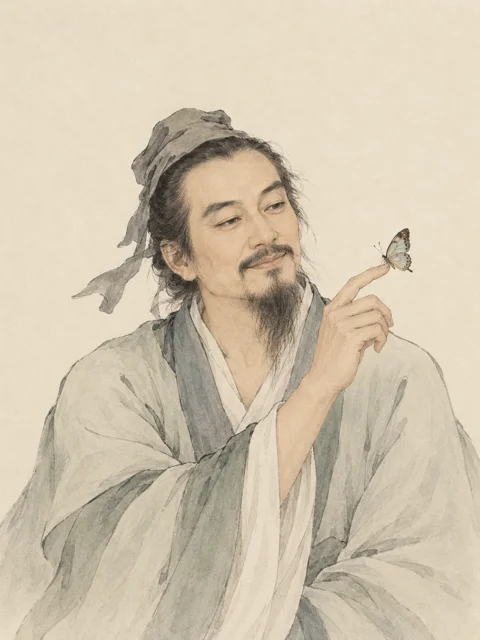
 AI 创作示意
GUANFU / en
庄子
AI 创作示意Chapter 11
版本按章对照,不代表逐句校勘对应。
中文原文(全三十三篇) / 庄子原典;维基文库贡献者整理
观复随文注释 · 50 条
聞在宥让人安存、宽容自在;宥读 yòu天下,不聞治天下也。在之也者,恐天下之淫其性使本性过度失常也;宥之也者,恐天下之遷其德改变天然的德性也。天下不淫其性,不遷其德,有治天下者哉?昔堯之治天下也,使天下欣欣焉,人樂其性,是不恬也;桀之治天下也,使天下瘁瘁困苦憔悴的样子焉,人苦其性,是不愉也。夫不恬不愉,非德也。非德也,而可長久者,天下无之。
人大喜,邪毗偏邪而助长一端於陽;大怒,邪毗於陰。陰陽并一作「並」毗,四時不至,寒暑之和不成,其反傷人之形乎!使人喜怒失位,居處无常,思慮不自得,中道不成章,於是乎天下始喬詰卓鷙矫异苛责、逞强凶狠的种种表现,而後有盜跖、曾、史之行。故舉天下以賞其善者,不足;舉天下以罰其惡者,不給:故天下之大,不足以賞罰。自三代以下者,匈匈纷扰不安的样子焉,終以賞罰爲事,彼何暇安其性命之情哉?而且悅一作「說」明邪?是淫於色也。悅一作「說」聰邪?是淫於聲也。悅一作「說」仁邪?是亂於德也。悅一作「說」義邪?是悖於理也。悅一作「說」禮邪?是相於技也。悅一作「說」樂邪?是相於淫也。悅一作「說」聖邪?是相於藝也。悅一作「說」知邪?是相於疵也。天下將安其性命之情,之八者,存,可也,亡,可也。天下將不安其性命之情,之八者,乃始臠卷傖囊纷乱纠结的样子,古注解释不一而亂天下也,而天下乃始尊之惜之。甚矣,天下之惑也!豈直過也而去之邪?乃齊戒同斋戒,洁身慎心以言之,跪坐以進之,鼓歌以儛之。吾若是何哉?故君子不得已而臨莅一作「蒞」天下,莫若无爲。无爲也,而後安其性命之情。故貴爲一作「以」身於爲天下,則可以託天下;愛以身(於)爲天下,則可以寄天下。故君子苟能无解其五藏,无擢其聰明,尸居而龍見静处如尸而应时显现如龙,淵默而雷聲静默如深渊而应物有力如雷,神動而天隨,從容无爲,而萬物吹纍一作「炊累」焉。吾又何暇治天下哉?
崔瞿問於老聃曰:「不治天下,安臧人心?」老聃曰:「汝愼无攖人心扰乱人的心;攖读 yīng。人心,排下而進上,上下囚殺,淖約柔弱纤细的样子柔乎剛彊,廉劌棱角锐利;劌读 guì彫琢,其熱焦火,其寒凝冰,其疾俛仰之間而再撫四海之外,其居也淵而靜,其動也縣(而)天。僨驕激动骄矜;僨读 fèn而不可係者,其唯人心乎!昔者黃帝始以仁義攖人之心,堯、舜於是乎,股无胈腿上的细毛;读 bá、脛无毛以養天下之形,愁其五藏以爲仁義,矜其血氣以規法度。然猶有不勝也。堯於是放讙兜传说中的上古人物,与三苗等并举於崇山,投三苗於三峗,流共工於幽都传说中北方幽暗之地,此不勝天下也。夫施及三王,而天下大駭矣,下有桀、跖,上有曾、史,而儒墨畢起,於是乎,喜怒相疑,愚知相欺,善否相非,誕信相譏,而天下衰矣;大德不同,而性命爛漫矣;天下好知,而百姓求竭矣。於是乎,斤一作「釿」鋸制焉,繩墨殺焉,椎鑿決焉。天下脊脊大亂,罪在攖人心。故賢者伏處大山嵁巖险峻的岩崖之下,而萬乘之君憂慄乎廟堂之上。今世,殊死斩首等死刑者相枕也,桁楊拘束颈足的刑具者相推也,刑戮者相望也,而儒墨乃始離跂攘臂乎桎梏之間。意!甚矣哉!其无愧而不知恥也,甚矣!吾未知聖知之不爲桁楊椄槢接合木材的榫楔也,仁義之不爲桎梏鑿枘卯眼与榫头,喻牢固嵌合也,焉知曾、史之不爲桀、跖嚆矢响箭,喻事情的开端;嚆读 hāo也?故曰:絕聖棄知,而天下大治。」
黃帝立爲天子,十九年,令行天下,聞廣成子传说中黄帝问道的隐者在於空同山名,一般写作崆峒之上,故往見之,曰:「我聞吾子達於至道,敢問至道之精?吾欲取天地之精,以佐五穀,以養民人。吾又欲官陰陽掌管、支配阴阳运行,以遂羣生。爲之奈何?」廣成子曰:「而所欲問者,物之質也。而所欲官者,物之殘也。自而治天下,雲氣不待族而雨,草木不待黃而落,日月之光益以荒矣。而佞人之心翦翦狭浅急切的样子者,又奚足以語至道?」黃帝退,捐天下,築特室,席白茅,閒居三月,復往邀之。廣成子南首而臥,黃帝順下風,膝行而進,再拜稽首叩头至地的礼节,而問曰:「聞吾子達於至道,敢問:治身奈何而可以長久?」廣成子蹶然而起,曰:「善哉問乎!來,吾語汝一作「女」至道。至道之精,窈窈冥冥幽深玄远而难以测见。至道之極,昏昏默默。无視无聽,抱神以靜,形將自正。必靜必清,无勞汝一作「女」形,无搖汝一作「女」精,乃可以長生。目无所見,耳无所聞,心无所知,汝一作「女」神將守形,形乃長生。愼汝一作「女」內,閉汝一作「女」外,多知爲敗。我爲汝一作「女」遂於大明之上矣,至彼至陽之原也;爲汝一作「女」入於窈冥之門矣,至彼至陰之原也。天地有官,陰陽有藏,愼守汝一作「女」身,物將自壯。我守其一守持纯一的本真,以處其和,故我脩身千二百歲矣,吾形未常一作「嘗」衰。」黃帝再拜稽首,曰:「廣成子之謂天矣!」廣成子曰:「來,余語汝一作「女」:彼其物无窮,而人皆以爲終;彼其物无測,而人皆以爲極。得吾道者,上爲皇而下爲王;失吾道者,上見光而下爲土。今夫百昌各种生物,皆生於土,而反於土。故余將去汝一作「女」,入无窮之門,以遊无極之野。吾與日月參光,吾與天地爲常。當我,緡乎?遠我,昏乎?人其盡死,而我獨存乎!」
雲將寓言中的云之主宰東遊,過扶搖旋风,此处借为神异地名之枝,而適遭鴻蒙寓言人物,寓意浑然未分的自然。鴻蒙方將拊髀拍打大腿一作「脾」雀躍而遊。雲將見之,倘然止,贄然恭敬肃立的样子立,曰:「叟何人邪?叟何爲此?」鴻蒙拊髀一作「脾」雀躍不輟,對雲將曰:「遊!」雲將曰:「朕願有問也。」鴻蒙仰而視雲將曰:「吁!」雲將曰:「天氣不和,地氣鬱結,六氣阴、阳、风、雨、晦、明不調,四時不節。今我願合六氣之精,以育羣生,爲之奈何?」鴻蒙拊髀一作「脾」雀躍,掉頭曰:「吾弗知!吾弗知!」雲將不得問。又三年,東遊,過有宗一作「宋」之野,而適遭鴻蒙。雲將大喜,行趨而進,曰:「天忘朕邪?天忘朕邪?」再拜稽首,願聞於鴻蒙。鴻蒙曰:「浮遊不知所求,猖狂不知所往,遊者鞅掌自在放任的样子;此处非忙碌义,以觀无妄。朕又何知?」雲將曰:「朕也自以爲猖狂,而民隨予所往。朕也不得已於民,今則民之放榜样、依循的对象也。願聞一言。」鴻蒙曰:「亂天之經,逆物之情,玄天弗成,解獸之羣,而鳥皆夜鳴,災及草木,禍及昆一作「止」蟲。噫一作「意」!治人之過也!」雲將曰:「然則吾奈何?」鴻蒙曰:「噫一作「意」!毒哉!」僊僊乎歸矣。雲將曰:「吾遇天難,願聞一言。」鴻蒙曰:「噫一作「意」!心養!汝徒處无爲,而物自化。墮爾形體,吐爾聰明,倫與物忘,大同乎涬溟混沌无分的状态;读 xìng míng。解心釋神,莫然无魂。萬物云云纷繁众多的样子,各復其根,各復其根而不知,渾渾沌沌,終身不離。若彼知之,乃是離之。无問其名,无闚其情,物故自生。」雲將曰:「天降朕以德,示朕以默。躬身求之,乃今也得。」再拜稽首,起辭而行。
世俗之人,皆喜人之同乎己,而惡人之異於己也。同於己而欲之,異於己而不欲者,以出乎衆爲心也。夫以出乎衆爲心者,曷常出乎衆哉?因衆以寧所聞,不如衆技衆矣。而欲爲人之國者,此覽一作「攬」乎三王之利,而不見其患者也。此以人之國僥倖也,幾何僥倖而不喪人之國乎?其存人之國也,无萬分之一,而喪人之國也,一不成而萬有餘喪矣!悲夫,有土者之不知也!夫有土者,有大物也。有大物者,不可以物;物而不物,故能物物役使、顺应万物而不被物役。明夫一作「乎」物物者之非物也,豈獨治天下百姓而已哉?出入六合上下四方,遊乎九州古代对天下地域的统称,獨往獨來,是謂獨有。獨有之人,是之謂至貴。
大人之教,若形之於影,聲之於響一作「嚮」,有問而應之,盡其所懷,爲天下配,處乎无響一作「嚮」,行乎无方无固定方式,挈汝適復之撓撓,以遊无端,出入无旁,與日无始。頌論形軀,合乎大同,大同而无己。无己,惡乎得有有?覩有者,昔之君子;覩无者,天地之友。
賤而不可不任者,物也。卑而不可不因者,民也。匿而不可不爲者,事也。麤同粗,粗略而不可不陳者,法也。遠而不可不居者,義也。親而不可不廣者,仁也。節而不可不積者,禮也。中而不可不高者,德也。一而不可不易者,道也。神而不可不爲者,天也。故聖人觀於天而不助,成於德而不累,出於道而不謀,會於仁与仁爱相契而不恃,薄於義而不積,應於禮而不諱,接於事而不辭,齊於法而不亂,恃於民而不輕,因於物而不去。物者,莫足爲也,而不可不爲。不明於天者,不純於德。不通於道者,无自而可。不明於道者,悲夫!何謂道?有天道自然无为的运行法则,有人道人为有意安排的行事方式。无爲而尊者,天道也;有爲而累者,人道也。主者,天道也;臣者,人道也。天道之與人道也,相去遠矣,不可不察也。
观复随文注释 · AI 辅助独立整理,待持续人工校订。释义以本章语境为依据;存在异说或底本疑讹的地方另作提示。原文及版本来源保留如下。
参考: 本站所收原典:外篇 · 在宥 ↗
原典公有领域;电子文本据维基文库贡献者,按 CC BY-SA 4.0 保留署名及相同方式共享;调整空白与排版。 · 查看原始版本
欢迎引用本站资源,分享道家与道教文化。引用时请注明出处“观复”,并附上所引用内容的原始页面链接,方便读者查阅。
观复白话释义(AI 辅助) / 观复 · AI 辅助独立整理
【白话释义|AI 辅助独立整理,未经人工学术审定】
我听说过让天下安住、宽容天下,没有听说过强行治理天下。让它安住,是怕天下人的本性被放纵扭曲;宽容它,是怕天下人的自然德性被迁改。天下人既不放纵扭曲本性,也不改变自然德性,还有什么需要强行治理的呢?从前尧治理天下,使天下人欣欣向荣,各自以其生活为乐,但这还不是恬静;桀治理天下,使天下人疲惫困苦,各自痛苦于处境,这便没有愉悦。不能恬静,也不能愉悦,都不合自然的德性。不合自然德性却能长久维持的事,天下没有。
人大喜,会偏向阳;大怒,会偏向阴。阴阳都失于偏盛,四季不能正常到来,寒暑不能调和,这又会反过来损伤人的形体。使人喜怒失去适当的位置,生活没有常态,思虑不能自得,行为失去中正的条理,于是天下人才开始矫激、乖戾、争高、凶猛,随后才有盗跖与曾参、史鱼那样相反的行为。因此,拿整个天下奖赏所谓善者,也不够;拿整个天下惩罚所谓恶者,也来不及。天下虽大,仍不够用来不断赏罚。夏商周三代以来,喧嚣纷扰,始终忙于赏罚,哪里还有空安顿人的性命本真!
再说,喜好视觉的精明吗?就容易过度沉溺色彩。喜好听觉的聪敏吗?就容易过度沉溺声音。喜好仁吗?就容易扰乱自然德性。喜好义吗?就容易违逆自然条理。喜好礼吗?就助长人为技巧。喜好乐吗?就助长放纵。喜好圣明吗?就助长才艺的炫耀。喜好智巧吗?就助长挑剔疵病。天下若能安顿性命本真,这八样东西存在也可以,不存在也可以;天下若不能安顿性命本真,这八样就开始纠缠纷乱,扰乱天下,天下人却反过来尊崇、珍惜它们。天下人的迷惑,太深了!他们哪里只是偶然经过、随即离开?还要斋戒着谈论,跪坐着进献,击鼓唱歌、跳舞颂扬。我对这又能怎么办!
所以君子若不得已而居位治理天下,最好无为。无为之后,人的性命本真才能安定。因此,把保重自身看得比治理天下更重要的人,才可以托付天下;珍爱自身、不轻易为天下牺牲生命的人,才可以寄托天下。君子如果能不扰乱内脏的平和,不拔高耳目的聪明,静居如受祭者,显现如游龙,沉默如深渊,发声如雷霆,精神发动,天运也与之相随,从容无为,万物便像受气吹动而自行生化。我又哪里需要忙着治理天下!
崔瞿问老聃:“不治理天下,怎么使人心归善?”老聃说:“你千万不要扰动人心。人心受压就下沉,受到推动就上升;这种上下牵动,会使它受困、受伤。它柔顺时比柔弱的东西还柔弱,刚强时又十分刚强;被削磨雕琢,就会失去本真。它热时像烈火焦灼,冷时像寒冰凝结;动得快时,一俯一仰之间,就能两次往返四海之外;安住时深沉寂静,活动时高悬天际。奔腾骄纵、无法捆住的,恐怕就是人心吧!
“从前黄帝开始用仁义扰动人心,尧舜接着辛勤劳作,大腿、小腿的毛都磨光了,以养护天下人的身体;让五脏忧愁来实行仁义,耗费血气来制定法度。即使如此,仍有不能胜任的地方。于是尧把驩兜放逐到崇山,把三苗迁到三危,把共工流放到幽都,这就表明他仍不能平服天下。这些做法延续到三王,天下便受到极大惊扰:坏的一端有桀、跖,好的一端有曾、史,儒家墨家也纷纷兴起。于是喜怒相猜,愚智相欺,善恶相互指责,虚妄与诚信相互讥刺,天下便衰败了;整体的德性不能相通,性命本真便散乱了;天下喜好智巧,百姓便奔求得精疲力竭。
“于是像用斧锯裁制、按绳墨砍削、拿椎凿割裂一样来整治人。天下动荡大乱,罪过就在于扰动人心。所以贤者隐藏在大山深岩之下,拥有万乘的国君却在朝堂上忧惧战栗。如今被处死的人尸首相枕,戴枷锁的人相互推挤,受刑戮的人前后相望,儒墨之士却还在刑具之间踮脚挥臂,宣扬主张。唉,他们没有惭愧、不知羞耻,实在太过分了!我不知道,所谓圣智,难道不正成为枷锁连接的部件?所谓仁义,难道不正成为刑具的榫眼和榫头?又怎么知道曾参、史鱼不是桀、跖出现的先声?所以说:断绝圣明的标榜,舍弃机巧之知,天下才会大治。”
黄帝做天子十九年,号令通行天下。他听说广成子住在空同山上,便前去拜见,说:“听说先生通达至高的道,请问至道的精髓是什么?我想取用天地的精华,帮助五谷生长,养育百姓;还想掌管阴阳,使万物顺遂生长。该怎么办?”广成子说:“你想问的,不过是外物的资质;你想掌管的,反而会使万物受损。自从你治理天下,云气还没有聚足便下雨,草木还没枯黄便凋落,日月的光辉也越来越昏暗。你这机巧之人的心思浅薄急迫,哪里配得上谈至道!”
黄帝退回,放下天下事务,另筑一室,铺上白茅,独居三个月,再去求见。广成子朝南躺着,黄帝从下风处跪行而进,两次拜伏叩头,问:“听说先生通达至道,请问怎样保养自身,才能长久?”广成子一下坐起,说:“问得好!来,我告诉你至道。至道的精髓,深远幽冥;至道的极境,浑默无声。不逐视听,抱守精神,安静下来,形体自然端正。务必宁静清明,不劳损你的身体,不摇荡你的精气,才可以长久保存生命。眼不逐物,耳不逐声,心不以机知扰动,你的精神便守住形体,形体于是长存。谨守内在,关闭外来的诱扰,多智多虑会导致败坏。
“我将带你上达大明之境,到至阳的根源;又带你进入幽冥之门,到至阴的根源。天地各有职司,阴阳各有藏处。谨慎守住自身,万物便会自然而壮盛。我守住浑一,安处和谐,所以我修养自身一千二百年,形体还不曾衰老。”黄帝再次拜伏叩头,说:“广成子真可以说与天相合!”
广成子说:“来,我告诉你:道的变化没有穷尽,人却把眼前的终结当作终结;道不可测量,人却把眼前的边际当作极限。得我的道,居上可以为皇,居下可以为王;失我的道,活着不过看见日光,死后不过化作泥土。各种生物,都从土中生,又归于土。所以我要离开你,进入无穷之门,游于无极之野。我与日月并光,与天地共常。迎着我,绵远难见;离开我,幽暗难寻。人终将都死去,而我独存于无穷!”
云将向东游行,经过扶摇神木的枝头,正好遇见鸿蒙。鸿蒙正拍着大腿,像雀鸟一样跳跃着游玩。云将惊异地停下,恭敬地站着,说:“老人家是什么人?为什么这样?”鸿蒙仍拍腿跳跃不停,回答:“游玩!”云将说:“我有事想请问。”鸿蒙抬头看他,说:“哦!”云将说:“天气不和,地气郁结,六气失调,四季失节。我想调合六气的精华,养育万物,该怎么办?”鸿蒙拍腿跳跃,摇头说:“我不知道!我不知道!”云将没能问出答案。
又过三年,云将向东游,经过有宗之野,再次遇见鸿蒙。他非常高兴,快步上前说:“天人啊,忘了我吗?天人啊,忘了我吗?”两次拜伏叩头,希望得到指教。鸿蒙说:“我漂游,不知道求什么;自在走动,不知道往哪里去。游人忙忙碌碌,我只观看自然而真实的存在。我又知道什么?”云将说:“我自以为自在任行,可百姓跟着我所去的方向。我对于百姓有不得已的责任,如今又成为他们效法的对象。希望听到一句指教。”
鸿蒙说:“扰乱自然的常规,违背万物的实情,使天地幽深的化育不能完成,拆散兽群,使鸟全在夜里惊鸣,灾害及于草木,祸患及于虫类。唉,这是治理者的过错!”云将说:“那么我怎么办?”鸿蒙说:“唉,干预真是有害啊!”说着轻快地要回去。云将说:“我很难遇见像您这样的天人,希望再听一句话。”
鸿蒙说:“唉,养心!你只须安处无为,万物自然变化。放下对形体的执着,吐去自恃的聪明,把分别和外物一起忘掉,浑同于自然未分的浩茫。解开心的拘束,释放精神,静默得仿佛不再有那个忙于思虑的魂。万物纷纷,各自返回根本;各自返回根本而不刻意求知,浑浑沌沌,终身不离。如果特意用知去把握,反而已经离开它。不要追问名称,不要窥探内情,事物本来就会自行生长。”云将说:“天人赐我以德,示我以静默。我亲身寻求,到现在才得到。”于是再次拜伏叩头,起身辞别。
世俗的人都喜欢别人同自己相同,厌恶别人同自己不同。对相同者有所欲求,对不同者有所排拒,是怀着超出众人的心。然而一心想超出众人,何曾真正超出众人?依靠众人来证实自己所听到的认识,还不如让众人的各种才能共同发挥。这样的人却想治理别人的国家,只看见三王居位的利益,没有看见其中的祸患。这是在拿别人的国家冒侥幸的风险,能有多少侥幸不把国家丧失呢?保存别国的机会,不到万分之一;而毁掉国家,一件事不成,就会引起万端损失。可悲啊,拥有国土的人竟不明白!
拥有国土,就是拥有重大的事物。拥有重大事物的人,不可被事物役使;对待外物而不被外物支配,才能使物各得其所。明白能够使物各得其所者不应成为受支配之物,何止可以治理天下百姓!他出入天地四方,游于九州,独往独来,这叫独有。这样独自保有本真的人,才是最尊贵的。
大人的教化,如形体自然产生影子,声音自然产生回响:有问便应,尽其内在所怀,同天下相配合;自身却安处于无声,行动没有固定的方向。提携你从往来烦扰中返回,游于无端之境,出入无边,与日月同在而不执着起始。使形体从容舒展,合于万物的大同;大同之后,便不执着一己。没有一己的执着,又从哪里产生据为己有?看重具体存在的,是从前所说的君子;体察无所执有的,才是天地的朋友。
看似低贱,却不能不借用的,是外物;地位卑下,却不能不依靠的,是百姓;细微隐伏,却不能不处理的,是事务;显得粗疏,却不能不陈设的,是法度;虽与自身有距离,却不能不安处其中的,是义;从亲近者开始,却不能不推广的,是仁;分成节文,却不能不积累实践的,是礼;内在中正,却不能不使之高明的,是德;浑然为一,却不能不随变化而通的,是道;神妙不测,却不能不顺其作用的,是天。
所以圣人观察自然,却不妄加助长;成全德性,却不为德名所累;由道出发,却不预设机谋;会合仁爱,却不以此自恃;亲近义,却不积存执着;应合礼,却不拘忌;接触事务,不推辞;齐同于法度,不扰乱;依靠百姓,不轻慢;顺着外物,不抛弃。外物没有什么值得刻意追逐,却又不能完全不应对。不明白自然,德性就不能纯;不通达道,便没有可以合宜行事的根由。不明白道的人,可悲啊!什么叫道?有天道,有人道。无为而居于尊位的,是天道;有所作为而承担劳累的,是人道。居主位者取法天道,居臣位者实行人道。天道与人道相距很远,不可不辨察。
校订说明:“在宥”释为使安住、宽容而不强制干预。“有土者”段“物物”依不为物役、使物各得其所解释。“广成子千二百岁”等为寓言中的长生说,不是现实寿命判断。末段对仁义礼法的定位与前段激烈批判存在层次差异,照原文分别译出,不强行消除。源文“上下囚杀”“臠卷傖囊”“玄天弗成”“神而不可不为”等疑难处均暂依整体语境释义,需后续文字校勘。
观复白话释义:AI 辅助依据古文独立编写,已进行文本覆盖核对,未经人工学术审定;原典来源及电子底本署名、许可见对应中文版本。 · 查看原始版本
Herbert A. Giles 英译(全三十三篇) / Herbert A. Giles(翟理斯),1889
On Letting Alone.
[Translator’s note] Argument :—The natural conditions of our existence require no artificial aids—The evils of government—Failure of coercion— Tao the refuge—Inaction the secret—The action of Inaction—Illustrations.
There has been such a thing as letting mankind alone; there has never been such a thing as governing mankind.
[Translator’s note] With success.
Letting alone springs from fear lest men's natural dispositions be perverted and their virtue laid aside. But if their natural dispositions be not perverted nor their virtue laid aside, what room is there left for government?
Of old, when Yao governed the empire, he caused happiness to prevail to excess in man's nature; and consequently the people were not satisfied. When Chieh
[Translator’s note] See p. 40 .
governed the empire he caused sorrow to prevail to excess in man's nature; and consequently the people were not contented. Dissatisfaction and discontent are subversive of virtue; and without virtue there is no such thing for an empire as stability.
[Translator’s note] Virtue, here in its ordinary sense.
When man rejoices greatly he gravitates towards the positive pole. When he sorrows deeply he gravitates towards the negative pole.
[Translator’s note] These "poles" are the male and female principles already alluded to on p. 82 . Originally developed from the Great Monad, they became the progenitors of all creation.
If the equilibrium of positive and negative
[Translator’s note] In nature.
is disturbed, the four seasons are interrupted, the balance of heat and cold is destroyed, and man himself suffers physically thereby.
Because men are made to rejoice and to sorrow and to displace their centre of gravity, they lose their steadiness, and are unsuccessful in thought and action. And thus it is that the idea of surpassing others first came into the world, followed by the appearance of such men as Robber Chê, Tsêng, and Shih, the result being that the whole world could not furnish enough rewards for the good nor distribute punishments enough for the evil among mankind. And as this great world is not equal to the demand for rewards and punishments; and as, ever since the time of the Three Dynasties
[Translator’s note] The legendary emperors Fu Hsi, Shên Nung, and Huang Ti, or the Yellow Emperor, already mentioned.
downwards, men have done nothing but struggle over rewards and punishments,—what possible leisure can they have had for adapting themselves to the natural conditions of their existence?
Besides, over-refinement of vision leads to debauchery in colour; over-refinement of hearing leads to debauchery in sound; over-refinement of charity leads to confusion in virtue;
[Translator’s note] Here again the manifestation of Tao . See p. 45 .
over-refinement of duty towards one's neighbour leads to perversion of principle;
[Translator’s note] The eternal principles which are of Tao and not of man.
over-refinement of ceremonial leads to divergence from the true object; over-refinement of music leads to lewdness of thought; over-refinement of wisdom leads to an extension of mechanical art; and over-refinement of shrewdness leads to an extension of vice.
[Translator’s note] As shown in the preceding chapter.
If people adapt themselves to the natural conditions of existence, the above eight
[Translator’s note] Vision, hearing, charity, duty to one's neighbour, ceremonial, music, wisdom, and shrewdness.
may be or may not be; it matters not. But if people do not adapt themselves to the natural conditions of existence, then these eight become hindrances and spoilers, and throw the world into confusion.
In spite of this, the world reverences and cherishes them, thereby greatly increasing the sum of human error. And not as a passing fashion, but with admonitions in words, with humility in prostrations, and with the stimulus of music and song. What then is left for me?
Therefore, for the perfect man who is unavoidably summoned to power over his fellows, there is naught like Inaction .
[Translator’s note] It is not according to the spirit of Tao that a man should shirk his mortal responsibilities. On the contrary, Tao teaches him how to meet them.
By means of inaction he will be able to adapt himself to the natural conditions of existence. And so it is that he who respects the State as his own body is fit to support it, and he who loves the State as his own body, is fit to govern it.
[Translator’s note] This last sentence is attributed by Huai Nan Tzŭ to Lao Tzŭ, and has been incorporated in the Tao-Tê-Ching , ch. xiii. It is curious that Chuang Tzŭ should say nothing about its authorship, and perhaps even more curious that Kuo Hsiang, his editor and commentator of the fourth century A.D. , should say nothing either about the claims of Lao Tzŭ or the Tao-Tê-Ching .
And if I can refrain from injuring my internal economy, and from taxing my powers of sight and hearing, sitting like a corpse while my dragon-power is manifested around, in profound silence while my thunder-voice resounds, the powers of heaven responding to every phase of my will, as under the yielding influence of inaction all things are brought to maturity and thrive,—what leisure then have I to set about governing the world?
[Translator’s note] Some of this passage is repeated in ch. xiv .
Ts'ui Chü
[Translator’s note] A casual personage.
asked Lao Tzŭ, saying, "If the empire is not to be governed, how are men's hearts to be kept in order?"
"Be careful," replied Lao Tzŭ, "not to interfere with the natural goodness of the heart of man. Man's heart may be forced down or stirred up. In each case the issue is fatal.
"By gentleness, the hardest heart may be softened. But try to cut and polish it,—'twill glow like fire or freeze like ice. In the twinkling of an eye it will pass beyond the limits of the Four Seas. In repose, profoundly still; in motion, far away in the sky. No bolt can bar, no bond can bind,—such is the human heart."
"Of old, the Yellow Emperor first caused charity and duty to one's neighbour to interfere with the natural goodness of the heart of man. In consequence of which, Yao and Shun wore the hair off their legs in endeavouring to feed their people. They disturbed their internal economy in order to find room for charity and duty to one's neighbour. They exhausted their energies in framing laws and statutes. Still they did not succeed.
"Thereupon, Yao confined Huan Tou on Mount Tsung; drove the chief of San-miao and his people into San-wei, and kept them there; and banished the Minister of Works to Yu Island.
[Translator’s note] These words are quoted (with variants) from the Shu Ching or Canon of History. They refer to individuals who had misconducted themselves in carrying out the new régime.
But they were not equal to their task, and through the times of the Three Princes
[Translator’s note] The Great Yü, T'ang, and Wên Wang, founder of the Chou dynasty.
the empire was in a state of great unrest. Among the bad men were Chieh and Chê; among the good were Tsêng and Shih. By and by, the Confucianists and the Mihists arose; and then came exultation and anger of rivals, fraud between the simple and the cunning, recrimination between the virtuous and the evil, slander between the honest and the dishonest,—until decadence set in, men fell away from their original virtue, their natures became corrupt, and there was a general rush for knowledge.
"The next thing was to coerce by all kinds of physical torture, thus bringing utter confusion into the empire, the blame for which rests upon those who would interfere with the natural goodness of the heart of man.
"In consequence, virtuous men sought refuge in mountain caves, while rulers of States sat trembling in their ancestral halls. Then, when dead men lay about pillowed on each others' corpses, when cangued prisoners and condemned criminals jostled each other in crowds,—then the Confucianists and the Mihists, in the midst of gyves and fetters, stood forth to preach!
[Translator’s note] Salvation from the ills of which they and their systems had been the cause.
Alas, they know not shame, nor what it is to blush!
"Until I can say that the wisdom of Sages is not a fastener of cangues, and that charity and duty to one's neighbour are not bolts for gyves, how should I know that Tsêng and Shih are not the forerunners
[Translator’s note] Lit. "sounding arrows," used by bandits as a signal for beginning the attack.
of Chieh and Chê?
[Translator’s note] The meaning intended is that good cannot exist without its correlative evil .
"Therefore I said, 'Abandon wisdom and discard knowledge, and the empire will be at peace.'"
[Translator’s note] These words have been incorporated in ch. xix of the Tao-Tê-Ching . The present rendering somewhat modifies the view I expressed on p. 16 of The Remains of Lao Tzŭ .
The Yellow Emperor sat on the throne for nineteen years, and his laws obtained all over the empire.
Hearing that Kuang Ch'êng Tzŭ
[Translator’s note] Said by some commentators to be another name for Lao Tzŭ, but if so, then it must have been Lao Tzŭ as he existed, an incarnation of Tao , before his appearance in the Confucian age.
was living on Mount K'ung-t'ung, he went thither to see him, and said, "I am told, Sir, that you are in possession of perfect Tao . May I ask in what perfect Tao consists? I desire to avail myself of the good influence of heaven and earth in order to secure harvests and feed my people. I should also like to control the Two Powers of nature
[Translator’s note] The Yin and the Yang . See pp. 82 , 120 .
in order to the protection of all living things. How can I accomplish this?"
"What you desire to avail yourself of," replied Kuang Ch'êng Tzŭ, "is the primordial integrity of matter. What you wish to control are the disintegrators thereof. Ever since the empire has been governed by you, the clouds have rained without waiting to thicken, the foliage of trees has fallen without waiting to grow yellow, the brightness of the sun and moon has paled, and the voice of the flatterer is heard on every side. How then speak of perfect Tao ?"
The Yellow Emperor withdrew. He resigned the Throne. He built himself a solitary hut. He lay upon straw. For three months he remained in seclusion, and then went again to see Kuang Ch'êng Tzŭ.
The latter was lying down with his face to the south. The Yellow Emperor approached after the manner of an inferior, upon his knees. Prostrating himself upon the ground he said, "I am told, Sir, that you are in possession of perfect Tao . May I ask how my self may be preserved so as to last?"
Kuang Ch'êng Tzŭ jumped up with a start. "A good question indeed!" cried he. "Come, and I will speak to you of perfect Tao .
"The essence of perfect Tao is profoundly mysterious; its extent is lost in obscurity.
"See nothing; hear nothing; let your soul be wrapped in quiet; and your body will begin to take proper form. Let there be absolute repose and absolute purity; do not weary your body nor disturb your vitality,—and you will live for ever. For if the eye sees nothing, and the ear hears nothing, and the mind
[Translator’s note] Lit. the heart.
thinks nothing, the soul will preserve the body, and the body will live for ever.
[Translator’s note] Not in the grosser worldly sense, but as a sublimated unit in eternity.
"Cherish that which is within you, and shut off that which is without; for much knowledge is a curse. Then I will place you upon that abode of Great Light which is the source of the positive Power, and escort you through the gate of Profound Mystery which is the source of the negative Power. These Powers are the controllers of heaven and earth, and each contains the other.
[Translator’s note] Knowledge thereof is knowledge of the great mystery of human existence.
"Cherish and preserve your own self,
[Translator’s note] In accordance with the above.
and all the rest will prosper of itself.
[Translator’s note] The welfare of the people, the success of their harvests, etc.
I preserve the original One , while resting in harmony with externals. It is because I have thus cared for my self now for twelve hundred years that my body has not decayed."
The Yellow Emperor prostrated himself and said, "Kuang Ch'êng Tzŭ is surely God...."
Whereupon the latter continued, "Come, I will tell you. That self is eternal; yet all men think it mortal. That self is infinite; yet all men think it finite. Those who possess Tao are princes in this life and rulers in the hereafter. Those who do not possess Tao , behold the light of day in this life and become clods of earth in the hereafter.
"Nowadays, all living things spring from the dust and to the dust return. But I will lead you through the portals of Eternity into the domain of Infinity. My light is the light of sun and moon. My life is the life of heaven and earth. I know not who comes nor who goes. Men may all die, but I endure for ever."
[Translator’s note] "A mighty drama, enacted on the theatre of Infinitude, with suns for lamps, and Eternity as a background; whose author is God, and whose purport and thousandfold moral lead us up to the 'dark with excess of light' of the throne of God."— Carlyle.
The Spirit of the Clouds when passing eastwards through the expanse of Air
[Translator’s note] The term here used has also been explained to mean some supernatural kind of tree, over which we may imagine the Cloud-Spirit to be passing.
happened to fall in with the Vital Principle. The latter was slapping his ribs and hopping about; whereupon the Spirit of the Clouds said, "Who are you, old man, and what are you doing here?"
"Strolling!" replied the Vital Principle, without stopping.
[Translator’s note] Activities ceaseless in their imperceptible operation.
"I want to know something," continued the Spirit of the Clouds.
"Ah!" uttered the Vital Principle, in a tone of disapprobation.
"The relationship of heaven and earth is out of harmony," said the Spirit of the Clouds; "the six influences do not combine,
[Translator’s note] The positive and negative principles, wind, rain, darkness, and light.
and the four seasons are no longer regular. I desire to blend the six influences so as to nourish all living beings. What am I to do?"
"I do not know!" cried the Vital Principle, shaking his head, while still slapping his ribs and hopping about; "I do not know!"
So the Spirit of the Clouds did not press his question; but three years later, when passing eastwards through the Yu-sung territory, he again fell in with the Vital Principle. The former was overjoyed, and hurrying up, said, "Has your Holiness forgotten me?"
He then prostrated himself, and desired to be allowed to interrogate the Vital Principle; but the latter said, "I wander on without knowing what I want. I roam about without knowing where I am going. I stroll in this ecstatic manner, simply awaiting events. What should I know?"
"I too roam about," answered the Spirit of the Clouds; "but the people depend upon my movements. I am thus unavoidably summoned to power; and under these circumstances I would gladly receive some advice."
"That the scheme of empire is in confusion," said the Vital Principle, "that the conditions of life are violated, that the will of God does not triumph, that the beasts of the field are disorganised, that the birds of the air cry at night, that blight reaches the trees and herbs, that destruction spreads among creeping things,—this, alas! is the fault of government ."
"True," replied the Spirit of the Clouds, "but what am I to do?"
"It is here," cried the Vital Principle, "that the poison lurks! Go back!"
[Translator’s note] To the root, to that natural state in which by inaction all things are accomplished.
"It is not often," urged the Spirit of the Clouds, "that I meet with your Holiness. I would gladly receive some advice."
"Feed then your people," said the Vital Principle, "with your heart.
[Translator’s note] By the influence of your own perfection.
Rest in inaction, and the world will be good of itself. Cast your slough. Spit forth intelligence. Ignore all differences. Become one with the infinite. Release your mind. Free your soul. Be vacuous. Be Nothing!
"Let all things revert to their original constitution. If they do this, without knowledge, the result will be a simple purity which they will never lose; but knowledge will bring with it a divergence therefrom. Seek not the names nor the relations of things, and all things will flourish of themselves."
[Translator’s note] "Knowledge is the knowing that we cannot know." Emerson.
"Your Holiness," said the Spirit of the Clouds, as he prostrated himself and took leave, "has informed me with power and filled me with mysteries. What I had long sought, I have now found."
The men of this world all rejoice in others being like themselves, and object to others not being like themselves.
[Translator’s note] "The man, and still more the woman, who can be accused either of doing 'what nobody does,' or of not doing 'what everybody does,' is the subject of as much depreciatory remark as if he or she had committed some grave moral delinquency." Mill's Essay on Liberty , ch. iii.
Those who make friends with their likes and do not make friends with their unlikes, are influenced by a desire to differentiate themselves from others. But those who are thus influenced by a desire to differentiate themselves from others,—how will they find it possible to do so?
[Translator’s note] As all have similar ambitions, they will only be on the same footing as the rest.
To subordinate oneself to the majority in order to gratify personal ambition, is not so good as to let that majority look each one after his own affairs. Those who desire to govern kingdoms, clutch at the advantages of the Three Princes without seeing the troubles involved. In fact, they trust to luck. But in thus trusting to luck not to destroy the kingdom, their chances of preserving it do not amount to one in ten thousand, while their chances of destroying it are ten thousand to nothing and even more. Such, alas! is the ignorance of rulers.
[Translator’s note] The above somewhat unsatisfactory paragraph condemns those who strive to distinguish themselves from, and set themselves up as governors of, their fellow-men.
For, given territory, there is the great thing—Man. Given man, he must not be managed as if he were a mere thing; though by not managing him at all he may actually be managed as if he were a mere thing. And for those who understand that the management of man as if he were a mere thing is not the way to manage him, the issue is not confined to mere government of the empire. Such men may wander at will between the six limits of space or travel over the continent of earth, unrestrained in coming and in going. This is to be distinguished from one's fellows, and this distinction is the highest attainable by man.
The doctrine of the perfect man is to him as shadow to form, as echo to sound. Ask and it responds, fulfilling its mission as the help-mate of humanity. Noiseless in repose, objectless in motion, it guides you to the goal, free to come and free to go for ever without end. Alone in its exits and its entrances, it rivals the eternity of the sun.
As for his body, that is in accordance with the usual standard. Being in accordance with the usual standard it is not distinguished in any way. But if not distinguished in any way, what becomes of the distinction by which he is distinguished?
Those who see what is to be seen,—of such were the perfect men of old. Those who see what is not to be seen,—they are the chosen of the universe.
[Translator’s note] Spiritual sight carries them beyond the horizon where natural vision stops short.
Low in the scale, but still to be allowed for,—matter. Humble, but still to be followed,—
[Translator’s note] Rather than guided.
mankind. Of others, but still to be attended to,—affairs. Harsh, but still necessary to be set forth,—the law. Far off, but still claiming our presence,—duty to one's neighbour. Near, but still claiming extension,—charity. Of sparing use, but still to be of bounteous store,—ceremony. Of middle course, but still to be of lofty scope,—virtue. One, but not to be without modification,— Tao . Spiritual, yet not to be devoid of action,— God .
[Translator’s note] In inaction there is action.
Therefore the true Sage looks up to God, but does not offer to aid. He perfects his virtue, but does not involve himself. He guides himself by Tao, but makes no plans. He identifies himself with charity, but does not rely on it. He extends to duty towards his neighbour, but does not store it up. He responds to ceremony, without tabooing it.
[Translator’s note] Although really recognising only the ceremony of the heart which requires no outward sign.
He undertakes affairs without declining them. He metes out law without confusion. He relies on his fellow-men and does not make light of them. He accommodates himself to matter and does not ignore it.
[Translator’s note] Thus the action of the Sage is after all inaction.
While there should be no action, there should be also no inaction.
[Translator’s note] Of a positive, premeditated character.
He who is not divinely enlightened will not be sublimely pure. He who has not clear apprehension of Tao will find this beyond his reach. And he who is not enlightened by Tao ,—alas indeed for him!
What then is Tao ?—There is the Tao of God, and the Tao of man. Inaction and compliance make the Tao of God: action and entanglement the Tao of man. The Tao of God is fundamental: the Tao of man is accidental. The distance which separates them is great. Let us all take heed thereto!
原著及 Herbert A. Giles 历史译本公有领域;据 Project Gutenberg #59709,完整电子书及使用条款见本站资料来源。 · 查看原始版本
我的书签(此浏览器)
还没有书签。