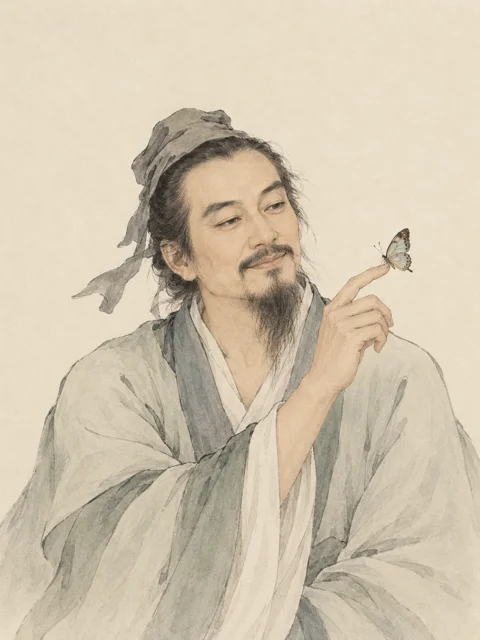
 AI 创作示意
GUANFU / en
庄子
AI 创作示意Chapter 12
版本按章对照,不代表逐句校勘对应。
中文原文(全三十三篇) / 庄子原典;维基文库贡献者整理
观复随文注释 · 83 条
天地雖大,其化均也;萬物雖多,其治一也;人卒众民雖衆,其主君也。君,原於德而成於天,故曰:玄古远古之君天下,无爲也,天德而已矣。以道觀言,而天下之君正。以道觀分,而君臣之義明。以道觀能,而天下之官治。以道汎觀普遍地观察;汎同泛,而萬物之應備。故通於天地者,德也。行於萬物者,道也。上治人者,事也。能有所藝者,技也。技兼於事,事兼於義,義兼於德,德兼於道,道兼於天。故曰:「古之畜天下养育天下之人者,无欲而天下足,无爲而萬物一作「天下」化,淵靜而百姓定。」記曰:「通於一而萬事畢,无心得而鬼神服。」
夫子曰:「夫道,覆載萬物者也,洋洋乎大哉!君子不可以不刳心排除成见,使心虚静;刳读 kū焉。无爲爲之之謂天,无爲言之之謂德,愛人利物之謂仁,不同同之之謂大,行不崖異刻意表现与众不同之謂寬,有萬不同之謂富。故執德之謂紀,德成之謂立,循於道之謂備,不以物挫志之謂完。君子明於此十者,則韜包容、蕴藏乎其事心之大也,沛乎充沛流行的样子其爲萬物逝也。若然者,藏金於山,藏珠於淵,不利貨財,不近貴富;不樂壽,不哀夭,不榮通,不醜窮;不拘一世之利以爲己私分私人的所得,不以王天下爲己處顯。顯則明。萬物一府同归于一个整体,死生同狀。」
夫子曰:「夫道,淵乎其居也,漻清澈深远;读 liáo乎其清也,金石不得无以鳴。故金石有聲,不考敲击不鳴,萬物孰能定之?夫王德具有王者德性的理想状态之人,素逝质朴无心地行动而恥通於事,立之本原而知通於神,故其德廣。其心之出,有物採之。故形非道不生,生非德不明。存形窮生,立德明道,非王德者邪?蕩蕩乎,忽然出,勃然動,而萬物從之乎!此謂王德之人。視乎冥冥,聽乎无聲。冥冥之中,獨見曉焉;无聲之中,獨聞和焉。故深之又深,而能物焉,神之又神,而能精焉。故其與萬物接也,至无而供其求,時騁而要其宿,大小,長短,脩遠。」
黃帝遊乎赤水之北,登乎崐崘之丘,而南望,還歸,遺其玄珠寓言中的黑色宝珠,喻道。使知索之而不得,使離朱传说视力极好的人索之而不得,使喫詬寓言人物,借指辩说之能索之而不得也,乃使象罔寓言人物,寓意若有若无、无心执取。象罔得之。黃帝曰:「異哉!象罔乃可以得之乎!」
堯之師曰許由,許由之師曰齧缺,齧缺之師曰王倪,王倪之師曰被衣。堯問於許由曰:「齧缺可以配天与天相配,此指居天子之位乎?吾藉王倪以要之。」許由曰:「殆哉岌一作「圾」乎天下!齧缺之爲人也,聰明叡知,給數以敏言辞敏捷而善于计虑,其性過人,而又乃以人受天。彼審乎禁過,而不知過之所由生。與之配天乎?彼且乘人而无天,方且本身而異形,方且尊知而火馳,方且爲緒使,方且爲物絯受外物拘束;絯读 gāi,方且四顧而物應,方且應衆宜,方且與物化,而未始有恆,夫何足以配天乎?雖然,有族有祖,可以爲衆父,而不可以爲衆父父,治亂之率也,北面臣子面北,指为臣之禍也,南面君主面南,指为君之賊也。」
堯觀乎華,華封人华地管理疆界的官员曰:「嘻!聖人!請祝聖人!使聖人壽!」堯曰:「辭。」「使聖人富!」堯曰:「辭。」「使聖人多男子!」堯曰:「辭。」封人曰:「壽、富、多男子,人之所欲也。汝一作「女」獨不欲,何邪?」堯曰:「多男子則多懼,富則多事,壽則多辱。是三者,非所以養德也,故辭。」封人曰:「始也,我以汝一作「女」爲聖人邪;今然,君子也。天生萬民,必授之職。多男子而授一作「受」之職,則何懼之有?富而使人分之,則何事之有?夫聖人,鶉居如鹌鹑居无定所而鷇食如雏鸟随所得而食;鷇读 kòu,鳥行而无彰,天下有道,則與物皆昌,天下无道,則脩德就閒,千歲厭世,去而上僊,乘彼白雲,至于帝鄉天帝之乡,指神仙境地,三患莫至,身常无殃,則何辱之有?」封人去之,堯隨之,曰:「請問……」封人曰:「退已!」
堯治天下,伯成子高寓言中的隐者立爲諸侯。堯授舜,舜授禹,伯成子高辭爲諸侯而耕。禹往見之,則耕在野。禹趨就下風,立而問焉,曰:「昔堯治天下,吾子立爲諸侯。堯授舜,舜授予,而吾子辭爲諸侯而耕。敢問:其故何也?」子高曰:「昔堯治天下,不賞而民勸,不罰而民畏。今子賞罰而民且不仁,德自此衰,刑自此立,後世之亂自此始矣!夫子闔行邪?无落吾事!」俋俋埋头耕作的样子;读 yì乎耕而不顧。
泰初天地未分的最初状态有无,无有无名,一之所起,有一而未形。物得以生,謂之德此指万物禀受于道而得以生存者。未形者有分,且然无間,謂之命。留動而生物,物成生理,謂之形。形體保神,各有儀則各物本身的法则,謂之性。性脩反德,德至同於初,同乃虛,虛乃大。合喙鳴声音自然应合;喙为嘴,喙鳴合,與天地爲合。其合緡緡幽昧混合的样子,若愚若昏,是謂玄德深隐不显的德性,同乎大順。
夫子問于老聃,曰:「有人治道,若相放,可不可,然不然。辯者有言曰:『離堅白把坚硬与白色分别论说的名家命题,若縣㝢悬于空间,喻虚悬无着。』若是,則可謂聖人乎?」老聃曰:「是胥易技係役于事务、拘于技巧,勞形怵心者也。執留之狗成思,猨一作「猿」狙之便自山林來。丘,予告若而所不能聞,與而所不能言:凡有首有趾无心无耳者衆,有形者與无形无狀而皆存者盡无。其動,止也;其死,生也;其廢,起也:此又非其所以也。有治在人,忘乎物,忘乎天,其名爲忘己。忘己之人,是之謂入於天进入顺任自然的境界。」
蔣一作「將」閭葂見季徹寓言中的隐者,曰:「魯君謂葂也曰:『請受教。』辭不獲命,旣已告矣,未知中否,請嘗薦之。吾謂魯君曰:『必服恭儉,拔出公忠之屬,而无阿私偏袒徇私,民孰敢不輯和睦、安定?』」季徹局局然拘束而笑的样子笑,曰:「若夫子之言,於帝王之德,猶螳蜋之怒臂以當車軼同车辙,车轮的道路,則必不勝任矣!且若是,則其自爲處一作「遽」危,其觀臺多,物將往投迹者衆。」蔣一作「將」閭葂覤覤然惊惧的样子;覤读 xì驚,曰:「葂也汒若於夫子之所言矣!雖然,願先生之言其風也。」季徹曰:「大聖之治天下也,搖蕩民心,使之成教易俗,舉滅其賊心,而皆進其獨志,若性之自爲,而民不知其所由一作「以」然。若然者,豈兄堯、舜之教民,溟涬浑然无分的样子然弟之哉?欲同乎德而心居矣!」
子貢孔子弟子,名端木赐南遊於楚,反於晉,過漢陰汉水南岸;水南称阴,見一丈人,方將爲圃畦分块种菜的田圃,鑿隧而入井,抱甕而出灌,搰搰费力劳苦的样子;读 hú然用力甚多,而見功寡。子貢曰:「有械於此,一日浸百畦,用力甚寡,而見功多。夫子不欲乎?」爲圃者仰一作「卬」而視之,曰:「奈一作「柰」何?」曰:「鑿木爲機,後重前輕,挈水若抽,數如泆湯,其名爲槔桔槔,利用杠杆提水的工具。」爲圃者忿然作色而笑,曰:「吾聞之吾師:有機械者必有機事凭借机械而追求效率的事务,有機事者必有機心计较功利机巧的心念。機心存於胷中則純白纯洁朴素的心性不備,純白不備則神生不定,神生不定者,道之所不載也。吾非不知,羞而不爲也。」子貢瞞然惭愧、茫然的样子慙,俯而不對。有間,爲圃者曰:「子奚爲者邪?」曰:「孔丘之徒也。」爲圃者曰:「子非夫博學以擬聖,於于以蓋衆,獨弦哀歌,以賣名聲於天下者乎?汝方將忘汝神氣,墮汝形骸,而庶幾乎!而身之不能治,而何暇治天下乎?子往矣,无乏吾事!」
子貢卑陬惭愧退缩的样子失色,頊頊然失意不安的样子;頊读 xū不自得,行三十里而後愈。其弟子曰:「向之人,何爲者邪?夫子何故見之變容失色,終日不自反邪?」曰:「始吾以爲天下一人耳,不知復有夫人也。吾聞之夫子:事求可,功求成,用力少,見功多者,聖人之道。今徒不然,執道者德全,德全者形全,形全者神全,神全者,聖人之道也。託生與民並行,而不知其所之,汒乎淳備哉!功利機巧,必忘夫人之心。若夫人者,非其志,不之;非其心,不爲;雖以天下譽之,得其所謂,謷然不顧;以天下非之,失其所謂,儻然不受:天下之非譽,无益損焉,是謂全德之人哉!我之謂風波之民!」反於魯,以告孔子。孔子曰:「彼假脩渾沌氏之術者也。識其一,不知其二,治其內,而不治其外。夫明白入素通达事理而归于质朴,无爲復朴,體性抱神,以遊世俗之間者,汝將固驚邪?且渾沌氏之術,予與汝何足以識之哉?」
諄芒寓言人物名將東之大壑大海,適遇苑風於東海之濱。苑風曰:「子將奚之?」曰:「將之大壑。」曰:「奚爲焉?」曰:「夫大壑之爲物也,注焉而不滿,酌焉而不竭。吾將遊焉。」苑風曰:「夫子无意于橫目之民眼睛横生的人,指百姓乎?願聞聖治。」諄芒曰:「聖治乎?官施而不失其宜,拔舉而不失其能,畢見其情事而行其所爲,行言自爲而天下化;手撓頤一作「顧」指用下巴示意,四方之民莫不俱至,此之謂聖治。」「願聞德人。」曰:「德人者,居无思,行无慮,不藏是非美惡;四海之內,共利之之爲一作「謂」悅,共給之之爲安;怊乎怅惘的样子;怊读 chāo若嬰兒之失其母也,儻乎若行而失其道也;財用有餘而不知其所自來,飲食取足而不知其所從。此謂德人之容。」「願聞神人。」曰:「上神乘光,與形滅亡,此謂照曠光明空旷的境界。致命盡情,天地樂而萬事銷亡,萬物復情,此之謂混冥浑然幽深、无所分别的状态。」
門无鬼與赤張滿稽觀於武王之師。赤張滿稽曰:「不及有虞氏乎!故離此患也!」門无鬼曰:「天下均治,而有虞氏治之邪?其亂而後治之與?」赤張滿稽曰:「天下均治之爲願,而何計以有虞氏爲?有虞氏之藥瘍一作「痬」也,禿而施髢戴上假发;髢读 dí,病而求醫。孝子操藥,以脩慈父,其色燋然,聖人羞之。至德之世,不尚賢,不使能,上如標枝高处的树枝,喻居上而不干涉一作「校」,民如野鹿,端正而不知以爲義,相愛而不知以爲仁,實而不知以爲忠,當而不知以爲信,蠢動而相使,不以爲賜,是故,行而无迹,事而无傳。」
孝子不諛阿谀奉承其親,忠臣不諂其君,臣子之盛也。親之所言而然,所行而善,則世俗謂之不肖子;君之所言而然,所行而善,則世俗謂之不肖臣,而未知此其必然邪?世俗之所謂然而然之,所謂善而善之,則不謂之導一作「道」諛之人也。然則俗故嚴於親而尊於君邪?謂己導諛一作「道人」則勃然作色,謂己眾一作「諛」人則怫然作色,而終身導諛一作「道人」也,終身眾一作「諛」人也,合譬飾辭聚衆也,是終始本末不相坐言行前后不能相副。垂衣裳,設采色,動容貌,以媚一世,而不自謂導一作「道」諛,與夫人之爲徒,通是非,而不自謂衆人,愚之至也。知其愚者,非大愚也。知其惑者,非大惑也。大惑者,終身不解。大愚者,終身不靈。三人行而一人惑,所適者猶可致也,惑者少也;二人惑,則勞而不至,惑者勝也。而今也以天下惑,予雖有祈嚮,不可得也,不亦悲乎!大聲不入於里耳普通人的耳朵,指世俗的欣赏,折楊、皇華当时流行的通俗歌曲一作「荂」則嗑然笑声;嗑读 hé而笑,是故高言不止於衆人之心。至言不出,俗言勝也。以二缶鍾惑,而所適不得矣。而今也以天下惑,予雖有祈嚮,其庸可得邪?知其不可得也而強之,又一惑也,故莫若釋之而不推。不推,誰其比憂?厲之人患恶疾者,古注多解作癞病,夜半生其子,遽取火而視之,汲汲然唯恐其似己也。
百年之木,破爲犧樽雕成兽形的礼用酒器,青黃而文之,其斷在溝中。比犧樽於溝中之斷,則美惡有間矣,其於失性,一也。跖與曾、史,行義有間矣,然其失性,均也。且夫失性有五:一曰五色亂目,使目不明;二曰五聲亂耳,使耳不聰;三曰五臭五种气味;臭读 xiù薰鼻,困惾中顙;四曰五味濁口,使口厲爽口味失常、受损;五曰趣舍趋取与舍弃滑心,使性飛揚。此五者,皆生之害也,而楊、墨乃始離跂,自以爲得,非吾所謂得也。夫得者困,可以爲得乎?則鳩鴞之在於籠也,亦可以爲得矣。且夫趣舍聲色以柴其內使内心闭塞如被篱栅围住,皮弁皮制礼帽、鷸冠以鹬羽装饰的帽子、搢笏把笏板插在腰带间、紳脩以約其外,內支盈於柴柵,外重纆繳捆绑的绳索,睆睆然睁眼而自得的样子在纆繳之中,而自以爲得,則是罪人交臂歷指,而虎豹在於囊檻,亦可以爲得矣!
观复随文注释 · AI 辅助独立整理,待持续人工校订。释义以本章语境为依据;存在异说或底本疑讹的地方另作提示。原文及版本来源保留如下。
参考: 本站所收原典:外篇 · 天地 ↗
原典公有领域;电子文本据维基文库贡献者,按 CC BY-SA 4.0 保留署名及相同方式共享;调整空白与排版。 · 查看原始版本
欢迎引用本站资源,分享道家与道教文化。引用时请注明出处“观复”,并附上所引用内容的原始页面链接,方便读者查阅。
观复白话释义(AI 辅助) / 观复 · AI 辅助独立整理
【白话释义|AI 辅助独立整理,未经人工学术审定】
天地虽然广大,化育万物却平等无私;万物虽然众多,其自然条理却相通为一;民众虽然众多,在政治组织中以君为主。君主的根基在德,成就则在顺应自然。因此说,远古统治天下的人无为而治,不过顺着天然的德性。以道考察言论,天下君主的立场便端正;以道考察职分,君臣的义分便清楚;以道考察才能,天下官职便能各司其事;以道普遍观察,对万物的应接便齐备。贯通天地的是德,通行万物的是道,在上治理人的是政事,能有所制作的是技艺。技艺包含在政事中,政事包含在义分中,义分包含在德中,德包含在道中,道又包含在自然中。因此说:“古代养育天下的人,无欲而天下自足,无为而万物自化,深静而百姓自定。”古代记载说:“贯通于一,万事便得其所;无心于占有所得,鬼神也会顺服。”
先生说:“道覆载万物,浩瀚广大!君子不可不虚空自己的心来体会它。不刻意作为而有所成就,叫作天;不刻意言说而有所显明,叫作德;爱人利物,叫作仁;使不同者相通,叫作大;行为不以奇异自高,叫作宽;容有万般差别,叫作富。所以,持守德性叫作纲纪,德性成就叫作自立,顺循大道叫作完备,不因外物挫伤心志叫作完整。君子明白这十点,处理事情便深藏不露,心量广大,精神充沛地与万物一同流行。
“这样的人,把黄金留藏在山中,把明珠留藏在深渊,不贪财货,不亲近富贵;不因长寿而狂喜,不因夭折而哀伤;不以显达为荣耀,不以穷困为羞耻。不把一世的利益圈成私有,不把统治天下看作自己的显贵。这样才是真正显明通达:把万物看作同在一府,把死生看作相通的形态。”
先生说:“道所安住的境地,深沉无底;它的清明,澄澈空远。金石发声也不能没有所凭:钟磬虽然能发声,不敲击便不响。万物的响应,谁能预先固定?德性充盛如王者的人,素朴地行进,以刻意精通世务为羞;立足根本,认识通达神妙,所以德性广大。他的心一旦应物而出,万物便各有所取。因此形体非道不能生,生命非德不能显明。保有形体,尽其生命,树立德性,明达于道,不正是王德之人吗?他广阔无际,忽然显现,蓬勃发动,万物便顺从而来,这叫王德之人。
“他看向幽冥,听向无声;在幽冥中独见明晓,在无声中独闻和谐。所以深入又深入,仍能应接事物;神妙又神妙,仍能掌握精微。他与万物相接,以至虚无执的心满足各自所需;随时驰行,又归结于安住,使大小、长短、远近各得其宜。”
黄帝游到赤水之北,登上昆仑山丘,向南眺望。返回时,遗失了玄珠。他派“知”去找,没有找到;派目力极好的离朱去找,没有找到;派善辩的喫诟去找,也没有找到。最后派似有形又无形的“象罔”去找,象罔找到了。黄帝说:“奇怪啊!竟然是象罔能找到它!”
尧的老师是许由,许由的老师是啮缺,啮缺的老师是王倪,王倪的老师是被衣。尧问许由:“啮缺可以承担与天相配的天子之位吗?我想借王倪去邀他。”许由说:“那天下可就危险了!啮缺聪明睿智,辩说敏捷,谋虑灵活,天资过人,却想用人为的方式来承接自然。他明白怎样禁止过错,却不知道过错从哪里发生。让他与天相配吗?他将依靠人为而忽略自然,以自身为本位而排斥不同的形态,尊崇智巧而像火一般急驰,被事务的头绪驱使,被外物束缚,四面张望着应付万物,忙着满足众人的需要,随着外物变化,却从未有内在常定。这样哪里足以与天相配?虽然如此,事物有支属,也有根源;他可以做众人的父长,却不能做父长之上的根本。他可能成为治乱转折的起因,给臣下带来祸患,给君位带来损害。”
尧巡视华地,守疆的人说:“啊,圣人!请让我祝福圣人长寿!”尧说:“辞谢。”守疆人说:“祝圣人富有!”尧说:“辞谢。”又说:“祝圣人多生男孩!”尧说:“辞谢。”守疆人问:“长寿、富有、多子,是人所想要的,你偏不要,为什么?”尧说:“儿子多,忧惧就多;财富多,事务就多;寿命长,遭辱就多。这三样不利于养德,所以辞谢。”
守疆人说:“起初我以为你是圣人,如今看来不过是君子。天生万民,必赋予各自的职分。儿子多,让他们各有职分,有什么可怕?财富多,分给别人,有什么多事?圣人像鹌鹑一样随处安居,像雏鸟一样随宜取食,像鸟飞过,不留下炫示的痕迹。天下有道,就同万物一起昌盛;天下无道,就修养德性,退处清闲。过了千年,厌倦世间,便离去升仙,乘白云,到天帝之乡。那三种忧患无从到来,自身常无灾殃,又有什么受辱?”守疆人转身离开。尧跟着说:“还想请问……”守疆人说:“退回去吧!”
尧治理天下时,伯成子高被立为诸侯。尧把天下交给舜,舜又交给禹,伯成子高便辞去诸侯之位,自己耕田。禹去拜访,看见他在田野耕作。禹快步来到下风处,站着问:“从前尧治理天下,先生做诸侯;尧传给舜,舜传给我,先生却辞位耕田。请问为什么?”子高说:“从前尧治理天下,不用奖赏,百姓便自勉;不用处罚,百姓便自知敬畏。如今你用赏罚,百姓反而将失去仁厚。德从这里衰退,刑从这里建立,后世的混乱从这里开始!先生何不走开,别耽误我做事!”说完继续用力耕田,不再回顾。
太初是无,还没有具体存在,也没有名称。一体的根源兴起,有了浑一,却尚未成形。万物从这里获得生命,叫作德。尚未成形时,已有所禀受的区别,然而仍相连无间,叫作命。阴阳流动变化,产生万物,事物形成有生命的条理,叫作形。形体保有精神,各有自身的法则,叫作性。修养本性,返回自然的德;德达到极致,便同于最初。同于最初便虚,虚便广大。开口发声能契合自然,发出的声音也彼此相合,便与天地相合。这种契合绵密难分,像愚昧,像昏暗,却正叫玄德,同于大道的顺遂。
孔子问老聃:“有人研究道,彼此追逐、仿效;把可说成不可,把如此说成不如此。善辩的人又说:‘把坚与白分开,就像悬在空中一样清楚。’这样可以叫圣人吗?”老聃说:“这不过是被技巧牵系的役者,劳累身体,惊扰内心。捉捕兽类的狗,因为善捕而受拘束;猿猴因为敏捷,被人从山林中捉来。丘,我告诉你未能听到的,给你未能说出的:有头有脚,却不用本心、真听的人很多;有形的存在,与无形无状的根源一同保全而不相离的,却极少。运动也就是止息,死亡也就是生,废弃也就是兴起,可这些还不是最根本的所以然。身在人事之中有所应对,却忘掉外物,忘掉对天的执着,这叫忘己。忘己的人,就叫进入自然。”
将闾葂见季彻,说:“鲁君对我说:‘请赐教。’我推辞不掉,已经告诉他了,却不知道说得是否合适,请让我陈述。我对鲁君说:‘一定要实行恭敬节俭,提拔公正忠诚的人,不徇私情,百姓谁敢不和顺?’”季彻局促地笑,说:“先生这番话,对于帝王之德,就像螳螂奋臂挡车,必定不能胜任!而且这样,是把自己放在危险的地方。你立的标准越多,外物前来投合、伪装迎合的也就越多。”将闾葂吃惊地说:“先生的话使我茫然了。虽然如此,愿听其大意。”
季彻说:“大圣人治理天下,使民心舒展,教化和风俗自然转变,消除彼此伤害的心,推进各人自得的心志,仿佛本性自行实现,而百姓不知道为什么如此。这样的治理,岂不比尧舜外加的教导更居于先,使尧舜的教化反显为后?所求的是同于自然之德,让内心安居。”
子贡南游楚国,返回晋国,经过汉水南岸,见一个老人正在整治菜园。他凿了一条通到井里的隧道,抱着瓦瓮取水出来浇地,费力很多,成效却少。子贡说:“有一种器械,一天能浇一百畦地,用力少,成效多,先生不想用吗?”老人抬头问:“什么样?”子贡说:“把木头做成杠杆,后面重,前面轻,提水像抽引一样,快得像沸水涌出,叫作桔槔。”老人变了脸色,带怒笑道:“我听老师说,有机械就会有机巧的事情,有机巧的事情就会有机巧的心。机心放在胸中,纯净素白便不完整;纯净不完整,精神生命便不安定;精神生命不安定,道就不能承载。我不是不知道,是羞于这样做。”子贡满脸惭愧,低头不答。
过了一会儿,老人问:“你做什么的?”子贡说:“我是孔丘的弟子。”老人说:“你难道就是那种广学以模仿圣人,自大地想盖过众人,独自弹琴悲歌,向天下贩卖名声的人吗?你若能忘掉对神气的执着,放下对形骸的拘守,或许才接近一些。连自己的身心还不能治理,哪里有空治理天下?走吧,不要耽误我的事!”
子贡惭愧失色,低落得不能自安,走了三十里才渐渐恢复。弟子问:“刚才那人是什么人?先生为什么一见他就变了脸色,整天恢复不过来?”子贡说:“起初我以为天下只有老师这一位高人,不知道还有那样的人。我听老师说,事情求可行,功业求完成,少用力而多见成效,是圣人的道。如今才见到另一层:持守道,德便完整;德完整,形体便完整;形体完整,精神便完整;精神完整,才是圣人的道。他寄托生命,与百姓一同生活,不刻意求往哪里去,茫然却淳厚完备。他心中必定忘了功利机巧。
“像那个人,不合自己心志的地方不去,不出于自己本心的事不做;天下都称赞他,称赞得恰合其实际,他也高远自持,不加理会;天下都非议他,说得不合其实,他也坦然,不受影响。天下毁誉对他没有增损,这可以叫德性完整的人吧!我却只是被风波摇动的人。”回到鲁国后,子贡把事情告诉孔子。孔子说:“那是借修浑沌氏之术的人,只知其一,不知其二,治内而未能通外。至于明白而归于素朴,无为而返回本真,体会本性、抱守精神,仍能游于世俗之间的人,你见了岂不更惊奇?况且浑沌氏的道术,我和你哪里足以完全认识!”
谆芒将向东去大海,恰好在东海岸遇见苑风。苑风问:“你去哪里?”他说:“去大海。”又问:“去做什么?”他说:“大海啊,水流进去不会满,从里面取水不会竭,我想去那里游玩。”苑风说:“先生不关心这些横着双眼的百姓吗?愿听圣人的治理。”谆芒说:“圣人的治理吗?安排官职不失合宜,提拔人才不失其所能,充分了解实际情况,然后施行该做的事;自己言行得宜,天下自然受到感化。只要挥手、示意,四方百姓无不前来,这就叫圣治。”
苑风说:“愿听有德之人的境界。”谆芒说:“有德之人,安居不刻意思谋,行动不忧虑盘算,心中不积藏是非美恶。四海之内,共同得利便以为喜悦,共同得到供养便以为安宁。他若有所失,像婴儿失去母亲;坦然无所执,像行路不预定方向。财用有余,却不追问从哪里来;饮食足够,却不追究从哪里得。这是德人的样子。”苑风说:“愿听神人的境界。”谆芒说:“最高的神人乘着光明,随形体同归变化消亡,这叫旷远的照明。尽其天命,顺尽实情,与天地同乐,万事的牵累消去,万物返回本真,这叫浑同于幽冥。”
门无鬼与赤张满稽观看周武王的军队。赤张满稽说:“不及有虞氏啊,所以才遭遇这种战争灾患!”门无鬼说:“是天下本来平治,有虞氏才治理它,还是乱了以后才来治理?”赤张满稽说:“所希望的是天下自然平治,又何须计较有虞氏?有虞氏的治理,不过像治疮,秃了才戴假发,病了才求医生。孝子捧药替慈父治病,神色焦虑,圣人对此觉得可惭,因为未能使病患不生。德性完整的时代,不刻意尊贤,不特意任能;在上者像高树枝梢,百姓像原野之鹿。行为端正,却不知道把它叫作义;相互爱护,却不知道叫作仁;诚实,却不知道叫作忠;行为合宜,却不知道叫作信。自然而动,互相帮助,不认为是恩赐。因此,行动不留人为痕迹,事情不成为夸耀传说。”
孝子不谄媚父母,忠臣不谄媚君主,这是臣子最好的操守。父母说什么都称对,做什么都称好,世俗就叫不肖子;君主说什么都称对,做什么都称好,世俗就叫不肖臣。可是人们不知道,相同的判断也应当适用于世俗:世俗说对,便跟着说对;世俗说好,便跟着说好,却不被认为是阿谀之人。难道世俗比父母更值得敬畏,比君主更值得尊重吗?
说他是迎合谄媚的人,他便勃然变色;说他是随众的人,他便愤然变色,却终身都在谄媚、终身都在随众。拼凑比喻,修饰言辞,聚集徒众,所说与所做、开头与结尾、根本与末节都不一致。穿上礼服,安排色彩,摆出仪容,取媚一世,却不承认自己阿谀;跟着别人一道,接受共同的是非,却不承认自己随众,这是愚昧到了极点。知道自己愚昧,还不算大愚;知道自己迷惑,还不算大惑。大惑的人终身不解,大愚的人终身不明。
三个人同行,一个迷路,还可能到达目的地,因为迷路的人少;两个迷路,就会白费力气而不到,因为迷路的人占了多数。如今整个天下都迷惑,我即使有想达到的方向,也无法实现,岂不可悲!高雅的乐声进不了里巷俗人的耳朵,听到《折杨》《皇华》这样的俗曲,他们便快活地笑。因此高远的言论进不了众人的心,至理不能说出,是因为俗言压倒了它。被两只粗陋瓦器的喧响扰乱,便不能听到自己所求的钟声。如今整个天下都迷惑,我即使有所向往,又怎么能够实现?明知不能而强求,又是一种迷惑,所以最好放下,不强行推求。不强推,谁还能不断给自己增添忧患?有个患恶疾的人半夜生了孩子,赶快取火来照看,急切地只怕孩子像自己一样。
一棵生长百年的树,被劈开做成祭祀酒器,涂上青黄花纹,剩下的木块扔在沟里。把酒器同沟中的断木相比,美丑当然不同,但在失去本性这一点上却相同。盗跖与曾参、史鱼,行为名义不同,但在失去本性这一点上同样如此。
使人失去本性的,有五种情况:第一,五色扰乱眼睛,使视觉失明;第二,五音扰乱耳朵,使听觉失聪;第三,五种气味熏鼻,使额间壅塞不舒;第四,五味混浊口腔,使味觉受损失常;第五,追求与舍弃扰乱内心,使本性浮动飞扬。这五者都是生命的祸害,杨朱、墨翟却还踮脚争逐,自以为有所获得,这不是我说的得。所谓得到,却使人受困,可以叫得吗?那笼中的鸠与鸮,也可说得其所了!
再说,以取舍声色堵塞内部,以皮冠、羽饰冠、插笏、长绅束缚外部,内心充满柴栅般的障碍,外面又重重绳索缠绕,在束缚之中睁眼自得,还以为有所得,那么被捆住双臂、束缚手指的罪人,关在囊笼槛栏里的虎豹,也都可以说得其所了!
校订说明:“夫子”在前两段未明指人物,保留为“先生”;后与老聃对话者依称名“丘”释为孔子。“知、象罔”等是寓意名称。“有形者与无形无状而皆存者尽无”“以二缶钟惑”等句传释分歧甚大,以上依上下文暂译,须重点校订。“季彻”段源文有疑误,未凭空补写缺句。“厲之人”按患恶疾者理解。篇中官职秩序、无为理想、批评机巧等观点逐段保留,不以一个总论替代其差异。
〔补校:“与形灭亡”暂依随形同归消亡释读;此句在神人语境中的含义仍有分歧,须进一步版本校勘。“皇华”有“皇荂”异文,曲名沿用正文。〕
观复白话释义:AI 辅助依据古文独立编写,已进行文本覆盖核对,未经人工学术审定;原典来源及电子底本署名、许可见对应中文版本。 · 查看原始版本
Herbert A. Giles 英译(全三十三篇) / Herbert A. Giles(翟理斯),1889
The Universe.
[Translator’s note] Argument :—The prëeminence of Tao —All things informed thereby—The true Sage illumined thereby—His attributes—His perfection—Man's senses his bane—Illustrations.
Vast as is the universe, its phenomena are regular. Countless though its contents, the laws which govern these are uniform. Many though its inhabitants, that which dominates them is sovereignty. Sovereignty begins in virtue and ends in God. Therefore it is called divine.
[Translator’s note] The term here used has been elsewhere rendered "infinite."
Of old, the empire was under the sovereignty of inaction. There was the virtue of God,—nothing more.
[Translator’s note] Meaning, of course, Tao . In other words, all things existed under their own natural conditions.
Words being in accordance with Tao , the sovereignty of the empire was correct. Delimitations being in accordance with Tao , the duties of prince and subject were clear. Abilities being in accordance with Tao , the officials of the empire governed. The point of view being always in accordance with Tao , all things responded thereto.
[Translator’s note] Under the reign of inaction, the natural prevailed over the artificial. (1) The sovereign could utter no cruel mandate. (2) Sovereign and subject each played his allotted part. (3) The right men were in the right place. (4) All things were as they were, and not as man would have them.
Thus, virtue was the connecting link between God and man, while Tao spread throughout all creation. Men were controlled by outward circumstances, applying their in-born skill to the development of civilised life. This skill was bound up with the circumstances of life, and these with duty, and duty with virtue, and virtue with Tao , and Tao with God.
Therefore it has been said, "As for those who nourished the empire of old, having no desires for themselves, the empire was not in want. They did nothing, and all things proceeded on their course. They preserved a dignified repose, and the people rested in peace."
[Translator’s note] We are not told who said these words. They are not in the Tao-Tê-Ching ; and yet if Lao Tzŭ did not utter them, it is difficult to say who did.
The Record says, "By converging to One , all things may be accomplished. By the virtue which is without intention, even the supernatural may be subdued."
[Translator’s note] How much more man ? Kuo Hsiang says the Record was the name of a work ascribed to Lao Tzŭ.
The Master said, " Tao covers and supports all things,"—so vast is its extent. Each man should prepare his heart accordingly.
[Translator’s note] This "Master" has been identified with both Chuang Tzŭ and Lao Tzŭ.
"To act by means of inaction is God. To speak by means of inaction is Virtue. To love men and care for things is Charity. To recognise the unlike as the like is breadth of view. To make no distinctions is liberal. To possess variety is wealth. And so, to hold fast to virtue is strength. To complete virtue is establishment. To follow Tao is to be prepared. And not to run counter to the natural bias of things is to be perfect.
"He who fully realises these ten points, by storing them within enlarges his heart, and with this enlargement brings all creation to himself. Such a man will bury gold on the hillside and cast pearls into the sea. He will not struggle for wealth, nor strive for fame. He will not rejoice at old age, nor grieve over early death. He will find no pleasure in success, no chagrin in failure. He will not account a throne as his own private gain, nor the empire of the world as glory personal to himself. His glory is to know that all things are One , and that life and death are but phases of the same existence!"
[Translator’s note] "Let man learn that he is here, not to work, but to be worked upon; and that, though abyss open under abyss, and opinion displace opinion, all are at last contained in the Eternal Cause." Emerson.
The Master said, "How profound in its repose, how infinite in its purity, is Tao !
"If metal and stone were without Tao , they would not be capable of emitting sound. And just as they possess the property of sound but will not emit sound unless struck, so surely is the same principle applicable to all creation.
[Translator’s note] Meaning that all creation is responsive to proper influences, in accordance with Tao , if we only knew where to seek them.
"The man of complete virtue remains blankly passive as regards what goes on around him. He is as originally by nature, and his knowledge extends to the supernatural. Thus, his virtue expands his heart, which goes forth to all who come to take refuge therein.
[Translator’s note] His heart does not initiate the movement, but simply responds to an influence brought to bear.
"Without Tao , form cannot be endued with life. Without virtue, life cannot be endued with intelligence. To preserve one's form, live out one's life, establish one's virtue, and realise Tao ,—is not this complete virtue?
"Issuing forth spontaneously, moving without premeditation, all things following in his wake,—such is the man of complete virtue!
"He can see where all is dark. He can hear where all is still. In the darkness he alone can see light. In the stillness he alone can detect harmony. He can sink to the lowest depths of materialism. To the highest heights of spirituality he can soar. This because he stands in due relation to all things. Though a mere abstraction, he can minister to their wants, and ever and anon receive them into rest,—the great, the small, the long, the short, for ever without end."
[Translator’s note] He is, as it were, a law of compensation to all things.
The Yellow Emperor travelled to the north of the Red Lake and ascended the K'un-lun Mountains. Returning south he lost his magic pearl.
[Translator’s note] His spiritual part, his soul.
He employed Intelligence to find it, but without success. He employed Sight to find it, but without success. He employed Speech
[Translator’s note] Also explained as "Strength."
to find it, but without success. Finally, he employed Nothing, and Nothing got it.
[Translator’s note] He did not employ Nothing to find it . He only employed Nothing.
"Strange indeed," quoth the Emperor, "that Nothing should have been able to get it!"
[Translator’s note] Knowledge, sight, and speech, tend to obscure rather than illuminate the spiritual nature of man. Only in a state of negation can true spirituality be found.
Yao's tutor was Hsü Yu. The latter's tutor was Yeh Ch'üeh, and Yeh Ch'üeh's tutor was Wang I, whose tutor was Pei I.
Yao enquired of Hsü Yu, saying, "Would Yeh Ch'üeh do to be emperor? I am going to get Wang I to ask him."
"Alas!" cried Hsü Yu, "that would be bad indeed for the empire. Yeh Ch'üeh is a clever and capable man. He is by nature better than most men, but he seeks by means of the human to reach the divine. He strives to do no wrong; but he is ignorant of the source from which wrong springs. Emperor forsooth! He avails himself of the artificial and neglects the natural. He lacks unity in himself. He worships intelligence and is always in a state of ferment. He is a slave to circumstances and to things. Wherever he looks, his surroundings respond. He himself responds to his surroundings.
[Translator’s note] He is not yet an abstraction, informed by Tao .
He is always undergoing modifications and is wanting in fixity. How should such a one be fit for emperor? Still every clan has its elder. He may be leader of a clan, but not a leader of leaders. A captain who has been successful in suppressing rebellion, as minister is a bane, as sovereign, a thief."
Yao went to visit Hua. The border-warden of Hua said "Ha! a Sage. My best respects to you, Sir. I wish you a long life."
"Don't!" replied Yao.
"I wish you plenty of money," continued the border-warden.
"Don't!" replied Yao.
"And many sons," added he.
"Don't!" replied Yao.
"Long life, plenty of money, and many sons," cried the warden, "these are what all men desire. How is it you alone do not want them?"
"Many sons," answered Yao, "are many anxieties. Plenty of money means plenty of trouble. Long life involves much that is not pleasant to put up with. These three gifts do not advance virtue; therefore I declined them."
"At first I took you for a Sage," said the warden, "but now I find you are a mere man. God, in sending man into the world, gives to each his proper function. If you have many sons and give to each his proper function, what cause have you for anxiety?
"And similarly, if you have wealth and allow others to share it, what troubles will you have?"
"The true Sage dwells like the quail
[Translator’s note] At random.
and feeds like a fledgeling.
[Translator’s note] Which is dependent on its parents.
He travels like the bird, leaving no trace behind. If there be Tao in the empire, he and all things are in harmony. If there be not Tao , he cultivates virtue in retirement. After a thousand years of this weary world, he mounts aloft, and riding upon the white clouds passes into the kingdom of God, whither the three evils do not reach, and where he rests secure in eternity. What is there to put up with in that?"
Thereupon the border-warden went off, and Yao followed him; saying, "May I ask——," to which the warden only replied "Begone!"
[Translator’s note] The style of the above episode varies enough from Chuang Tzŭ's standard to make its authorship doubtful.
When Yao was Emperor, Poh Ch'êng Tzŭ Kao
[Translator’s note] Lao Tzŭ under a previous incarnation. See the Kuang Ch'êng Tzŭ of p. 125.
was one of his vassals. But when Yao handed over the empire to Shun, and Shun to the Great Yü, Poh Ch'êng Tzŭ Kao resigned his fief and betook himself to agriculture.
The Great Yü going to visit him, found him working in the fields; whereupon he approached humbly, saying, "When Yao was emperor, you, Sir, were a vassal; but when Yao handed over the empire to Shun, and Shun to me, you resigned your fief and betook yourself to agriculture. May I enquire the reason of this?"
"When Yao ruled the empire," said Tzŭ Kao, "the people exerted themselves without reward and behaved themselves without punishment. But now you reward and punish them, and yet they are not good. From this point virtue will decline, the reign of force will begin, and the troubles of after ages will date their rise. Away with you! Do not interrupt my work." And he quietly went on ploughing as before.
[Translator’s note] The above episode is unmistakably spurious.
At the beginning of the beginning, even Nothing did not exist. Then came the period of the Nameless.
[Translator’s note] "The Nameless," says the Tao-Tê-Ching , ch. i, "was the beginning of heaven and earth." See also ch. ii , ante .
When One came into existence, there was One , but it was formless. When things got that by which they came into existence, it was called their virtue .
[Translator’s note] Sc. that, by virtue of which they are what they are. See p. 45 .
That which was formless, but divided,
[Translator’s note] I.e. allotted.
though without interstice,
[Translator’s note] Unbroken in continuity.
was called destiny .
Then came the movement which gave life, and things produced in accordance with the principles of life had what is called form . When form encloses the spiritual part, each with its own characteristics, that is its nature . By cultivating this nature, we are carried back to virtue; and if this is perfected, we become as all things were in the beginning. We become unconditioned, and the unconditioned is great. As birds join their beaks in chirping,
[Translator’s note] Unconsciously.
and beaks to chirp must be joined,—to be thus joined with the universe without being more conscious of it than an idiot, this is divine virtue , this is accordance with the eternal fitness of things.
Confucius asked Lao Tzŭ, saying, "There are persons who cultivate Tao according to fixed rules of possible and impossible, fit and unfit, just as the schoolmen speak of separating hardness from whiteness as though these could be hung up on different pegs.
[Translator’s note] See p. 22 .
Could such persons be termed sages?"
"That," replied Lao Tzŭ, "is but the skill of the handicraftsman, wearing out body and soul alike. The powers of the hunting-dog involve it in trouble;
[Translator’s note] It is kept by man instead of being free.
the cleverness of the monkey brings it down from the mountain.
[Translator’s note] Into the hands of man.
Ch'iu, what I mean you cannot understand, neither can you put it into words.
[Translator’s note] Ch'iu was the personal name of Confucius. It is never uttered by the Confucianist, the term "a certain one" being usually substituted. Neither is it ever written down, except with the omission of some stroke, by which its form is changed.
Those who have a head and feet, but no mind nor ears, are many. Those who have a body without a body or appearance of one, and yet there they are,—are none. Movement and rest, life and death, rise and fall, are not at the beck and call of man. Cultivation of self is in his own hands. To be unconscious of objective existences and of God, this is to be unconscious of one's own personality. And he who is unconscious of his own personality, combines in himself the human and the divine."
Chiang Lü Mien went to see Chi Ch'ê,
[Translator’s note] Two obscure personages.
and said, "The Prince of Lu begged me to instruct him, but I declined. However, he would take no refusal, so I was obliged to do so. I don't know if I was correct in my doctrine or not. Please note what I said. I told him to be decorous and thrifty; to advance the public-spirited and loyal, and to have no partialities. Then, I said, no one would venture to oppose him."
Chi Ch'ê sniggered and said, "Your remarks on the virtues of Princes may be compared with the mantis stretching out its feelers and trying to stop a carriage,—not likely to effect the object proposed.
[Translator’s note] See ch. iv , where the same figure is used.
Besides, he would be placing himself in the position of a man who builds a lofty tower and makes a display of his valuables where all his neighbours will come and gaze at them."
[Translator’s note] Attracting people by means not in accordance with Tao .
"Alas! I fear I am but a fool," replied Chiang Lü Mien. "Nevertheless, I should be glad to be instructed by you in the proper course to pursue."
"The government of the perfect Sage," explained Chi Ch'ê, "consists in influencing the hearts of the people so as to cause them to complete their education, to reform their manners, to subdue the rebel mind, and to exert themselves one and all for the common good. This influence operates in accordance with the natural disposition of the people, who are thus unconscious of its operation. He who can so act has no need to humble himself before the teachings of Yao and Shun. He makes the desires of the people coincident with virtue, and their hearts rest therein."
When Tzŭ Kung
[Translator’s note] See ch. vi .
went south to the Ch'u State on his way back to the Chin State, he passed through Han-yin. There he saw an old man engaged in making a ditch to connect his vegetable garden with a well. He had a pitcher in his hand, with which he was bringing up water and pouring it into the ditch,—great labour with very little result.
"If you had a machine here," cried Tzŭ Kung, "in a day you could irrigate a hundred times your present area. The labour required is trifling as compared with the work done. Would you not like to have one?"
"What is it?" asked the gardener.
"It is a contrivance made of wood," replied Tzŭ Kung, "heavy behind and light in front. It draws up water as you do with your hands, but in a constantly overflowing stream. It is called a well-sweep."
[Translator’s note] Still used all over China.
Thereupon the gardener flushed up and said, "I have heard from my teacher that those who have cunning implements are cunning in their dealings, and that those who are cunning in their dealings have cunning in their hearts, and that those who have cunning in their hearts cannot be pure and incorrupt, and that those who are not pure and incorrupt are restless in spirit, and that those who are restless in spirit are not fit vehicles for Tao . It is not that I do not know of these things. I should be ashamed to use them."
At this Tzŭ Kung was much abashed, and said nothing. Then the gardener asked him who he was, to which Tzŭ Kung replied that he was a disciple of Confucius.
"Are you not one who extends his learning with a view to being a Sage; who talks big in order to put himself above the rest of mankind; who plays in a key to which no one can sing so as to spread his reputation abroad? Rather become unconscious of self and shake off the trammels of the flesh,—and you will be near. But if you cannot govern your own self, what leisure have you for governing the empire? Begone! Do not interrupt my work."
Tzŭ Kung changed colour and slunk away, being not at all pleased with this rebuff; and it was not before he had travelled some thirty li that he recovered his usual appearance.
"What did the man we met do," asked a disciple, "that you should change colour and not recover for such a long time?"
"I used to think there was only one man in all the world," replied Tzŭ Kung.
[Translator’s note] Meaning Confucius.
"I did not know that there was also this man. I have heard the Master say that the test of a scheme is its practicability, and that success must be certain. The minimum of effort with the maximum of success,—such is the way of the Sage.
[Translator’s note] The absurdity of attributing such doctrines to Confucius will be apparent to every student of the Sage's remains.
"Not so this manner of man. Aiming at Tao , he perfects his virtue. By perfecting his virtue he perfects his body, and by perfecting his body he perfects his spiritual part. And the perfection of the spiritual part is the Tao of the Sage. Coming into life he is as one of the people, knowing not whither he is bound. How complete is his purity? Success, profit, skill,—these have no place in his heart. Such a man, if he does not will it, he does not stir; if he does not wish it, he does not act. If all the world praises him, he does not heed. If all the world blames him, he does not repine.
[Translator’s note] Reminding us of the philosopher Yung of ch. i .
The praise and the blame of the world neither advantage him nor otherwise. He may be called a man of perfect virtue. As for me, I am but a mere creature of impulse."
So he went back to Lu to tell Confucius. But Confucius said, "That fellow pretends to a knowledge of the science of the ante-mundane. He knows something, but not much. His government is of the internal, not of the external. What is there wonderful in a man by clearness of intelligence becoming pure, by inaction reverting to his original integrity, and with his nature and his spiritual part wrapped up in a body, passing through this common world of ours? Besides, to you and to me the science of the ante-mundane is not worth knowing."
[Translator’s note] It is only the present which concerns man.
[Translator’s note] This last is an utterance which might well have fallen from the lips of Confucius. But the whole episode is clearly an interpolation of later times.
As Chun Mang was starting eastwards to the ocean, he fell in with Yüan Fêng on the shore of the eastern sea.
[Translator’s note] These names are probably allegorical, but it is difficult to say in exactly what sense.
"Whither bound?" cried the latter.
"I am going to the ocean," replied Chun Mang.
"What are you going to do there?" asked Yüan Fêng.
"The ocean," said Chun Mang, "is a thing you cannot fill by pouring in, nor empty by taking out. I am simply on a trip."
[Translator’s note] You cannot do anything to the infinite.
"But surely you have intentions with regard to the straight-browed people?... Come, tell me how the Sage governs."
[Translator’s note] The straight-browed, lit. horizontal-eyed, people, are said by one commentator to have been "savages."
"Oh, the government of the Sage," answered Chun Mang. "The officials confine themselves to their functions. Ability is secure of employment. The voice of the people is heard, and action is taken accordingly. Men's words and deeds are their own affairs, and so the empire is at peace. A beck or a call, and the people flock together from all sides. This is how the Sage governs."
"Tell me about the man of perfect virtue," said Yüan Fêng.
"The man of perfect virtue," replied Chun Mang, "in repose has no thoughts, in action no anxiety. He recognises no right, nor wrong, nor good, nor bad. Within the Four Seas, when all profit—that is his pleasure; when all share—that is his repose. Men cling to him as children who have lost their mothers; they rally round him as wayfarers who have missed their road. He has wealth and to spare, but he knows not whence it comes. He has food and drink more than sufficient, but knows not who provides it. Such is a man of virtue."
"And now," said Yüan Fêng, "tell me about the divine man."
"The divine man," replied Chun Mang, "rides upon the glory of the sky where his form can no longer be discerned. This is called absorption into light. He fulfils his destiny. He acts in accordance with his nature. He is at one with God and man. For him all affairs cease to exist, and all things revert to their original state. This is called envelopment in darkness."
Mên Wu Kuei and Ch'ih Chang Man Chi were looking at Wu Wang's troops.
[Translator’s note] The famous founder of the Chou dynasty, B.C. 1169-1116.
"He is not equal to the Great Yü," said the latter; and consequently "we are involved in all these troubles."
"May I ask," replied Mên Wu Kuei, "if the empire was under proper government when the Great Yü began to govern it, or had he first to quell disorder and then to proceed to government?"
"If the empire had all been under proper government," said the other, "what would there have been for the Great Yü to do? He was as ointment to a sore. Only bald men use wigs; only sick people want doctors. And the Sage blushes when a filial son, with anxious look, administers medicine to cure his loving father.
[Translator’s note] Because to need drugs, the father must first have been sick; and this, from a Chinese point of view, is clearly the fault of the son.
"In the Golden Age, good men were not appreciated; ability was not conspicuous. Rulers were mere beacons, while the people were free as the wild deer. They were upright without being conscious of duty to their neighbours. They loved one another without being conscious of charity. They were true without being conscious of loyalty. They were honest without being conscious of good faith. They acted freely in all things without recognising obligations to any one. Thus, their deeds left no trace; their affairs were not handed down to posterity.
[Translator’s note] Rousseau, in Du Contrat Social , thus describes society as it would be if every man was a true Christian:—"Chacun remplirait son devoir; le peuple serait soumis aux lois, les chefs seraient justes et modérés, les magistrats intègres, incorruptibles, les soldats mépriseraient la mort, il n'y aurait ni vanité ni luxe."
"A filial son does not humour his parents. A loyal minister does not flatter his prince. This is the acme of filial piety and loyalty. To assent to whatever a parent or a prince says, and to praise whatever a parent or a prince does, this is what the world calls unfilial and disloyal conduct, though apparently unaware that the principle is of universal application. For though a man assents to whatever the world says, and praises whatever the world does, he is not dubbed a toady; from which one might infer that the world is severer than a father and more to be respected than a prince!
"If you tell a man he is a wheedler, he will not like it. If you tell him he is a flatterer, he will be angry. Yet he is everlastingly both. But all such sham and pretence is what the world likes, and consequently people do not punish each other for doing what they do themselves. For a man to arrange his dress, or make a display, or suit his expression so as to get into the good graces of the world, and yet not to call himself a flatterer; to identify himself in every way with the yeas and nays of his fellows, and yet not call himself one of them;—this is the height of folly.
"A man who knows that he is a fool is not a great fool. A man who knows his error is not greatly in error. Great error can never be shaken off; a great fool never becomes clear-headed. If three men are travelling and one man makes a mistake, they may still arrive at their destination, error being in the minority. But if two of them make a mistake, then they will not succeed, error being in the majority. And now, as all the world is in error, I, though I know the true path, am alas! unable to guide.
"Grand music does not appeal to vulgar ears. Give them the Chê-yang or the Huang-hua ,
[Translator’s note] The "Not for Joseph" and "Sally Come Up" of ancient China.
and they will roar with laughter. And likewise great truths do not take hold of the hearts of the masses. And great truths not finding utterance, common-places carry the day. Two earthen instruments will drown the sound of one metal one; and the result will not be melodious.
"And now, as all the world is in error, I, though I know the true path,—how shall I guide? If I know that I cannot succeed and yet try to force success, this would be but another source of error. Better, then, to desist and strive no more. But if I strive not, who will?
"An ugly man who has a son born to him in the middle of the night will hurry up with a light, in dread lest the child should be like himself.
"An old tree is cut down to make sacrificial vessels, which are then ornamented with colour. The stump remains in a ditch. The sacrificial vessels and the stump in the ditch are very differently treated as regards honour and dishonour; equally, as far as destruction of the woods original nature is concerned. Similarly, the acts of Robber Chê and of Tsêng and Shih are very different; but the loss of original nature is in each case the same.
"The causes of this loss are five in number; viz.—The five colours confuse the eye, and the eyes fail to see clearly. The five sounds confuse the ear, and the ear fails to hear accurately. The five scents confuse the nose, and obstruct the sense of smell. The five tastes cloy the palate, and vitiate the sense of taste. Finally, likes and dislikes cloud the understanding, and cause dispersion of the original nature.
"These five are the banes of life; yet Yang and Mih regarded them as the summum bonum .
[Translator’s note] As attainment of Tao . For Yang Chu and Mih Tzu, see chs. ii and viii .
They are not my summum bonum . For if men who are thus fettered can be said to have attained the summum bonum , then pigeons and owls in a cage may also be said to have attained the summum bonum !
"Besides, to stuff one's inside with likes and dislikes and sounds and colours; to encompass one's outside with fur caps, feather hats, the carrying of tablets, or girding of sashes—full of rubbish inside while swathed in magnificence without—and still to talk of having attained the summum bonum ;—then the prisoner with arms tied behind him and fingers in the squeezer, the tiger or the leopard which has just been put in a cage, may justly consider that they too have attained the summum bonum !"
[Translator’s note] "L'homme," says Rousseau ( op. cit. ), "est né libre, et partout il est dans les fers."
[Translator’s note] This chapter, as it stands, is clearly not from the hand of Chuang Tzŭ. One critic justly points out the want of logical sequence in arrangement of argument and illustrations. Another, while admitting general refinement of style, calls attention to a superficiality of thought noticeable in certain portions. "Yet only those," he adds, "who eat and sleep with their Chuang Tzŭs would be able to detect this."
原著及 Herbert A. Giles 历史译本公有领域;据 Project Gutenberg #59709,完整电子书及使用条款见本站资料来源。 · 查看原始版本
我的书签(此浏览器)
还没有书签。