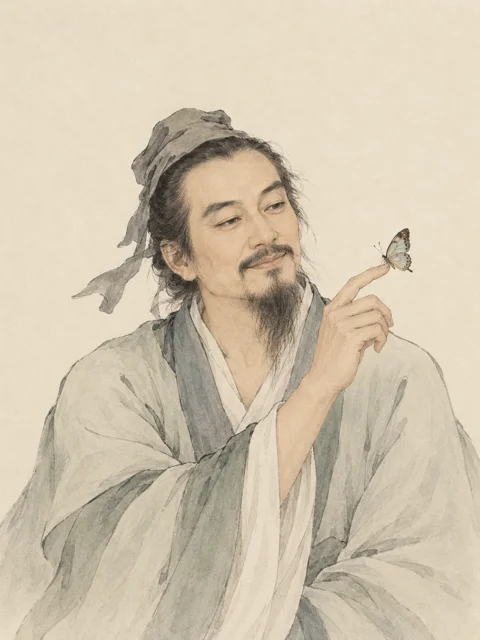
 AI 创作示意
GUANFU / en
庄子
AI 创作示意Chapter 13
版本按章对照,不代表逐句校勘对应。
中文原文(全三十三篇) / 庄子原典;维基文库贡献者整理
观复随文注释 · 51 条
天道運而无所積运行流转而不滞留,故萬物成。帝道運而无所積,故天下歸。聖道運而无所積,故海內服。明於天,通於聖,六通四辟上下四方处处通达,於帝王之德者,其自爲也,昧然无不靜者矣。聖人之靜也,非曰「靜也善,故靜也」,萬物无足以鐃心扰乱心神;鐃通挠者,故靜也。水靜,則明燭明亮地映照鬚眉,平中準水面平直可作准则,大匠取法焉。水靜猶明,而況精神?聖人之心,靜乎!天地之鑒一作「鑑」也,萬物之鏡也!
夫虛靜恬淡、寂漠一作「寞」无爲者,天地之平,而道德之質一作「至」,故帝王聖人休焉。休則虛,虛則實,實者倫条理矣。虛則靜,靜則動,動則得矣。靜則无爲,无爲也,則任事者責矣。无爲則俞俞安适自得的样子。俞俞者,憂患不能處,年壽長矣。夫虛靜恬淡、寂漠一作「寞」无爲者,萬物之本也。明此以南鄉面南而治;鄉通向,堯之爲君也。明此以北面面北而立,指为臣,舜之爲臣也。以此處上,帝王天子之德也。以此處下,玄聖素王有道德而无王位的圣者之道也。以此退居而閒游,江海山林之士服。以此進爲而撫世安抚治理世人,則功大名顯而天下一也。靜而聖,動而王,无爲也而尊,樸素而天下莫能與(之)爭美。夫明白於天地之德者,此之謂大本大宗,與天和者也。所以均調天下,與人和者也。與人和者,謂之人樂;與天和者,謂之天樂顺应自然的精神快乐。莊子曰:「『吾師乎!吾師乎!䪡萬物而不爲戾,澤及萬世而不爲仁,長於上古而不爲壽,覆載天地、刻彫一作「雕」衆形而不爲巧。』此之謂天樂。故曰:『知天樂者,其生也天行,其死也物化随万物自然变化,靜而與陰同德,動而與陽同波。』故知天樂者,无天怨,无人非,无物累,无鬼責,故曰:『其動也天,其靜也地,一心定而王天下。其鬼不祟鬼神降下的灾祸,其魂不疲,一心定而萬物服。』言以虛靜,推於天地,通於萬物,此之謂天樂。天樂者,聖人之心以畜天下养育天下之人也。」
夫帝王之德,以天地爲宗,以道德爲主,以无爲爲常。无爲也,則用天下而有餘;有爲也,則爲天下用而不足,故古之人,貴夫无爲也。上无爲也,下亦无爲也,是下與上同德;下與上同德,則不臣。下有爲也,上亦有爲也,是上與下同道;上與下同道,則不主。上必无爲而用天下,下必有爲爲天下用,此不易之道也。故古之王天下者,知雖落天地智慧虽能包罗天地;落通络,不自慮也;辯雖彫一作「雕」萬物,不自說也;能雖窮海內,不自爲也。天不產而萬物化,地不長而萬物育,帝王无爲而天下功。故曰:「莫神於天,莫富於地,莫大於帝王。」故曰:「帝王之德配天地。」此乘天地,馳萬物,而用人羣之道也。
本在於上,末在於下,要在於主,詳在於臣。三軍五兵古代五类兵器,泛指武器之運,德之末也;賞罰利害,五刑古代五种主要刑罚之辟刑法;读 pì,教之末也;禮法數度一作「度數」,形一作「刑」名比詳,治之末也;鍾一作「鐘」鼓之音,羽旄羽毛、旄牛尾制的舞具之容,樂之末也;哭泣,衰絰丧服与麻带;读 cuī dié,隆殺礼仪等差的增减;杀读 shài之服,哀之末也。此五末者,須精神之運,心術之動,然後從之者也。末學者,古人有之,而非所以先也。君先而臣從,父先而子從,兄先而弟從,長先而少從,男先而女從,夫先而婦從。夫尊卑先後,天地之行也,故聖人取象焉。天尊地卑,神明之位也;春夏先,秋冬後,四時之序也;萬物化作,萌區有狀,盛衰之殺,變化之流也。夫天地,至神,而有尊卑先後之序,而況人道乎?宗廟尚親,朝廷尚尊,鄉黨尚齒尊重年长者,行事尚賢,大道之序也。語道而非其序者,非其道也。語道而非其道者,安取道?是故古之明大道者,先明天,而道德次之,道德已明而仁義次之,仁義已明而分守职责、职分次之,分守已明而形名实际表现与职分名目次之,形名已明而因任依据才能授予职务次之,因任已明而原省考核、省察次之,原省已明而是非次之,是非已明而賞罰次之,賞罰已明,而愚知處宜,(貴賤履位,)仁賢不肖襲情,必分其能,必由其名。以此事上,以此畜下,以此治物,以此脩身,知謀不用,必歸其天,此之謂太平,治之至也。故書曰:「有形有名。」形名者,古人有之,而非所以先也。古之語大道者,五變而形名可舉,九變而賞罰一作「形名」可言也。驟而語形名,不知其本也;驟而語賞罰,不知其始也。倒道而言,迕道违背道;迕读 wǔ而說者,人之所治也,安能治人?驟而語形名賞罰,此有知治之具,非知治之道,可用於天下,不足以用天下,此之謂辯士,一曲之人只通晓一方面的人也。禮法數度,形一作「刑」名比詳,古人有之,此下之所以事上,非上之所以畜下也。
昔者舜問於堯曰:「天王之用心何如?」堯曰:「吾不敖无告无处求告的困苦者,不廢窮民,苦死者,嘉孺子而哀婦人,此吾所以用心已。」(舜曰:「美則美矣,而未大也。」堯曰:「然則何如?」)舜曰:「天德而出寧,日月照而四時行,若晝夜之有經,雲行而雨施矣。」堯曰:「膠膠擾擾胶着纷扰的样子乎!子,天之合也。我,人之合也。」夫天地者,古之所大也,而黃帝、堯、舜之所共美也。故古之王天下者,奚爲哉?天地而已矣!
孔子西藏書於周室,子路謀曰:「由聞周之徵藏史管理典籍收藏的史官有老聃者,免而歸居。夫子欲藏書,則試往因焉。」孔子曰:「善。」往見老聃,而老聃不許,於是繙翻阅、讲说十二經此处所称典籍,具体所指有异说以說。老聃中其說,曰:「太一作「大」謾过于繁杂冗长,願聞其要。」孔子曰:「要在仁義。」老聃曰:「請問:仁義,人之性邪?」孔子曰:「然。君子不仁則不成,不義則不生。仁義,眞人之性也,又將奚爲矣?」老聃曰:「請問:何謂仁義?」孔子曰:「中心勿一作「物」愷和乐,兼愛无私,此仁義之情也。」老聃曰:「意!幾乎後言!夫兼愛,不亦迂乎?无私焉,乃私也。夫子若欲使天下无失其牧乎?則天地固有常矣,日月固有明矣,星辰固有列矣,禽獸固有羣矣,樹木固有立矣。夫子亦放德而行,循道而趨,已至矣,又何偈偈急切奔忙的样子乎揭仁義,若擊鼓而求亡子焉?意!夫子亂人之性也!」
士成綺見老子而問曰:「吾聞:夫子,聖人也,吾固不辭遠道而來願見,百舍经过许多宿站,形容路远重趼脚底重生厚茧;趼读 jiǎn而不敢息。今吾觀子,非聖人也。鼠壤有餘蔬,而棄妹,不仁也。生熟不盡於前,而積斂一作「歛」无崖。」老子漠然不應。士成綺明日復見,曰:「昔者吾有刺讥刺、责难於子,今吾心正郤矣,何故也?」老子曰:「夫巧知神聖之人,吾自以爲脫焉。昔者子呼我牛也,而謂之牛,呼我馬也,而謂之馬。苟有其實,人與之名,而弗受,再受其殃。吾服也恆服常自然而然地顺应,吾非以服有服。」士成綺鴈行像雁群斜列而行,表示敬避避影,履行遂進,而問:「脩身若何?」老子曰:「而容崖然,而目衝然,而顙頯然,而口闞然口张开的样子,而狀義然,似繫馬而止也,動而持,發也機,察而審,知巧而覩於泰,凡以爲不信。邊境一作「竟」有人焉,其名爲竊。」
老子曰:「夫道,於大不終,於小不遺,故一作「於」萬物備。廣廣乎其无不容也,淵乎其不可測也。形德仁義,神之末也,非至人,孰能定之?夫至人,有世,不亦大乎?而不足以爲之累,天下奮㨀操持权柄;㨀同柄一作「棅」而不與之偕,審乎无假而不與物一作「利」遷,極物之眞,能守其本,故外天地,遺萬物,而神未嘗有所困也。通乎道,合乎德,退仁義,賓禮樂把礼乐置于辅助地位,至人之心有所定矣。」
世之所貴道者,書也。書不過語,語有貴也。語之所貴者,意也。意有所隨。意之所隨者,不可以言傳也。而世因貴言傳書,世雖貴之哉,猶不足貴也,爲其貴非其貴也。故視而可見者,形與色也;聽而可聞者,名與聲也。悲夫!世人以形色名聲爲足以得彼之情!夫形色名聲果不足以得彼之情,則知者不言,言者不知,而世豈一作「奚」識之哉?
桓公讀書於堂上,輪扁名扁的车轮工匠斲輪斫削制造车轮;斲读 zhuó於堂下,釋椎鑿而上,問桓公曰:「敢問:公之所讀者一作「爲」,何言邪?」公曰:「聖人之言也。」曰:「聖人在乎?」公曰:「已死矣。」曰:「然則君之所讀者,古人之糟魄酒糟渣滓,喻留存的言语表迹已夫!」桓公曰:「寡人讀書,輪人安得議乎?有說則可,无說則死!」輪扁曰:「臣也以臣之事觀之。斲輪,徐則甘而不固宽缓松弛而不牢固,疾則苦而不入紧涩而难以嵌入,不徐不疾,得之於手而應於心,口不能言,有數有难以言传的尺度分寸存焉於其間,臣不能以喻臣之子,臣之子亦不能受之於臣,是以行年七十而老斲輪。古之人與!其不可傳也,死矣!然則君之所讀者,古人之糟魄已矣一作「夫」!」
观复随文注释 · AI 辅助独立整理,待持续人工校订。释义以本章语境为依据;存在异说或底本疑讹的地方另作提示。原文及版本来源保留如下。
参考: 本站所收原典:外篇 · 天道 ↗
原典公有领域;电子文本据维基文库贡献者,按 CC BY-SA 4.0 保留署名及相同方式共享;调整空白与排版。 · 查看原始版本
欢迎引用本站资源,分享道家与道教文化。引用时请注明出处“观复”,并附上所引用内容的原始页面链接,方便读者查阅。
观复白话释义(AI 辅助) / 观复 · AI 辅助独立整理
【白话释义|AI 辅助独立整理,未经人工学术审定】
天道运行而没有积滞,所以万物得以成就;帝王之道运行而没有积滞,所以天下归向;圣人之道运行而没有积滞,所以四海信服。明白自然,通达圣人,六方贯通、四面敞开,达到帝王德性的人,其自身的状态深沉安静。圣人的静,不是想着“静很好,所以我要静”,而是万物没有什么足以扰乱他的心,所以自然安静。水静,就能清楚照见须眉,平得符合水准,木匠也取它作标准。水静尚能明照,何况精神!圣人的心安静,正是天地的镜子、万物的明鉴。
虚静恬淡、寂寞无为,是天地的平常状态,道德的根本质地,所以帝王圣人安处于此。安处就虚,虚才能容纳真实,真实便各有条理。虚就静,静而后动,动便得宜。静就无为,无为便让承担事务的人各负其责。无为则从容自得;从容自得,忧患无从停驻,年寿也能长久。虚静恬淡、寂寞无为,是万物的根本。明白这一点而南面为君,就是尧的做法;明白这一点而北面为臣,就是舜的做法。在上位如此,是帝王天子的德;在下位如此,是深通大道而无王位的圣人的道。
以此退居闲游,江海山林的隐士便信服;以此进身抚育世间,便功大名显,天下归一。静而为圣,动而为王,无为而尊贵,朴素而天下无人能与其争美。明白天地之德,这叫大本大宗,是与天相和;由此均衡调和天下,是与人相和。与人相和,叫人乐;与天相和,叫天乐。
庄子说:“我的老师啊,我的老师!使万物毁坏而不算暴虐,恩泽施及万世而不自称仁,长于远古而不以寿命自居,覆载天地、雕成万形而不自称巧。这就叫天乐。”所以说:“懂得天乐的人,生时随自然运行,死时随万物变化;静时与阴同德,动时与阳同流。”因此,懂得天乐的人,不受天的怨责,不受人的非难,没有外物的牵累,没有鬼神的责罚。所以说:“动时如天,静时如地,心一旦安定,便可王天下;鬼神不作祟,魂神不疲劳,心一旦安定,万物便顺服。”这就是说,以虚静推及天地,贯通万物,叫作天乐。天乐,就是圣人用来涵养天下的心境。
帝王之德,以天地为根宗,以道德为主,以无为为常。无为,就能任用天下而有余;刻意亲自作为,就会被天下事务役使而不足,所以古人贵无为。在上无为,在下也无为,上下就没有职分区别,在下者便不能履行臣职;在下有为,在上也事事亲为,上下又成同样的行事方式,在上者便不能履行主职。在上者无为以任用天下,在下者有为以服务天下,这是本篇所说不变的道理。
所以古代治理天下的人,智慧虽能笼罩天地,却不亲自包揽谋虑;辩才虽能分辨万物,却不亲自包揽言说;能力虽能穷尽海内,却不亲自包揽事务。天不刻意生产,万物却变化;地不刻意促长,万物却生育;帝王无为,天下却各成功业。因此说:“没有比天更神妙,没有比地更富厚,没有比帝王更重大的。”所以又说:“帝王的德,与天地相配。”这就是顺乘天地、使万物各行其用、任用众人的道理。
根本在上,枝末在下;纲要在君,细节在臣。三军与各种兵器的运用,是德的末端;奖赏刑罚、利益损害以及五刑的施行,是教化的末端;礼法制度、名实核比的细节,是治理的末端;钟鼓的声音、羽旄的舞容,是音乐的末端;哭泣、丧服麻带、亲疏不同的服丧等级,是哀情的末端。这五种末端,都应先有精神的运行、内心的发动,然后随之产生。末端的学问,古人也有,却不把它放在最先。
君先臣后,父先子后,兄先弟后,长先少后,男先女后,夫先妇后。尊卑先后,被本篇看作天地运行的秩序,圣人因而取象于此:天尊地卑,是神明所居的地位;春夏在先,秋冬在后,是四时的次序;万物变化,萌生各有形态,盛衰递减,是变化的流行。天地如此神妙,尚有尊卑先后,何况人事?宗庙尊亲,朝廷尊位,乡里尊年,办事尊贤,这就是大道的次序。谈道却否定它的次序,就是否定所谈的道;谈道却否定道,又从哪里取道?
所以古代明白大道的人,先明白自然,其次明白道德;道德明白之后,再讲仁义;仁义之后,再讲职分;职分之后,再讲形名;形名之后,再讲因才任用;因才任用之后,再讲考核省察;考核之后,再辨是非;是非之后,再施赏罚。赏罚明白了,愚与智各处合宜,贵与贱各履其位,仁贤与不肖各顺其实情,必须分辨其能力,依循其名分。用它事上、养下、治物、修身,不必动用机诈谋略,都归于自然,这叫太平,是治理的极境。
所以古书说:“有形,有名。”形名古人也有,却不放在开头。古人谈大道,经过五层转进,才可说形名;经过九层转进,才可说赏罚。一上来便谈形名,是不知根本;一上来便谈赏罚,是不知起始。把道倒置、违逆着讲,这样的人应当接受治理,哪里能治理别人!急着讲形名赏罚,只是知道治理的工具,不是知道治理的道;可以被天下任用,却不足以任用天下。这叫辩士,是拘于一端的人。礼法制度、形名核比,古人也有,但这是臣下事上的方式,不是在上者涵养臣下的根本。
从前舜问尧:“天子的用心应当怎样?”尧说:“我不傲慢对待无处诉告的人,不抛弃穷民,为死者悲苦,爱护孩子,怜悯妇女,这就是我的用心。”舜说:“好是好,还不够广大。”尧问:“那么应该怎样?”舜说:“依天德而显出安宁,像日月照耀、四时运行,像昼夜有常、云行雨降。”尧说:“我还是胶着扰攘!你是与天相合,我只是与人事相合。”天地,是古人所尊大的,也是黄帝、尧、舜共同称美的。所以古代王天下的人,究竟做什么?不过效法天地而已。
孔子打算向西到周王室收藏自己的书。子路建议:“我听说周的藏书史官有位老聃,已经免职家居。先生要藏书,可以试着去求助于他。”孔子说:“好。”前去见老聃,老聃却不答应。孔子于是展开十二经加以解说。老聃中途打断:“太散漫了,请说要点。”孔子说:“要点在仁义。”老聃说:“请问,仁义是人的本性吗?”孔子说:“是。君子不仁便不能成其德,不义便不能立其生。仁义是真人的本性,还能有什么别的?”老聃说:“请问什么是仁义?”孔子说:“内心和悦,兼爱无私,这是仁义的实情。”
老聃说:“唉,这话差得远了!刻意兼爱,不是太迂远吗?特意标榜无私,反而还是一种私心。先生想使天下不失去其养育吗?天地本来有常,日月本来有光,星辰本来有列,禽兽本来有群,树木本来各有所立。先生只要顺德而行,循道而进,就已经到达了。又何必急急忙忙高举仁义,好像敲鼓去寻找逃走的孩子?唉,先生这样是在扰乱人的本性!”
士成绮见老子,问道:“我听说先生是圣人,所以不辞远路前来,希望拜见,走了上百程,脚底长出重茧也不敢休息。如今看您,却不像圣人。住处杂乱如鼠洞,还有剩下的菜蔬,却苛待、弃置妹妹,不仁;面前生熟食物吃不完,还无止境地积敛。”老子漠然不答。第二天,士成绮又来,说:“昨天我指责您,今天心里的尖刻却自行退去了,这是为什么?”
老子说:“那些机巧、智慧、神异、圣明的称号,我自以为已经摆脱。昨天你若叫我牛,我便应作牛;叫我马,我便应作马。果真有那个实情,别人给它名称,却不接受,便再招一重灾害。我的顺受一向自然如此,不是为了显示顺受才顺受。”士成绮侧身避让,仿佛连影子也不敢冒犯,谨慎地走近,问:“怎样修身?”老子说:“你容貌高峻,目光逼人,额面突露,嘴巴张扬,神态自以为是,像一匹被系住的马勉强停着;行动拘持,一发动就像触机的箭;观察虽细,智巧却流露着骄矜。这些都使人不能信任。边境上有一类这样窥伺取巧的人,名字就叫贼。”
老子说:“道在大的方面没有尽头,在小的方面没有遗漏,所以万物都完备于其中。广大得无所不容,深沉得不可测量。形体、德行、仁义,都是神妙根源的末端;不是至人,谁能恰当安置它们?至人拥有天下,岂不广大?却不足以成为他的负担。天下人争夺权柄,他不随同;明白无所依待的真实,不随外物迁移;穷究事物的真相,守住自身根本。所以把天地放在心外,把万物置于不执着之处,精神从不受困。通于道,合于德,使仁义退居其次,使礼乐居于宾位,至人的心已有安定的根基。”
世人重视道,常是重视记载道的书。书不过是言语,言语也有它可贵的地方;言语之所以可贵,在于意义;意义又有所追随。而意义所追随的根本,不能单靠言语传授。世人因此重视文字传下来的书,虽然重视,却未必重视到了真正可贵之处。眼睛能看见的,是形与色;耳朵能听见的,是名与声。可悲啊,世人以为形色名声就足以把握真实!形色名声若不足以把握真实,那么真正知道的人不说,开口言说的人并不知道,世人又哪里认识这一点!
齐桓公在堂上读书,轮扁在堂下削制车轮。他放下锤凿,走上堂问:“请问君上读的是什么话?”桓公说:“圣人的话。”轮扁问:“圣人还活着吗?”桓公说:“已经死了。”轮扁说:“那么君上所读的,不过是古人留下的糟粕罢了!”桓公说:“我读书,做车轮的人怎么能议论!有说得出的道理便罢,没有道理就处死!”
轮扁说:“我是从自己的工作来看的。做轮子,榫口削得太松,就容易装入却不牢;削得太紧,就艰涩而装不进。恰到好处,不松不紧,在手上把握,心里相应,嘴却说不出来,其中有个精微的尺度。我不能把它完全讲明给儿子,儿子也不能从我这里完整接受,所以我已经七十岁,还得亲自做轮子。古人也一样,那不能传授的部分,已经随着他们死去了。因此君上读的,不过是古人留下的糟粕罢了!”
校订说明:本篇关于君臣、男女、尊卑的论述是古代文本的政治与礼制观点,按原文保留。“十二经”并非现代通行的固定十二部经书名单,故不补列。士成绮批评老子一段“鼠壤有余蔬,而弃妹”文字与解释存疑,暂依字面和常见训释处理。“轮扁”故事的“不徐不疾”依榫口松紧解释,另有操作缓急之说。末段批评以书代道,不等于删除本篇前面对学习层次的详细论述。
〔补校:“知者不言,言者不知”保留原文断言;上下文着重讨论言语不能完整传递根本体会。〕
观复白话释义:AI 辅助依据古文独立编写,已进行文本覆盖核对,未经人工学术审定;原典来源及电子底本署名、许可见对应中文版本。 · 查看原始版本
Herbert A. Giles 英译(全三十三篇) / Herbert A. Giles(翟理斯),1889
The Tao of God.
[Translator’s note] Argument :— Tao is repose—Repose the secret of the universe—Cultivation of essentials—Neglect of accidentals—The sequence of Tao —Spontaneity of true virtue— Tao is unconditioned— Tao cannot be conveyed—Illustrations.
The Tao of God operates ceaselessly; and all things are produced. The Tao of the sovereign operates ceaselessly; and the empire rallies around him. The Tao of the Sage operates ceaselessly; and all within the limit of surrounding ocean acknowledge his sway. He who apprehends God, who is in relation with the Sage, and who recognises the radiating virtue of the sovereign,—his actions will be to him unconscious, the actions of repose.
[Translator’s note] With him all will be inaction, by which all things will be accomplished.
The repose of the Sage is not what the world calls repose. His repose is the result of his mental attitude. All creation could not disturb his equilibrium: hence his repose.
When water is still, it is like a mirror, reflecting the beard and the eyebrows. It gives the accuracy of the water-level, and the philosopher makes it his model. And if water thus derives lucidity from stillness, how much more the faculties of the mind? The mind of the Sage being in repose becomes the mirror of the universe, the speculum of all creation.
Repose, tranquillity, stillness, inaction,—these were the levels of the universe, the ultimate perfection of Tao .
[Translator’s note] In the early days of Time, ere matter had assumed shape, it was by such levels that the spiritual was adjusted.
Therefore wise rulers and Sages rest therein. Resting therein they reach the unconditioned, from which springs the conditioned; and with the conditioned comes order.
[Translator’s note] Meaning those laws which are inseparable from concrete existences.
Again, from the unconditioned comes repose, and from repose comes movement,
[Translator’s note] When once inner repose has been established, outer movement results as a matter of necessity, without injury to the organism.
and from movement comes attainment. Further, from repose comes inaction, and from inaction comes potentiality of action.
[Translator’s note] When inaction has been achieved, action results spontaneously and unconsciously to the organism.
And inaction is happiness; and where there is happiness no cares can abide, and life is long.
Repose, tranquillity, stillness, inaction,—these were the source of all things. Due perception of this was the secret of Yao's success as a ruler, and of Shun's success as his minister. Due perception of this constitutes the virtue of sovereigns on the throne, the Tao of the inspired Sage and of the uncrowned King below. Keep to this in retirement, and the lettered denizens of sea and dale will recognise your power. Keep to this when coming forward to pacify a troubled world, and your merit shall be great and your name illustrious, and the empire united into one. In your repose you will be wise; in your movements, powerful. By inaction you will gain honour; and by confining yourself to the pure and simple, you will hinder the whole world from struggling with you for show.
To fully apprehend the scheme of the universe,
[Translator’s note] Lit. : "the virtue of heaven and earth," meaning their inaction by which all things are brought to maturity.
this is called the great secret of being in accord with God , whereby the empire is so administered that the result is accord with man. To be in accord with man is human happiness; to be in accord with God is the happiness of God.
Chuang Tzŭ said, "O my exemplar! Thou who destroyest all things, and dost not account it cruelty; thou who benefitest all time, and dost not account it charity; thou who art older than antiquity and dost not account it age; thou who supportest the universe, shaping the many forms therein, and dost not account it skill;—this is the happiness of God!"
Therefore it has been said, "Those who enjoy the happiness of God, when born into the world, are but fulfilling their divine functions; when they die, they do but undergo a physical change. In repose, they exert the influence of the Negative; in motion, they wield the power of the Positive."
[Translator’s note] See ante , chs. vi and xi .
Thus, those who enjoy the happiness of God have no grievance against God, no grudge against man. Nothing material injures them; nothing spiritual punishes them. Accordingly it has been said, "Their motion is that of heaven;
[Translator’s note] One of ceaseless revolution, without beginning or end.
their repose is that of earth. Mental equilibrium gives them the empire of the world. Evil spirits do not harass them without; demons do not trouble them within. Mental equilibrium gives them sovereignty over all creation." Which signifies that in repose to extend to the whole universe and to be in relation with all creation,—this is the happiness of God. This enables the mind of the Sage to cherish the whole empire.
For the virtue of the wise ruler is modelled upon the universe, is guided by Tao , and is ever occupied in inaction. By inaction, he administers the empire, and has energy to spare; but by action he finds his energy inadequate to the administration of the empire. Therefore the men of old set great store by inaction.
But if rulers practise inaction and the ruled also practise inaction, the ruled will equal the rulers, and will not be as their subjects. On the other hand, if the ruled practise action and rulers also practise action, rulers will assimilate themselves to the ruled, and will not be as their masters. Rulers must practise inaction in order to administer the empire. The ruled must practise action in order to subserve the interests of the empire. This is an unchangeable law.
[Translator’s note] And one over which the commentators have exhausted not a little wit. At the end of the chapter, the reader will be able to draw his own conclusions.
Thus, the men of old, although their knowledge did not extend throughout the universe, were not troubled in mind. Although their intellectual powers beautified all creation, they did not rejoice. Although their abilities exhausted all things within the limits of ocean, they did not act.
Heaven has no parturitions, yet all things are evolved. Earth knows no increment, yet all things are nourished. The wise ruler practises inaction, and the empire applauds him. Therefore it has been said, "There is nothing more mysterious
[Translator’s note] In its action.
than heaven, nothing richer than earth, nothing greater than the wise ruler." Wherefore also it has been said, "The virtue of the wise ruler makes him the peer of heaven and earth." Charioted upon the universe, with all creation for his team, he passes along the highway of mortality.
The essential is in the ruler; the accidental in the ruled.
[Translator’s note] Lit. the "root," and the "tip" of the branch, respectively.
The ultima ratio lies with the prince; representation is the duty of the minister.
Appeal to arms is the lowest form of virtue. Rewards and punishments are the lowest form of education. Ceremonies and laws are the lowest form of government. Music and fine clothes are the lowest form of happiness. Weeping and mourning are the lowest form of grief. These five should follow the movements of the mind.
The ancients indeed cultivated the study of accidentals, but they did not allow it to precede that of essentials. The prince precedes, the minister follows. The father precedes, the son follows. The elder brother precedes, the younger follows. Seniors precede, juniors follow. Men precede, women follow. Husbands precede, wives follow. Distinctions of rank and precedence are part of the scheme of the universe, and the Sage adopts them accordingly. In point of spirituality, heaven is honourable, earth is lowly. Spring and summer precede autumn and winter: such is the order of the seasons. In the constant production of all things, there are phases of existence. There are the extremes of maturity and decay, the perpetual tide of change. And if heaven and earth, divinest of all, admit of rank and precedence, how much more man?
In the ancestral temple, parents rank before all; at court, the most honourable; in the village, the elders; in matters to be accomplished, the most trustworthy. Such is the order which appertains to Tao . He who in considering Tao disregards this order, thereby disregards Tao ; and he who in considering Tao disregards Tao ,—whence will he secure Tao ?
Therefore, those of old who apprehended Tao , first apprehended God. Tao came next, and then charity and duty to one's neighbour, and then the functions of public life, and then forms and names, and then employment according to capacity, and then distinctions of good and bad, and then discrimination between right and wrong, and then rewards and punishments. Thus wise men and fools met with their dues; the exalted and the humble occupied their proper places. And the virtuous and the worthless being each guided by their own natural instincts, it was necessary to distinguish capabilities, and to adopt a corresponding nomenclature, in order to serve the ruler, nourish the ruled, administer things generally, and elevate self. Where knowledge and plans are of no avail, one must fall back upon the natural. This is perfect peace, the acme of good government. Therefore it has been written, "Wherever there is form, there is also its name." Forms and names indeed the ancients had, but did not give precedence to them.
Thus, those of old who considered Tao , passed through five phases before forms and names were reached, and nine before rewards and punishments could be discussed.
[Translator’s note] As given in the preceding paragraph.
To rise per saltum to forms and names is to be ignorant of their source; to rise per saltum to rewards and punishments is to be ignorant of their beginning. Those who invert the process of discussing Tao , arguing in a directly contrary sense, are rather to be governed by others than able to govern others themselves.
To rise per saltum to forms and names and rewards and punishments, this is to understand the instrumental part of government, but not to understand the great principle of government.
[Translator’s note] Which is Tao .
This is to be of use in the administration of the empire, but not to be able to administer the empire. This is to be a sciolist, a man of narrow views.
Ceremonies and laws were indeed cultivated by the ancients; but they were employed in the service of the rulers by the ruled. Rulers did not employ them as a means of nourishing the ruled.
[Translator’s note] From the beginning of this chapter, the argument has been eminently unsatisfactory.
Of old, Shun asked Yao, saying, "How does your Majesty employ your faculties?"
"I am not arrogant towards the defenceless," replied Yao. "I do not neglect the poor. I grieve for those who die. I pity the orphan. I sympathise with the widow. Beyond this, nothing."
"Good indeed!" cried Shun, "but yet not great."
"How so?" inquired Yao.
"Be passive," said Shun, "like the virtue of God. The sun and moon shine; the four seasons revolve; day and night alternate; clouds come and rain falls."
"Alas!" cried Yao, "what a muddle I have been making. You are in accord with God; I am in accord with man."
Of old, heaven and earth were considered great; and the Yellow Emperor and Yao and Shun all thought them perfection. Consequently, what did those do who ruled the empire of old? They did what heaven and earth do; no more.
When Confucius was going west to place his works in the Imperial library of the House of Chou, Tzŭ Lu
[Translator’s note] The most popular of all the disciples of Confucius. In the striking words of Mr. Watters, "He was equally ready to argue, fight, be silent, pray for his master, and die with him. So it is very unfair in Dr. Legge to call him a kind of Peter, meaning of course Simon Peter, a man who lacked faith, courage, and fidelity, and who moreover cursed and swore."— Guide to the Tablets in a Confucian Temple.
counselled him, saying, "I have heard that a certain librarian of the Chêng department, by name Lao Tan,
[Translator’s note] Or, as usually named in this work, Lao Tzŭ. "Chêng" appears to have been merely a distinctive name.
has resigned and retired into private life. Now as you, Sir, wish to deposit your works, it would be advisable to go and interview him."
"Certainly," said Confucius; and he thereupon went to see Lao Tzŭ. The latter would not hear of the proposal; so Confucius began to expound the doctrines of his twelve canons, in order to convince Lao Tzŭ.
[Translator’s note] These twelve have been variously enumerated as (1) the Book of Changes , Parts i and ii, with the ten Wings . (2) The twelve Dukes of the Spring and Autumn , etc.
"This is all nonsense," cried Lao Tzŭ, interrupting him. "Tell me what are your criteria."
"Charity," replied Confucius, "and duty towards one's neighbour."
"Tell me, please," asked Lao Tzŭ, "are these part of man's original nature?"
[Translator’s note] The question of an innate moral sense early occupied the attention of Chinese thinkers.
"They are," answered Confucius. "Without charity, the superior man could not become what he is. Without duty to one's neighbour, he would be of no effect. These two belong to the original nature of a pure man. What further would you have?"
"Tell me," said Lao Tzŭ, "in what consist charity and duty to one's neighbour?"
"They consist," answered Confucius, "in a capacity for rejoicing in all things; in universal love, without the element of self. These are the characteristics of charity and duty to one's neighbour."
"What stuff!" cried Lao Tzŭ. "Does not universal love contradict itself?
[Translator’s note] If every one loves every one, there can be no such thing as love, just as absolute altruism only achieves the same result as absolute egoism.
Is not your elimination of self a positive manifestation of self?
[Translator’s note] On the "Don't nail his ear to the pump" principle.
Sir, if you would cause the empire not to lose its source of nourishment,—there is the universe, its regularity is unceasing; there are the sun and moon, their brightness is unceasing; there are the stars, their groupings never change; there are birds and beasts, they flock together without varying; there are trees and shrubs, they grow upwards without exception, Be like these; follow Tao ; and you will be perfect. Why then these vain struggles after charity and duty to one's neighbour, as though beating a drum in search of a fugitive. Alas! Sir, you have brought much confusion into the mind of man."
[Translator’s note] The drum similitude occurs again in ch. xiv .
Shih Ch'êng Ch'i
[Translator’s note] Of whom nothing is known.
visited Lao Tzŭ, and addressed him, saying, "Having heard, Sir, that you were a Sage, I put aside all thought of distance to come and visit you. Travelling many stages, the soles of my feet thickened, but I did not venture to rest. And now I see you are not a Sage. While rats feasted off your leavings, you turned your sister out of doors. This is not charity. Though you have no lack of food, raw and cooked, you are stingy beyond all bounds."
At this Lao Tzŭ was silent and made no reply; and the next day Shih Ch'êng Ch'i came again and said, "Before, I was rude to you; now, I am sorry. How is this?"
"I have no pretension," replied Lao Tzŭ, "to be possessed of cunning knowledge nor of divine wisdom. Had you yesterday called me an ox, I should have considered myself an ox. Had you called me a horse, I should have considered myself a horse.
"For if men class you in accordance with truth, and you reject the classification, you only double the reproach. My humility is natural humility. It is not humility for humility's sake."
Shih Ch'êng Ch'i moved respectfully away.
[Translator’s note] Without allowing his shadow to fall on Lao Tzŭ. Bringing one foot up to the other only. Not venturing to let it pass as in ordinary walking.
Then he advanced again, also respectfully, and said, "May I ask you about personal cultivation?"
Lao Tzŭ said, "Your countenance is a strange one. Your eyes protrude. Your jaws are heavy. Your lips are parted. Your demeanour is self-satisfied. You look like a man on a tethered horse.
[Translator’s note] His body there, his mind elsewhere.
You are too confident. You are too hasty. You think too much of your own powers. Such men are not trusted. Those who are found on the wrong side of a boundary line are called thieves."
Lao Tzŭ said, " Tao is not too small for the greatest, nor too great for the smallest. Thus all things are embosomed therein; wide indeed its boundless capacity, unfathomable its depth.
"Form, and virtue, and charity, and duty to one's neighbour, these are the accidentals of the spiritual. Except he be a perfect man, who shall determine their place? The world of the perfect man, is not that vast? And yet it is not able to involve him in trouble. All struggle for power, but he does not join. Though discovering nothing false, he is not tempted astray. In spite of the utmost genuineness, he still confines himself to essentials.
[Translator’s note] To the root, not to the branch.
"He thus places himself outside the universe, beyond all creation, where his soul is free from care. Apprehending Tao , he is in accord with virtue. He leaves charity and duty to one's neighbour alone. He treats ceremonies and music as adventitious. And so the mind of the perfect man is at peace.
"Books are what the world values as representing Tao . But books are only words, and the valuable part of words is the thought therein contained. That thought has a certain bias which cannot be conveyed in words, yet the world values words as being the essence of books. But though the world values them, they are not of value; as that sense in which the world values them is not the sense in which they are valuable.
"That which can be seen with the eye is form and colour; that which can be heard with the ear is sound and noise. But alas! the people of this generation think that form, and colour, and sound, and noise, are means by which they can come to understand the essence of Tao . This is not so. And as those who know, do not speak, while those who speak do not know, whence should the world derive its knowledge?"
[Translator’s note] The first half of this last sentence has been pitchforked à propos de bottes into ch. lvi of the Tao-Tê-Ching . See The Remains of Lao Tzŭ , pp. 7 and 38.
Duke Huan.
[Translator’s note] The famous ruler of the Ch'i State. Flourished 7th century B.C.
was one day reading in his hall, when a wheelwright who was working below,
[Translator’s note] Below the covered dais, termed "hall," which has an open frontage, in full view of which such work might be carried on.
flung down his hammer and chisel, and mounting the steps said, "What words may your Highness be studying?"
"I am studying the words of the Sages," replied the Duke.
"Are the Sages alive?" asked the wheelwright.
"No," answered the Duke; "they are dead."
"Then the words your Highness is studying," rejoined the wheelwright, "are only the dregs of the ancients."
"What do you mean, sirrah!" cried the Duke, "by interfering with what I read? Explain yourself, or you shall die."
"Let me take an illustration," said the wheelwright, "from my own trade. In making a wheel, if you work too slowly, you can't make it firm; if you work too fast, the spokes won't fit in. You must go neither too slowly nor too fast. There must be co-ordination of mind and hand. Words cannot explain what it is, but there is some mysterious art herein. I cannot teach it to my son; nor can he learn it from me. Consequently, though seventy years of age, I am still making wheels in my old age. If the ancients, together with what they could not impart, are dead and gone, then what your Highness is studying must be the dregs."
[Translator’s note] This episode of the wheelwright is to be found in the works of Huai Nan Tzŭ, of the 2nd century B.C. He used it to illustrate the opening words of the Tao-Tê-Ching ; and in The Remains of Lao Tzŭ , p. 6, it is stated that he stole it from Chuang Tzŭ without acknowledgment.
[Translator’s note] When that statement was made I had not come to the conclusion, now forced upon me, that the above chapter is not from the hand of Chuang Tzŭ. As one critic remarks, the style is generally admirable; but it is not the style of Chuang Tzŭ.
原著及 Herbert A. Giles 历史译本公有领域;据 Project Gutenberg #59709,完整电子书及使用条款见本站资料来源。 · 查看原始版本
我的书签(此浏览器)
还没有书签。