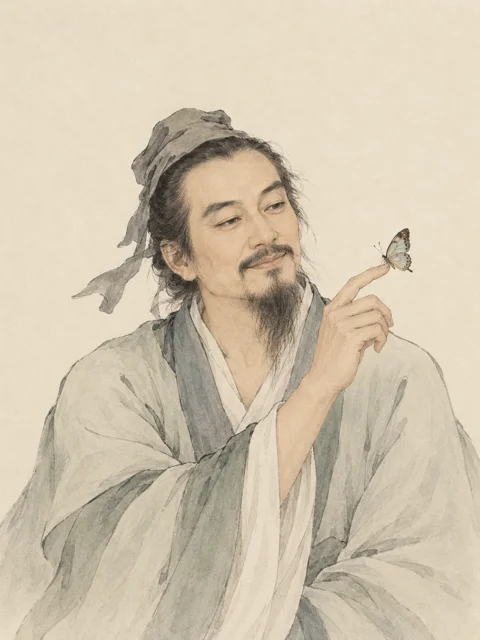
 AI 创作示意
GUANFU / en
庄子
AI 创作示意Chapter 16
版本按章对照,不代表逐句校勘对应。
中文原文(全三十三篇) / 庄子原典;维基文库贡献者整理
观复随文注释 · 31 条
繕性修治本性;繕读 shàn於俗,俗學世俗的学问以求復其初,滑欲治理、扰动欲望,古注说法不一於俗,思以求致其明,謂之蔽蒙受到蒙蔽之民。古之治道者,以恬安静淡泊養知。生而无以知爲也,謂之以知養恬。知與恬智慧与恬静交相養,而和理和谐与条理出其性。夫德,和也;道,理也。德无不容,仁也;道无不理,義也;義明而物親,中同忠,忠实一作「忠」也;中純實而反乎情,樂也;信行容體而順乎文礼仪的外在形式,禮也。禮樂徧行,則天下亂矣。彼正而蒙己,德德則不冒,冒則物必失其性也。
古之人,在混芒浑朴未分的状态之中,與一世而得澹漠焉。當是時也,陰陽和靜,鬼神不擾,四時得節,萬物不傷,羣生不夭,人雖有知,无所用之,此之謂至一浑然纯一的境界。當是時也,莫之爲而常自然。逮德下衰,及燧人传说中发明钻木取火者、伏戲伏羲,传说中的上古帝王始爲天下,是故順而不一。德又下衰,及神農传说教民农耕的上古帝王、黃帝始爲天下,是故安而不順。德又下衰,及唐、虞唐尧、虞舜始爲天下,興治化之流,澆醇冲淡淳厚;此本夹有异文一作「𣻏淳」散朴,離道以善,險德损害天然德性以行,然後去性而從於心。心與心識,知而不足以定天下,然後附之以文,益之以博。文滅質外在文饰掩没天然质朴,博溺心繁多知识淹没心灵,然後民始惑亂,无以反其性(情)而復其初。由是觀之,世喪道矣,道喪世矣,世與道交相喪也。
道之人何由興乎世?世亦何由興乎道哉?道无以興乎世,世无以興乎道,雖聖人不在山林之中,其德隱矣。隱,故不自隱。古之所謂隱士者,非伏其身而弗見也,非閉其言而不出也,非藏其知而不發也,時命时代的条件与所遇命运大謬也。當時命而大行乎天下,則反一无迹回复纯一而不留人为痕迹;不當時命而大窮乎天下,則深根寧極扎根本性、安守虚静而待。此存身之道也。古之行一作「存」身者,不以辯飾知,不以知窮天下,不以知窮德,危然独立而端正的样子處其所,而反其性已一作「己」,又何爲哉?道固不小行,德固不小識片面的见识;小識傷德,小行傷道。故曰:「正己而已矣。」
樂全内在快乐完整无损之謂得志。古之所謂得志者,非軒冕高官车服,代指爵位荣禄之謂也,謂其无以益其樂而已矣。今之所謂得志者,軒冕之謂也。軒冕在身,非性命也,物之儻來寄偶然到来而暂时寄托的外物也。寄之,其來,不可圉阻挡;读 yǔ,其去,不可止。故不爲軒冕肆志放纵心志,不爲窮約穷困趨俗,其樂,彼與此同,故无憂而已矣。今寄去則不樂,由是觀之,雖樂,未嘗不荒也。故曰:「喪己於物,失性於俗者,謂之倒置之民把外物置于本性之上的人。」
观复随文注释 · AI 辅助独立整理,待持续人工校订。释义以本章语境为依据;存在异说或底本疑讹的地方另作提示。原文及版本来源保留如下。
参考: 本站所收原典:外篇 · 繕性 ↗
原典公有领域;电子文本据维基文库贡献者,按 CC BY-SA 4.0 保留署名及相同方式共享;调整空白与排版。 · 查看原始版本
欢迎引用本站资源,分享道家与道教文化。引用时请注明出处“观复”,并附上所引用内容的原始页面链接,方便读者查阅。
观复白话释义(AI 辅助) / 观复 · AI 辅助独立整理
【白话释义|AI 辅助独立整理,未经人工学术审定】
想用世俗的学问修治本性,以求返回最初的状态;又在世俗欲望中使心迷乱,却想靠思虑达到明彻,这样的人叫作被遮蔽蒙昧的人。古代修道的人,以恬静涵养认识。认识发生,却不拿它作刻意造作的工具,这叫用认识来涵养恬静。认识与恬静互相涵养,和谐与条理由本性中显出。
德,就是和谐;道,就是条理。德无所不容,叫仁;道无所不理,叫义;义理明白,万物相亲,叫忠;内在纯真充实,返回真实情性,叫乐;忠信见于行动容貌,顺应适当的文饰,叫礼。然而把礼乐全面推行成外加规范,天下就会乱。那些以为自己端正、却遮蔽了自己的人,应当让德自然成为德,不加覆盖;一旦用人为覆盖,万物必定失去本性。
古人处在浑朴未分的状态,同整个时代一起安于淡漠。那时阴阳和静,鬼神不扰,四季适时,万物不受伤,众生不夭折。人虽然有知能,却没有需要施展机巧的地方,这叫至一。那时没有谁刻意作为,一切恒常自然而成。
等到德性下降,燧人、伏羲开始治理天下,于是虽还顺遂,却已不再浑一。德性进一步下降,神农、黄帝开始治理天下,于是虽还安定,却已不再纯然顺应。德性再下降,尧舜开始治理天下,兴起治理教化的风气,冲淡醇厚,分散素朴;离开大道去追逐善名,以刻意行为危害德性。此后,人便离开本性,追随成心。心与心互相用识知揣测,智巧却不足以安定天下,于是又附加文饰,增添广博的知识。文饰消灭质朴,博学淹没本心,百姓由此开始迷惑混乱,无法返回本性、恢复最初的状态。
由此看来,世间失去了道,道也失去了在世间通行的条件,世与道互相失去了。行道的人凭什么在世间兴起?世间又凭什么在道中复兴?道不能在世间兴起,世间不能在道中复兴,即使圣人没有住在山林,他的德也隐没了。这种隐没,不是他故意隐藏自己。
古代所谓隐士,不是藏起身体不让人见,不是闭口不说话,也不是把智慧藏住不显露;而是时运与他的道路大不相合。遇到合宜的时运,得以在天下大行其道,就返回浑一,不留刻意施为的痕迹;遇不到合宜的时运,在天下极其困顿,就深固根本,安住于宁静的极处,等待时机。这是保全自身的道。
古代保全自身的人,不用辩说装饰智慧,不凭智慧穷尽天下,不凭智慧穷尽德性,只安然独处自己的位置,返回本性罢了,还要做什么?道本来不靠琐细的行为推行,德本来不靠狭小的认识显明。狭小的认识损伤德,琐细的刻意行为损伤道。所以说:“端正自身就够了。”
快乐完整无缺,就叫得志。古代所谓得志,不是得到车驾冠冕和官位,而是已经没有什么外物能再增加他的快乐。如今所谓得志,却是得到官位。官位落到身上,不属于性命本身,只是外物偶然前来寄居。它既是暂寄,来时不能阻挡,去时也不能强留。所以不因高官显位而放纵心志,不因穷困窘迫而趋从世俗;身在彼境或此境,内在的快乐一样,因此无忧。
如今,寄来的官位一离开,就不快乐。由此看,即使原先快乐,也始终是迷失于外物之中。所以说:“在外物中丧失自己,在世俗中失去本性,这样的人叫作把本末颠倒的人。”
校订说明:首句“滑欲于俗”有不同断读,暂依沉溺世俗欲望而求明的批评语境释出。“彼正而蒙己,德德则不冒”文字晦涩,以上为一种语境性解释,须重点校勘。上古帝王使德性逐层下降,是本篇思想史寓言式叙述,未改作经考证的历史事实。“轩冕”以车驾、冠冕代指官位显达。
观复白话释义:AI 辅助依据古文独立编写,已进行文本覆盖核对,未经人工学术审定;原典来源及电子底本署名、许可见对应中文版本。 · 查看原始版本
Herbert A. Giles 英译(全三十三篇) / Herbert A. Giles(翟理斯),1889
Exercise of Faculties.
[Translator’s note] Argument :— Tao unattainable by mundane arts—To be reached through repose—The world's infancy—The reign of peace—Government sets in— Tao declines—The true Sages of old—Their purity of aim.
Those who exercise their faculties in mere worldly studies, hoping thereby to revert to their original condition; and those who sink their aspirations in mundane thoughts, hoping thereby to reach enlightenment;—these are the dullards of the earth.
The ancients, in cultivating Tao , begat knowledge out of repose. When born, this knowledge was not applied to any purpose; and so it may be said that out of knowledge they begat repose. Knowledge and repose thus mutually producing each other, harmony and order were developed. Virtue is harmony; Tao is order.
Virtue all-embracing,—hence charity. Tao all-influencing,—hence duty to one's neighbour. From the establishment of these two springs loyalty. Then comes music, an expression of inward purity and truth; followed by ceremonial, or sincerity expressed in ornamental guise. If music and ceremonial are ill regulated, the empire is plunged into confusion. And to attempt to correct others while one's own virtue is clouded, is to set one's own virtue a task for which it is inadequate, the result being that the natural constitution of the object will suffer.
Primeval man enjoyed perfect tranquillity throughout life. In his day, the Positive and Negative principles were peacefully united; spiritual beings gave no trouble; the four seasons followed in due order; nothing suffered any injury; death was unknown; men had knowledge, but no occasion to use it. This may be called perfection of unity.
[Translator’s note] All things, all conditions, were One .
At that period, nothing was ever made so; but everything was so.
By and by, virtue declined. Sui Jen
[Translator’s note] The Prometheus of China.
and Fu Hsi
[Translator’s note] See ch. vi .
ruled the empire. There was still natural adaptation,
[Translator’s note] Of man to his surroundings.
but the unity was gone.
[Translator’s note] The tide of coercion had set in.
A further decline in virtue. Shên Nung
[Translator’s note] The inventor of agriculture.
and Huang Ti
[Translator’s note] The Yellow Emperor. See ch. vi .
ruled the empire. There was peace, but the natural adaptation was gone.
Again virtue declined. Yao and Shun ruled the empire. Systems of government and moral reform were introduced. Man's original integrity was scattered. Goodness led him astray from Tao ;
[Translator’s note] But for goodness, evil could not exist.
his actions imperilled his virtue.
[Translator’s note] As opposed to inaction.
Then he discarded natural instinct and took up with the intellectual. Mind was pitted against mind, but it was impossible thus to settle the empire. So art and learning were added. But art obliterated the original constitution, and learning overwhelmed mind; upon which confusion set in, and man was unable to revert to his natural instincts, to the condition in which he at first existed.
Thus it may be said that the world destroys Tao , and that Tao destroys the world. And the world and Tao thus mutually destroying each other, how can the men of Tao elevate the world, and how can the world elevate Tao ? Tao cannot elevate the world; neither can the world elevate Tao . Though the Sages were not to dwell on mountain and in forest, their virtue would still be hidden;—hidden, but not by themselves.
Those of old who were called retired scholars, were not men who hid their bodies, or kept back their words, or concealed their wisdom. It was that the age was not suitable for their mission. If the age was suitable and their mission a success over the empire, they simply effaced themselves in the unity which prevailed. If the age was unsuitable and their mission at failure, they fell back upon their own resources and waited. Such is the way to preserve oneself.
Those of old who preserved themselves, did not ornament their knowledge with rhetoric. They did not exhaust the empire with their knowledge. They did not exhaust virtue. They kept quietly to their own spheres, and reverted to their natural instincts. What then was left for them to do ?
Tao does not deal with detail. Virtue does not take cognizance of trifles. Trifles injure virtue; detail injures Tao . Wherefore it has been said, "Self-reformation is enough." He whose happiness is complete has attained his desire.
Of old, attainment of desire did not mean office . It meant that nothing could be added to the sum of happiness. But now it does mean office, though office is external and is not a part of oneself. That which is adventitious, comes. Coming, you cannot prevent it; going, you cannot arrest it. Therefore, not to look on office as the attainment of desire, and not because of poverty to become a toady, but to be equally happy under all conditions,—this is to be without sorrow.
But now-a-days, both having and not having
[Translator’s note] Office.
are causes of unhappiness. From which we may infer that even happiness is not exempt from sorrow.
[Translator’s note] A reductio ad absurdum .
Wherefore it has been said, "Those who over-estimate the external and lose their natural instincts in worldliness,—these are the people of topsy-turvydom."
[Translator’s note] We are left in the dark as to the authorship of the numerous quotations in this and the preceding chapter. It is, however, a point of minor importance, neither chapter having the slightest claim to be regarded as the genuine work of Chuang Tzŭ.
原著及 Herbert A. Giles 历史译本公有领域;据 Project Gutenberg #59709,完整电子书及使用条款见本站资料来源。 · 查看原始版本
我的书签(此浏览器)
还没有书签。