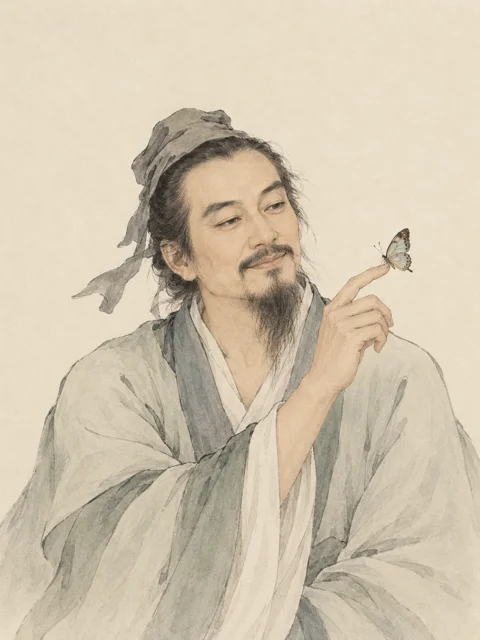
 AI 创作示意
GUANFU / en
庄子
AI 创作示意Chapter 17
版本按章对照,不代表逐句校勘对应。
中文原文(全三十三篇) / 庄子原典;维基文库贡献者整理
观复随文注释 · 78 条
秋水時至按季节到来,百川灌河流入黄河,涇流主流、通流;涇通径之大,兩涘水边;读 sì渚涯洲渚与水岸一作「崖」之間,不辯牛馬,於是焉,河伯传说中的黄河之神欣然自喜,以(爲)天下之美,爲盡在己。順流而東行,至於北海,東面而視,不見水端,於是焉,河伯始旋其面目,望洋仰视远望的样子;不是海洋之义向若北海神之名而歎,曰:「野語有之,曰『聞道百,以爲莫己若』者,我之謂也。且夫我嘗聞少仲尼之聞而輕伯夷之義者,始吾弗信,今我睹子之難窮也,吾非至於子之門,則殆矣!吾長見笑於大方之家通晓大道的人!」北海若曰:「井蛙一作「鼃」不可以語於海者,拘於墟一作「虛」也。夏蟲不可以語於冰者,篤於時局限于生存的时节也。曲士见识偏狭的人不可以語於道者,束於教也。今爾出於涯一作「崖」涘,觀於大海,乃知爾醜,爾將可與語大理矣。天下之水,莫大於海,萬川歸之,不知何時止,而不盈,尾閭传说中海水排泄之处泄之,不知何時已,而不虛,春秋不變,水旱不知。此其過江、河之流,不可爲量數,而吾未嘗以此自多者,自以比形於天地,而受氣於陰陽,吾在(於)天地之間,猶小石小木之在大山也,方存乎見少,又奚以自多?計四海之在天地之間也,不似礨空小孔穴;礨读 lěi之在大澤乎?計中國之在海內,不似稊米小米粒;稊读 tí之在大一作「太」倉乎?號物之數爲一作「謂」之萬,人處一焉;人卒九州,穀食之所生,舟車之所通,人處一焉。此其比萬物也,不似豪末之在於馬體乎?五帝之所連,三王之所爭,仁人之所憂,任士承担世事的士人之所勞,盡此矣。伯夷辭之以爲名,仲尼語之以爲博,此其自多也,不似爾向之自多於水乎?」
河伯曰:「然則吾大天地而小豪末,可乎?」北海若曰:「否。夫物,量无窮,時无止,分无常所处境遇没有固定状态,終始无故。是故,大知觀於遠近,故小而不寡,大而不多,知量无窮;證曏今故,故遙而(不)悶,掇而不跂近而不踮足企求;此句有异解,知時无止;察乎盈虛,故得而不喜,失而不憂,知分之无常也;明乎坦塗,故生而不悅一作「說」,死而不禍,知終始之不可故也。計人之所知,不若其所不知,其生之時,不若未生之時,以其至小,求窮其至大之域一作「城」,是故迷亂而不能自得也。由此觀之,又何以知豪末之足以定至細之倪边际、分际?又何以知天地之足以窮至大之域一作「城」?」
河伯曰:「世之議者皆曰:『至精无形,至大不可圍。』是信情乎?」北海若曰:「夫自細視大者不盡,自大視細者不明。夫精,小之微也;垺大;读 póu,大之殷也。故異便,此勢之有也。夫精粗者,期於有形者也;无形者,數之所不能分也;不可圍者,數之所不能窮也。可以言論者,物之粗也;可以意致者,物之精也;言之所不能論,意之所不能察致者,不期精粗焉。是故大人之行:不出乎害人,不多仁恩;動不爲利,不賤門隸守门的仆役;貨財弗爭,不多辭讓;事焉不借人,不多食乎力凭自己的劳动生活,不賤貪汙;行殊乎俗,不多辟異偏僻奇异的行为;爲在從衆,不賤佞諂;世之爵祿不足以爲勸,戮恥不足以爲辱,知是非之不可爲分、細大之不可爲倪。聞曰:『道人不聞不求声名显闻,至德不得,大人无己。』約分之至也。」
河伯曰:「若物之外,若物之內,惡至而倪貴賤?惡至而倪小大?」北海若曰:「以道觀之,物无貴賤;以物觀之,自貴而相賤;以俗觀之,貴賤不在己。以差觀之,因其所大而大之,則萬物莫不大;因其所小而小之,則萬物莫不小;知天地之爲稊米也,知豪末之爲丘山也,則差數覩矣。以功觀之,因其所有而有之,則萬物莫不有;因其所无而无之,則萬物莫不无;知東西之相反而不可以相无,則功分定矣。以趣觀之,因其所然而然之,則萬物莫不然;因其所非而非之,則萬物莫不非;知堯、桀之自然而相非,則趣操志趣操守覩矣。昔者堯、舜讓而帝,之、噲燕相子之与燕王哙,禅让致乱讓而絕;湯、武爭而王,白公楚国白公胜,争权失败被杀爭而滅。由此觀之,爭讓之禮,堯、桀之行,貴賤有時,未可以爲常也。梁麗栋梁般的大木可以衝城,而不可以窒穴,言殊器也。騏驥驊騮古代名马的名称,一日而馳千里,捕鼠不如狸狌野猫一类善捕鼠的动物,言殊技也。鴟猫头鹰一类的鸟(鵂)夜撮蚤捕捉跳蚤,察豪末,晝出,瞋目而不見丘山,言殊性也。故曰:蓋師是而无非,師治而无亂乎!是未明天地之理、萬物之情者也。是猶師天而无地,師陰而无陽,其不可行,明矣。然且語而不舍,非愚則誣也。帝王殊禪,三代殊繼。差其時,逆其俗者,謂之篡夫夺取君位的人;當其時,順其俗者,謂之義之徒。默默乎,河伯!汝一作「女」惡知貴賤之門、小大之家?」
河伯曰:「然則我何爲乎?何不爲乎?吾辭受趣舍,吾終奈何?」北海若曰:「以道觀之,何貴何賤?是謂反衍反复变化,无固定一端,无拘而志,與道大蹇;何少何多?是謂謝施推移变化,无一而行,與道參差。嚴乎若國之有君,其无私德;繇繇乎若祭之有社,其无私福;汎汎一作「泛泛」乎其若四方之无窮,其无所畛域界限、范围;兼懷萬物,其孰承翼偏向、辅助?是謂无方。萬物一齊,孰短孰長?道无終始,物有死生,不恃其成;一虛一滿,不位乎其形不固守某种固定形态。年不可舉,時不可止;消息消减与增长盈虛,終則有始。是所以語大義之方,論萬物之理也。物之生也,若驟若馳,无動而不變,无時而不移。何爲乎?何不爲乎?夫固將自化。」
河伯曰:「然則何貴於道邪?」北海若曰:「知道者必達於理,達於理者必明於權因时制宜的权变,明於權者不以物害己。至德者,火弗能熱,水弗能溺,寒暑弗能害,禽獸弗能賊。非謂其薄之迫近、冒犯危险也,言察乎安危,寧於禍福,謹於去就,莫之能害也。故曰:『天在內,人在外,德在乎天。』知天人之行,本乎天,位乎得,蹢䠱徘徊进退;读 zhí zhú而屈伸,反要而語極。」曰:「何謂天?何謂一作「論」人?」北海若曰:「牛馬四足,是謂天。落馬首给马套上络头;落通络,穿牛鼻,是謂人。故曰:『无以人滅天,无以故滅命,无以得殉名为追逐名声而牺牲自身。謹守而勿失,是謂反其眞。』」
夔传说中的独足动物;读 kuí憐羡慕蚿多足虫,通常指马陆;读 xián,蚿憐蛇,蛇憐風,風憐目,目憐心。夔謂蚿曰:「吾以一足趻踔跳跃;读 chěn chuō而行,予无如矣。今子之使萬足,獨奈何?」蚿曰:「不然。子不見夫唾者乎?噴則大者如珠,小者如霧,雜而下者,不可勝數也。今予動吾天機天然的运动机能,而不知其所以然。」蚿謂蛇曰:「吾以衆足行,而不及子之无足,何也?」蛇曰:「夫天機之所動,何可易邪?吾安用足哉?」蛇謂風曰:「予動吾脊脅而行,則有似也。今子蓬蓬然起於北海,蓬蓬然入於南海,而似无有,何也?」風曰:「然。予蓬蓬然起於北海,而入於南海也,然而指我則勝我,鰌我亦勝我。雖然,夫折大木、蜚大屋者,唯我能也。」故以衆小不勝爲大勝也。爲大勝者,唯聖人能之。
孔子遊於匡春秋地名,宋人圍之數匝周、圈;读 zā,而弦歌不輟一作「惙」。子路入見,曰:「何夫子之娛也?」孔子曰:「來,吾語汝一作「女」。我諱窮,久矣,而不免,命也。求通,久矣,而不得,時也。當堯、舜,而天下无窮人,非知得也;當桀、紂,而天下无通人,非知失也:時勢適然。夫水行不避蛟龍者,漁父之勇也。陸行不避兕古代犀牛一类的兽;读 sì虎者,獵夫之勇也。白刃交於前,視死若生者,烈士之勇也。知窮之有命,知通之有時,臨大難而不懼者,聖人之勇也。由,處矣,吾命有所制矣!」无幾何,將甲者進,辭曰:「以爲陽虎鲁国权臣,传说相貌似孔子也,故圍之。今非也,請辭而退。」
公孫龍战国名家代表人物問於魏牟魏国公子牟曰:「龍少學先王之道,長而明仁義之行,合同異讨论事物相同相异的名家命题,離堅白分别论说坚硬与白色,然不然,可不可,困百家之知,窮衆口之辯,吾自以爲至達已一作「矣」。今吾聞莊子之言,汒焉異之,不知論之不及與?知之弗若與?今吾无所開吾喙。敢問其方?」公子牟隱几一作「机」大息,仰天而笑曰:「子獨不聞夫埳井浅井;埳同坎之蛙一作「鼃」乎?謂東海之鼈一作「鱉」曰:『吾樂與!吾跳梁乎井幹之上,入休乎缺甃井壁的砖;读 zhòu之崖,赴水則接掖持頤,蹶泥則沒足滅跗脚背;读 fū,還虷蟹與科斗蝌蚪,莫吾能若也!且夫擅一壑之水,而跨跱埳井之樂,此亦至矣。夫子奚不時來入觀乎?』東海之鼈一作「鱉」,左足未入,而右膝已縶绊住;读 zhí矣,於是逡巡迟疑退却而却一作「卻」,告之海曰:『夫千里之遠,不足以舉其大;千仞之高,不足以極其深;禹之時,十年九潦多次水灾;潦读 lǎo,而水弗爲加益;湯之時,八年七旱,而崖不爲加損。夫不爲頃久推移,不以多少進退者,此亦東海之大樂也。』於是埳井之蛙一作「鼃」聞之,適適然驚,規規然自失也。且夫知不知是非之境一作「竟」,而猶欲觀於莊子之言,是猶使蚊一作「蚉」負山、商蚷古注为马陆一类多足虫馳河也,必不勝任矣。且夫知不知論極妙之言,而自適一時之利者,是非埳井之蛙一作「鼃」與?且彼方跐黃泉而登大皇高天、太空,无南无北,奭然四解,淪於不測;无東无西,始於玄冥,反於大通。子乃規規然,而求之以察,索之以辯,是直用管闚天,用錐指地也,不亦小乎?子往矣!且子獨不聞夫壽陵餘子寿陵的年轻人,邯郸学步故事主人公之學行於邯鄲與?未得國能,又失其故行矣,直匍匐而歸耳。今子不去,將忘子之故,失子之業!」公孫龍口呿张着嘴;呿读 qū而不合,舌舉而不下,乃逸而走。
莊子釣於濮水古代水名;濮读 pú。楚王使大夫二人往先焉,曰:「願以境一作「竟」內累矣!」莊子持竿不顧,曰:「吾聞楚有神龜,死已三千歲矣,王巾笥用巾包裹、装入竹箱而藏之廟堂之上。此龜者,寧其死爲留骨而貴乎?寧其生而曳尾拖着尾巴於塗中泥水之中;塗同涂乎?」二大夫曰:「寧生而曳尾塗中。」莊子曰:「往矣!吾將曳尾於塗中。」
惠子相梁在魏国做宰相;梁指魏国,莊子往見之。或謂惠子曰:「莊子來,欲代子相。」於是惠子恐,廋一作「搜」於國中,三日三夜。莊子往見之,曰:「南方有鳥,其名鵷鶵传说中凤凰一类的鸟,子知之乎?夫鵷鶵,發於南海,而飛於北海,非梧桐不止,非練實竹实,凤凰传说中的食物不食,非醴泉甘美的泉水;醴读 lǐ不飲。於是鴟得腐鼠,鵷鶵過之,仰而視之,曰:『嚇!』今子欲以子之梁國而嚇我邪?」
莊子與惠子遊於濠梁濠水上的桥之上。莊子曰:「鯈魚白鲦一类小鱼;鯈读 tiáo出游從一作「愛」容,是魚樂也。」惠子曰:「子非魚,安知可作怎么知道,后文又借作哪里知道魚之樂?」莊子曰:「子非我,安知我不知魚之樂?」惠子曰:「我非子,固不知子矣。子固非魚也,子之不知魚之樂,全矣!」莊子曰:「請循其本。子曰『汝一作「女」安知魚樂』云者,旣已知吾知之,而問我。我知之濠上也。」
观复随文注释 · AI 辅助独立整理,待持续人工校订。释义以本章语境为依据;存在异说或底本疑讹的地方另作提示。原文及版本来源保留如下。
参考: 本站所收原典:外篇 · 秋水 ↗
原典公有领域;电子文本据维基文库贡献者,按 CC BY-SA 4.0 保留署名及相同方式共享;调整空白与排版。 · 查看原始版本
欢迎引用本站资源,分享道家与道教文化。引用时请注明出处“观复”,并附上所引用内容的原始页面链接,方便读者查阅。
观复白话释义(AI 辅助) / 观复 · AI 辅助独立整理
【观复白话释义|AI 辅助·未经人工学术审定】
秋天的洪水按季节来到,许多河流一齐汇入黄河。河面水势浩大,隔着两岸和沙洲的边缘,连牛马都分辨不清。河伯因此得意洋洋,觉得天下的美好全都集中在自己这里。他顺流向东,到了北海,朝东望去,看不见水的尽头。这才改变了自得的神色,仰望海神若,感叹说:“俗话说,‘听到许多道理,就以为没有人比得上自己’,说的正是我啊。我曾听说,有人认为仲尼的见闻算不得多,伯夷的义行算不得高,起初我不相信。如今亲眼看见你这无穷无尽的样子,我若没有来到你的门前,可就危险了,必定长久受到通晓大道的人嘲笑!”
北海若说:“不能跟井里的青蛙谈海,是因为它受居住地方的限制;不能跟夏天的虫子谈冰,是因为它受生存季节的限制;不能跟见识偏狭的读书人谈道,是因为他受所学教条的束缚。如今你走出了自己的河岸,看见大海,才知道自己的局限,可以跟你谈更大的道理了。天下的水,没有比海更大的。万条河流归向它,不知什么时候停止,它却不满溢;海水从尾闾流泄,不知什么时候结束,它却不枯竭。春秋轮换,它不因此改变;旱涝交替,它也觉察不出水量的变动。海超过江河,确实无法用数量计算。不过,我从未因此自高自大。我把自身放在天地之间衡量,知道自己从阴阳二气获得存在;我在天地之间,就像小石头、小树木处在大山里。正感到自己渺小,又哪里会自夸呢?计算四海在天地之间所占的位置,不就像大泽中的一个小孔吗?计算中原在四海以内所占的位置,不就像大粮仓里的一粒小米吗?说到事物的种类,人们称为万物,人不过其中一种。人遍布九州,生活在五谷生长、舟车能够通达的地方,一个人又只是其中一员。人同万物相比,不就像马身上的一根毫毛尖吗?五帝相继治理的,三王相互争夺的,仁爱之人忧虑的,担当天下事务的人辛劳经营的,全在这一点范围之内。伯夷辞让它而得到名声,仲尼谈论它而显示博学;他们若因此自得,不就像你方才凭着河水自夸一样吗?”
河伯问:“那么,我把天地看作大,把毫毛尖看作小,可以吗?”北海若说:“不可以。事物的数量和大小没有穷尽,时间没有止境,得失的份额没有定数,终结和开始没有固定不变的常态。所以,见识广大的人观察远近:面对小的不嫌少,面对大的不觉得多,因为知道量没有穷尽;考察古往今来,不因年代遥远而迷惘,不因眼前可及而踮脚急求,因为知道时间没有止境;明察盈亏消长,得到不欣喜,失去不忧愁,因为知道所分得的并不固定;明白生死共同经过的道路,便不把活着当作可喜之事,不把死亡当作灾祸,因为知道终始不能固守。人的已知远远少于未知,活着的时间远远短于尚未出生的时间。拿这么小的范围去求尽那么大的领域,便会迷惑纷乱,不能安适自得。由此看来,又凭什么知道毫毛尖足以确定最细小的界限,天地足以穷尽最大的范围呢?”
河伯问:“世上议论的人都说,‘最精微的没有形体,最大的无法圈定’,这话确实吗?”北海若说:“从小处看大,不能看尽;从大处看小,不能看清。所谓精,是小之中的微细;所谓巨大,是大之中的丰厚。因此,两者各有不同的观察条件,这是它们所处形势造成的。精细和粗大,都是就有形的东西而言;没有形体的,数量不能把它分开;无法圈定的,数量不能把它穷尽。能够用言语议论的,是事物较粗显的一面;能够用心意领会的,是事物较精微的一面;言语不能议论、心意也不能察知的,便不应再限定在精与粗之内。因此,通达之人的行为,不以伤害别人为出发点,却不夸耀仁爱恩惠;行动不为求利,却不轻贱看门服役的人;不争财货,却不夸耀辞让;做事不依赖别人,却不把自食其力当作可夸耀的事,也不据此轻贱贪求之人;行为虽与世俗不同,却不炫耀孤僻奇异;做事顺从众人,也不以此鄙薄谄媚者。世上的爵位俸禄不足以诱使他奋求,刑戮耻辱不足以使他自觉受辱,因为他知道,是非不能划出绝对的分界,大小不能确立最终的边际。我听说,‘有道之人不求声名,德行至高的人不自以为有所得,通达之人不执著于自我。’这正是把自身的分别之见收敛到极处。”
河伯问:“无论在事物之外还是之内,究竟从哪里划分贵贱,又从哪里划分大小呢?”北海若说:“从道来看,事物没有贵贱;从各个事物自身来看,都贵重自己而轻贱别的;从世俗来看,贵贱又不由自己决定。从差别来看,依据某物较大的一面而认定它大,那么万物没有不大的;依据某物较小的一面而认定它小,那么万物没有不小的。明白天地也可以像一粒小米,毫毛尖也可以像一座山丘,就看清大小差别的相对关系了。从功用来看,依据某物具有的用处而认定它有用,那么万物没有无用的;依据某物不具备的用处而认定它无用,那么万物没有不缺少用处的。明白东与西方向相反,却不能互相取消,就能认清功用各有分属。从志趣来看,依据某物自己肯定的而肯定它,那么万物没有不对的;依据某物自己否定的而否定它,那么万物没有不错的。明白尧与桀都自以为对而认为对方错,就能看清志趣操守各有依据。
“过去,尧、舜通过禅让而成就帝业,子之、燕王哙却因禅让而灭亡;汤、武通过争战而称王,白公却因争夺而败亡。由此看来,争夺或辞让的行为,尧或桀那样的做法,受到尊重还是轻贱,要看所处的时机,不能当作永远不变的准则。粗大的梁柱可以撞城,却不能堵塞小洞,说的是器物各有适用之处;骐骥、骅骝这样的骏马,一天可以奔跑千里,捉老鼠却不如野猫,说的是本领各不相同;猫头鹰夜里能捉跳蚤,看清毫毛尖,白天出来瞪大眼睛却看不见山丘,说的是天性各有不同。所以说,难道可以只奉是为师而取消非,只取治而取消乱吗?这样的人还不明白天地的道理、万物的实情,就像只尊天而排除地,只尊阴而排除阳,显然行不通。若还喋喋不休,不是愚昧,就是欺妄。帝王禅让的方式不一,三代传位的方式也不同;错过时机、违背习俗的,被称为篡夺者;符合时机、顺应习俗的,被称为行义之人。河伯,静静想想吧!你哪里能认定贵贱的门径、大小的归属呢?”
河伯问:“那么,我该做什么,不该做什么?辞让或接受,追求或舍弃,究竟怎样才好?”北海若说:“从道来看,什么贵,什么贱?贵贱会相互转化,不要拘束自己的心志,否则便同大道大有阻隔。什么少,什么多?多少会相互迁移,不要把行为固定在一种尺度上,否则便同大道不合。庄重得像一国的君主,不施私人恩惠;从容得像祭祀中的土地神,不把福祉专赐给某一个人;广阔得像无边无际的四方,不划出自己的疆界。包容万物,又特别扶持哪一个呢?这便叫作不偏定于一方。万物一体,又把谁定为短,把谁定为长呢?道没有开始和终结,事物却有死亡和出生,所以不要倚仗一时的成功;一时空虚,一时充实,不应固守某一种形态。年岁不能追回,时光不能停住;消长盈虚,终结之后又有开始。这就是用来谈论大道、说明万物条理的方向。万物的生长变化,像疾奔,像飞驰,没有一个动作不在改变,没有一刻不在迁移。还要执意认定做什么、不做什么呢?万物本来就会自行变化。”
河伯问:“既然如此,道又有什么可贵呢?”北海若说:“懂得道的人必然通晓事理,通晓事理的人必然明白如何权衡变化,明白权变的人就不会让外物损害自己。德行达到极处的人,火不能使他灼伤,水不能使他沉溺,寒暑不能伤害他,禽兽不能残害他。这并不是说他直接迎着这些危险冲上去,而是说他能察明安危,安然面对祸福,审慎决定离开还是接近,因此没有什么能够伤害他。所以说,‘天然本性在内,人为作为在外,真正的德性在于天然。’认识天然和人为的运行方式,以天然为根本,安住于自得,随境遇进退屈伸,返回根本而谈论最终的道理。”河伯问:“什么叫天然,什么叫人为?”北海若说:“牛马长着四条腿,这叫天然;给马套上笼头,给牛穿鼻子,这叫人为。所以说,‘不要用人为毁坏天然,不要用刻意造作毁坏生命的禀赋,不要牺牲自身所得的本真去追逐名声。谨慎守住,不使丧失,就叫回归真实的本性。’”
独脚的夔羡慕多足的蚿,蚿羡慕蛇,蛇羡慕风,风羡慕眼睛,眼睛羡慕心。夔问蚿:“我用一只脚跳着走,已经不知怎样才好了。如今你调动那么多脚,到底怎么做到的?”蚿说:“不是你想的那样。你没看见吐唾沫的人吗?一喷出来,大的像珠子,小的像雾,混杂着落下,多得数不清。如今我只是发动自身天然的机能,并不知道为什么会这样。”蚿问蛇:“我用这么多脚走,却赶不上你没有脚的,为什么呢?”蛇说:“天然机能发动起来,哪里能随意改变?我又何必用脚呢?”蛇问风:“我靠活动脊背和两胁前行,总还有形体可见。你却呼呼地从北海刮起,又呼呼地进入南海,似乎没有形体,这是为什么?”风说:“确实如此。我呼呼地从北海吹起,进入南海,可是有人用手指挡我,局部就能挡住我;用脚踩我,也能胜过我。不过,折断大树、掀飞大屋,只有我能做到。”所以,在许多细小的地方不求取胜,才能取得大的胜利。能成就这种大胜的,只有圣人。
孔子在匡地游历,宋人把他围了好几层,他仍然弹琴唱歌,不曾停止。子路进来问:“先生怎么还这样快活?”孔子说:“来,我告诉你。我避讳困厄很久了,却未能免除,这是命;我寻求通达很久了,却得不到,这是时机。在尧舜的时候,天下没有困顿的人,并不是人人都聪明;在桀纣的时候,天下没有通达的人,并不是人人都失去智慧,只是时势造成了那样的处境。在水中行进而不避蛟龙,是渔人的勇;在陆地行走而不避犀牛猛虎,是猎人的勇;利刃在眼前交错,把死看作生,是壮士的勇;知道困厄有命、通达有时,面对大难而不恐惧,是圣人的勇。由,安处下来吧,我的命运自有所制约。”没过多久,率领武装的人前来致歉说:“我们以为您是阳虎,所以包围了您。现在知道不是,请允许我们告退。”
公孙龙问魏国公子牟:“我年少时学习先王之道,长大后明白仁义的实践;我能把同与异合起来,把坚与白分开,能把人认为不对的说成对,把人认为不可以的说成可以,使各家智者困惑,使众人的辩说走到尽头。我自以为最通达了。如今听到庄子的言论,却茫然觉得奇异,不知道是我的论说赶不上他,还是我的认识不如他。我竟没有地方可以开口。敢问应当怎样理解?”公子牟靠着几案长叹,仰天笑道:“你难道没听说过浅井里的青蛙吗?它对东海的大鳖说:‘我真快乐啊!我跳跃在井栏上,进到破损井壁的空隙里休息;跳入水中,水托着我的腋窝和下巴;踩进泥里,泥埋住我的脚和脚背。看看小虫、螃蟹和蝌蚪,没有谁比得上我!独占这一坑水,在浅井中自在蹲坐,这快乐真到极点了。先生为什么不常常进来看看呢?’东海大鳖左脚还没迈进,右膝就已卡住,只好迟疑着退开,告诉它大海的情况:‘千里的距离不足以说明海的广大,千仞的高度不足以穷尽海的深度。禹时十年有九年水灾,海水并不因此增多;汤时八年有七年旱灾,海岸并不因此退缩。它不随时间长短而改变,不随来水多少而增减,这就是东海的大快乐。’浅井青蛙听了,惊慌失措,局促得不知自己置身何处。
“你的见识还不明白是非分别的边界,却想考察庄子的言论,好比叫蚊子背山,让马陆在黄河中疾驰,一定不能胜任。认识上不懂讨论极精妙的言论,只满足于一时的辩论之利,不正是浅井里的青蛙吗?庄子却能下踏黄泉,上登高天,无所谓南北,豁然四面通解,沉入不可测的深处;无所谓东西,从幽深玄冥之中出发,返回广大通达的境界。你却拘谨局促,想靠细密分析求得它,靠争辩搜索它,这简直是拿管子看天,拿锥尖测地,不也太狭小了吗?你走吧!你难道没有听说寿陵的年轻人到邯郸学走路的故事?还没学会那里的步法,反倒丢了原来的走法,只好爬着回去。如今你再不走,恐怕连原来的本领也会忘记,把自己的学业都丢了!”公孙龙张开嘴合不拢,抬起舌头放不下,只好逃走。
庄子在濮水边钓鱼。楚王派两位大夫先来传话,说:“愿把国内政事托付给您,让您费心了。”庄子握着钓竿,没有回头,说:“我听说楚国有一只神龟,死去已经三千年,国王用巾包着,放进竹匣,珍藏在宗庙的殿堂上。这只龟是宁愿死后留下骨甲受到尊贵,还是宁愿活着,在泥水里拖着尾巴呢?”两位大夫说:“宁愿活着,在泥水里拖着尾巴。”庄子说:“你们回去吧!我也要在泥水里拖着尾巴。”
惠子在梁国做宰相,庄子去看望他。有人对惠子说:“庄子来,是想代替你做宰相。”惠子害怕起来,在国中搜寻了三天三夜。庄子去见他,说:“南方有一种鸟,名叫鹓鶵,你知道吗?它从南海出发,飞到北海,不是梧桐不栖息,不是竹实不吃,不是甘泉不喝。这时,一只猫头鹰得到一只腐烂的老鼠,鹓鶵从上空飞过,它仰头望着,发出‘吓!’的怒叫。如今你也想拿你的梁国来吓我吗?”
庄子和惠子在濠水的桥上游玩。庄子说:“小鱼出来游动,悠然自得,这就是鱼的快乐啊。”惠子说:“你不是鱼,怎么知道鱼的快乐?”庄子说:“你不是我,怎么知道我不知道鱼的快乐?”惠子说:“我不是你,当然不知道你;你本来就不是鱼,所以你不知道鱼的快乐,这一点已经说定了!”庄子说:“请回到最初的话。你说‘你怎么知道鱼的快乐’,这话已经承认我知道,然后才来问我。我是在濠水桥上知道的。”
【篇末疑难注记】“尾闾”是本文想象的海水泄出处;“礨空”释为小孔穴。“掇而不跂”“约分”等句古义不尽确定,正文分别按不急求近前之物、收敛分别之见处理。“反衍”“谢施”按相互转化迁移理解。“鰌我”据上下文释为用脚踩踏,字义仍待校。“夔”“蚿”“商蚷”保留寓言生物的称呼,其中蚿、商蚷为多足虫类。“孔子游于匡”而下文称“宋人”,沿用所给文本,不擅改国名。末段的“安知”同时容有“怎么知道”和“在哪里知道”的语义,释义保留对话转折,未替双方补成单一逻辑结论。原文夹注的异体、异文按相应语义融入,人物言说中的古史事例均为本文叙述与论证。
观复白话释义:AI 辅助依据古文独立编写,已进行文本覆盖核对,未经人工学术审定;原典来源及电子底本署名、许可见对应中文版本。 · 查看原始版本
Herbert A. Giles 英译(全三十三篇) / Herbert A. Giles(翟理斯),1889
Autumn Floods.
[Translator’s note] Argument :—Greatness and smallness always relative—Time and space infinite—Abstract dimensions do not exist—Their expression is concrete—Terms are not absolute—Like causes produce unlike effects—In the unconditioned alone can the absolute exist—The only absolute is Tao —Illustrations.
[Translator’s note] [This chapter is supplementary to chapter ii. It is the most popular of all, and has earned for its author the sobriquet of "Autumn Floods."]
It was the time of autumn floods. Every stream poured into the river, which swelled in its turbid course. The banks receded so far from one another that it was impossible to tell a cow from a horse.
Then the Spirit of the River laughed for joy that all the beauty of the earth was gathered to himself. Down with the stream he journeyed east, until he reached the ocean. There, looking eastwards and seeing no limit to its waves, his countenance changed. And as he gazed over the expanse, he sighed and said to the Spirit of the Ocean, "A vulgar proverb says that he who has heard but part of the truth thinks no one equal to himself. And such a one am I.
"When formerly I heard people detracting from the learning of Confucius or underrating the heroism of Poh I,
[Translator’s note] See ch. vi .
I did not believe. But now that I have looked upon your inexhaustibility—alas for me had I not reached your abode, I should have been for ever a laughing-stock to those of comprehensive enlightenment!"
[Translator’s note] The Spirit of a paltry river learns that the ripple of his rustic stream is scarcely the murmur of the world.
To which the Spirit of the Ocean replied, "You cannot speak of ocean to a well-frog,—the creature of a narrower sphere. You cannot speak of ice to a summer insect,—the creature of a season. You cannot speak of Tao to a pedagogue: his scope is too restricted. But now that you have emerged from your narrow sphere and have seen the great ocean, you know your own insignificance, and I can speak to you of great principles.
"There is no body of water beneath the canopy of heaven which is greater than ocean. All streams pour into it without cease, yet it does not overflow. It is constantly being drained off, yet it is never empty. Spring and autumn bring no change; floods and droughts are equally unknown. And thus it is immeasurably superior to mere rivers and brooks,—though I would not venture to boast on this account, for I get my shape from the universe, my vital power from the Yin and Yang . In the universe I am but as a small stone or a small tree on a vast mountain. And conscious thus of my own insignificance, what is there of which I can boast?
"The Four Seas,—are they not to the universe but like puddles in a marsh? The Middle Kingdom,—is it not to the surrounding ocean like a tare-seed in a granary? Of all the myriad created things, man is but one. And of all those who inhabit the land, live on the fruit of the earth, and move about in cart and boat, an individual man is but one. Is not he, as compared with all creation, but as the tip of a hair upon a horse's skin?
"The succession of the Five Rulers, the contentions of the Three Kings, the griefs of the philanthropist, the labours of the administrator, are but this and nothing more.
[Translator’s note] Sc. ambition.
Poh I refused the throne for fame's sake. Confucius discoursed to get a reputation for learning. This over-estimation of self on their part, was it not very much your own in reference to water?"
"Very well," replied the Spirit of the River, "am I then to regard the universe as great and the tip of a hair as small?"
"Not at all," said the Spirit of the Ocean. "Dimensions are limitless; time is endless. Conditions are not invariable; terms are not final. Thus, the wise man looks into space, and does not regard the small as too little, nor the great as too much; for he knows that there is no limit to dimension. He looks back into the past, and does not grieve over what is far off, nor rejoice over what is near; for he knows that time is without end.
[Translator’s note] Space infinite has been illustrated by Locke by a centre from which you can proceed for ever in all directions. Time infinite, by a point in a line from which you can proceed backwards and forwards for ever.
He investigates fulness and decay, and does not rejoice if he succeeds, nor lament if he fails; for he knows that conditions are not invariable.
[Translator’s note] Fulness and decay are the inevitable precursors of each other.
He who clearly apprehends the scheme of existence, does not rejoice over life, nor repine at death; for he knows that terms are not final.
[Translator’s note] Life and death are but links in an endless chain.
"What man knows is not to be compared with what he does not know. The span of his existence is not to be compared with the span of his non-existence. With the small to strive to exhaust the great, necessarily lands him in confusion, and he does not attain his object. How then should one be able to say that the tip of a hair is the ne plus ultra of smallness, or that the universe is the ne plus ultra of greatness?"
[Translator’s note] These predicates are abstract terms, which are not names of real existences but of relations, states, or conditions of existences; not things, but conditions of things.
"Dialecticians of the day," replied the Spirit of the River, "all say that the infinitesimally small has no form, and that the infinitesimally great is beyond all measurement. Is that so?"
"If we regard greatness as compared with that which is small," said the Spirit of the Ocean, "there is no limit to it; and if we regard smallness as compared with that which is great, it eludes our sight.
[Translator’s note] That is, if we proceed from the concrete to the abstract. Given a large or a small thing, there is no limit to the smallness or greatness with which each may be respectively compared.
The infinitesimal is a subdivision of the small; the colossal is an extension of the great. In this sense the two fall into different categories.
"Both small and great things must equally possess form. The mind cannot picture to itself a thing without form, nor conceive a form of unlimited dimensions. The greatness of anything may be a topic of discussion, or the smallness of anything may be mentally realized. But that which can be neither a topic of discussion nor be realized mentally, can be neither great nor small.
"Therefore, the truly great man, although he does not injure others, does not credit himself with charity and mercy.
[Translator’s note] These are natural to him.
He seeks not gain, but does not despise his followers who do. He struggles not for wealth, but does not take credit for letting it alone. He asks help from no man, but takes no credit for his self-reliance, neither does he despise those who seek preferment through friends. He acts differently from the vulgar crowd, but takes no credit for his exceptionality; nor because others act with the majority does he despise them as hypocrites. The ranks and emoluments of the world are to him no cause for joy; its punishments and shame no cause for disgrace. He knows that positive and negative cannot be distinguished,
[Translator’s note] What is positive under certain conditions will be negative under others. These terms are in fact identical. See ch. ii .
that great and small cannot be defined.
[Translator’s note] They are infinite.
"I have heard say, the man of Tao has no reputation; perfect virtue acquires nothing; the truly great man ignores self;—this is the height of self-discipline."
[Translator’s note] Clause 2 of the above quotation appears with variations in ch. xxxviii of the Tao-Te-Ching . The variations settle the correctness of the rendering already given in The Remains of Lao Tzŭ , p. 26.
"But how then," asked the Spirit of the River, "are the internal and external extremes of value and worthlessness, of greatness and smallness, to be determined?"
[Translator’s note] With no standard of measurement.
"From the point of view of Tao ," replied the Spirit of the Ocean, "there are no such extremes of value or worthlessness. Men individually value themselves and hold others cheap. The world collectively withholds from the individual the right of appraising himself.
"If we say that a thing is great or small because it is relatively great or small, then there is nothing in all creation which is not great, nothing which is not small. To know that the universe is but as a tare-seed, and that the tip of a hair is a mountain,—this is the expression of relativity.
"If we say that something exists or does not exist, in deference to the function it fulfils or does not fulfil, then there is nothing which does not exist, nothing which does exist. To know that east and west are convertible and yet necessary terms,—this is the due adjustment of functions.
[Translator’s note] Any given point is of course east in relation to west, west in relation to east. Absolutely, it may be said that its westness does not exclude its eastness; or, that it is neither east nor west.
"If we say that anything is good or evil because it is either good or evil in our eyes, then there is nothing which is not good, nothing which is not evil. To know that Yao and Chieh were both good and both evil from their opposite points of view,—this is the expression of a standard.
"Of old Yao abdicated in favour of Shun, and the latter ruled. Kuei abdicated in favour of Chih, and the latter failed.
[Translator’s note] Kuei was a prince of the Yen State, who was humbugged into imitating the glorious example of Yao and abdicating in favour of his minister Chih. Three short years of power landed the latter in all the horrors of a general revolution.
T'ang and Wu
[Translator’s note] See ch. xii .
got the empire by fighting. By fighting, Poh Kung lost it.
[Translator’s note] A revolutionary leader who, on the failure of his scheme, ended his life by strangulation. See the Tso Chuan , 16th year of Duke Ai.
From which it may be seen that the rationale of abdicating or fighting, of acting like Yao or like Chieh, must be determined according to the opportunity, and may not be regarded as a constant quantity.
"A battering-ram can knock down a wall, but it cannot repair the breach.
[Translator’s note] This sentence has sorely puzzled all commentators.
Different things are differently applied.
"Ch'ih-Chi and Hua Liu could travel 1,000 li in one day, but for catching rats they were not equal to a wild cat.
[Translator’s note] Two of the eight famous steeds of Muh Wang, a semi-historical ruler of old.
Different animals possess different aptitudes.
"An owl can catch fleas at night, and see the tip of a hair, but if it comes out in the daytime its eyes are so dazzled it cannot see a mountain. Different creatures are differently constituted.
"Thus, as has been said, those who would have right without its correlative, wrong; or good government without its correlative, misrule,—they do not apprehend the great principles of the universe nor the conditions to which all creation is subject. One might as well talk of the existence of heaven without that of earth, or of the negative principle without the positive, which is clearly absurd. Such people, if they do not yield to argument, must be either fools or knaves.
"Rulers have abdicated under different conditions, dynasties have been continued under different conditions. Those who did not hit off a favourable time and were in opposition to their age,—they were called usurpers. Those who did hit off the right time and were in harmony with their age,—they were called patriots. Fair and softly, my River friend; what should you know of value and worthlessness, of great and small?"
[Translator’s note] It is therefore quite unnecessary to teach you where to fix the limits of that of which you know nothing.
"In this case," replied the Spirit of the River, "what am I to do and what am I not to do? How am I to arrange my declinings and receivings, my takings-hold and my lettings-go?"
"From the point of view of Tao ," said the Spirit of the Ocean, "value and worthlessness are like slopes and plains.
[Translator’s note] A slope to-day may be a plain to-morrow.
To consider either as absolutely such would involve great injury to Tao . Few and many are like giving and receiving presents. These must not be regarded from one side, or there will be great confusion to Tao .
[Translator’s note] It would be unfair only to regard, from the receiver's standpoint, the amount given. The intention of the giver must also be taken into the calculation.
Be discriminating, as the ruler of a State whose administration is impartial. Be dispassionate, as the worshipped deity whose dispensation is impartial. Be expansive, like the points of the compass, to whose boundlessness no limit is set. Embrace all creation, and none shall be more sheltered than another. This is the unconditioned. And where all things are equal, how can we have the long and the short?
" Tao is without beginning, without end. Other things are born and die. They are impermanent; and now for better, now for worse, they are ceaselessly changing form. Past years cannot be recalled: time cannot be arrested. The succession of states is endless; and every end is followed by a new beginning. Thus it may be said that man's duty to his neighbour is embodied in the eternal principles of the universe.
[Translator’s note] All he has to do is to be .
"The life of man passes by like a galloping horse, changing at every turn, at every hour. What should he do, or what should he not do, other than let his decomposition go on?"
"If this is the case," retorted the Spirit of the River, "pray what is the value of Tao ?"
"Those who understand Tao ," answered the Spirit of the Ocean, "must necessarily apprehend the eternal principles above mentioned and be clear as to their application. Consequently, they do not suffer any injury from without.
[Translator’s note] They never oppose, but let all things take their course.
"The man of perfect virtue cannot be burnt by fire, nor drowned in water, nor hurt by frost or sun, nor torn by wild bird or beast. Not that he makes light of these; but that he discriminates between safety and danger. Happy under prosperous and adverse circumstances alike, cautious as to what he discards and what he accepts;—nothing can harm him.
[Translator’s note] Plato taught that it was impossible to make a slave of a wise man, meaning that the latter by virtue of his mental endowment would rise superior to mere physical thrall. "A wise and just man," said he, "could be as happy in a state of slavery as in a state of freedom."
"Therefore it has been said that the natural abides within, the artificial without. Virtue abides in the natural. Knowledge of the action of the natural and of the artificial has its root in the natural, its development in virtue. And thus, whether in motion or at rest, whether in expansion or in contraction, there is always a reversion to the essential and to the ultimate."
[Translator’s note] Those eternal principles which embody all human obligations.
"What do you mean," enquired the Spirit of the River, "by the natural and the artificial?"
"Horses and oxen," answered the Spirit of the Ocean, "have four feet. That is the natural. Put a halter on a horse's head, a string through a bullock's nose,—that is the artificial.
"Therefore it has been said, do not let the artificial obliterate the natural; do not let will obliterate destiny; do not let virtue be sacrificed to fame. Diligently observe these precepts without fail, and thus you will revert to the divine."
[Translator’s note] If man does not set himself in opposition to God, the result will be Tao .
The walrus envies the centipede;
[Translator’s note] Its many legs and nimble gait.
the centipede envies the snake;
[Translator’s note] Which moves without legs.
the snake envies the wind;
[Translator’s note] Which moves far more quickly even without body.
the Wind envies the eye;
[Translator’s note] Which travels even without moving.
the eye envies the mind;
[Translator’s note] Which can comprehend the whole universe, past and present alike.
The walrus said to the centipede, "I hop about on one leg, but not very successfully. How do you manage all these legs you have?"
[Translator’s note] "Walrus" is of course an analogue. But for the one leg, the description given by a commentator of the creature mentioned in the text applies with significant exactitude.
"I don't manage them," replied the centipede. "Have you never seen saliva? When it is ejected, the big drops are the size of pearls, the small ones like mist. They fall promiscuously on the ground and cannot be counted. And so it is that my mechanism works naturally, without my being conscious of the fact."
The centipede said to the snake, "With all my legs I do not move as fast as you with none. How is that?"
"One's natural mechanism," replied the snake, "is not a thing to be changed. What need have I for legs?"
The snake said to the wind, "I can manage to wriggle along, but I have a form. Now you come blustering down from the north sea to bluster away to the south sea, and you seem to be without form. How is that?"
"'Tis true," replied the wind, "that I bluster as you say; but any one who can point at me or kick at me, excels me.
[Translator’s note] As I cannot do as much to them.
On the other hand, I can break huge trees and destroy large buildings. That is my strong point. Out of all the small things in which I do not excel I make one great one in which I do excel. And to excel in great things is given only to the Sages."
[Translator’s note] Everything has its own natural qualifications. What is difficult to one is easy to another.
[Translator’s note] No illustration is given of the "eye" and "mind." "'Tis the half-length portrait," says Lin Hsi Chung, "of a beautiful girl;"—which is ingenious if not sound.
When Confucius visited K'uang, the men of Sung surrounded him closely.
[Translator’s note] This is a mistake. "K'uang" was in the Wei State, and it was by the men of Wei that Confucius was surrounded.
Yet he went on playing and singing to his guitar without ceasing.
"How is it, Sir," enquired Tzŭ Lu, "that you are so cheerful?"
[Translator’s note] See p. 165 . Tzŭ Lu would have been the first to be cheerful himself.
"Come here," replied Confucius, "and I will tell you. For a long time I have been struggling against failure, but in vain. Fate is against me. For a long time I have been seeking success, but in vain. The hour has not come.
"In the days of Yao and Shun, no man throughout the empire was a failure, though no one was conscious of the gain. In the days of Chieh and Chou, no man throughout the empire was a success, though no one was conscious of the loss. The times and circumstances were adapted accordingly.
"To travel by water and not avoid sea-serpents and dragons,—this is the courage of the fisherman. To travel by land and not avoid the rhinoceros and the tiger,—this is the courage of hunters. When bright blades cross, to look on death as on life,—this is the courage of the hero. To know that failure is fate and that success is opportunity, and to remain fearless in great danger,—this is the courage of the Sage. Yu! rest in this. My destiny is cut out for me."
Shortly afterwards, the captain of the troops came in and apologised, saying, "We thought you were Yang Hu; consequently we surrounded you. We find we have made a mistake." Whereupon he again apologised and retired.
[Translator’s note] Yang Hu was "wanted" by the people of Wei, and it appears that Confucius was unfortunately like him in feature. But the whole episode is clearly the interpolation of a forger.
Kung Sun Lung
[Translator’s note] A philosopher of the Chao State, whose treatise on the "hard and white" etc. is said to be still extant. See ch. ii .
said to Mou of Wei, "When young I studied the Tao of the ancient Sages. When I grew up I knew all about the practice of charity and duty to one's neighbour, the identification of like and unlike, the separation of hardness and whiteness, and about making the not-so so, and the impossible possible. I vanquished the wisdom of all the philosophies. I exhausted all the arguments that were brought against me. I thought that I had indeed reached the goal. But now that I have heard Chuang Tzŭ, I am lost in astonishment at his grandeur. I know not whether it is in arguing or in knowledge that I am not equal to him. I can no longer open my mouth. May I ask you to impart to me the secret?"
Kung Tzŭ Mou leant over the table and sighed. Then he looked up to heaven, and smiling replied, saying, "Have you never heard of the frog in the old well?—The frog said to the turtle of the eastern sea, 'Happy indeed am I! I hop on to the rail around the well. I rest in the hollow of some broken brick. Swimming, I gather the water under my arms and shut my mouth. I plunge into the mud, burying my feet and toes; and not one of the cockles, crabs, or tadpoles I see around me are my match. [Fancy pitting the happiness of an old well against all the water of Ocean!] Why do you not come, Sir, and pay me a visit?'
"Now the turtle of the eastern sea had not got its left leg down ere its right had already stuck fast, so it shrank back and begged to be excused. It then described the sea, saying, 'A thousand li would not measure its breadth, nor a thousand fathoms its depth. In the days of the Great Yü, there were nine years of flood out of ten; but this did not add to its bulk. In the days of T'ang, there were seven years out of eight of drought; but this did not narrow its span. Not to be affected by duration of time, not to be affected by volume of water,—such is the great happiness of the eastern sea.'
[Translator’s note] To be impervious to external influences.
"At this the well-frog was considerably astonished, and knew not what to say next. And for one whose knowledge does not reach to the positive-negative domain,
[Translator’s note] Where contraries are identical.
to attempt to understand Chuang Tzŭ, is like a mosquito trying to carry a mountain, or an ant to swim a river,—they cannot succeed. And for one whose knowledge does not reach to the abstrusest of the abstruse, but is based only upon such victories as you have enumerated,—is not he like the frog in the well?
"Chuang Tzŭ moves in the realms below while soaring to heaven above. For him north and south do not exist; the four points are gone; he is engulphed in the unfathomable. For him east and west do not exist. Beginning with chaos, he has gone back to Tao ; and yet you think you are going to examine his doctrines and meet them with argument! This is like looking at the sky through a tube, or pointing at the earth with an awl,—a small result.
[Translator’s note] The area covered by an awl's point being infinitesimal.
"Have you never heard how the youth of Shou-ling went to study at Han-tan? They did not learn what they wanted at Han-tan, and forgot all they knew before into the bargain, so that they returned home in disgrace. And you, if you do not go away, you will forget all you know, and waste your time into the bargain."
Kung Sun Lung's jaw dropped; his tongue clave to his palate; and he slunk away.
[Translator’s note] Another spurious episode, as is evident from its general weakness, not to mention repetitions of figures and allusions taken from other chapters.
Chuang Tzŭ was fishing in the P'u when the prince of Ch'u sent two high officials to ask him to take charge of the administration of the Ch'u State.
Chuang Tzŭ went on fishing, and without turning his head said, "I have heard that in Ch'u there is a sacred tortoise which has been dead now some three thousand years. And that the prince keeps this tortoise carefully enclosed in a chest on the altar of his ancestral temple. Now would this tortoise rather be dead and have its remains venerated, or be alive and wagging its tail in the mud?"
"It would rather be alive," replied the two officials, "and wagging its tail in the mud."
"Begone!" cried Chuang Tzŭ. "I too will wag my tail in the mud."
Hui Tzŭ was prime minister in the Liang State. Chuang Tzŭ went thither to visit him.
Some one remarked, "Chuang Tzŭ has come. He wants to be minister in your place."
Thereupon Hui Tzŭ was afraid, and searched all over the State
[Translator’s note] With warrants.
for three days and three nights to find him.
Then Chuang Tzŭ went to see Hui Tzŭ, and said, "In the south there is a bird. It is a kind of phœnix. Do you know it? It started from the south sea to fly to the north sea. Except on the wu-t'ung tree,
[Translator’s note] Eleococca verrucosa . Williams.
it would not alight. It would eat nothing but the fruit of the bamboo, drink nothing but the purest spring water. An owl which had got the rotten carcass of a rat, looked up as the phœnix flew by, and screeched.
[Translator’s note] To warn it off.
Are you not screeching at me over your kingdom of Liang?"
Chuang Tzŭ and Hui Tzŭ had strolled on to the bridge over the Hao, when the former observed, "See how the minnows are darting about! That is the pleasure of fishes."
"You not being a fish yourself," said Hui Tzŭ, "how can you possibly know in what consists the pleasure of fishes?"
"And you not being I," retorted Chuang Tzŭ, "how can you know that I do not know?"
"If I, not being you, cannot know what you know," urged Hui Tzŭ, "it follows that you, not being a fish, cannot know in what consists the pleasure of fishes."
"Let us go back," said Chuang Tzŭ, "to your original question. You asked me how I knew in what consists the pleasure of fishes. Your very question shows that you knew I knew.
[Translator’s note] For you asked me how I knew .
I knew it from my own feelings on this bridge."
[Translator’s note] From my own feelings above the bridge I infer those of the fishes below.
原著及 Herbert A. Giles 历史译本公有领域;据 Project Gutenberg #59709,完整电子书及使用条款见本站资料来源。 · 查看原始版本
我的书签(此浏览器)
还没有书签。