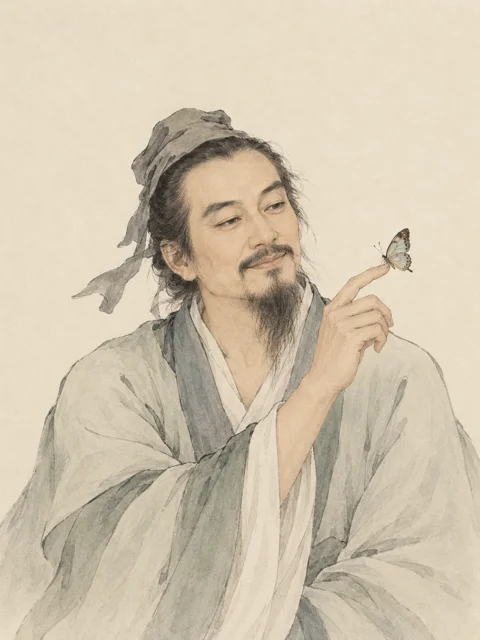
 AI 创作示意
GUANFU / en
庄子
AI 创作示意Chapter 18
版本按章对照,不代表逐句校勘对应。
中文原文(全三十三篇) / 庄子原典;维基文库贡献者整理
观复随文注释 · 46 条
天下有至樂至极而不依赖外物的快乐,无有哉?有可以活身保全生命者,无有哉?今奚爲奚據?奚避奚處?奚就奚去?奚樂奚惡?夫天下之所尊者,富、貴、壽、善也;所樂者,身安、厚味丰厚美味的食物、美服、好色、音聲也;所下者,貧、賤、夭、惡也;所苦者,身不得安逸,口不得厚味,形不得美服,目不得好色,耳不得音聲。若不得者,則大憂以懼,其爲形也亦愚哉!夫富者,苦身疾作,多積財而不得盡用,其爲形也亦外矣!夫貴者,夜以繼日,思慮善否,其爲形也亦疏矣!人之生也,與憂俱生,壽者惛惛,久憂,不死,何之苦也,其爲形也亦遠矣!列士有名望、有志节的士人爲天下見善矣,未足以活身,吾未知善之誠善邪?誠不善邪?若以爲善矣,不足活身;以爲不善矣,足以活人。故曰:「忠諫不聽,蹲循退让、逡巡不进勿爭。」故夫子胥伍子胥,春秋吴国大臣爭之,以殘其形;不爭,名亦不成。誠有善无有哉?今俗之所爲,與其所樂,吾又未知樂之果樂邪?果不樂邪?吾觀夫俗之所樂舉羣趣者,誙誙然争先趋赴的样子;誙读 kēng如將不得已,而皆曰樂者,吾未之樂也,亦未之不樂也。果有樂无有哉?吾以无爲不强求、不妄作誠樂矣,又俗之所大苦也。故曰:「至樂无樂,至譽无譽。」天下是非,果未可定也。雖然,无爲可以定是非。至樂活身,唯无爲幾存。請嘗試言之:天无爲以之清,地无爲以之寧,故兩无爲相合,萬物皆化。芒乎芴乎幽微恍惚、难以辨识,而无從出乎!芴乎芒乎,而无有象乎!萬物職職繁衍不息的样子,皆從无爲殖。故曰:「天地,无爲也,而无不爲也。」人也,孰能得无爲哉?
莊子妻死,惠子弔之,莊子則方箕踞两腿张开而坐,形如簸箕鼔一作「距鼓」盆而歌。惠子曰:「與人居,長子,老身,死,不哭亦足矣,又鼔一作「鼓」盆而歌,不亦甚乎?」莊子曰:「不然。是其始死也,我獨何能无概然感伤的样子?察其始,而本无生;非徒无生也,而本无形;非徒无形也,而本无氣古人认为构成生命、万物的元气。雜乎芒芴之間,變而有氣,氣變而有形,形變而有生,今又變而之死,是相與爲春秋年龄冬夏四時行也。人且偃然寢於巨室天地自然,喻死后所归,而我噭噭然大声哭泣;噭读 jiào隨而哭之,自以爲不通乎命,故止也。」
支離叔與滑介叔觀於冥伯之丘,崐崘之虛,黃帝之所休。俄而柳瘤,身体上的赘生物生其左肘,其意蹷蹷然惊动不安的样子惡之。支離叔曰:「子惡之乎?」滑介叔曰:「亡,予何惡?生者,假借也。假之而生,生者塵垢也,死生爲晝夜。且吾與子觀化观看、体会自然变化,而化及我,我又何惡焉?」
莊子之楚,見空髑髏骷髅头骨;读 dú lóu,髐然枯骨显露的样子;髐读 xiāo有形。撽敲击;读 qiào以馬捶马鞭,因而問之,曰:「夫子貪生失理而爲此乎?將子有亡國之事,斧鉞之誅,而爲此乎?將子有不善之行,愧遺父母妻子之醜,而爲此乎?將子有凍餒受冻挨饿之患,而爲此乎?將子之春秋故及此乎?」於是語卒,援髑髏,枕而臥。夜半,髑髏見夢曰:「子之談者,似辯士。諸子所言,皆生人之累也,死則无此矣。子欲聞死之說乎?」莊子曰:「然。」髑髏曰:「死,无君於上,无臣於下,亦无四時之事,從然以天地爲春秋,雖南面王樂,不能過也。」莊子不信,曰:「吾使司命传说中掌管生命的神復生子形,爲子骨肉肌一作「飢」膚,反子父母、妻子、閭里乡里、邻里、知識相识的人,子欲之乎?」髑髏深矉蹙頞皱起鼻梁,形容不悦,曰:「吾安能棄南面王樂,而復爲人間之勞乎?」
顏淵東之齊,孔子有憂色。子貢下席而問曰:「小子敢問:回東之齊,夫子有憂色,何邪?」孔子曰:「善哉汝一作「女」問!昔者管子有言,丘甚善之,曰:『褚盛物的布袋;读 zhǔ小者不可以懷大,綆汲水的井绳;读 gěng短者不可以汲深。』夫若是一作「然」者,以爲命有所成,而形有所適也,夫不可損益。吾恐回與齊侯言堯、舜、黃帝之道,而重以燧人、神農之言,彼將內求於己而不得,不得則惑,人惑則死。且汝一作「子」獨不聞邪?昔者海鳥止於魯郊,魯侯御而觴之于廟,奏九韶传说中舜的乐曲以爲樂,具太牢牛、羊、猪齐备的祭品以爲膳。鳥乃眩視憂悲,不敢食一臠小块肉;读 luán,不敢飲一杯,三日而死。此以己養養鳥也,非以鳥養養鳥也。夫以鳥養養鳥者,宜栖之深林,遊之壇陸高出水面的平地,浮之江湖,食之鰌䱔泥鳅、鲦鱼等小鱼,隨行列而止,委蛇而處。彼唯人言之惡聞,奚以夫譊譊喧闹的样子;读 náo爲乎?咸池、九韶之樂,張之洞庭之野,鳥聞之而飛,獸聞之而走,魚聞之而下入,人卒聞之,相與還而觀之。魚處水而生,人處水而死。彼必相與異,其好惡故異也,故先聖不一其能,不同其事。名止於實,義設於適,是之謂條達通畅而合乎条理而福持。」
列子行食於道,從見百歲髑髏,攓蓬拨开蓬草;攓通搴而指之,曰:「唯予與汝一作「女」,知而未嘗死,未嘗生也。汝一作「若」果養乎?予果歡乎?種有幾物种变化有其微妙机理,属古代观念,得水則爲㡭,得水土之際則爲鼃蠙之衣水边青苔一类生物的旧称,生於陵屯則爲陵舄植物旧名,具体对应尚有争议,陵舄得鬱棲則爲烏足,烏足之根爲蠐螬金龟子等昆虫的幼虫,其葉爲胡蝶。胡蝶,胥也,化而爲蟲,生於竈下,其狀若脫,其名爲鴝掇。鴝掇千日爲鳥,其名爲乾餘骨。乾餘骨之沫爲斯彌,斯彌爲食醯醋中的小虫;醯读 xī,頤輅生乎食醯。黃軦生乎九猷,瞀芮生乎腐蠸,羊奚比乎不箰不长笋;箰同笋久竹生青寧篇中古代物名,所指有争议,青寧生程,程生馬,馬生人,人又反入於機。萬物皆出於機万物出于变化之机,并非现代生物学说,皆入於機。」
观复随文注释 · AI 辅助独立整理,待持续人工校订。释义以本章语境为依据;存在异说或底本疑讹的地方另作提示。原文及版本来源保留如下。
原典公有领域;电子文本据维基文库贡献者,按 CC BY-SA 4.0 保留署名及相同方式共享;调整空白与排版。 · 查看原始版本
欢迎引用本站资源,分享道家与道教文化。引用时请注明出处“观复”,并附上所引用内容的原始页面链接,方便读者查阅。
观复白话释义(AI 辅助) / 观复 · AI 辅助独立整理
【观复白话释义|AI 辅助·未经人工学术审定】
天下究竟有没有最高的快乐?有没有能够保全生命的办法?如今应当做什么、依靠什么,躲避什么、安处哪里,接近什么、离开什么,以什么为乐、以什么为厌呢?天下人尊崇的是富有、尊贵、长寿和美好的名声,喜欢的是身体安逸、滋味丰厚、衣服华美、颜色悦目、音乐动听;轻视的是贫穷、卑贱、短命和恶名,感到痛苦的是身体不得安闲,嘴里吃不到美味,身上穿不到华服,眼睛看不到美色,耳朵听不到悦耳的声音。得不到这些,便深深忧愁恐惧,这样对待自己的身体,不也太愚昧了吗?富人劳苦身体,拼命做事,积聚许多财物却不能全都享用,这种养身的办法,不也偏向身外了吗?贵人日夜不停地考虑事情妥当不妥当,这种养身的办法,不也同身体本身疏远了吗?人生下来,忧患也随之而生。长寿的人昏昏沉沉,长久忧虑而不得死去,何等痛苦;这种养身的办法,不也离本意太远了吗?
有操守的士人被天下称善,却未必能保全自己。我不知道这所谓的善,究竟真是善,还不是善。如果说是善,它不足以保全自身;如果说不是善,它又足以保全别人。因此有人说:“忠诚劝谏而不被听从,就退让顺随,不要强争。”伍子胥坚持争谏,因而身体遭到残害;假如不争,他的名声也不会成就。究竟有没有确实不移的善呢?今天世俗所做的、所喜好的,我也不知道究竟真快乐,还是不快乐。我看世人所说的快乐,众人一齐奔赴,坚执不回,像不得不如此,却都说是快乐。我既没有认定那就是快乐,也没有认定那不是快乐。究竟有没有快乐呢?我认为无所强为才是真快乐,世俗却把这当作大苦事。所以说:“最高的快乐不执著于快乐,最高的赞誉不依赖赞誉。”天下的是非,确实不能轻易确定。虽然如此,无为可以使这些是非之争安定下来。要得到最高的快乐、保全自身,大概只有无为接近这一点。
试着这样说:天无所强为,因此清明;地无所强为,因此安宁。两种无为相互配合,万物就各自变化。恍惚幽微啊,找不出它从哪里发端;幽微恍惚啊,也见不到固定的形象。万物繁盛生长,都从无为中繁育。所以说:“天地无所强为,却没有什么不成就。”人之中,谁能够获得这样的无为呢?
庄子的妻子死了,惠子来吊唁,庄子正两腿伸开坐着,敲盆唱歌。惠子说:“她同你共同生活,为你养育孩子,陪着你衰老。如今死了,你不哭也就罢了,还敲盆唱歌,不太过分了吗?”庄子说:“不是那样。她刚死时,我怎么会不伤感呢?只是追察她的最初,本来没有生命;不但没有生命,本来还没有形体;不但没有形体,本来还没有气。她混同在恍惚幽微之中,经过变化有了气,气变化而有形体,形体变化而有生命,如今又变化而走向死亡。这就像春夏秋冬四季相互运行一样。她正安然睡在天地这间大屋里,我却跟在后面放声哭泣,我觉得这就是不通晓生命的变化,所以停止了。”
支离叔和滑介叔到冥伯之丘、昆仑的高地游观,那里是黄帝曾休息的地方。忽然,滑介叔左肘生了肿物,神情一时显出不安。支离叔问:“你厌恶它吗?”滑介叔说:“不,我有什么可厌恶的?生命是暂时借来的,借着各种条件而存在;有生命的形体,不过像聚集起来的尘垢。死与生就像夜与昼。况且我和你本就在观察变化,如今变化来到我身上,我又为什么厌恶它呢?”
庄子到楚国去,看见一个空骷髅,干枯而轮廓分明。他用马鞭敲了敲,接着问:“先生,你是贪生而失去做人的道理,才成了这样吗?还是遇到亡国的事,遭到斧钺诛杀,才成了这样?还是做了不好的事,羞愧于给父母妻儿留下耻辱,才成了这样?还是遭遇寒冷饥饿,才成了这样?还是年岁已尽,到了这个地步?”说完,他就拉过骷髅,枕着睡下。
半夜,骷髅出现在梦里,说:“你谈论起来,像个辩士。你说的那些,全是活人的拖累,死了就没有这些了。你想听听死亡的情形吗?”庄子说:“想。”骷髅说:“死后,上面没有君主,下面没有臣属,也没有四季必须从事的事务;自在放任,把天地的悠久当作自己的年岁,即使南面称王的快乐,也不能超过它。”庄子不信,说:“假如我请掌管生命的神恢复你的身体,重新给你骨肉肌肤,让你回到父母、妻儿、乡里和熟人中间,你愿意吗?”骷髅深深皱起眉头,蹙紧鼻梁,说:“我怎么肯放弃南面称王般的快乐,重新去承受人世的劳苦呢?”
颜渊向东去齐国,孔子面有忧色。子贡离开坐席,问:“学生冒昧请问,颜回向东去齐国,先生为什么忧虑?”孔子说:“你问得好!从前管子有句话,我十分赞同:‘袋子小,装不了大的东西;井绳短,打不到深处的水。’这就是说,人的禀赋有其一定的限度,形体也有适合它的条件,不能随意增减。我怕颜回对齐侯谈尧、舜、黄帝之道,又加上燧人、神农的言论。齐侯回头在自己心里寻求这些境界却得不到,得不到就会困惑;人一旦困惑恼乱,就可能使颜回遭到死祸。
“你难道没有听过吗?从前有一只海鸟停在鲁国郊外,鲁侯把它迎到宗庙,用酒招待,演奏《九韶》使它快乐,备下牛羊猪三牲给它作膳食。那鸟却看得眼花缭乱,忧愁悲伤,不敢吃一块肉,不敢喝一杯酒,三天就死了。这是按照养自己的办法养鸟,并不是按照养鸟的办法养鸟。照鸟本身的需要养它,就应让它栖息在深林,游走在沙洲陆地,浮游在江湖,吃泥鳅小鱼,随着鸟群停留,自由安适地生活。它连人的说话声都不喜欢听,何必还让它听那些喧闹的音乐呢?把《咸池》《九韶》的音乐奏在洞庭的旷野,鸟听了就飞走,兽听了就逃跑,鱼听了就潜入水底,人们听了却相互围拢观看。鱼在水里生存,人在水里却会淹死。彼此本来不同,喜好厌恶自然不同。所以,古代圣人不强求大家具有一样的才能,不强迫大家做一样的事情。名称应止于真实情况,行事准则应建立在适合的条件上,这就叫条理通达,福祉得以保持。”
列子在路边吃饭,随行时看见一个年代久远的骷髅,便拨开蓬草,指着它说:“只有我和你知道,从根本的变化来看,未曾真正死去,也未曾真正生出。你果真处于安养之中吗?我果真处于欢乐之中吗?物种自有微妙的变化开端:遇到水,成为一种水生细物;处在水土交接的地方,成为青蛙蚌类所附着的苔衣;生在高地土堆上,成为陵舄草。陵舄在郁积湿润的环境中,成为乌足草。乌足的根变成蛴螬,叶子变成蝴蝶。蝴蝶又有变化,成为生在灶下的虫,形状像脱去外壳的东西,名叫鸲掇。鸲掇经过一千天,变成名叫乾余骨的鸟。乾余骨的唾沫变成斯弥,斯弥变成食醯,颐辂从食醯中产生;黄軦从九猷中产生,瞀芮从腐蠸中产生;羊奚同不笋相结合,久生的竹子产生青宁,青宁产生程,程产生马,马产生人,人又返回变化的枢机。万物都从这一枢机中出来,又都回到这一枢机中。”
【篇末疑难注记】“列士”指以操守见称的人。“蹲循”按退让顺随处理。“柳生其左肘”的“柳”古注多解释为瘤,正文据此释义。“人惑则死”主语转换含蓄,正文按齐侯困惑而危及颜回理解,仍待校订。末段“㡭”“陵舄”“乌足”“鸲掇”“乾余骨”“斯弥”“食醯”“颐辂”“黄軦”“九猷”“瞀芮”“腐蠸”“羊奚”“不箰”“青宁”“程”等多为古代物名,部分所指和句读不明;正文保留完整转化序列,不把它改写成现代生物学。“胡蝶,胥也”及“羊奚比乎不箰久竹生青宁”尤其难定,采用暂行断读。“几”“机”按变化的微始或枢机理解。骷髅、物种变生等内容均保留为篇中寓言及古人的说法。
观复白话释义:AI 辅助依据古文独立编写,已进行文本覆盖核对,未经人工学术审定;原典来源及电子底本署名、许可见对应中文版本。 · 查看原始版本
Herbert A. Giles 英译(全三十三篇) / Herbert A. Giles(翟理斯),1889
Perfect Happiness.
[Translator’s note] Argument :—The uncertainty of human happiness—What the world aims at is physical well-being—This is not profitable even to the body—In inaction alone is true happiness to be found—Inaction the rule of the material universe—Acquiescence in whatever our destiny may bring forth—Illustrations.
[This chapter is supplementary to chapter vi.]
Is perfect happiness to be found on earth, or not? Are there those who can enjoy life, or not? If so, what do they do, what do they affect, what do they avoid, what do they rest in, accept, reject, like, and dislike?
What the world esteems comprises wealth, rank, old age, and goodness of heart. What it enjoys comprises comfort, rich food, fine clothes, beauty, and music. What it does not esteem comprises poverty, want of position, early death, and evil behaviour. What it does not enjoy comprises lack of comfort for the body, lack of rich food for the palate, lack of fine clothes for the back, lack of beauty for the eye, and lack of music for the ear. If men do not get these, they are greatly miserable. Yet from the point of view of our physical frame, this is folly.
[Translator’s note] Physically we can, and most of us do, get along very well without these extras.
Wealthy people who toil and moil, putting together more money than they can possibly use,—from the point of view of our physical frame, is not this going beyond the mark?
Officials of rank who turn night into day in their endeavours to compass the best ends;—from the point of view of our physical frame, is not this a divergence?
Man is born to sorrow, and what misery is theirs whose old age with dulled faculties only means prolonged sorrow! From the point of view of our physical frame, this is going far astray.
Patriots are in the world's opinion admittedly good. Yet their goodness does not enable them to enjoy life;
[Translator’s note] Patriotism has been illustrated in China by countless heroic deeds, associated always with the death of the hero concerned.
and so I know not whether theirs is veritable goodness or not. If the former, it does not enable them to enjoy life; if the latter, it at any rate enables them to cause others to enjoy theirs.
It has been said, "If your loyal counsels are not attended to, depart quietly without resistance." Thus, when Tzŭ Hsü
[Translator’s note] The famous Wu Yüan, 6th century B.C., whose opposition to his sovereign led to his own disgrace and death.
resisted, his physical frame perished; yet had he not resisted, he would not have made his name. Is there then really such a thing as this goodness, or not?
As to what the world does and the way in which people are happy now, I know not whether such happiness be real happiness or not. The happiness of ordinary persons seems to me to consist in slavishly following the majority, as if they could not help it. Yet they all say they are happy.
[Translator’s note] "The general average of mankind are not only moderate in intellect, but also in inclinations: they have no tastes or wishes strong enough to incline them to do anything unusual." Mill's Essay on Liberty .
But I cannot say that this is happiness or that it is not happiness. Is there then, after all, such a thing as happiness?
I make true pleasure to consist in inaction , which the world regards as great pain. Thus it has been said, "Perfect happiness is the absence of happiness;
[Translator’s note] The non-existence of any state or condition necessarily includes the non-existence of its correlate. If we do not have happiness, we are at once exempt from misery; and such a negative state is a state of "perfect happiness."
perfect renown is the absence of renown."
Now in this sublunary world of ours it is impossible to assign positive and negative absolutely. Nevertheless, in inaction they can be so assigned. Perfect happiness and preservation of life are to be sought for only in inaction.
Let us consider. Heaven does nothing; yet it is clear. Earth does nothing; yet it enjoys repose. From the inaction of these two proceed all the modifications of things. How vast, how infinite is inaction, yet without source! How infinite, how vast, yet without form!
The endless varieties of things around us all spring from inaction. Therefore it has been said, "Heaven and earth do nothing, yet there is nothing which they do not accomplish." But among men, who can attain to inaction?
[Translator’s note] Lin Hsi Chung condemns the whole of the above exordium as too closely reasoned for Chuang Tzŭ, with his rugged, elliptical style.
When Chuang Tzŭ's wife died, Hui Tzŭ went to condole. He found the widower sitting on the ground, singing, with his legs spread out at a right angle, and beating time on a bowl.
"To live with your wife," exclaimed Hui Tzŭ, "and see your eldest son grow up to be a man, and then not to shed a tear over her corpse,—this would be bad enough. But to drum on a bowl, and sing; surely this is going too far."
"Not at all," replied Chuang Tzŭ. "When she died, I could not help being affected by her death. Soon, however, I remembered that she had already existed in a previous state before birth, without form, or even substance; that while in that unconditioned condition, substance was added to spirit; that this substance then assumed form; and that the next stage was birth. And now, by virtue of a further change, she is dead, passing from one phase to another like the sequence of spring, summer, autumn, and winter. And while she is thus lying asleep in Eternity, for me to go about weeping and wailing would be to proclaim myself ignorant of these natural laws. Therefore I refrain."
A hunchback and a one-legged man were looking at the tombs of departed heroes, on the K'un-lun Mountains, where the Yellow Emperor rests. Suddenly, ulcers broke out upon their left elbows, of a very loathsome description.
"Do you loathe this?" asked the hunchback.
"Not I," replied the other, "why should I? Life is a loan with which the borrower does but add more dust and dirt to the sum total of existence. Life and death are as day and night; and while you and I stand gazing at the evidences of mortality around us, if the same mortality overtakes me, why should I loathe it?"
Chuang Tzŭ one day saw an empty skull, bleached, but still preserving its shape. Striking it with his riding whip, he said, "Wert thou once some ambitious citizen whose inordinate yearnings brought him to this pass?—some statesman who plunged his country in ruin and perished in the fray?—some wretch who left behind him a legacy of shame?—some beggar who died in the pangs of hunger and cold? Or didst thou reach this state by the natural course of old age?"
When he had finished speaking, he took the skull, and placing it under his head as a pillow, went to sleep. In the night, he dreamt that the skull appeared to him and said, "You speak well, Sir; but all you say has reference to the life of mortals, and to mortal troubles. In death there are none of these. Would you like to hear about death?"
Chuang Tzŭ having replied in the affirmative, the skull began:—"In death, there is no sovereign above, and no subject below. The workings of the four seasons are unknown. Our existences are bounded only by eternity. The happiness of a king among men cannot exceed that which we enjoy."
Chuang Tzŭ, however, was not convinced, and said, "Were I to prevail upon God to allow your body to be born again, and your bones and flesh to be renewed, so that you could return to your parents, to your wife, and to the friends of your youth,—would you be willing?"
At this, the skull opened its eyes wide and knitted its brows and said, "How should I cast aside happiness greater than that of a king, and mingle once again in the toils and troubles of mortality?"
[Translator’s note] Reminding us strangely of Hamlet .
When Yen Yüan
[Translator’s note] See p. 179 .
went eastwards to the Ch'i State, Confucius was sad. Tzŭ Kung arose and said, "Is it, Sir, because Hui
[Translator’s note] Yen Yüan's personal name.
has gone east to Ch'i that you are sad?"
"A good question," replied Confucius. "There is a saying by Kuan Chung
[Translator’s note] Prime Minister to Duke Huan of the Ch'i State, 7th century B.C.
of old which I highly esteem: 'Small bags won't hold big things; short ropes won't reach down deep wells.' Thus, destiny is a pre-arrangement, just as form has its limitations. From neither, to neither, can you either take away or add. And I fear lest Hui, on his visit to the prince of Ch'i, should preach the Tao of Yao and Shun, and dwell on the words of Sui Jen and Shên Nung. The prince will then search within himself, but will not find. And not finding, he will doubt. And when a man doubts, he will kill.
[Translator’s note] Lit. "he will die." But the verb "to die" is often used in the sense of "to make to die;" and this seems to be the only available sense here.
"Besides, have you not heard that of old when a sea-bird alighted outside the capital of Lu, the prince went out to receive it, and gave it wine in the temple, and had the Chiu Shao
[Translator’s note] Music composed by the legendary Emperor Shun.
played to amuse it, and a bullock slaughtered to feed it? But the bird was dazed and too timid to eat or drink anything; and in three days it was dead. This was treating the bird like oneself, and not as a bird would treat a bird. Had he treated it as a bird would have treated a bird, he would have put it to roost in a deep forest, to wander over a plain, to swim in a river or lake, to feed upon fish, to fly in order, and to settle leisurely. When the bird was already terrified at human voices, fancy adding music! Play the Hsien Ch'ih
[Translator’s note] Music of the Yellow Emperor.
or the Chiu Shao in the wilds of Tung-t'ing, and birds will fly away, beasts will take themselves off, and fishes will dive down below. But men will collect to hear.
[Translator’s note] See p. 244 .
"Water, which is life to fishes, is death to man. Being differently constituted, their likes and dislikes are different. Therefore the Sages of the past favoured not uniformity of skill or of occupation. Reputation was commensurate with reality; means were adapted to the end. This was called a due relationship with others coupled with advantage to oneself."
[Translator’s note] Several sentences of the above are clearly in imitation of parts of ch. ii . The whole episode is beyond doubt a forgery.
Lieh Tzŭ, being on a journey, was eating by the roadside, when he saw an old skull. Plucking a blade of grass, he pointed at it and said, "Only you and I know that there is no such thing as life and no such thing as death.
[Translator’s note] Lit. "that you have never died nor lived."
Are you really at peace? Or am I really happy?
[Translator’s note] Who can say whether what we call death may not after all be life, and life death?
"Certain germs, falling upon water, become duckweed. When they reach the junction of the land and the water, they become lichen. Spreading up the bank, they become the dog-tooth violet. Reaching rich soil, they become wu-tsu , the root of which becomes grubs, while the leaves comes from butterflies, or hsü . These are changed into insects, born in the chimney corner, which look like skeletons. Their name is ch'ü-to . After a thousand days, the ch'ü-to becomes a bird, called Kan-yü-ku , the spittle of which becomes the ssŭ-mi . The ssŭ-mi becomes a wine fly, and that comes from an i-lu . The huang-k'uang produces the chiu-yu and the mou-jui produces the glow-worm. The yang-ch'i grafted to an old bamboo which has for a long time put forth no shoots, produces the ch'ing-ning , which produces the leopard, which produces the horse, which produces man.
"Then man goes back into the great Scheme, from which all things come and to which all things return."
[Translator’s note] Such is the eternal round, marked by the stages which we call life and death.
[Translator’s note] Many of the names in the above paragraph have not been identified even by Chinese commentators. On all counts then they may safely be left where they are.
原著及 Herbert A. Giles 历史译本公有领域;据 Project Gutenberg #59709,完整电子书及使用条款见本站资料来源。 · 查看原始版本
我的书签(此浏览器)
还没有书签。