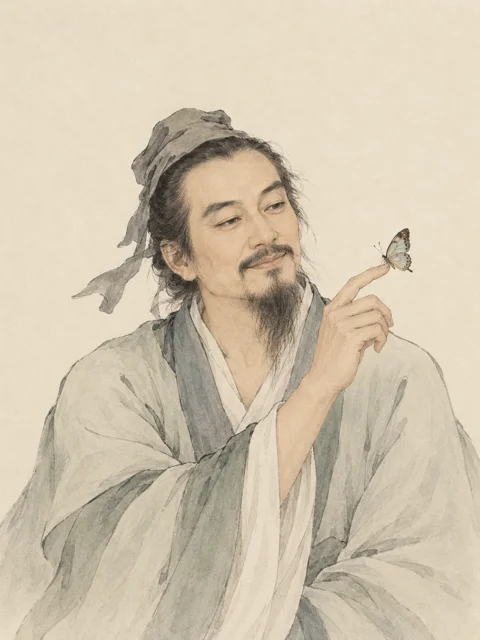
 AI 创作示意
GUANFU / en
庄子
AI 创作示意Chapter 29
版本按章对照,不代表逐句校勘对应。
中文原文(全三十三篇) / 庄子原典;维基文库贡献者整理
观复随文注释 · 72 条
孔子與柳下季柳下惠,鲁国贤者展禽爲友,柳下季之弟名曰盜跖传说中的大盗;本篇为寓言性叙事。盜跖從卒跟从的兵卒九千人,橫行天下,侵暴諸侯,穴室樞戶穿墙、拆门而入,驅人牛馬,取人婦女,貪得忘親,不顧父母兄弟,不祭一作「祀」先祖,所過之邑一作「處」,大國守城,小國入保进入堡垒防守,萬民苦之。孔子謂柳下季曰:「夫爲人父者必能詔告诫、教导其子,爲人兄者必能教其弟。若父不能詔其子,兄不能教其弟,則无貴父子兄弟之親矣。今先生,世之才士也,弟爲盜跖,爲天下害,而弗能教也,丘竊爲先生羞之。丘請爲先生往說之。」柳下季曰:「先生言:『爲人父者必能詔其子,爲人兄者必能教其弟。』若子不聽父之詔,弟不受兄之教,雖今先生之辯,將奈一作「柰」之何哉?且跖之爲人也,心如涌泉,意如飄風,强足以距一作「拒」敵,辯足以飾非掩饰过错,順其心則喜,逆其心則怒,易辱人以言。先生必无往。」孔子不聽,顏回爲馭,子貢爲右做车右,负责护卫,往見盜跖。
盜跖乃方休卒徒太山之陽泰山南面;山南称阳,膾切细的生肉;读 kuài人肝而餔吃食;读 bū之。孔子下車而前,見謁者通报接见的侍者曰:「魯人孔丘,聞將軍高義,敬再拜謁者。」謁者入通。盜跖聞之,大怒,目如明星,髮上指冠,曰:「此夫魯國之巧僞人孔丘,非邪?爲我告之:『爾作言造語,妄稱文、武,冠枝木之冠枝木装饰的冠,篇中用来讥刺儒服,帶死牛之脅死牛皮制的带子,多辭繆一作「謬」說,不耕而食,不織而衣,搖脣鼔一作「鼓」舌,擅生是非,以迷天下之主,使天下學士不反其本,妄作孝悌,而儌倖於封侯富貴者也。子之罪大極重,疾走歸!不然,我將以子肝益晝餔之膳。』」孔子復通曰:「丘得幸於季,願望履幕下到帐下拜见的谦辞。」謁者復通。盜跖曰:「使來前!」孔子趨而進,避席反走,再拜盜跖。盜跖大怒,兩展其足,案劒瞋目,聲如乳虎哺育幼崽的母虎,曰:「丘來前!若所言,順吾意則生,逆吾心則死!」
孔子曰:「丘聞之:凡天下有三德:生而長大,美好无雙,少長貴賤見而皆悅之,此上德也。知維天地,(能)辯彫萬一作「諸」物,此中德也。勇悍果敢,聚衆率兵,此下德也。凡人有此一德者,足以南面稱孤居君位,以孤自称矣。今將軍兼此三者,身長八尺二寸,面目有光,脣如激丹鲜明的朱红色,齒如齊貝排列齐整的贝壳,喻牙齿,音中黃鍾古代十二律之一,而名曰盜跖。丘竊爲將軍恥,不取焉。將軍有意聽臣,臣請南使吳、越,北使齊、魯,東使宋、衞,西使晉、楚,使爲將軍造大城數百里,立數十萬戶之邑,尊將軍爲諸侯,與天下更始重新开始,罷兵休卒,收養昆弟,共祭先祖。此聖人才士之行,而天下之願也。」
盜跖大怒曰:「丘來前!夫可規以利而可諫以言者,皆愚陋恆民之謂耳!今長大美好,人見而悅之者,此吾父母之遺德也。丘雖不吾譽,吾獨不自知邪?且吾聞之:『好面譽人者,亦好背而毀之。』今丘告我以大城衆民,是欲規我以利用利益诱导、约束我,而恆民畜我也,安可長久一作「久長」也?城之大者,莫大乎天下矣。堯、舜有天下,子孫无置錐之地。湯、武立爲天子,而後世絕滅。非以其利大故邪?且吾聞之,古者禽獸多而人民少,於是民悉一作「皆」巢木上一作「居」以避之,晝(日)拾杼一作「橡」栗,(而)暮宿其一作「栖木」上,故命之曰『有巢氏传说教民构巢居住的上古人物之民』。古者民不知衣服,夏多積薪,冬則煬之烤火取暖;煬读 yáng,故命(之)曰『知生之民』。神農之世,臥則居居安处不动的样子,起則于于舒缓自得的样子,民知其母,不知其父,與麋鹿共處,耕而食,織而衣,无有相害之心,此至德之隆也。然而黃帝不能致德,與蚩尤传说中与黄帝交战的首领戰於涿鹿古代地名;涿读 zhuō之野,流血百里。堯、舜作,立羣臣,湯放其主,武王殺紂,自是之後,以强陵弱,以衆暴寡。湯、武以來,皆亂人之徒也。今子,脩文、武之道,掌天下之辯,以教後世,縫衣淺帶,矯言僞行,以迷惑天下之主,而欲求富貴焉。盜莫大於子,天下何故不謂子爲盜丘,而乃謂我爲盜跖?子以甘辭說子路而使從之,使子路去其危冠高高的帽子,解其長劒,而受教於子,天下皆曰:『孔丘能止暴禁非。』其卒之也,子路欲殺衞君而事不成,身菹剁成肉酱;读 zū於衞東門之上,是子教之不至也。子自謂才士聖人邪?則再逐於魯,削迹於衞,窮於齊,圍於陳、蔡,不容身於天下。子教子路菹。此患,上无以爲身,下无以爲人。子之道,豈足貴邪?世之所高,莫若黃帝。黃帝尚不能全德,而戰涿鹿之野,流血百里。堯不慈,舜不孝,禹偏枯半身瘫弱,湯放其主,武王伐紂,文王拘羑里传说商纣囚文王之地;羑读 yǒu。此六子者,世之所高也,孰論之,皆以利惑其眞,而强反其情性,其行乃甚可羞也!世之所謂賢士,伯夷、叔齊。伯夷、叔齊辭孤竹之君,而餓死於首陽之山,骨肉不葬。鮑焦传说中守节的隐者,飾行非世,抱木而死;申徒狄,諫而不聽,負石自投於河,爲魚鼈所食;介子推春秋晋国隐士,文中采用传说,至忠也,自割其股,以食文公,文公後背之,子推怒而去,抱木而燔死;尾生传说守约抱柱而死的人,與女子期於梁下,女子不來,水至不去,抱梁柱而死。此四子者,无異於磔犬祭祀中肢解的狗;磔读 zhé流豕沉水祭祀的猪、操瓢而乞者,皆離名追逐、依附名声;离通罹等说法不一輕死,不念本養壽命者也。世之所謂忠臣者,莫若王子比干、伍子胥。子胥沈一作「沉」江,比干剖心。此二子者,世謂忠臣也,然卒爲天下笑。自上觀之,至于子胥、比干,皆不足貴也。丘之所以說我者:若告我以鬼事,則我不能知也;若告我以人事者,不過此矣,皆吾所聞知也。今吾告子以人之情:目欲視色,耳欲聽聲,口欲察味,志氣欲盈。人上壽百歲,中壽八十,下壽六十,除病瘦死喪憂患,其中開口而笑者,一月之中,不過四五日而已矣。天與地无窮,人死者有時。操有時之具,而託於无窮之間,忽然无異騏驥骏马之馳過隙也。不能悅其志意,養其壽命者,皆非通道者也。丘之所言,皆吾之所棄也。亟去赶快离开;亟读 jí,走歸,无復言之!子之道,狂狂伋伋忙乱奔竞的样子一作「汲汲」,詐巧虛僞事也,非可以全眞也,奚足論哉?」
孔子再拜,趨走出門,上車,執轡缰绳;读 pèi三失,目芒然无見,色若死灰,據軾靠着车前横木低頭,不能出氣。歸到魯東門外,適遇柳下季。柳下季曰:「今者闕然數日不見,車馬有行色,得微往見跖邪?」孔子仰天而歎,曰:「然。」柳下季曰:「跖得无逆汝一作「女」意若前乎?」孔子曰:「然。丘所謂无病而自灸也。疾走,料虎頭捋摸老虎的头;料有异解,編虎須,幾不免虎口哉!」
子張孔子弟子,字子张問於滿苟得寓言人物,名寓苟求所得曰:「盍不爲行?无行則不信,不信則不任,不任則不利。故觀之名,計之利,而義眞是也。若棄名利,反之於心,則夫士之爲行,不可一日不爲乎?」滿苟得曰:「无恥者富,多信者顯。夫名利之大者,幾在无恥而信。故觀之名,計之利,而信眞是也。若棄名利,反之於心,則夫士之爲行,抱其天乎!」
子張曰:「昔者桀、紂貴爲天子,富有天下;今謂臧聚古注释作奴隶一类卑贱者曰『汝一作「女」行如桀、紂』,則有怍色惭愧的神色,有不服之心者,小人所賤也。仲尼、墨翟,窮爲匹夫;今謂宰相曰『子一作「今」行如仲尼、墨翟』,則變容易色,稱不足者,士誠貴也。故勢爲天子,未必貴也;窮爲匹夫,未必賤也。貴賤之分,在行之美惡。」滿苟得曰:「小盜者拘,大盜者爲諸侯。諸侯之門,義士存焉。昔者桓公小白,殺兄入嫂,而管仲爲臣;田成子常齐国田常,谥成子,殺君竊國,而孔子受幣。論則賤之,行則下之,則是言行之情,悖戰相反而冲突於胷中也,不亦拂乎?故書曰:『孰惡孰美?成者爲首,不成者爲尾。』」
子張曰:「子不爲行,卽將疏戚无倫,貴賤无義,長幼无序,五紀六位古代人伦尊卑关系的统称將何以爲別乎?」滿苟得曰:「堯殺長子,舜流母弟,疏戚有倫乎?湯放桀,武王殺紂,貴賤有義乎?王季爲適嫡子、正统继承者;读 dí,周公殺兄,長幼有序乎?儒者僞辭,墨者兼愛,五紀六位將有別乎?且子正爲名,我正爲利。名利之實,不順於理,不監於道。吾日與子訟於无約寓言中裁决争论的人物名,曰:『小人殉財,君子殉名。其所以變其情,易其性,則異矣;乃至於棄其所爲,而殉其所不爲,則一也。』故曰:无爲小人,反殉而天;无爲君子,從天之理。若枉若直,相而天極。面觀四方,與時消息。若是若非,執而圓機圆转无滞的枢机。獨成而意,與道徘徊一作「俳佪」。无轉而行,无成而義,將失而所爲。无赴而富,无殉而成,將棄而天。比干剖心,子胥抉眼,忠之禍也。直躬證父直躬告发父亲偷羊的故事,尾生溺死,信之患也。鮑子立乾,申子不自理,廉之害也。孔子不見母,匡子不見父,義之失也。此上世之所傳,下世之所語,以爲士者,正其言,必其行,故服其殃,離其患也。」
无足寓言人物,名寓不知满足問於知和寓言人物,名寓通晓和适曰:「人卒未有不興名就利者。彼富則人歸之,歸則下之,下則貴之。夫見下貴者,所以長生安體樂意之道也。今子獨无意焉,知不足邪?意知而力不能行邪?故推正不忘邪?」知和曰:「今夫此人,以爲與己同時而生、同鄉而處者,以爲夫絕俗過世之士焉,是專无主正,所以覽古今之時,是非之分也,與俗化世,去至重,棄至尊,以爲其所爲也。此其所以論長生安體樂意之道,不亦遠乎?慘怛忧伤痛苦之疾,恬愉之安,不監於體;怵惕恐惧戒备之恐,欣懽之喜,不監於心;知爲爲而不知所以爲,是以貴爲天子,富有天下,而不免於患也。」
无足曰:「夫富之於人,无所不利。窮美究勢,至人之所不得逮,賢人之所不能及,俠人之勇力挟持、借助别人的勇力而以爲威强,秉借助、掌握人之知謀以爲明察,因人之德以爲賢良,非享國而嚴若君父。且夫聲色滋味權勢之於人,心不待學而樂之,體不待象而安之。夫欲惡避就,固不待師,此人之性(也)。天下雖非我,孰能辭之?」知和曰:「知者之爲故,動以百姓,不違其度,是以足而不爭。无以爲,故不求。不足,故求之,爭四處而不自以爲貪;有餘,故辭之,棄天下而不自以爲廉。廉貪之實,非以迫外也,反監之度,勢爲天子而不以貴驕人,富有天下而不以財戲人,計其患,慮其反,以爲害於性,故辭而不受也,非以要名譽也。堯、舜爲帝而雍和乐,非仁天下也,不以美害生也。善卷、許由得帝而不受,非虛辭讓也,不以事害己。此皆就其利,辭其害,而天下稱賢焉,則可以有之,彼非以興名譽也。」
无足曰:「必持其名,苦體絕甘,約養节制生活供养以持生,則亦久病長阨而不死者也。」知和曰:「平爲福,有餘爲害者,物莫不然,而財其甚者也。今富人,耳營鍾鼓管籥古代管乐器之聲,口嗛於芻豢草食和谷饲的牲畜,泛指肉食醪醴浊酒与甜酒;读 láo lǐ之味,以感其意,遺忘其業,可謂亂矣。侅溺沉溺壅塞的样子於馮氣盛气、自满之气,若負重,行而上也,可謂苦矣。貪財而取慰,貪權而取竭,靜居則溺,體澤則馮,可謂疾矣。爲欲富就利,故滿若堵耳而不知避,且馮而不舍,可謂辱矣。財積而无一作「不」用,服膺牢牢记在心中而不舍,滿心戚醮忧惧不安;醮读 jiào,求益而不止,可謂憂矣。內則疑劫一作「刦」請之賊,外則畏寇盜之害,內周樓疏楼阁、透窗,指防备设施,外不敢獨行,可謂畏矣。此六者,天下之至害也,皆遺忘而不知察。及其患至,求盡性竭財,單以反一日之无故,而不可得也。故觀之名則不見,求之利則不得,繚意使心意纠缠(絕)體而爭此,不亦惑乎?」
观复随文注释 · AI 辅助独立整理,待持续人工校订。释义以本章语境为依据;存在异说或底本疑讹的地方另作提示。原文及版本来源保留如下。
参考: 本站所收原典:杂篇 · 盜跖 ↗
原典公有领域;电子文本据维基文库贡献者,按 CC BY-SA 4.0 保留署名及相同方式共享;调整空白与排版。 · 查看原始版本
欢迎引用本站资源,分享道家与道教文化。引用时请注明出处“观复”,并附上所引用内容的原始页面链接,方便读者查阅。
观复白话释义(AI 辅助) / 观复 · AI 辅助独立整理
【观复白话释义|AI 辅助·未经人工学术审定】
孔子与柳下季是朋友。柳下季的弟弟名叫盗跖,有九千名徒众跟随,横行天下,侵犯欺凌诸侯,挖穿屋墙,撬开门户,抢走牛马,掳取妇女;贪图所得,忘掉亲情,不顾父母兄弟,也不祭祀祖先。他所到之处,大国闭城防守,小国进入堡垒躲避,百姓深受其苦。
孔子对柳下季说:“做父亲的,应当能训导儿子;做兄长的,应当能教导弟弟。父亲不能训导儿子,兄长不能教导弟弟,父子兄弟的亲情还有什么值得看重的呢?先生是当世有才能的人,弟弟却成了盗跖,危害天下,您又不能教导他,我私下替先生惭愧。请让我替先生去劝说他。”柳下季说:“先生说父亲必须能训导儿子,兄长必须能教导弟弟,可儿子若不听父亲的训导,弟弟不接受兄长的教诲,即使有先生这样的口才,又能怎么办?况且跖这个人,心思像涌泉,意念像疾风,强悍足以抵挡敌人,善辩足以掩饰过错;顺他的心,他就欢喜,逆他的意,他就发怒,动不动就用言语侮辱人。先生千万别去。”孔子不听,让颜回驾车,子贡陪乘在右,前去见盗跖。
盗跖正在泰山南面让部下休息,自己把人的肝切细了吃。孔子下车上前,对通报的人说:“鲁国人孔丘,听说将军道义高尚,谨向通报者再拜,求见将军。”通报者进去传话。盗跖听了大怒,两眼如亮星,头发直竖冲冠,说:“这不就是鲁国那个巧诈虚伪的孔丘吗?替我告诉他:‘你编造言辞,妄称文王、武王,戴着枝木做的冠,腰间束着死牛皮带,满口繁琐歪理,不耕田却吃饭,不织布却穿衣,摇唇鼓舌,擅自制造是非,迷惑天下君主,使天下求学的人不肯回到根本,假作孝悌,侥幸谋求封侯富贵。你的罪极大极重,快滚回去!不然,我就把你的肝添到午饭里。’”
孔子再请通报:“我有幸与令兄季交好,愿到将军帐下拜见。”通报者又进去传话。盗跖说:“叫他上前!”孔子小步快进,避开坐席,退后再拜。盗跖怒气未消,伸开双脚,按着剑,瞪着眼,声音像护崽的母虎:“丘,过来!你说的话顺我的意,就让你活;逆我的心,就让你死!”
孔子说:“我听说天下有三种出众的禀赋:生得高大,容貌无双,长幼贵贱见了都喜爱,这是上等;智慧能贯通天地,辩才能辨明万物,这是中等;勇猛果敢,能聚集众人,率领军队,这是下等。一个人有其中一项,就足以面南称君。如今将军兼有三者,身高八尺二寸,面容光彩照人,嘴唇像鲜明的朱砂,牙齿像排列整齐的贝壳,声音合于黄钟之律,却被叫作盗跖,我私下替将军觉得羞辱,不愿认可这个称呼。将军若愿听我的话,我愿南往吴、越,北往齐、鲁,东往宋、卫,西往晋、楚,请他们给将军建立幅员数百里的大城、容纳数十万户的都邑,尊将军为诸侯,与天下重新开始。然后解散军队,让士卒休息,收聚奉养兄弟,同祭祖先。这是圣人与才士的行为,也是天下人的愿望。”
盗跖大怒,说:“丘,过来!可以用利益来诱导、用言辞来劝服的,不过是愚陋的普通人。你说我身材高大、容貌美好,别人见了欢喜,这都是父母留给我的禀赋。即使你不夸我,难道我自己不知道?我还听说,喜欢当面赞人的,也喜欢背后毁人。你拿大城和众多人民来告诉我,是想用利益诱导我,把我当普通人来摆布,这怎么能长久?城域再大,也没有比天下更大的。尧、舜有天下,子孙却没有立锥之地;汤、武做了天子,后代却终于绝灭。难道不是因为利益太大吗?
“而且我听说,古时禽兽多,人口少,人们在树上搭巢躲避禽兽,白天拾橡实、栗子,晚上住在树上,所以叫‘有巢氏之民’。古人不知道穿衣,夏天多积柴草,冬天用来烤火,所以叫‘知生之民’。神农时代,人们睡卧安稳,起身舒缓,只知母亲,不知父亲,与麋鹿共同生活,耕田得食,织布得衣,没有互相伤害的心,这是至德最兴盛的时候。可是黄帝不能保持这样的德,与蚩尤在涿鹿原野作战,血流百里。尧、舜兴起,设置群臣;汤流放自己的君主,武王杀纣。从此以后,强者欺凌弱者,人多的残害人少的。从汤、武以来,这些人都是扰乱天下的一类。
“如今你修习文王、武王的道路,把持天下的言论,用来教后世,穿着宽大的衣服,束着狭窄的带子,言语造作,行为虚伪,迷惑天下君主,借此追求富贵。盗贼没有比你更大的,天下为什么不叫你盗丘,反而叫我盗跖?你用甜言蜜语说服子路跟从你,让他丢开高冠,解下长剑,接受你的教导,天下都说孔丘能止暴禁非。结果,照我所说,子路想杀卫君而没有成功,身体在卫国东门被剁碎。这就是你教得不到家的结果。你自称才士圣人吗?你两次被鲁国驱逐,在卫国被禁绝行迹,在齐国受困,被围于陈、蔡,天下没有容身之处。你又把子路教得遭到碎身之祸。这样的祸患,往上不能保全自身,往下不能保全他人,你的道有什么值得尊贵?
“世人最推崇的,没有超过黄帝的。黄帝尚且不能保全德性,在涿鹿作战,血流百里。在我的判断中,尧不慈,舜不孝,禹劳作得肢体偏枯,汤流放君主,武王攻伐纣,文王被囚羑里。这六个人是世人所尊崇的,可仔细论说,都是被利益迷惑了本真,强行违背自己的情性,行为很可羞!
“世人称为贤士的,有伯夷、叔齐。他们辞去孤竹国的君位,在首阳山饿死,尸骨没有得到安葬。鲍焦修饰品行,非议世道,抱树而死;申徒狄进谏不被听从,背着石头投河,成为鱼鳖的食物;介子推被说成极忠,割下腿肉给文公吃,文公后来背弃他,他愤怒离去,抱树烧死;尾生和女子约在桥下相会,女子没来,河水涨了也不走,抱着桥柱淹死。这后面四个人,在我看来,与祭祀中被割裂的狗、被投入水中的猪,以及拿瓢讨食的乞人没有两样,都是被名声缠住,轻视死亡,不顾养护寿命这个根本的人。
“世人说到忠臣,没有比王子比干、伍子胥更受推崇的。子胥被沉江,比干被剖心。世人说他们是忠臣,他们最终却成了天下的笑谈。从前面那些人直到子胥、比干,依我看来,都没有什么值得崇贵。你来劝我,若讲鬼神的事情,我不能知晓;若讲人间的事情,也超不出这些,都是我已经听说、知道的。
“现在我把人的实情告诉你:眼睛想看美色,耳朵想听乐声,嘴想辨尝美味,心意想得到满足。人活得长的有一百岁,中等的八十,短的六十;去掉疾病、衰弱、死亡、丧事和忧患,一个月里真正能开口笑的,不过四五天。天地无穷,人的生命却有尽期。拿有尽期的身体,寄托在无穷的天地之间,一晃就像骏马驰过缝隙。不能使心意舒畅、养护寿命的人,都算不得通道。你说的,都是我抛弃的东西。赶快走,回去,别再说了!你的道忙乱急迫,尽是诈巧虚伪的事情,不能保全本真,有什么值得谈?”
孔子再次拜礼,急步出门,上车抓缰绳,接连三次脱手;眼神茫然,什么也看不清,面如死灰,靠着车前横木低头,连气都喘不出。回到鲁国东门外,恰好碰见柳下季。柳下季说:“这几天没见,您的车马有远行的样子,莫非去见跖了?”孔子仰天叹道:“是。”柳下季说:“跖是不是像我先前说的那样,顶撞了您?”孔子说:“是。我这叫没有病却自己去受艾灸。我急跑过去,摸老虎脑袋,编老虎胡须,差点没逃出虎口!”
子张问满苟得:“您为什么不修品行?没有品行就不被信任,不被信任就不受任用,不受任用就得不到利益。所以,论名声,算利益,道义确实都合算。即使丢开名利,回到内心来看,士人修行也没有一天可以停止吧?”满苟得说:“不知羞耻的人能够致富,多能取信于人的人能够显达。重大的名利,差不多都在厚颜无耻而又能使人相信这上面。所以,论名声,算利益,让人信服才真是关键。若丢开名利,回到内心,士人的行为只须保全自己的天性吧!”
子张说:“从前桀、纣贵为天子,富有天下;如今你对一个奴仆说‘你的行为像桀、纣’,他也会羞惭,不服气,可见连小人也鄙视他们。仲尼、墨翟困穷,只是平民;如今你对宰相说‘您的行为像仲尼、墨翟’,他就会改变脸色,谦称比不上,可见他们确实被士人尊重。因此,势位到了天子,未必尊贵;穷到只是平民,未必卑贱。贵贱的区别在于行为的善恶。”
满苟得说:“小偷被拘捕,大盗却成为诸侯,而诸侯门下还有讲道义的士人。从前齐桓公小白杀兄,纳嫂,管仲却给他做臣;田成子常杀君窃国,孔子却收受他的礼物。嘴上议论时鄙视他们,实际行动中却屈居他们之下,这不是言语与行动的实情在心中相互冲突吗?难道不违逆?所以书上说:‘谁丑恶,谁美好?成功的居首,失败的居末。’”
子张说:“您若不修品行,亲疏就没有伦次,贵贱就没有道义,长幼就没有次序,五纪六位还怎么分别?”满苟得说:“依我所讲的这些旧事,尧杀长子,舜放逐同母弟弟,亲疏有伦次吗?汤放桀,武王杀纣,贵贱有道义吗?王季被立为嫡嗣,周公杀兄,长幼有次序吗?儒者用虚伪的言辞,墨者主张无差别的兼爱,五纪六位还会有分别吗?而且你专为名,我专为利;名和利的实质,都不顺于自然的条理,也未经大道照察。我曾要与你到无约那里争论,请他裁判,他说:‘小人为财牺牲自己,君子为名牺牲自己。他们改变真情、变易本性的缘由不同;至于放弃本该保全的自己,去为本不该追逐的东西牺牲,却是相同的。’
“所以说:不要做那种小人,回转过来,顺从你的天性;也不要做那种君子,依循自然的条理。或屈或直,都察看你天然的准则;面向四方,随着时势消长。或是或非,掌握能圆转的枢机;成全你自己的心意,与道从容往来。不要为了外物扭转你的行为,不要刻意树立自己的道义,否则就会丧失原本要保全的东西。不要奔赴富贵,不要为成就牺牲自身,否则就会抛弃天性。
“比干被剖心,子胥遭抉眼,是忠的祸害;直躬告发父亲,尾生淹死,是信的祸患;鲍焦站立而死,申徒狄不能保全自己,是廉的伤害;孔子不见母亲,匡子不见父亲,是义的过失。这些是前世传下、后世谈论的故事。那些以士人自居的人,要使自己的言论始终端正,要使自己的行为必定兑现,因而承受灾殃,遭遇祸患。”
无足问知和:“人们终究没有谁不求名逐利。一个人富了,别人就来归附;来归附,就对他谦卑;对他谦卑,就尊重他。受人谦恭尊重,正是长寿、安身、乐意的方法。如今只有您无意于此,是认识不足,还是知道了却无力做到,所以托辞正道而始终不肯放下这种说法呢?”
知和说:“如今这种人,把和自己同时出生、同乡居住的富贵者,当成超越世俗的高士。这正是因为自己没有主见和准则,不能用它们考察古今时势和是非的分别,只随着世俗改变,舍弃最重大的生命,抛下最尊贵的天性,去做他们所追逐的事情。他们这样谈长寿、安身、乐意,离真正的方法不也太远了吗?悲苦的病痛与恬适的安宁,不能从身体的实情去省察;惊惧的恐慌与欣然的欢喜,不能从内心的实情去省察。只知道忙着做事,却不知道为什么做,因此即使贵为天子、富有天下,也免不了祸患。”
无足说:“财富对人,没有什么不利。它可以穷尽美好的享用,把权势发挥到极处,至人达不到,贤人也赶不上。可以借别人的勇力形成威强,借别人的智谋表现明察,借别人的德行显示贤良;虽不拥有国家,威严却如君父。而且声色、美味、权势,人心不经学习就喜欢,身体不经仿效就觉得舒适。好恶、趋避,本就不需要老师教,这是人的天性。即使天下都非议我,谁能拒绝这些?”
知和说:“有智慧的人处理事情,行动顾及百姓,不违背应有的限度,因此知足而不争。没有用途的,就不求。确实缺少,才去求,即使四处争取,也不以为自己贪;已经有余,就辞去,即使舍弃天下,也不以为自己廉。廉与贪的实质,不是受外面的压力支配,而是回头察看自身合宜的限度。势位为天子,却不用尊贵骄人;财富有天下,却不用财物戏弄人。计算随之而来的祸患,考虑其反面,认为会伤害本性,就辞而不受,并不是为了求名誉。尧、舜做帝王而安和,并非借此对天下施恩求名,而是不让美好的名位伤害生命;善卷、许由得到帝位而不接受,并非虚假谦让,而是不让事务伤害自己。他们都选择有益于生命的,辞去有害的。天下因此称他们贤,也可以任其如此,他们并不是为了树立名誉。”
无足说:“如果一定要守住这样的名节,使身体受苦,断绝美味,减省奉养来维持生命,那也不过是长期患病、长久困厄而还没有死的人罢了。”
知和说:“适度平和是福,过多有余是害,万物无不如此,财富尤其如此。如今富人的耳朵忙于钟鼓管籥的声音,嘴巴沉迷牛羊酒醴的滋味,以这些东西搅动心意,忘掉自己本来的事业,可以叫作乱。深陷于充胀的欲气,如背着重物登高,可以叫作苦。贪财求安慰,贪权把自己耗竭;静居时耽溺,身体丰润时又骄满,可以叫作病。为了求富逐利,欲望充塞,像堵住耳朵一样不知道回避,还膨胀不止,可以叫作辱。积了财却舍不得用,紧抱不放,满心忧惧,还不停求增,可以叫作忧。在内怀疑有劫取财物的贼,在外害怕寇盗侵害;家里层层防护,出门不敢独行,可以叫作惧。这六样都是天下极大的祸害,富人却全忘了,不知道省察。等祸患到了,想耗尽生命、用尽钱财,只换回一天无事,也得不到。因此,从名声看,并未显出好处;从利益求,也没有真正所得。为了争这些,使心意纠结、身体受损,难道不是迷惑吗?”
【篇末疑难注记】本篇多借盗跖、满苟得等人的反诘颠覆常见评价。关于尧杀子、孔子受田氏礼物、子路谋杀卫君等,均只是篇中发言者的主张,不能直接当作已核实史实。“危冠”为高冠,“菹”指剁碎。“离名”按受名声拘系解释。“臧聚”指卑微之人,暂以奴仆释。“多信者显”“而信真是也”字义存在疑问,正文依所供“信”字试作取信于人解,不擅改为其他字。“五纪六位”为人伦等级的概称,具体名目有异说。“无约”按寓言人物名理解,亦有把它解释为不受约束的读法。“反殉而天”中的“而”作“你的”,“殉”结合上下文作顺从解。“匡子”身份及“不见”二亲的故事依据不明,保留原说。“知者之为故,动以百姓”按顾及百姓的读法处理,尚待校。“侅溺”“冯气”“戚醮”“楼疏”等字词疑难,依其所列乱、苦、疾、辱、忧、畏的语境试释。
观复白话释义:AI 辅助依据古文独立编写,已进行文本覆盖核对,未经人工学术审定;原典来源及电子底本署名、许可见对应中文版本。 · 查看原始版本
Herbert A. Giles 英译(全三十三篇) / Herbert A. Giles(翟理斯),1889
Robber Chê.
[Spurious.]
Confucius was on terms of friendship with Liu Hsia Chi, whose younger brother was known as "Robber Chê."
[Translator’s note] This is an anachronism. Liu Hsia Chi ( or Hui) was a virtuous official of the Lu State. He flourished some 80 and more years before the time of Confucius.
Robber Chê had a band of followers nine thousand strong. He ravaged the whole empire, plundering the various nobles and breaking into people's houses. He drove off oxen and horses. He stole men's wives and daughters. Family ties put no limit to his greed. He had no respect for parents nor for brothers. He neglected the worship of his ancestors. Wherever he passed, the greater States flew to arms, the smaller ones to places of safety. All the people were sore distressed.
"A father," said Confucius to Liu Hsia Chi, "should surely be able to admonish his son; an elder brother to teach his younger brother. If this be not so, there is an end of the value attached to these relationships.
"Now you, Sir, are one of the scholars of the age, while your younger brother is the Robber Chê, the scourge of the empire. You are unable to teach him, and I blush for you. Let me go and have a talk with him on your behalf."
"As to what you say, Sir, about fathers and elder brothers," answered Liu Hsia Chi, "if the son will not listen to his father, nor the younger brother to his elder brother, what becomes of your arguments then?
"Besides, Chê's passions are like a bubbling spring. His thoughts are like a whirlwind. He is strong enough to defy all foes. He can argue until wrong becomes right. If you follow his inclinations, he is pleased. If you oppose them he is angry. He is free with the language of abuse. Do not go near him."
Confucius paid no attention to this advice; but with Yen Hui as charioteer and Tzŭ Kung on his right, went off to see Robber Chê.
The latter had just encamped to the south of T'ai-shan, and was engaged in devouring a dish of minced human liver. Confucius alighted from his chariot, and advancing addressed the doorkeeper as follows:—
"I am Confucius of the Lu State. I have heard of the high character of your captain."
He then twice respectfully saluted the doorkeeper, who went in to announce his arrival.
When Robber Chê heard who it was, he was furious. His eyes glared like stars. His hair raised his cap from his head as he cried out, "What! that crafty scoundrel Confucius of Lu? Go, tell him from me that he is a mere word-mongerer. That he talks nonsense about Wên Wang and Wu Wang. That he wears an extravagant cap, with a thong from the side of a dead ox. That what he says is mostly rhodomontade. That he consumes where he does not sow, and wears clothes he does not weave. That his lips patter and his tongue wags. That his rights and wrongs are of his own coining, whereby he throws dust in the eyes of rulers and prevents the scholars of the empire from reverting to the original source of all things.
[Translator’s note] Sc. Tao .
That he makes a great stir about filial piety and brotherly love, glad enough himself to secure some fat fief or post of power. Tell him that he deserves the worst, and that if he does not take himself off his liver shall be in my morning stew."
But Confucius sent in again, saying, "I am a friend of Liu Hsia Chi. I am anxious to set eyes upon your captain's shoe-strings."
[Translator’s note] Another interpretation is "upon your captain's feet visible from beneath the screen."
When the doorkeeper gave this second message, Robber Chê said, "Bring him before me!" Thereupon Confucius hurried in, and avoiding the place of honour stepped back and made two obeisances.
Robber Chê, flaming with anger, straddled out his two legs, and laying his hand upon his sword glared at Confucius and roaring like a tigress with young, said, "Ch'iu! come here. If what you say suits my ideas, you will live. Otherwise you will die."
"I have heard," replied Confucius, "that the world contains three classes of virtue. To grow up tall, of a beauty without compare, and thus to be the idol of young and old, of noble and lowly alike,—this is the highest class. To be possessed of wisdom which embraces the universe and can explain all things,—this is the middle class. To be possessed of courage which will stand test and gather followers around,—this is the lowest class.
"Now any man whose virtue belongs to either of these classes is fit to occupy the place and title of ruler. But you, Captain, unite all three in yourself. You are eight feet two in height. Your expression is very bright. Your lips are like vermilion. Your teeth like a row of shells. Your voice is like a beautiful bell;—yet you are known as Robber Chê. Captain, I blush for you.
"Captain, if you will hearken to me I will go south for you to Wu and Yüeh, north to Ch'i and Lu, east to Sung and Wei, and west to Chin and Ch'u. I will have a great wall built for you of many li in extent, enclosing hamlets of many hundreds of thousands of inhabitants, over which State you shall be ruler. Your relations with the empire will enter upon a new phase. You will disband your men. You will gather your brothers around you. You will join in worship of your ancestors. Such is the behaviour of the true Sage and the man of parts, and such is what the world desires."
"Ch'iu! come here," cried Robber Chê in a great rage. "Those who are squared by offers and corrected by words are the stupid vulgar masses. The height and the beauty which you praise in me are legacies from my parents. Even though you did not praise them, do you think I should be ignorant of their existence? Besides, those who flatter to the face speak evil behind the back. Now all you have been saying about the great State and its numerous population simply means squaring me by offers as though one of the common herd. And of course it would not last.
"There is no State bigger than the empire. Yao and Shun both got this, yet their descendants have not territory enough to insert an awl's point. T'ang and Wu Wang both sat upon the Imperial throne, yet their posterity has been obliterated from the face of the earth.
[Translator’s note] Hardly in Chuang Tzŭ's time.
Was not this because of the very magnitude of the prize?
"I have also heard that in olden times the birds and animals outnumbered man, and that the latter was obliged to seek his safety by building his domicile in trees. By day he picked up acorns and chestnuts. At night he slept upon a branch. Hence the name Nest-builders .
"Of old, the people did not know how to make clothes. In summer they collected quantities of fuel, and in winter warmed themselves by fire. Hence the name Provident .
"In the days of Shên Nung, they lay down without caring where they were and got up without caring whither they might go. A man knew his mother but not his father. He lived among the wild deer. He tilled the ground for food. He wove cloth to cover his body. He harboured no thought of injury to others. These were the glorious results of an age of perfect virtue.
"The Yellow Emperor, however, could not attain to this virtue. He fought with Ch'ih Yu at Chŏ-lu, and blood flowed for a hundred li . Then came Yao and Shun with their crowd of ministers. Then T'ang who deposed his sovereign, and Wu Wang who slew Chou. After which time the strong took to oppressing the weak, the many to coercing the few. In fact, ever since T'ang and Wu Wang we have had none other than disturbers of the peace.
"And now you come forward preaching the old dogmas of Wên Wang and palming off sophistries without end, in order to teach future generations. You wear patched clothes and a narrow girdle, you talk big and act falsely, in order to deceive the rulers of the land, while all the time you yourself are aiming at wealth and power! You are the biggest thief I know of; and if the world calls me Robber Chê, it most certainly ought to call you Robber Ch'iu.
"By fair words you enticed Tzŭ Lu to follow you. You made him doff his martial cap,
[Translator’s note] Shaped like a cock's comb.
and ungird his long sword, and sit a disciple at your feet. And all the world cried out that Confucius could stop violence and prevent wrong-doing. By and by, when Tzŭ Lu wished to slay the prince of Wei, but failed, and was himself hacked to pieces and exposed over the eastern gate of Wei,—that was because you had not properly instructed him.
[Translator’s note] See the account in the Tso Chuan .
"You call yourself a man of talent and a Sage forsooth! Twice you have been driven out of Lu. You were tabooed in Wei. You were a failure in Ch'i. You were surrounded by the Ch'êns and the Ts'ais. In fact, the empire won't have you anywhere. It was your teaching which brought Tzŭ Lu to his tragical end. You cannot take care, in the first place, of yourself, nor, in the second place, of others. Of what value can your doctrine be?
"There is none to whom mankind has accorded a higher place than to the Yellow Emperor. Yet his virtue was not complete. He fought at Chŏ-lu, and blood ran for a hundred li . Yao was not paternal.
[Translator’s note] He killed his eldest son.
Shun was not filial.
[Translator’s note] He banished his mother's younger brother.
The great Yü was deficient in one respect.
[Translator’s note] He was wanting in natural feeling. When engaged in his great engineering work of draining the empire, he even passed his own door without going in to see his family.
T'ang deposed his sovereign. Wu Wang vanquished Chou. Wên Wang was imprisoned at Yin Li.
"Now these six worthies enjoy a high reputation among men. Yet a fuller investigation shows that in each case a desire for advantage disturbed their original purity and forced it into a contrary direction. Hence the shamelessness of their deeds.
"Among those whom the world calls virtuous were Poh I and Shu Ch'i. They declined the sovereignty of Ku-chu and died of starvation on Mount Shou-yang, their corpses deprived of burial.
"Pao Chiao made a great show of virtue and abused the world in general. He grasped a tree and died.
[Translator’s note] Tzŭ Kung, one of Confucius' disciples, is said to have scolded Pao Chiao so vigorously that the latter withered up into dead wood.
"Shên T'u Ti, when no heed was paid to his counsels, jumped into the river with a stone on his back and became food for fishes.
[Translator’s note] See p. 72 .
"Chieh Tzŭ T'ui was truly loyal. He cut a slice from his thigh to feed Wên Wang. Afterwards, when Wên Wang turned his back upon him, he retired in anger, and grasping a tree, was burnt to death.
[Translator’s note] He took refuge in a forest, from which Wên Wang, anxious to recover his friend, tried to smoke him out!
"Wei Shêng made an assignation with a girl beneath a bridge. The girl did not come, and the water rose. But Wei Shêng would not leave. He grasped a buttress and died.
"These four differed in no way from dogs and pigs going about begging to be slaughtered. They all exaggerated reputation and disregarded death. They did not reflect upon their original nature and seek to preserve life into the old age allotted.
"Among ministers whom the world calls loyal, none can compare with Wang Tzŭ, Pi Kan, and Wu Tzŭ Hsü. The last-mentioned drowned himself. Pi Kan was disembowelled. These two worthies are what men call loyal ministers; yet, as a matter of fact, all the world laughs at them!
"Thus, from the most ancient times down to Tzŭ Hsü and Pi Kan, there have been none deserving of honour. And as to the sermon you, Ch'iu, propose to preach to me,—if it is on ghostly subjects, I shan't understand them, and if it is on human affairs, why there is nothing more to be said. I know it all already.
"I will now tell you a few things. The lust of the eye is for beauty. The lust of the ear is for music. The lust of the palate is for flavour. The lust of ambition is for gratification. Man's greatest age is one hundred years. A medium old age is eighty years. The lowest estimate is sixty years. Take away from this the hours of sickness, disease, death, mourning, sorrow, and trouble, and there will not remain more than four or five days a month upon which a man may open his mouth to laugh. Heaven and Earth are everlasting. Sooner or later every man has to die. That which thus has a limit, as compared with that which is everlasting, is a mere flash, like the passage of some swift steed seen through a crack. And those who cannot gratify their ambition and live through their allotted span, are men who have not attained to Tao .
"Ch'iu! all your teachings are nothing to me. Begone! Go home! Say no more! Your doctrine is a random jargon, full of falsity and deceit. It can never preserve the original purity of man. Why discuss it further?"
Confucius made two obeisances and hurriedly took his leave. On mounting his chariot, he three times missed hold of the reins. His eyes were so dazed that he could see nothing. His face was ashy pale. With down-cast head he grasped the bar of his chariot, unable to find vent for his feelings.
Arriving outside the eastern gate of Lu, he met Liu Hsia Chi, who said, "I have not seen you for some days. From the look of your equipage I should say you had been travelling. I guess now you have been to see Chê."
Confucius looked up to heaven, and replied with a sigh, "I have."
"And did he not rebuff you," asked Liu Hsia Chi, "as I said he would?"
"He did," said Confucius. "I am a man who has cauterized himself without being ill. I hurried away to smooth the tiger's head and comb out his beard. And I very nearly got into the tiger's mouth."
Tzŭ Chang asked Man Kou Tê,
[Translator’s note] Which means "Full of the Ill-gotten."
saying, "Why do you not practise virtue? Otherwise, it is impossible to inspire confidence. And without confidence, no place. And without place, no wealth. Thus, with a view to reputation or to wealth, duty towards one's neighbour is the true key.
[Translator’s note] As leading to reputation, which was what Tzŭ Chang wanted.
If you were to discard all thoughts of reputation and wealth and attend to the cultivation of the heart, surely you would not pass one day without practising the higher virtues."
"Those who have no shame," replied Man Kou Tê,
[Translator’s note] Meaning himself.
"grow rich. Those who inspire confidence make themselves conspicuous.
[Translator’s note] Meaning Tzŭ Chang.
Reputation and wealth are mostly to be got out of shamelessness and confidence inspired. Thus, with a view to reputation or to wealth, the confidence of others is the true key.
[Translator’s note] As leading to wealth, which was what Man Kou Tê wanted.
If you were to discard all thoughts of reputation and wealth, surely the virtuous man would then have no scope beyond himself."
[Translator’s note] Beyond his own nature.
"Of old," said Tzŭ Chang, "Chieh and Chou sat upon the Imperial throne, and the whole empire was theirs. Yet if you were now to tell any common thief that his moral qualities resembled theirs, he would resent it as an insult. By such miserable creatures are they despised."
"Confucius and Mih Tzŭ, on the other hand, were poor and simple enough. Yet if you were to tell any Prime Minister of to-day that his moral qualities resembled theirs, he would flush with pride and declare you were paying him too high a compliment. So truly honourable is the man of learning.
"Thus, the power of a monarch does not necessarily make him worthy; nor do poverty and a low station necessarily make a man unworthy. The worthy and the unworthy are differentiated by the worthiness and unworthiness of their acts."
"A petty thief," replied Man Kou Tê, "is put in gaol. A great brigand becomes ruler of a State. And among the retainers of the latter, men of virtue will be found.
"Of old, Duke Huan, named Hsiao Poh, slew his elder brother and took his sister-in-law to wife. Yet Kuan Chung became his minister.
"T'ien Ch'êng Tzŭ killed his prince and seized the kingdom. Yet Confucius accepted his pay.
[Translator’s note] See p. 111 .
"To condemn a man in words, yet actually to take service under him,—does not this show us practice and precept directly opposed to one another?
"Therefore it was written, 'Who is bad? Who is good? He who succeeds is the head. He who does not succeed is the tail.'"
"But if you do not practise virtue," said Tzŭ Chang, "and make no distinction between kith and kin, assign no duties to the worthy and to the unworthy, no precedence to young and old, how then are the Five Bonds and the Six Ranks to be distinguished?"
[Translator’s note] Commentators are divided as to these Bonds and Ranks. One makes the former calendaric. Another considers that the five cardinal virtues and six ranks of nobility are meant. Of the latter there are only five, but "sovereign" is added to patch the deficiency.
"Yao slew his eldest son," answered Man Kou Tê. "Shun banished his mother's brother. Was there kith and kin in that?
"T'ang deposed Chieh. Wu Wang slew Chou. Was that the duty of the worthy towards the unworthy?
"Wang Chi was the legitimate heir, but Chow Kung slew his elder brother. Was that precedence of young and old?
"The false principles of the Confucianists, the universal love of the Mihists,—do these help to distinguish the Five Bonds and the Six Ranks?
"You, Sir, are all for reputation. I am all for wealth. As to which pursuit is not in accordance with principle nor in harmony with right, let us refer to the arbitration of Wu Yoh."
"The mean man," said Wu Yoh, "devotes himself to wealth. The superior man devotes himself to reputation. The moral results are different in each case. But if both would set aside their activities and devote themselves to doing nothing, the results would be the same.
"Wherefore it has been said, 'Be not a mean man. Revert to your natural self. Be not a superior man. Abide by the laws of heaven.'
"As to the straight and the crooked, view them from the standpoint of the infinite.
[Translator’s note] All distinctions are thus merged.
Gaze around you on all sides, until time withdraws you from the scene.
"As to the right and the wrong, hold fast to your magic circle,
[Translator’s note] At the centre of which all positives and negatives converge. See ch. ii , p. 18 .
and with independent mind walk ever in the way of Tao .
"Do not swerve from the path of virtue; do not bring about your own good deeds,—lest your labour be lost. Do not make for wealth; do not aim at success,—lest you cast away that which links you to God.
"Pi Kan was disembowelled. Tzŭ Hsü had his eyes gouged out.
[Translator’s note] Better known as Wu Yüan. See p. 112 . He expressed a wish to be buried on the road to the Yüeh State that he might witness the defeat of the Wu State. Whereupon the prince of the latter State at once had him deprived of sight.
Such was the fate of loyalty.
"Chih Kung bore witness against his father. Wei Shêng was drowned. Such are the misfortunes of the faithful.
"Pao Chiao dried up where he stood. Shên Tzŭ would not justify himself.
[Translator’s note] He would not defend himself against a charge of putting poison in his father's food.
Such are the evils of honesty.
"Confucius did not visit his mother.
[Translator’s note] There is no authority for this statement.
K'uang Tzŭ did not visit his father.
[Translator’s note] By whom he had been turned out of doors.
Such are the trials which come upon the upright.
"The above instances have been handed down to us from antiquity and are discussed in modern times. They show that men of learning emphasized their precepts by carrying them out in practice; and that consequently they paid the penalty and fell into these calamities."
Discontent asked Complacency, saying, "There is really no one who does not either aim at reputation or make for wealth. If a man is rich, others flock around him. These necessarily take a subordinate position, and consequently pay him court. And it would seem that such subordination and respect constitute a royal road to long life, comfort, and general happiness. How is it then that you, Sir, have no mind for these things? Is it that you are wanting in wit? Or is it that you are physically unable to compete, and therefore go in for being virtuous, though all the time unable to forget?"
"You and your friends," replied Complacency, "regard all men as alike because they happen to be born at the same time and in the same place as yourselves. You look on us as scholars who have separated from humanity and cast off the world, and who have no guiding principle beyond poring over the records of the past and present, or indulging in the logomachy of this and that.
"Were we to lead the mundane lives you do, it would be at the sacrifice of the very conditions of existence. And surely thus we should be wandering far from the royal road to long life, comfort, and general happiness. The discomfort of wretch edness, the comfort of well-being, you do not refer to the body.
[Translator’s note] But to some external cause of which the body becomes subjectively conscious.
The abjectness of terror, the elation of joy, you do not refer to the mind itself. You know that such things are so, but you do not know how they are so. Wherefore, though equalling the Son of Heaven in power, and with all the empire as your personal property, you would not be free from care."
"Wealth," replied Discontent, "is of the greatest service to a man. It enables him to do good, and to exert power, to an extent which the perfect man or the true Sage could never reach. He can borrow the courage and strength of others to make himself formidable. He can employ the wisdom and counsels of others to add clearness to his own deliberations. He can avail himself of the virtue of others and cause it to appear as his own. Without being in possession of a throne, he can wield the authority of a prince.
"Besides, the pleasures of music, beauty, rich food, and power, do not require to be studied before they can be appreciated by the mind; nor does the body need the example of others before it can enjoy them. We need no teacher to tell us what to like or dislike, to follow or to avoid. Such knowledge is instinctive in man. The world may condemn this view, but which of us is free from the taint?"
"The wise man," answered Complacency, "acts for the common weal, in pursuit of which he does not overstep due limits. Wherefore, if there is a sufficiency, he does not strive for more. He has no use for more, and accordingly does not seek it. But if there is not a sufficiency, then he seeks for more. He strives in all directions, yet does not account it greed. If there is a surplus, he declines it. Even though he refused the whole empire, he would not account it honesty. To him, honesty and greed are not conditions into which we are forced by outward circumstances, but characteristics innate in the individual. He may wield the power of the Son of Heaven, but will not employ it for the degradation of others. He may own the whole empire, yet will not use his wealth to take advantage of his fellows. But a calculation of the troubles and the anxieties inseparable therefrom, cause him to reject these as injurious to his nature, not from a desire for reputation.
"When Yao and Shun occupied the throne, there was peace. They did not try to be beneficent rulers. They did not inflict injury by doing good.
[Translator’s note] They were simply natural, and good results followed.
"Shan Chüan and Hsü Yu both declined the proffered throne. Theirs was no empty refusal. They would not cause injury to themselves.
"In all these cases, each individual adopted the profitable course in preference to the injurious course. And the world calls them virtuous, whereby they acquire a reputation at which they never aimed."
"It is necessary," argued Discontent, "to cling to reputation. If all pleasures are to be denied to the body and one's energies to be concentrated upon health with a view to the prolongation of life, such life would be itself nothing more than the prolonged illness of a confirmed invalid."
"Happiness," said Complacency, "is to be found in contentment. Too much is always a curse, most of all in wealth.
"The ears of the wealthy man ring with sounds of sweet music. His palate is cloyed with rich meats and wine. In the pursuit of pleasure, business is forgotten. This is confusion.
"He eats and drinks to excess, until his breathing is that of one carrying a heavy load up a hill. This is misery.
"He covets money to surround himself with comforts. He covets power to vanquish rivals. But his quiet hours are darkened by diabetes and dropsy. This is disease.
"Even when, in his desire for wealth, he has piled up an enormous fortune, he still goes on and cannot desist. This is shame.
"Having no use for the money he has collected, he still hugs it to him and cannot bear to part with it. His heart is inflamed, and he ever seeks to add more to the pile. This is unhappiness.
"At home, he dreads the pest of the pilfering thief. Abroad, the danger of bandit and highwayman. So he keeps strict guard within, while never venturing alone without. This is fear.
"These six are the greatest of the world's curses. Yet such a man never bestows a thought upon them, until the hour of misfortune is at hand. Then, with his ambitions gratified, his natural powers exhausted, and nothing but wealth remaining, he would gladly obtain one day's peace, but cannot do so.
"Wherefore, if reputation is not to be enjoyed and wealth is not to be secured, how pitiable it is that men should harass their minds and wear out their bodies in such pursuits!"
原著及 Herbert A. Giles 历史译本公有领域;据 Project Gutenberg #59709,完整电子书及使用条款见本站资料来源。 · 查看原始版本
我的书签(此浏览器)
还没有书签。