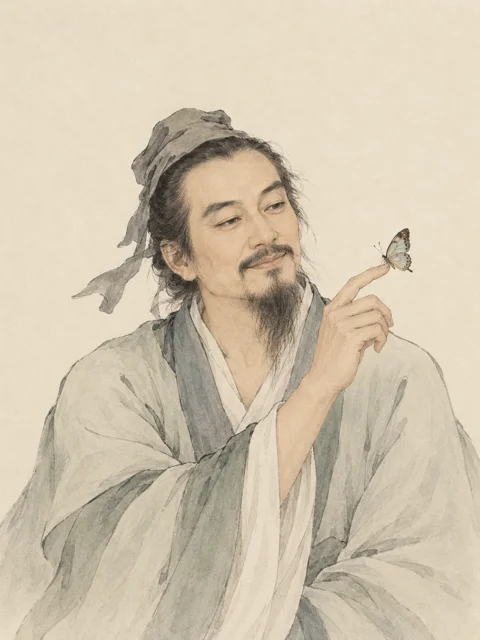
 AI 创作示意
GUANFU / zh-Hant
庄子
AI 创作示意外篇 · 天運
版本按章对照,不代表逐句校勘对应。
中文原文(全三十三篇) / 庄子原典;维基文库贡献者整理
观复随文注释 · 63 条
「天其運乎?地其處乎?日月其爭於所乎?孰主張是?孰維綱是?孰居无事,推而行是?意者其有機緘机关发动、约束的装置而不得已邪?意者其運轉而不能自止邪?雲者爲雨乎?雨者爲雲乎?孰隆施是?孰居无事,淫樂而勸是?風起北方,一西一東,有上彷徨,孰噓吸是?孰居无事而披拂是?敢問何故?」巫咸古代传说中的神巫祒曰:「來!吾語汝一作「女」。天有六極上下四方五常古注多指仁义礼智信,亦有异说,帝王順之則治,逆之則凶。九洛篇中古语,释为九州等说法不一之事,治成德備,監照下土,天下載之,此謂上皇。」
商大宰掌管政务的大臣;同太宰蕩問仁於莊子。莊子曰:「虎狼,仁也。」曰:「何謂也?」莊子曰:「父子相親,何爲不仁?」曰:「請問至仁?」莊子曰:「至仁无親最高的仁不偏爱某一亲属。」大一作「太」宰曰:「蕩聞之:『无親則不愛,不愛則不孝。』謂至仁不孝,可乎?」莊子曰:「不然。夫至仁,尚矣,孝固不足以言之。此非過孝之言也,不及孝之言也。夫南行者,至於郢楚国都城;读 yǐng,北面而不見冥山传说中的北方山名,是何也則?去之遠也。故曰:以敬孝,易;以愛孝,難。以愛孝,易;而忘親,難。忘親,易;使親忘我,難。使親忘我,易;兼忘天下,難。兼忘天下,易;使天下兼忘我,難。夫德遺堯、舜,而不爲也,利澤施於萬世,天下莫知也,豈直太息而言仁孝乎哉?夫孝悌仁義,忠信貞廉,此皆自勉以役其德者也,不足多也。故曰:至貴,國爵幷焉国家爵位不足以再增其贵;至富,國財幷焉;至願,名譽幷焉。是以道不渝改变。」
北門成問於黃帝曰:「帝張咸池传说中黄帝的乐曲之樂於洞庭之野,吾始聞之戄惊惧;读 jué一作「懼」,復聞之怠,卒聞之而惑,蕩蕩默默,乃不自得。」帝曰:「汝一作「女」殆其然哉!吾奏之以人,徽一作「徵」之以天,行之以禮義,建之以大一作「太」清。(夫至樂者,先應之以人事,順之以天理,應之以自然,然後調理四時,太和极为和谐的状态萬物。)四時迭起,萬物循生,一盛一衰,文武此指舒缓与激越的乐声倫經,一清一濁,陰陽調和,流光其聲,蟄蟲冬眠蛰伏的虫类始作。吾驚之以雷霆,其卒无尾,其始无首,一死一生,一僨倒下;读 fèn一起,所常无窮,而一不可待。汝故戄一作「懼」也。吾又奏之以陰陽之和,燭之以日月之明,其聲能短能長,能柔能剛,變化齊一,不主故常,在谷滿谷,在阬滿阬,塗郤守神堵塞孔隙而保守精神,以物爲量,其聲揮綽舒展宽广的样子,其名高明,是故鬼神守其幽,日月星辰行其紀。吾止之於有窮,流之於无止。子欲慮之而不能知也,望之而不能見也,逐之而不能及也,儻然立於四虛四方空旷的所在之道,倚於槁梧枯木几案而吟:『目知窮乎所欲見,力屈乎所欲逐,吾旣不及已矣一作「夫」,形充一作「光」空虛,乃至委蛇随顺自在;读 wēi yí。』汝一作「女」委蛇,故怠。吾又奏之以无怠之聲,調之以自然之命,故若混逐叢生,林樂而无形,布揮而不曳,幽昏而无聲,動於无方,居於窈冥幽深难测,或謂之死,或謂之生,或謂之實,或謂之榮繁盛、显现,行流散徙,不主常聲。世疑之,稽於聖人。聖也者,達於情而遂於命也。天一作「夫」機自然的机能不張,而五官皆備,此之謂天樂,无言而心悅一作「說」。故有猋一作「焱」氏传说中的古代人物爲之頌曰:『聽之不聞其聲,視之不見其形,充滿天一作「夫」地,苞裹六極。』汝一作「女」欲聽之而无接焉,而故惑也。樂也者,始於戄一作「懼」,戄一作「懼」故祟;吾又次之以怠,怠故遁;卒之於惑,惑故愚,愚故道,道可載而與之俱也。」
孔子西遊於衞,顏淵問師金曰:「以夫子之行,爲奚如?」師金曰:「惜乎!而夫子其窮哉!」顏淵曰:「何也?」師金曰:「夫芻狗草扎的狗,用作祭品之未陳也,盛以篋衍盛物的方箱,巾以文繡,尸祝祭祀中代表神者与司祝者齋一作「齊」戒以將之。及其已陳也,行者踐其首脊,蘇者拾取柴草的人取而爨烧火做饭之而已。將復取而盛以篋衍,巾以文繡,遊居寢臥其下,彼不得夢,必且數眯梦魇、神思不安;此义有异说焉。今而夫子,亦取先王已陳芻狗,取弟子遊居寢臥其下,故伐樹於宋,削迹於衞,窮於商、周,是非其夢邪?圍於陳、蔡之間,七日不火食未能吃到熟食,死生相與鄰,是非其眯邪?夫水行莫如用舟,而陸行莫如用車。以舟之可行於水也,而求推之於陸,則沒世不行尋常寻、常为古代长度单位,指短距离。古今非水陸與?周、魯非舟車與?今蘄行周於魯,是猶推舟於陸也,勞而无功,身必有殃。彼未知夫无方之傳,應物而不窮者也。且子獨不見夫桔槔利用杠杆原理提水的器具者乎?引之則俯,舍之則仰。彼,人之所引,非引人也,故俯仰而不得罪於人。故夫三皇、五帝之禮義法度,不矜於同而矜於治,故譬三皇、五帝之禮義法度,其猶柤梨一作「棃」橘柚邪?其味相反,而皆可於口。故禮義法度者,應時而變者也。今取猨狙而衣以周公之服,彼必齕齧挽裂,盡去而後慊满足;读 qiè。觀古今之異,猶猨狙之異乎周公也。故西施病心而矉皱眉;同颦其里,其里之醜人見而美之,歸亦捧心而矉其里,其里之富人見之,堅閉門而不出,貧人見之,挈妻子而去之走。彼知美矉,而不知矉之所以美。惜乎!而夫子其窮哉!」
孔子行年五十有一,而不聞道,乃南之沛,見老聃。老聃曰:「子來乎!吾聞:子,北方之賢者也。子亦得道乎?」孔子曰:「未得也。」老子曰:「子惡乎求之哉?」曰:「吾求之於數度礼仪制度与规则一作「度數」,五年而未得也。」老子曰:「子又惡乎求之哉?」曰:「吾求之於陰陽,十有二年而未得。」老子曰:「然。使道而可獻,則人莫不獻之於其君;使道而可進,則人莫不進之於其親;使道而可以告人,則人莫不告其兄弟;使道而可以與人,則人莫不與其子孫。然而不可者,无他也,中无主而不止,外无正而不行。由中出者,不受於外,聖人不出;由外入者,无主於中,聖人不隱。名,公器也,不可多取。仁義,先王之遽一作「蘧」廬临时歇宿的旅舍也,止可以一宿,而不可久處,覯而多責。古之至人,假道於仁,託宿於義,以遊逍遙之墟一作「虛」,食於苟簡之田,立於不貸之圃。逍遙,无爲也;苟簡,易養也;不貸,无出也。古者謂是采眞之遊采择、顺任真性的自在生活。以富爲是者,不能讓祿;以顯爲是者,不能讓名;親權者,不能與人柄。操之則慄,舍之則悲,而一无所鑒,以闚其所不休者,是天之戮民受刑之人,喻受外物束缚者也。怨、恩、取、與、諫、教、生、殺,八者正之器也,唯循大變,无所湮堵塞不通者,爲能用之。故曰:『正者,正也。』其心以爲不然者,天門弗開矣。」
孔子見老聃而語仁義。老聃曰:「夫播穅扬散谷糠;穅同糠眯目,則天地四方易位矣;蚊虻噆膚叮咬皮肤;噆读 zǎn,則通昔通宵;昔通夕不寐矣。夫仁義憯惨毒、伤害;读 cǎn然,乃憤吾心,亂莫大焉!吾子使天下无失其朴,吾子亦放風而動,揔一作「總」德而立矣,又奚傑然,若負建鼓竖立的大鼓而求亡子者邪?夫鵠天鹅;读 hú不日浴而白,烏不日黔染黑;读 qián而黑。黑白之朴,不足以爲辯;名譽之觀,不足以爲廣。泉涸,魚相與處於陸,相呴互相呵气;呴读 xǔ以濕,相濡以沫,不若相忘於江湖。」
孔子見老聃歸,三日不談。弟子問曰:「夫子見老聃,亦將何規哉?」孔子曰:「吾乃今於是乎見龍。龍,合而成體,散而成章,乘乎雲氣,而養乎陰陽。予口張而不能嗋闭口;读 xié。予又何規老聃哉?」子貢曰:「然則人固有尸居而龍見,雷聲而淵默,發動如天地者乎?賜亦可得而觀乎?」遂以孔子聲見老聃。老聃方將倨堂据坐堂上,而應微曰:「予年運而往矣,子將何以戒我乎?」子貢曰:「夫三王、五帝之治天下不同,其係聲名,一也。而先生獨以爲非聖人,如何哉?」老聃曰:「小子少進!子何以謂不同?」對曰:「堯授舜,舜授禹,禹用力,而湯用兵,文王順紂而不敢逆,武王逆紂而不肯順,故曰不同。」老聃曰:「小子少進,余語汝一作「女」三皇一作「王」、五帝之治天下。黃帝之治天下,使民心一,民有其親死,不哭,而民不非也。堯之治天一作「夫」下,使民心親,民有爲其親,殺其殺,而民不非也。舜之治天一作「夫」下,使民心競,民孕婦十月生子,子生五月而能言,不至乎孩而始誰,則人始有夭矣。禹之治天一作「夫」下,使民心變,人有心而兵有順,殺盜非殺人,自爲種而天下耳,是以天下大駭,儒墨皆起。其作始有倫,而今乎婦女,何言哉?余語汝一作「女」:三皇、五帝之治天一作「夫」下,名曰治之,而亂莫甚焉!三皇之知一作「治」,上悖日月之明,下睽山川之精,中墮四時之施。其知憯於𧓽蠆毒虫;蠆读 chài之尾、鮮規之獸恶兽名,古注有异说,莫得安其性命之情者,而猶自以爲聖人,不可恥乎?其无恥也!」子貢蹵蹵然局促不安的样子,立不安。
孔子謂老聃曰:「丘治詩、書、禮、樂、易、春秋六經,自以爲久矣,孰知其故矣;以奸求见、干谒;通干者七十二君,論先王之道,而明周、召周公、召公之迹,一君无所鉤用采用、任用。甚矣夫,人之難說也!道之難明邪?」老子曰:「幸矣,子之不遇治世之君也!夫六經,先王之陳迹遗留下来的旧迹也,豈其所以迹哉?今子之所言,猶迹也。夫迹,履鞋,喻产生行迹的根本之所出,而迹豈履哉?夫白鶂水鸟名;鶂读 yì之相視,眸子不運而風化此处指生物感应生育的古代想象。蟲,雄鳴於上風,雌應於下風,而(風)化。類,自爲雌雄,故風化。性不可易,命不可變,時不可止,道不可壅。苟得於道,无自而不可;失焉者,无自而可。」孔子不出,三月復見,曰:「丘得之矣。烏鵲孺,魚傅沫,細要细腰蜂;要同腰者化,有弟而兄啼。久矣夫,丘不與化爲人!不與化爲人,安能化人?」老子曰:「可,丘得之矣!」
观复随文注释 · AI 辅助独立整理,待持续人工校订。释义以本章语境为依据;存在异说或底本疑讹的地方另作提示。原文及版本来源保留如下。
参考: 本站所收原典:外篇 · 天運 ↗
原典公有领域;电子文本据维基文库贡献者,按 CC BY-SA 4.0 保留署名及相同方式共享;调整空白与排版。 · 查看原始版本
欢迎引用本站资源,分享道家与道教文化。引用时请注明出处“观复”,并附上所引用内容的原始页面链接,方便读者查阅。
观复白话释义(AI 辅助) / 观复 · AI 辅助独立整理
【白话释义|AI 辅助独立整理,未经人工学术审定】
“天是在运行吗?地是在安处吗?日月是在争逐各自的位置吗?是谁主宰这些?是谁维系这些?是谁自己无事,却推动它们运行?莫非有某种机关,使它们不得不如此?还是它们不断运转,自己停不下来?云形成雨,还是雨形成云?是谁使它们蓬勃施布?是谁安居无事,却以充沛的乐意催动它们?风从北方起来,时而向西,时而向东,在高处往来,是谁在呼吸它?是谁安居无事,却使它吹拂?请问这是什么缘故?”巫咸祒说:“来,我告诉你。天有六方的极限,有五种恒常的运行。帝王顺应它们便治,违逆它们便凶。使天下各处事务有序,治理成功,德性完备,明察下土,天下拥戴,这就叫上皇。”
商的太宰荡向庄子问仁。庄子说:“虎狼也有仁。”太宰问:“为什么?”庄子说:“父子相亲,怎么不是仁?”太宰说:“请问最高的仁。”庄子说:“最高的仁没有偏亲。”太宰说:“我听说,没有亲爱就没有爱,没有爱就不孝。说最高的仁不孝,可以吗?”庄子说:“不是这样。最高的仁极其崇高,孝本来不足以完整说明它。你这番话不是超越了孝,而是连孝的深意还未达到。向南走到郢都,再面向北方看不见冥山,为什么?因为离得太远了。
“所以说,以敬行孝容易,以爱行孝难;以爱行孝容易,忘掉对亲子的刻意执着难;自己忘掉执着容易,使父母也忘掉对自己的牵挂难;使父母忘掉牵挂容易,连天下一并相忘难;忘掉天下容易,使天下也忘掉自己的功德难。德性超越尧舜而不刻意作为,恩泽施及万世而天下不知是谁所赐,哪里只是叹息着谈仁孝!孝悌仁义、忠信贞廉,都是勉励自身、役使德性的规范,不值得特别夸耀。所以说,达到最高的尊贵,国家爵位便不再重要;达到最高的富足,国家财货便不再重要;达到最高的自得,名誉便不再重要。这样道才不被外物改变。”
北门成问黄帝:“帝在洞庭的原野演奏《咸池》乐,我初听惊惧,再听疲怠,最后听得迷惑,心神荡荡、默然无语,竟不能自得。”黄帝说:“你大概确实会这样。我以人事演奏它,以自然来征验它,按礼义运行它,建立在大清明的境界。最高的音乐,先应合人事,顺着天理,响应自然,然后调理四季,使万物达到大和。
“四时交替,万物相继生长,一盛一衰,舒缓与激越自有条理,一清一浊,阴阳调和,声光流动,蛰伏的虫开始活动。我以雷霆般的声音惊动它们,结束没有可固定的尾,开始没有可固定的头;一死一生,一倒一起,常道无穷,而没有一种形态可以固守等待。因此你惊惧。
“我又以阴阳的和谐演奏,以日月的明光照耀。声音可短可长,可柔可刚,变化而相通,不固守旧常;在谷中充满谷,在坑中充满坑,闭塞外在的罅隙,守住精神,按万物各自的分量应接。声音广大舒展,所呈现的境界高明。因此鬼神安守幽深,日月星辰依次运行。我让它止于具体的有限,却使其流行于无止境。你想思考却不能尽知,想看却不能尽见,想追却不能赶上,只得茫然站在四面空旷的路上,倚着梧木几案吟叹:‘眼和智力穷于所要看见的,体力屈于所要追逐的,我已不能赶上。形体充满空虚,于是随顺游移。’你随顺放松,所以疲怠。
“我又以不疲怠的声音演奏,依自然的禀命调和。声音像万物混合生长,丛林般繁茂而没有固定形体;散布流行,却不受拖曳;幽暗无声,动无固定方向,安住深远。有人说它是死,有人说它是生;有人说它是结果,有人说它是开花。它流行、散布、迁移,不固守一种声音。世人疑惑,要向圣人考问。所谓圣人,是通达实情、顺遂天命的人。天然的机能不刻意张扬,五种官能却齐备,这叫天乐,无须言语而心自欢悦。
“所以有猋氏歌颂它说:‘听不见声音,看不见形体,却充满天地,包裹六方。’你想听,却没有可直接接取的声音,因此迷惑。这样的音乐,始于惊惧,惊惧使人震动不安;再进到疲怠,疲怠使人放下追逐;最后到迷惑,迷惑使人不再自恃聪明,像是愚钝;由此进入道,道便可以承载你,让你与它同行。”
孔子向西游到卫国。颜渊问乐师金:“先生这次出行,您看会怎样?”师金说:“可惜啊,你的先生恐怕要困穷!”颜渊问:“为什么?”师金说:“祭祀用的草狗还没陈设时,装在箱中,覆盖锦绣,祭官斋戒着捧出;等祭祀用过了,路人踩它的头背,拾柴人拿去烧火罢了。如果再把它装箱,盖锦绣,带着人住在、睡在它下面,不做噩梦,也必受惊扰。如今你的先生,正是重新取来先王用过的草狗,带弟子住在它下面。因此在宋国遭伐树威胁,在卫国被排斥,在商周之地困厄,这不就是噩梦?被围于陈蔡,七天没有熟食,逼近死亡,这不就是梦魇般的困扰?
“水上行走,最好用船;陆地行走,最好用车。因为船能行水,便想推着它在陆上走,一辈子也走不了几步。古今不就像水陆不同?周代制度与鲁国现实,不就像舟车各宜?如今想把周制硬行于鲁,如同陆地推舟,劳而无功,自身必有灾殃。他还不懂不固守一种形式、随物应变而不穷的传承。
“你难道没见桔槔?拉它便低下,放开便升起。它受人牵引,不去牵引人,所以俯仰都不招怨。因此三皇五帝的礼义法度,不以相同为贵,而以合于治理为贵。它们就像山楂、梨、橘、柚,滋味不同,却都可口。所以礼义法度要随时代改变。如今把猿猴捉来,给它穿周公的衣服,它必定咬扯撕裂,全部脱掉才满意。古今之异,就像猿猴与周公之异。
“西施心口疼,在乡里皱眉。邻里的丑女看见,觉得美,回去也捧着胸口,在乡里皱眉。富人看见,关紧门不出;穷人看见,带着妻儿逃走。她只知道皱眉显美,却不知道西施为什么皱眉仍美。可惜啊,你的先生恐怕要困穷!”
孔子五十一岁,还没有闻道,于是南下沛地见老聃。老聃说:“你来了!听说你是北方的贤者,你已经得道了吗?”孔子说:“还没有。”老子问:“你从哪里求?”孔子说:“从制度法数中求,五年没有得到。”老子又问:“还从哪里求?”孔子说:“从阴阳中求,十二年也没有得到。”
老子说:“是这样。假如道可以献出,没有人不献给君主;可以进奉,没有人不进给父母;可以直接告诉人,没有人不告诉兄弟;可以直接交给人,没有人不交给子孙。不能如此,没有别的原因:内心没有主宰,道就不能安住;外在没有适当的相应,道就不能实行。从内心发出的,外面不能接受,圣人便不强行发出;从外面进入的,内心不能作主,圣人便不强行藏存。
“名声是公共的器物,不可多占。仁义是先王暂时的旅舍,可以住一夜,不可久住;久处其中,就会遭到更多责求。古代至人借仁为经过的路,托义为暂宿的处,游于逍遥的空境,吃在简易足用的田地,立于不向外求贷的园圃。逍遥,就是无为;简易,就是容易养活;不求贷,就是不使精神向外驰出。古人称之为采取本真的游行。
“把富有当作最高价值的人,不能让出俸禄;把显贵当作最高价值的人,不能让出名声;亲近权力的人,不能把权柄交给别人。握住就战栗,放下就悲伤,始终没有明鉴去看清自己为何不得休息,这就是受到自然刑罚般束缚的人。怨、恩、取、与、谏、教、生、杀,这八种都是治理的器用;只有顺循大的变化、不被阻塞的人,才会运用。因此说:‘治理者,要先使自己端正。’内心如果执着地拒绝自然之变,通往自然的门便不开。”
孔子见老聃,谈仁义。老聃说:“扬起糠皮迷了眼,天地四方的位置也会看乱;蚊虻咬了皮肤,整夜就睡不着。仁义这样惨烈地刺入,激扰我的心,没有更大的扰乱!先生只须使天下不失其朴,自己也随风而动,保有德性而立,何必高举标榜,像背着大鼓寻找逃走的孩子?天鹅不是天天洗澡才白,乌鸦不是天天染色才黑。黑白的本来状态,不值得争辩;名誉的外观,不值得扩张。泉干了,鱼困在陆上,彼此呵气、吐沫润湿,不如在江湖中彼此相忘。”
孔子见老聃回来,三天没有说话。弟子问:“先生见老聃,有什么规劝他的话吗?”孔子说:“我到今天才见到龙!龙合则成体,散则成文,乘云气,受养于阴阳。我张着嘴,竟合不拢,又哪里能规劝老聃!”子贡说:“那么真有人安居如尸而显现如龙,发声如雷而沉默如渊,发动如天地吗?我也能去看看吗?”于是以孔子的名义求见老聃。
老聃正舒坐堂上,微声应道:“我的年岁已经流逝,你要拿什么告诫我?”子贡说:“三王五帝治理天下的方式不同,却同样享有声名。先生偏说他们不是圣人,为什么?”老聃说:“年轻人,往前一点。你凭什么说他们不同?”子贡答:“尧让给舜,舜让给禹;禹用劳力,汤用武力;文王顺从纣,不敢违逆;武王违逆纣,不肯顺从。所以说不同。”
老聃说:“年轻人,再往前一点,我告诉你三皇五帝的治理。黄帝使民心浑一,有人父母死了不哭,百姓也不非议。尧使民心偏于亲爱,有人为了父母,杀死杀害父母的人,百姓也不非议。舜使民心竞争,妇女怀胎十月生子,孩子生下五月就能说话,还没到正常发笑的年龄,就开始辨认你我,人于是开始有过早耗损生命的情形。禹使民心机变,人有计较,兵事便被说成顺理;杀盗贼被说成不算杀人,各人各立一类,天下只剩纷争。因此天下大受惊扰,儒墨都兴起了。起初好像还有条理,如今竟成了细碎争竞,还有什么可说!
“我告诉你,三皇五帝治理天下,名义上叫治理,实际扰乱没有更甚的!他们的智巧,在上违背日月光明,在下乖离山川精气,在中破坏四时化育。他们的智巧,比蝎尾毒刺、凶猛之兽更伤人,使人不能安于性命本真,却还自以为圣人,不可耻吗?实在无耻!”子贡局促不安,站也站不稳。
孔子对老聃说:“我研治《诗》《书》《礼》《乐》《易》《春秋》六经,自以为很久了,也熟知其道理。我借这些求见七十二位君主,论说先王之道,阐明周公、召公的事迹,没有一位君主采用。人真难说服啊!还是道太难说明呢?”老子说:“幸好你没有遇上治理当世的君主!六经是先王留下的痕迹,难道就是产生这些痕迹的根源吗?你如今说的,仍只是痕迹。脚印是鞋走出来的,脚印难道就是鞋?白鶂彼此相视,眼珠不动,便感气而生育;虫类雄的在上风鸣,雌的在下风应,也感气而生育;一种叫类的生物,自兼雌雄,也自然而生化。天性不可硬改,禀命不可强变,时序不可停止,道不可壅塞。若得于道,怎样都可以;若失于道,怎样都不可以。”
孔子闭门三个月,再去见老聃,说:“我领会了。乌鹊孵育,鱼以沫相传,细腰蜂养化其幼;家里弟弟出生,哥哥会哭。我太久没有让自己成为随变化而行的人!自己不随变化,怎么能感化别人?”老子说:“可以了,丘,你领会了!”
校订说明:本篇含多处上古自然生殖观,如白鶂目感、鱼傅沫、细腰蜂化子,按原文转述,不替换成现代生物学知识。“九洛”“不及孝之言”“自为种而天下耳”“而今乎妇女”“鲜规之兽”等词句疑难,已取语境解释,须进一步校勘;“妇女”一处不据其字面补造人物情节。“舜时婴儿早言”的说法属于批评争竞的寓言性夸张。
〔补校:“治世之君”暂作治理当世的君主;“幸”有庆幸或反讽等理解,本句仍待版本与注疏复核。〕
观复白话释义:AI 辅助依据古文独立编写,已进行文本覆盖核对,未经人工学术审定;原典来源及电子底本署名、许可见对应中文版本。 · 查看原始版本
Herbert A. Giles 英译(全三十三篇) / Herbert A. Giles(翟理斯),1889
The Circling Sky.
[Translator’s note] Argument :—The Ultimate Cause—Integrity of Tao —Music and Tao —Failure of Confucianism—Confucius and Lao Tzŭ—Confucius attains to Tao —Illustrations.
[This chapter is supplementary to ch. v .]
"The sky turns round; the earth stands still; sun and moon pursue one another. Who causes this? Who directs this? Who has leisure enough to see that such movements continue?
"Some think there is a mechanical arrangement which makes these bodies move as they do. Others think that they revolve without being able to stop.
"The clouds cause rain; rain causes clouds. Whose kindly bounty is this? Who has leisure enough to see that such, result is achieved?
"Wind comes from the north. It blows now east, now west; and now it whirls aloft. Who puffs it forth? Who has leisure enough to be flapping it this way or that? I should like to know the cause of all this."
[Translator’s note] We are not told the name of this questioner.
Wu Han Chao
[Translator’s note] An ancient worthy.
said, "Come here, and I will tell you. Above there are the Six Influences
[Translator’s note] The Yin and Yang principles, wind, rain, darkness, and light; as in ch. xi .
[Translator’s note] Some commentators read, the "Six Cardinal Points," viz. : N., E., S., W., above, and below.
and the Five Virtues.
[Translator’s note] Charity, duty to one's neighbour, order, wisdom, and truth.
If a ruler keeps in harmony with these, his rule is good; if not, it is bad. By following the nine chapters of the Lo book,
[Translator’s note] Containing a mystic revelation of knowledge in the form of a diagram, supposed to have been delivered to one of the legendary rulers of China more than 2,000 years before the Christian era.
his rule will be a success and his virtue complete; he will watch over the interests of his people, and all the empire will owe him gratitude. This is to be an eminent ruler."
[Translator’s note] "A very round answer," says Lin Hsi Chung, "to a very square question."
Tang, a high official of Sung, asked Chuang Tzŭ about charity. Chuang Tzŭ said, "Tigers and wolves have it."
"How so?" asked Tang.
"The natural love between parents and offspring," replied Chuang Tzŭ,—"is not that charity?"
Tang then inquired about perfect charity.
"Perfect charity," said Chuang Tzŭ, "does not admit of love for the individual."
[Translator’s note] It embraces all men equally. To love one person would imply at least the possibility of hating another. See also p. 167 , where Lao Tzŭ refutes the doctrine of universal love.
"Without such love," replied Tang, "it appears to me there would be no such thing as affection, and without affection no filial piety. Does perfect charity not admit of filial piety?"
"Not so," said Chuang Tzŭ. "Perfect charity is the more extensive term. Consequently, it was unnecessary to mention filial piety. It was not that filial piety was omitted. It was merely not particularised.
"A man who travels southwards to Ying,
[Translator’s note] Capital of the Ch'u State.
cannot see Mount Ming in the north. Why? Because he is too far off.
"Therefore it has been said that it is easy to be respectfully filial, but difficult to be affectionately filial.
[Translator’s note] The artificial is easier than the natural.
But even that is easier than to become unconscious of one's natural obligations, which is in turn easier than to cause others to be unconscious of the operations thereof.
[Translator’s note] I.e. to be filial without letting others be conscious of the fact.
Similarly, this is easier than to become altogether unconscious of the world, which again is easier than to cause the world to be unconscious of one's influence upon it.
[Translator’s note] Such is perfect charity, which operates without letting its operation be known.
"True virtue does nothing, yet it leaves Yao and Shun far behind. Its good influence extends to ten thousand generations, yet no man knoweth it to exist. What boots it then to sigh after charity and duty to one's neighbour?
"Filial piety, fraternal love, charity, duty to one's neighbour, loyalty, truth, chastity, and honesty,—these are all studied efforts, designed to aid the development of virtue. They are only parts of a whole.
"Therefore it has been said, 'Perfect honour includes all the honour a country can give. Perfect wealth includes all the wealth a country can give. Perfect ambition includes all the reputation one can desire.' And by parity of reasoning, Tao does not admit of sub-division."
Pei Mên Ch'êng
[Translator’s note] Of whom nothing is recorded.
said to the Yellow Emperor, "When your Majesty played the Han-ch'ih
[Translator’s note] Name of a piece of music, the meaning of which is not known.
in the wilds of Tung-t'ing, the first time I heard it I was afraid, the second time I was amazed, and the last time I was confused, speechless, overwhelmed."
"You are not far from the truth," replied the Yellow Emperor. "I played as a man, drawing inspiration from God. The execution was punctilious, the expression sublime.
"Perfect music first shapes itself according to a human standard; then it follows the lines of the divine; then it proceeds in harmony with the five virtues; then it passes into spontaneity. The four seasons are then blended, and all creation is brought into accord. As the seasons come forth in turn, so are all things produced. Now fulness, now decay, now soft and loud in turn, now clear, now muffled, the harmony of Yin and Yang . Like a flash was the sound which roused you as the insect world is roused,
[Translator’s note] By the warm breath of spring.
followed by a thundering peal, without end and without beginning, now dying, now living, now sinking, now rising, on and on without a moment's break. And so you were afraid.
"When I played again, it was the harmony of the Yin and Yang , lighted by the glory of sun and moon; now broken, now prolonged, now gentle, now severe, in one unbroken, unfathomable volume of sound. Filling valley and gorge, stopping the ears and dominating the senses, adapting itself to the capacities of things,—the sound whirled around on all sides, with shrill note and clear. The spirits of darkness kept to their domain. Sun, moon, and stars, pursued their appointed course. When the melody was exhausted I stopped; if the melody did not stop, I went on.
[Translator’s note] The music was naturally what it was, independently of the player.
You would have sympathised, but you could not understand. You would have looked, but you could not see. You would have pursued, but you could not overtake. You stood dazed in the middle of the wilderness, leaning against a tree and crooning, your eye conscious of exhausted vision, your strength failing for the pursuit, and so unable to overtake me. Your frame was but an empty shell. You were completely at a loss, and so you were amazed.
"Then I played in sounds which produce no amazement, the melodious law of spontaneity, springing forth like nature's countless buds, in manifold but formless joy, as though poured forth to the dregs, in deep but soundless bass. Beginning nowhere, the melody rested in void; some would say dead, others alive, others real, others ornamental, as it scattered itself on all sides in never to be anticipated chords.
"The wondering world enquires of the Sage. He is in relation with its variations and follows the same eternal law.
"When no machinery is set in motion, and yet the instrumentation is complete, this is the music of God. The mind awakes to its enjoyment with out waiting to be called. Accordingly, Yu Piao praised it, saying, 'Listening you cannot hear its sound; gazing you cannot see its form.
[Translator’s note] Yu Piao is said to have been one of the pre-historic rulers of China. Readers of the Tao-Tê-Ching (ch. xiv) will here find another nail for the coffin of that egregious fraud. See The Remains of Lao Tzŭ , p. 14. Also ch. xxii of this work.
It fills heaven and earth. It embraces the six cardinal points.' Now you desired to listen to it, but you were not able to grasp its existence. And so you were confused.
"My music first induced fear; and as a consequence, respect. I then added amazement, by which you were isolated.
[Translator’s note] From consciousness of your surroundings.
And lastly, confusion; for confusion means absence of sense, and absence of sense means Tao , and Tao means absorption therein."
When Confucius travelled west to the Wei State, Yen Yüan
[Translator’s note] The "John" among the disciples of Confucius. He closed a pure and gentle life at the early age of 32, to the inexpressible grief of the Sage.
asked Shih Chin,
[Translator’s note] Chief musician of the Lu State.
saying, "What think you of my Master?"
"Alas!" replied Shih Chin, "he is not a success."
"How so?" enquired Yen Yüan.
"Before the straw dog has been offered in sacrifice," replied Shih Chin, "it is kept in a box, wrapped up in an embroidered cloth, and the augur fasts before using it. But when it has once been offered up, passers-by trample over its body, and fuel-gatherers pick it up for burning. Then, if any one should take it, and again putting it in a box and wrapping it up in an embroidered cloth, watch and sleep alongside, he would not only dream, but have nightmare into the bargain.
[Translator’s note] The thing being uncanny. From which it would appear that the use of the straw dog was to induce dreams of future events.
"Now your Master has been thus treating the ancients, who are like the dog which has already been offered in sacrifice. He causes his disciples to watch and sleep alongside of them. Consequently, his tree
[Translator’s note] Beneath which he used to teach.
has been cut down in Sung; they will have none of him in Wei; in fact, his chances among the Shangs and the Chous are exhausted. Is not this the dream? And then to be surrounded by the Ch'êns and the Ts'ais, seven days without food, death staring him in the face,—is not this the nightmare?
"For travelling by water there is nothing like a boat. For travelling by land there is nothing like a cart. This because a boat moves readily in water; but were you to try to push it on land you would never succeed in making it go.
[Translator’s note] Be in harmony with your surroundings.
Now ancient and modern times may be likened unto water and land; Chou and Lu to the boat and the cart. To try to make the customs of Chou succeed in Lu, is like pushing a boat on land: great trouble and no result, except certain injury to oneself. Your Master has not yet learnt the doctrine of non-angularity, of self-adaptation to externals.
"Have you never seen a well-sweep? You pull it, and down it comes. You release it, and up it goes. It is the man who pulls the well-sweep, and not the well-sweep which pulls the man; so that both in coming down and going up, it does not run counter to the wishes of the man. And so it was that the ceremonial and obligations and laws of the Three Emperors and Five Rulers did not aim at uniformity of application but at good government of the empire. Their ceremonial, obligations, laws, etc., were like the cherry-apple, the pear, the orange, and the pumelo,—all differing in flavour but each palatable. They changed with the changing season.
"Dress up a monkey in the robes of Chou Kung,
[Translator’s note] See ch. iv .
and it will not be happy until they are torn to shreds. And the difference between past and present is much the same as the difference between Chou Kung and a monkey.
"When Hsi Shih
[Translator’s note] A famous beauty of old.
was distressed in mind, she knitted her brows. An ugly woman of the village, seeing how beautiful she looked, went home, and having worked herself into a fit frame of mind, knitted her brows. The result was that the rich people of the place barred up their doors and would not come out, while the poor people took their wives and children and departed elsewhere. That woman saw the beauty of knitted brows, but she did not see wherein the beauty of knitted brows lay.
[Translator’s note] In suitability to the individual.
Alas! your Master is emphatically not a success."
Confucius had lived to the age of fifty-one without hearing Tao , when he went south to P'ei, to see Lao Tzŭ.
Lao Tzŭ said, "So you have come, Sir, have you? I hear you are considered a wise man up north. Have you got Tao ?"
"Not yet," answered Confucius.
"In what direction," asked Lao Tzŭ, "have you sought for it?"
"I sought it for five years," replied Confucius, "in the science of numbers, but did not succeed."
"And then?..." continued Lao Tzŭ.
"Then," said Confucius, "I spent twelve years seeking for it in the doctrine of the Yin and Yang , also without success."
"Just so," rejoined Lao Tzŭ. "Were Tao something which could be presented, there is no man but would present it to his sovereign, or to his parents. Could it be imparted or given, there is no man but would impart it to his brother or give it to his child. But this is impossible, for the following reason. Unless there is a suitable endowment within, Tao will not abide. Unless there is outward correctness, Tao will not operate. The external being unfitted for the impression of the internal, the true Sage does not seek to imprint. The internal being unfitted for the reception of the external, the true Sage does not seek to receive.
[Translator’s note] Attempting neither to teach nor to learn.
"Reputation is public property; you may not appropriate it in excess. Charity and duty to one's neighbour are as caravanserais established by wise rulers of old; you may stop there one night, but not for long, or you will incur reproach.
"The perfect men of old took their road through charity, stopping a night with duty to their neighbour, on their way to ramble in transcendental space. Feeding on the produce of non-cultivation, and establishing themselves in the domain of no obligations, they enjoyed their transcendental inaction. Their food was ready to hand; and being under no obligations to others, they did not put any one under obligation to themselves. The ancients called this the outward visible sign of an inward and spiritual grace.
"Those who make wealth their all in all, cannot bear loss of money. Those who make distinction their all in all, cannot bear loss of fame. Those who affect power will not place authority in the hands of others. Anxious while holding, distressed if losing, yet never taking warning from the past and seeing the folly of their pursuit,—such men are the accursed of God.
"Resentment, gratitude, taking, giving, censure of self, instruction of others, power of life and death,—these eight are the instruments of right; but only he who can adapt himself to the vicissitudes of fortune, without being carried away, is fit to use them. Such a one is an upright man among the upright. And he whose heart is not so constituted,—the door of divine intelligence is not yet opened for him."
Confucius visited Lao Tzŭ, and spoke of charity and duty to one's neighbour.
Lao Tzŭ said, "The chaff from winnowing will blind a man's eyes so that he cannot tell the points of the compass. Mosquitoes will keep a man awake all night with their biting. And just in the same way this talk of charity and duty to one's neighbour drives me nearly crazy. Sir! strive to keep the world to its own original simplicity. And as the wind bloweth where it listeth, so let Virtue establish itself. Wherefore such undue energy, as though searching for a fugitive with a big drum?
[Translator’s note] See p. 167 .
"The snow-goose is white without a daily bath. The raven is black without daily colouring itself. The original simplicity of black and of white is beyond the reach of argument. The vista of fame and reputation is not worthy of enlargement. When the pond dries up and the fishes are left upon dry ground, to moisten them with the breath or to damp them with a little spittle is not to be compared with leaving them in the first instance in their native rivers and lakes."
[Translator’s note] Repeated from ch. vi .
On returning from this visit to Lao Tzŭ, Confucius did not speak for three days. A disciple asked him, saying, "Master, when you saw Lao Tzŭ, in what direction did you admonish him?"
"I saw a Dragon," replied Confucius, "—a Dragon which by convergence showed a body, by radiation became colour, and riding upon the clouds of heaven, nourished the two Principles of Creation. My mouth was agape: I could not shut it. How then do you think I was going to admonish Lao Tzŭ?"
Upon this Tzŭ Kung remarked, "Ha! then a man can sit corpse-like manifesting his dragon-power around, his thunder-voice heard though profound silence reigns, his movements like those of the universe? I too would go and see him."
[Translator’s note] More repetition, this time from ch. xi .
So on the strength of his connection with Confucius, Tzŭ Kung obtained an interview. Lao Tzŭ received him distantly and with dignity, saying in a low voice, "I am old, Sir. What injunctions may you have to give me?"
"The administration of the Three Kings and of the Five Rulers," replied Tzŭ Kung, "was not uniform; but their reputation has been identical. How then, Sir, is it that you do not regard them as Sages?"
"Come nearer, my son," said Lao Tzŭ. "What mean you by not uniform ?"
"Yao handed over the empire to Shun," replied Tzŭ Kung; "and Shun to Yü. Yü employed labour, and T'ang employed troops. Wên Wang followed Chou Hsin and did not venture to oppose him. Wu Wang opposed him and would not follow. Therefore I said not uniform ."
"Come nearer, my son," said Lao Tzŭ, "and I will tell you about the Three Kings and the Five Rulers.
"The Yellow Emperor's administration caused the affections of the people to be catholic. Nobody wept for the death of his parents, and nobody found fault.
[Translator’s note] All loved each other equally.
"The administration of Yao diverted the affections of the people into particular channels. If a man slew the slayer of his parents, nobody blamed him.
[Translator’s note] Filial affection began to predominate.
"The administration of Shun brought a spirit of rivalry among the people. Children were born after ten months' gestation; when five months old, they could speak; and ere they were three years of age,
[Translator’s note] Including gestation.
could already tell one person from another. And so early death came into the world.
[Translator’s note] A veritable anti-climax, hopelessly unworthy of either Lao Tzŭ or Chuang Tzŭ.
"The administration of Yü wrought a change in the hearts of the people. Individuality prevailed, and force was called into play. Killing robbers was not accounted murder; and throughout the empire people became sub-divided into classes. There was great alarm on all sides, and the Confucianists and the Mihists arose. At first the relationships were duly observed; but what about the women of to-day?
[Translator’s note] Meaning that in the olden days men could not marry before thirty, women before twenty, whereas now the State is cursed with early marriages. Or, according to Dr. Legge's view of a famous passage in the Book of Rites, that formerly it was shameful in men and women not to be married at the age of thirty and twenty, respectively, whereas now the State is cursed with late marriages.
"Let me tell you. The government of the Three Kings and Five Rulers was so only in name. In reality, it was utter confusion. The wisdom of the Three Kings was opposed to the brilliancy of the sun and moon above, destructive of the energy of land and water below, and subversive of the influence of the four seasons between.
[Translator’s note] More repetition. See ch. x . ad fin.
That wisdom is more harmful than a hornet's tail, preventing the very animals from putting themselves into due relation with the conditions of their existence—and yet they call themselves Sages! Is not their shamelessness shameful indeed?"
At this Tzŭ Kung became ill at ease.
[Translator’s note] The whole of the above episode may without hesitation be written off as a feeble forgery.
Confucius said to Lao Tzŭ, "I arranged the Six Canons of Poetry, History, Rites, Music, Changes, and Spring and Autumn. I spent much time over them, and I am well acquainted with their purport. I used them in admonishing seventy-two rulers, by discourses on the wisdom of ancient sovereigns and illustrations from the lives of Chou and Shao. Yet not one ruler has in any way adopted my suggestions. Alas that man should be so difficult to persuade, and wisdom so difficult to illustrate."
"It is well for you, Sir," replied Lao Tzŭ, "that you did not come across any real ruler of mankind. Your Six Canons are but the worn-out foot-prints of ancient Sages. And what are foot-prints? Why, the words you now utter are as it were foot-prints. Foot-prints are made by the shoe: they are not the shoe itself.
"Fish-hawks gaze at each other with motionless eyes,—and their young are produced. The male of a certain insect chirps with the wind while the female chirps against it,—and their offspring is produced. There is another animal which, being an hermaphrodite, produces its own offspring. Nature cannot be changed. Destiny cannot be altered. Time cannot stop. Tao cannot be obstructed. Once attain to Tao , and there is nothing which you cannot accomplish. Without it, there is nothing which you can accomplish."
For three months after this Confucius did not leave his house. Then he again visited Lao Tzŭ and said, "I have attained. Birds lay eggs, fish spawn, insects undergo metamorphosis, and mammals suckle their young.
[Translator’s note] Lit. "when a younger brother comes, the elder cries,"—from which may be inferred the meaning in the translation.
[Translator’s note] The whole sentence signifies that every development proceeds according to fixed laws. It is useless to try to do anything. Nature is always self-similar.
For a long time I have not been enlightened. And he who is not enlightened himself,—how should he enlighten others?"
Lao Tzŭ said, "Ch'iu, you have attained!"
[Translator’s note] "The style of this chapter," says Lin Hsi Chung, "gives it a foremost place among the 'outside' essays of Chuang Tzŭ. But the insertion of that dialogue between Confucius and Lao Tzŭ on charity and duty towards one's neighbour is like eking out a sable robe with a dog's tail."
原著及 Herbert A. Giles 历史译本公有领域;据 Project Gutenberg #59709,完整电子书及使用条款见本站资料来源。 · 查看原始版本
我的书签(此浏览器)
还没有书签。