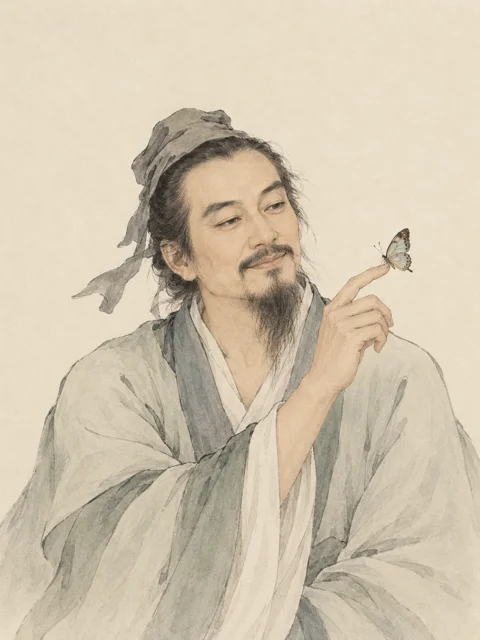
 AI 创作示意
GUANFU / zh-Hant
庄子
AI 创作示意外篇 · 刻意
版本按章对照,不代表逐句校勘对应。
中文原文(全三十三篇) / 庄子原典;维基文库贡献者整理
观复随文注释 · 29 条
刻意刻苦磨砺自己的心志尚行崇尚高洁的行为,離世異俗,高論怨誹,爲亢高傲独立而已矣,此山谷之士,非世之人,枯槁赴淵困饿或投水自尽以明志者之所好也。語仁義忠信,恭儉推讓,爲脩而已矣,此平世之士致力于安定社会的人,教誨之人,遊居學者之所好也。語大功,立大名,禮君臣,正上下,爲治而已矣,此朝廷之士,尊主強一作「彊」國之人,致功幷兼者之所好也。就藪澤草木茂密的水泽,處閒曠,釣魚閒處,无爲而已矣,此江海之士,避世之人,閒暇者之所好也。吹呴吐气、呵气的呼吸方法呼吸,吐故納新呼出旧气、吸入新气,熊經鳥申仿熊攀援、仿鸟伸展的导引动作,爲壽而已矣,此導一作「道」引调息伸体的古代养生方法之士,養形之人,彭祖传说中的长寿人物壽考长寿、高龄者之所好也。
若夫不刻意而高,无仁義而脩,无功名而治,无江海而閒,不導一作「道」引而壽,无不忘也,无不有也,澹然安静淡泊的样子无極,而衆美從之,此天地之道,聖人之德也。故曰:夫恬淡一作「惔」寂漠,虛无无爲,此天地之平,而道德之質也,故曰聖人休。休焉則平易矣,平易則恬淡一作「惔」矣。平易恬淡一作「惔」,則憂患不能入,邪氣不能襲,故其德全而神不虧。故曰:聖人之生也天行顺任自然地运行,其死也物化随着万物自然变化;靜而與陰同德,動而與陽同波;不爲福先,不爲禍始;感而後應,迫而後動,不得已而後起;去知與故去掉智巧与故意造作,循天之理,故无天災,无物累,无人非,无鬼責;其生若浮,其死若休;不思慮,不豫謀预先谋划;豫通预;光矣而不耀,信矣而不期不必约定而自然可信;其寢不夢,其覺无憂;其神純粹,其魂一作「魄」不罷不疲倦;罷通疲。虛无恬淡一作「惔」,乃合天德。
故曰:悲樂者,德之邪;喜怒者,道之過;好惡者,德之失。故心不憂樂,德之至也;一而不變,靜之至也;无所於忤抵触;读 wǔ,虛之至也;不與物交,淡之至也;无所於逆,粹之至也。故曰:形勞而不休則弊,精精神、精气用而不已則勞,勞則竭。水之性,不雜則清,莫動則平,鬱閉而不流,亦不能清,天德之象也。故曰:純粹而不雜,靜一而不變,淡而无爲,動而以天行,此養神之道也。夫有干、越吴、越,两地以铸剑著称之劒一作「劍」者,柙匣子;读 xiá而藏之,不敢用也,寶之至也。精神四達並流一作「流並達」,无所不極,上際於天,下蟠盘曲、遍及於地,化育萬物,不可爲象,其名爲同帝与自然主宰同一。
純素纯粹质朴的本性之道,唯神是守;守而勿失,與神爲一;一之精通,合于天倫天然的条理。野語民间俗语有之曰:「衆人重利,廉士重名,賢士尚志,聖人貴精。」故素也者,謂其无所與雜也;純也者,謂其不虧其神也。能體純素,謂之眞人体道而保持本真的理想人物。
观复随文注释 · AI 辅助独立整理,待持续人工校订。释义以本章语境为依据;存在异说或底本疑讹的地方另作提示。原文及版本来源保留如下。
参考: 本站所收原典:外篇 · 刻意 ↗
原典公有领域;电子文本据维基文库贡献者,按 CC BY-SA 4.0 保留署名及相同方式共享;调整空白与排版。 · 查看原始版本
欢迎引用本站资源,分享道家与道教文化。引用时请注明出处“观复”,并附上所引用内容的原始页面链接,方便读者查阅。
观复白话释义(AI 辅助) / 观复 · AI 辅助独立整理
【白话释义|AI 辅助独立整理,未经人工学术审定】
刻意磨砺心志,崇尚高洁行为,离开世间,与风俗不同,高谈阔论,怨愤讥刺,不过是追求高亢。这是山谷中的隐士、非议世俗的人,以及使自己枯槁、甚至投水自尽的人所爱好的。谈仁义忠信,讲恭敬节俭、推让谦退,不过是追求修养。这是希望平治世道的人、从事教诲的人、游学或居家讲学的人所爱好的。谈大功业,立大名声,以礼规定君臣,端正上下名分,不过是追求治理。这是朝廷之士、尊君强国的人、建立功业并兼他国的人所爱好的。前往水泽,居处空旷,钓鱼闲居,不过是追求不从事世务。这是江海之士、避世的人、喜欢闲暇的人所爱好的。吹气呼吸,吐出旧气,吸入新气,像熊攀举、像鸟伸展,不过是追求长寿。这是导引之士、养护形体的人、向往彭祖长寿的人所爱好的。
至于不刻意磨砺而自然高洁,不标举仁义而自然修善,不追求功名而自然有治,不必到江海而自然清闲,不作导引而自然长寿,对一切都能忘却执着,却又无所不具,淡然无穷,各种美善自然随来,这才是天地之道、圣人之德。因此说:恬淡寂寞、虚静无为,是天地平常的状态,道德本来的质地,所以圣人安处其中。安处其中,就平和简易;平和简易,就恬淡。平易恬淡,忧患不能侵入,邪气不能侵袭,所以德性完整,精神不亏。
因此说,圣人生时随自然运行,死时随万物变化;静时与阴同德,动时与阳同流。不抢先求福,不主动引祸;受到感发然后回应,形势迫近然后行动,不得已然后兴起。去掉机巧和成规的执着,顺循自然条理,所以没有违天而招的灾,没有外物的牵累,不受人的非难,没有鬼神的责罚。活着如漂游,死去如休息;不沉溺思虑,不预设机谋;有光而不炫耀,可信而不刻意约求。睡时不被梦扰,醒时不怀忧虑;精神纯粹,魂魄不疲。虚静恬淡,才合于天然的德性。
所以说,过度悲乐是德性的偏邪,喜怒失节是对道的越过,执着好恶是德性的丧失。内心不被忧乐牵动,是德的极致;守一而不被迁改,是静的极致;没有什么硬加抵触,是虚的极致;不与外物纠缠,是淡的极致;无所强行违逆,是纯粹的极致。
又说,形体劳作不停,就会疲敝;精力运用不止,就会劳累;劳累过度,就会枯竭。水的本性,不夹杂便清,不搅动便平;可是郁闭不流,也不能保持清明。这正是自然德性的象征。因此说:纯粹不杂,宁静守一,不被外物改变,恬淡无为,行动依照自然,这就是养神的道理。拥有吴越宝剑的人,把剑收在匣里,不敢轻易使用,是因为极其珍惜。精神却能通达四方,自然流行,无处不到,上接于天,下盘于地,化育万物,无法画出固定形象,这种状态称为与天帝相同。
纯净素朴的道,专在守住精神;守住而不失,与精神浑然为一;专一而精微通达,便合于自然的条理。民间有句话说:“众人重利益,廉士重名声,贤士尚志向,圣人贵精神。”所谓素,是不夹杂外物;所谓纯,是不损伤精神。能够亲身体会并保持纯素,就叫真人。
校订说明:“熊经鸟申”为古代导引动作的形象说法,未补充现代训练方法。“不与物交”依全篇应物而不累的语境,释为不与物纠缠,非完全断绝生活接触。“干越之剑”按吴越宝剑解释,原文字形有异说。“无天灾”等为养神理想的论述,并非现实中不受疾病灾害的保证。
观复白话释义:AI 辅助依据古文独立编写,已进行文本覆盖核对,未经人工学术审定;原典来源及电子底本署名、许可见对应中文版本。 · 查看原始版本
Herbert A. Giles 英译(全三十三篇) / Herbert A. Giles(翟理斯),1889
Self-Conceit.
[Translator’s note] Argument :—Would-be sages—The vanity of effort—Method of the true Sage—Passivity the key—The soul and mortality—Re-absorption into the immortal.
Self-conceit and assurance, which lead men to quit society, and be different from their fellows, to indulge in tall talk and abuse of others,—these are nothing more than personal over-estimation, the affectation of recluses and those who have done with the world and have closed their hearts to mundane influences.
Preaching of charity and duty to one's neighbour, of loyalty and truth, of respect, of economy, and of humility,—this is but moral culture, affected by would-be pacificators and teachers of mankind, and by scholars at home or abroad.
Preaching of meritorious services, of fame, of ceremonial between sovereign and minister, of due relationship between upper and lower classes,—this is mere government, affected by courtiers or patriots who strive to extend the boundaries of their own State and to swallow up the territory of others.
Living in marshes or in wildernesses, and passing one's days in fishing—this is mere inaction, affected by wanderers who have turned their backs upon the world and have nothing better to do.
Exhaling and inhaling,
[Translator’s note] The "breathing" theory. See ch. vi ., ad init.
getting rid of the old and assimilating the new, stretching like a bear and craning like a bird,—
[Translator’s note] As these creatures are supposed to do in order to get good air into their systems.
—this is but valetudinarianism, affected by professors of hygiene and those who try to preserve the body to the age of P'êng Tsu.
[Translator’s note] See ch. i .
But in self-esteem without self-conceit, in moral culture without charity and duty to one's neighbour, in government without rank and fame, in retirement without solitude, in health without hygiene,—there we have oblivion absolute coupled with possession of all things; an infinite calm which becomes an object to be attained by all.
Such is the Tao of the universe, such is the virtue of the Sage. Wherefore it has been said, "In tranquillity, in stillness, in the unconditioned, in inaction, we find the levels of the universe, the very constitution of Tao ."
[Translator’s note] Almost verbatim from ch. xiii , p. 158 , where the passage appears as part of Chuang Tzŭ's own text, and not as a quotation from any other author.
Wherefore it has been said, "The Sage is a negative quantity, and is consequently in a state of passivity. Being passive he is in a state of repose. And where passivity and repose are, there sorrow and anxiety do not enter, and foul influences do not collect. And thus his virtue is complete and his spirituality unimpaired."
Wherefore it has been said, "The birth of the Sage is the will of God; his death is but a modification of existence. In repose, he shares the passivity of the Yin ; in action, the energy of the Yang . He will have nothing to do with happiness, and so has nothing to do with misfortune.
[Translator’s note] Each of which proceeds from the other in an endless chain.
He must be influenced ere he will respond. He must be urged ere he will move. He must be compelled ere he will arise. Ignoring the future and the past, he resigns himself to the laws of God.
"And therefore no calamity comes upon him, nothing injures him, no man is against him, no spirit punishes him. He floats through life to rest in death. He has no anxieties; he makes no plans. His honour does not make him illustrious. His good faith reflects no credit upon himself.
[Translator’s note] It is all God's, as part of the great scheme.
His sleep is dreamless, his awaking without pain. His spirituality is pure,
[Translator’s note] Without desires.
and his soul vigorous. Thus unconditioned and in repose, he is a partaker of the virtue of God."
Wherefore it has been said, "Sorrow and happiness are the heresies
[Translator’s note] Evil influences.
of virtue; joy and anger lead astray from Tao ; love and hate cause the loss of virtue. The heart unconscious of sorrow and happiness,—that is perfect virtue. One , without change,—that is perfect repose. Without any obstruction,—that is the perfection of the unconditioned. Holding no relations with the external world,—that is perfection of the negative state. Without blemish of any kind,—that is the perfection of purity."
Wherefore it has been said, "If the body toils without rest, it dies. If the mind is employed without ceasing, it becomes wearied; and being wearied, its power is gone."
Pure water is by nature clear. If untouched, it is smooth. If dammed, it will not flow, neither will it be clear. It is an emblem of the virtue of God. Wherefore it has been said, "Pure, without admixture; uniform, without change; negative, without action; moved, only at the will of God;—such would be the spirituality nourished according to Tao ."
Those who possess blades from Kan
[Translator’s note] The Wu State.
or Yüeh, keep them carefully in their scabbards, and do not venture to use them. For they are precious in the extreme. The spirit spreads forth on all sides: there is no point to which it does not reach, attaining heaven above, embracing earth beneath. Influencing all creation, its form cannot be portrayed. Its name is then Of-God .
[Translator’s note] Such is man's spiritual existence before he is born into the world of mortals.
The Tao of the pure and simple consists in preserving spirituality. He who preserves his spirituality and loses it not, becomes one with that spirituality. And through that unity the spirit operates freely, and comes into due relationship with God.
[Translator’s note] Returning after its brief career on earth, to the eternity whence it came.
A vulgar saying has it, "The masses value money; honest men, fame; virtuous men, resolution; and Sages, the soul."
Thus, the pure is that in which there is nothing mixed; the simple is that which implies no injury to the spirituality. And he who can keep the pure and simple within himself,—he is a divine man.
[Translator’s note] It requires but scant acumen to relegate this chapter to the limbo of forgeries. Lin Hsi Chung thinks it is probably from the hand of the unknown artist who is responsible for ch. xiii .
原著及 Herbert A. Giles 历史译本公有领域;据 Project Gutenberg #59709,完整电子书及使用条款见本站资料来源。 · 查看原始版本
我的书签(此浏览器)
还没有书签。