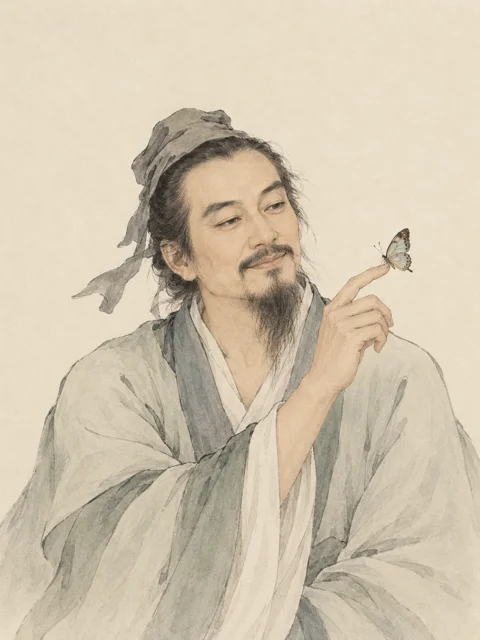
 AI 创作示意
GUANFU / zh-Hans
庄子
AI 创作示意大宗師 · 白话释义
版本按章对照,不代表逐句校勘对应。
中文原文(全三十三篇) / 庄子原典;维基文库贡献者整理
观复随文注释 · 83 条
知天之所爲,知人之所爲者,至矣!知天之所爲者,天而生也;知人之所爲者,以其知之所知,以養其知之所不知,終其天年,而不中道夭者,是知之盛也。雖然,有患。夫知有所待有所依赖而後當,其所待者,特未定也。庸詎知吾所謂天之非人乎?所謂人之非天乎?且有眞人体道而不受外物拘束的理想人物,而後有眞知。
何謂眞人?古之眞人,不逆寡违逆少数;古注对此说法不一,不雄成以成功自雄、自夸,不謩士谋虑事务;此句有异解。若然者,過而弗悔,當而不自得也。若然者,登高不慄,入水不濡沾湿;读 rú,入火不熱,是知之能登假达到至境;假读 gé於道也若此。古之眞人,其寢不夢,其覺无憂,其食不甘,其息深深。眞人之息以踵深至脚跟,形容呼吸深静,衆人之息以喉。屈服者,其嗌咽喉;读 yì言若哇。其耆欲嗜好欲望;耆通嗜深者,其天機天然的生机与灵性淺。古之眞人,不知悅一作「說」生,不知惡死,其出不訢,其入不距,翛然自在无拘束的样子;翛读 xiāo而往,翛然而來,而已矣;不忘其所始,不求其所終,受而喜之,忘而復之,是之謂不以心捐道抛弃自然之道,不以人助天,是之謂眞人。若然者,其心志,其容寂,其顙頯额面宽厚朴实的样子,淒然似秋,煖然似春,喜怒通四時,與物有宜,而莫知其極。故聖人之用兵也,亡國而不失人心,利澤施乎萬世,不爲愛人。故樂通物,非聖人也;有親,非仁也;天時,非賢也;利害不通,非君子也;行名失己,非士也;亡身不眞,非役人也。若狐不偕、務光、伯夷、叔齊传说中不食周粟的孤竹国二子、箕子、胥餘、紀他、申徒狄传说以投水表志的古代贤者,是役人之役,適人之適,而不自適其適者也。古之眞人,其狀,義而不朋,若不足而不承,與乎其觚有棱角的器物,喻方正而不堅也,張乎其虛而不華也,邴邴欣悦的样子乎其似喜乎,崔乎其不得已乎,滀乎進我色也,與乎止我德也,厲乎其似世乎,謷乎其未可制也,連乎其似好閉也,悗乎忘其言也。以刑爲體,以禮爲翼,以知爲時,以德爲循。以刑爲體者,綽乎其殺也;以禮爲翼者,所以行於世也;以知爲時者,不得已於事也;以德爲循者,言其與有足者至於丘也,而人眞以爲勤行者也。故其好之也一,其弗好之也一。其一也一,其不一也一。其一,與天爲徒;其不一,與人爲徒。天與人不相勝不互相压制也。是之謂眞人。
死生,命也;其有夜旦之常,天也。人之有所不得與,皆物之情也。彼特以天爲父,而身猶愛之,而況其卓乎?人特以有君爲愈乎己,而身猶死之,而況其眞乎?泉涸,魚相與處於陸,相呴互相呵气;呴读 xǔ以濕,相濡互相沾湿一作「𣽉」以沫,不如相忘於江湖。與其譽堯而非桀也,不如兩忘而化其道。夫大塊自然整体、天地,載我以形,勞我以生,佚我以老,息我以死,故善吾生者,乃所以善吾死也。夫藏舟於壑,藏山於澤,謂之固矣,然而夜半有力者負之而走,昧一作「昩」者不知也。藏小大有宜,猶有所遯仍会逃失变化;遯同遁。若夫藏天下於天下,而不得所遯,是恆物之大情也。特犯人之形偶然获得人的形体,而猶喜之;若人之形者,萬化而未始有極也,其爲樂,可勝計邪?故聖人將遊於物之所不得遯,而皆存。善夭善老,善始善終,人猶效之,又況萬物之所係,而一化贯通万物的自然变化之所待乎?
夫道,有情有信有真实存在、可验证的作用,无爲无形,可傳而不可受,可得而不可見,自本自根,未有天地,自古以固存,神鬼神帝,生天生地,在太極天地未分的原初状态之先而不爲高,在六極上下四方的极远处之下而不爲深,先天地生而不爲久,長於上古而不爲老。狶韋氏传说中的上古帝王得之,以挈天地;伏戲得之,以襲氣母元气的根源;維斗北斗星得之,終古不忒差错;读 tè;日月得之,終古不息;堪坏得之,以襲崐崘;馮夷传说中的河神得之,以遊大川;肩吾得之,以處大山;黃帝得之,以登雲天;顓頊传说中的上古帝王;读 zhuān xū得之,以處玄宮;禺強传说中的北方神得之,立乎北極;西王母得之,坐乎少廣传说西王母居住之地,莫知其始,莫知其終;彭祖得之,上及有虞,下及五伯;傅說商王武丁的贤相;说读 yuè得之,以相武丁,奄有天下,乘東維,騎箕尾箕宿、尾宿,古代星宿名,而比於列星。
南伯子葵問乎女偊寓言中的得道女子;偊读 yǔ曰:「子之年長矣,而色若孺一作「𡦗」子,何也?」曰:「吾聞道矣。」南伯子葵曰:「(道)可得學邪?」曰:「惡!惡可?子非其人也。夫卜梁倚有聖人之才而无聖人之道,我有聖人之道而无聖人之才。吾欲以教之,庶幾其果爲聖人乎?不然,以聖人之道,告聖人之才,亦易矣,吾猶守而告之,參日而後能外天下不以天下为心之牵累;已外天下矣,吾又守之,七日而後能外物不受外物拘束;已外物矣,吾又守之,九日而後能外生超脱对生命的执著;已外生矣,而後能朝徹心境如清晨般透彻明朗;朝徹而後能見獨体悟独立无待的道,見獨而後能无古今,无古今而後能入於不死不生。殺生者不死,生生者不生。其爲物,无不將也,无不迎也,无不毀也,无不成也,其名爲攖寧与纷扰接触而内心安宁。攖寧也者,攖而後成者也。」南伯子葵曰:「子獨惡乎聞之?」曰:「聞諸一作「之」副墨寓言名字,借指文字之子,副墨之子聞諸洛誦寓言名字,借指诵读之孫,洛誦之孫聞之瞻明,瞻明聞之聶許,聶許聞之需役,需役聞之於謳,於謳聞之玄冥,玄冥聞之參寥寓言名字,寓意深远空寂,參寥聞之疑始寓言名字,寓意未明的起始。」
子祀、子輿、子犁、子來四人相與語曰:「孰能以无爲首,以生爲脊,以死爲尻尾骨、臀部;读 kāo?孰知死生存亡之一體者,吾與之友矣!」四人相視而笑,莫逆於心心意相通而毫无抵触,遂相與爲友。俄而子輿有病,子祀往問之。曰:「偉哉!夫造物者將以予爲此拘拘身体弯曲拘束的样子也!」曲僂發背,上有五管五脏的孔道,頤一作「願」隱於齊,肩高於頂,句贅发髻;句读 gōu指天,陰陽之氣有沴阴阳失调之气;读 lì。其心閒而无事,跰𨇤而鑑于井,曰:「嗟乎!夫造物者又將以予爲此拘拘也!」子祀曰:「汝一作「女」惡之乎?」曰:「亡,予何惡?浸假渐渐、假若而化予之左臂以爲雞,予因以(求)時夜报晓、司晨;浸假而化予之右臂以爲彈,予因以求鴞炙烤鸮鸟肉;浸假而化予之尻以爲輪,以神爲馬,予因而乘之,豈更駕哉?且夫得者時也,失者順也,安時而處順,哀樂不能入也,此古之所謂縣解解除倒悬般的束缚;縣通悬也。而不能自解者,物有結之。且夫物不勝天,久矣,吾又何惡焉?」俄而子來有病,喘喘然將死,其妻子環而泣之。犁往問之,曰:「叱避,无怛化惊扰自然的变化。」倚其戶,與之語曰:「偉哉!造化又將奚以汝爲?將奚以汝適?以汝爲鼠肝乎?以汝爲蟲臂乎?」子來曰:「父母於子,東西南北,唯命之從。陰陽於人,不翅不止、不仅;翅通啻於父母。彼近吾死,而我不聽,我則捍一作「悍」矣,彼何罪焉?夫大塊,載我以形,勞我以生,佚我以老,息我以死,故善吾生者,乃所以善吾死也。今大冶高明的铸造匠鑄金,金踊躍,曰:『我且必爲鏌鋣古代宝剑名;读 mò yé!』大冶必以爲不祥之金。今一犯人之形,而曰『人耳人耳』!夫造化一作「物」者必以爲不祥之人。今一以天地爲大鑪,以造化爲大冶,惡乎往而不可哉?」成然寐,蘧然覺,(發然汗出。)
子桑戶、孟子反、子琴張三人相與友,曰:「孰能相與於无相與,相爲於无相爲?孰能登天遊霧,撓挑腾跃、游动无極,相忘以生,无所終窮?」三人相視而笑,莫逆於心,遂相與友。莫然有間,而子桑戶死,未葬。孔子聞之,使子貢往待事帮助料理丧事焉。或編曲,或鼔一作「鼓」琴,相和而歌曰:「嗟來桑戶乎!嗟來桑戶乎!而已反其眞返回自然本真的状态,而我猶爲人猗!」子貢趨而進,曰:「敢問:臨尸而歌,禮乎?」二人相視而笑,曰:「是惡知禮意?」子貢反以告孔子,曰:「彼何人者邪?脩行无有,而外其形骸,臨尸而歌,顏色不變,无以命之。彼何人者邪?」孔子曰:「彼,遊方之外世俗礼法范围以外者也;而丘,遊方之內者也。外內不相及,而丘使汝一作「女」往弔之,丘則陋矣!彼方且與造物者爲人,而遊乎天地之一氣。彼以生爲附贅縣疣附生的赘肉瘤疣,喻形体之累,以死爲決𤴯潰癕。夫若然者,又惡知死生先後之所在?假於異物,託於同體,忘其肝膽,遺其耳目,反覆終始,不知端倪,芒然彷徨乎塵垢之外,逍遙乎无爲之業。彼又惡能憒憒然昏乱烦扰的样子,爲世俗之禮,以觀衆人之耳目哉?」子貢曰:「然則夫子何方之依?」(孔子)曰:「丘,天之戮民也。雖然,吾與汝一作「女」共之。」子貢曰:「敢問其方?」孔子曰:「魚相造乎水,人相造乎道。相造乎水者,穿池而養給;相造乎道者,无事而生定。故曰:魚相忘乎江湖,人相忘乎道術。」子貢曰:「敢問畸人与常俗不同的人?」曰:「畸人者,畸於人而侔於天与自然相合;侔读 móu。故曰:天之小人,人之君子;人之君子,天之小人也。」
顏回問仲尼,曰:「孟孫才,其母死,哭泣无涕,中心不慼悲伤忧愁,居喪不哀,无是三者,以善喪蓋魯國。固有无其實而得其名者乎?回壹怪之。」仲尼曰:「夫孟孫氏,盡之矣,進於知矣;唯簡之而不得,夫已有所簡矣。孟孫氏,不知所以生,不知所以死,不知就先,不知就後,若化爲物,以待其所不知之化已乎!且方將化,惡知不化哉?方將不化,惡知已化哉?吾特與汝,其夢未始覺者邪?且彼有駭形而无損心,有旦宅而无情死。孟孫氏特覺,人哭亦哭,是自其所以乃,且也相與『吾之』耳矣。庸詎知吾所謂『吾之』乎?且汝夢爲鳥而厲乎天,夢爲魚而沒於淵。不識今之言者,其覺者乎,其夢者乎?造適不及笑,獻笑不及排,安排而去化,乃入於寥天一空明而与天合一的境界。」
意而子見許由,許由曰:「堯何以資汝?」意而子曰:「堯謂我:『汝必躬服仁義,而明言是非。』」許由曰:「而奚來爲軹?夫堯旣已黥在脸上刺字的刑罚;读 qíng汝以仁義,而劓割鼻的刑罚;读 yì汝以是非矣,汝將何以遊夫遙蕩恣睢轉徙之塗乎?」意而子曰:「雖然,吾願遊於其藩。」許由曰:「不然。夫盲者无以與乎眉目顏色之好,瞽者无以與乎青黃黼黻古代礼服上的彩色纹样之觀。」意而子曰:「夫无莊之失其美,據梁之失其力,黃帝之亡其知,皆在鑪捶炉火与锤炼,喻自然造化之間耳。庸詎知夫造物者之不息我黥而補我劓,使我乘成以隨先生邪?」許由曰:「噫!未可知也。我爲汝言其大略:吾師乎!吾師乎!䪡萬物而不爲戾一作「義」,澤及萬世而不爲仁,長於上古而不爲老,覆載天地、刻彫衆形而不爲巧。此所遊已!」
顏回曰:「回益矣。」仲尼曰:「何謂也?」曰:「回忘仁義矣。」曰:「可矣,猶未也。」它日復見,曰:「回益矣。」曰:「何謂也?」曰:「回忘禮樂矣。」曰:「可矣,猶未也。」它日復見,曰:「回益矣。」曰:「何謂也?」曰:「回坐忘静坐而忘却形体、成见的修养矣。」仲尼蹵然曰:「何謂坐忘?」顏回曰:「墮枝體忘却肢体;墮通隳,枝通肢,黜聰明摒除感官与智巧的拘限,離形去知,同於大通万物贯通的自然之道,此謂坐忘。」仲尼曰:「同則无好也,化則无常也。而果其賢乎?丘也請一作「謂」從而後也。」
子輿與子桑友,而淋一作「霖」雨十日。子輿曰:「子桑殆病矣。」裹飯而往食之,至子桑之門,則若歌若哭,鼔一作「鼓」琴曰:「父邪?母邪?天乎?人乎?」有不任其聲而趨舉急促地唱出其詩焉。子輿入,曰:「子之歌詩,何故若是?」曰:「吾思夫使我至此極困穷的处境者,而弗得也。父母豈欲吾貧哉?天无私覆,地无私載,天地豈私貧我哉?求其爲之者,而不得也。然而至此極者,命也夫!」
观复随文注释 · AI 辅助独立整理,待持续人工校订。释义以本章语境为依据;存在异说或底本疑讹的地方另作提示。原文及版本来源保留如下。
参考: 本站所收原典:大宗師 ↗
原典公有领域;电子文本据维基文库贡献者,按 CC BY-SA 4.0 保留署名及相同方式共享;调整空白与排版。 · 查看原始版本
欢迎引用本站资源,分享道家与道教文化。引用时请注明出处“观复”,并附上所引用内容的原始页面链接,方便读者查阅。
观复白话释义(AI 辅助) / 观复 · AI 辅助独立整理
【白话释义|AI 辅助独立整理,未经人工学术审定】
知道自然的作用,又知道人为的作用,认识就达到了极高处。知道自然的作用,就顺着自然生活;知道人为的作用,就用自己已经知道的,养护自己所不能穷知的生命,活尽天年,不在中途夭折,这是智慧的盛境。虽然如此,仍有难处:认识必须依凭某种条件,才能判断恰当,可它所依凭的条件并未确定。我怎么知道自己所谓的自然,不是人为?所谓的人为,不是自然?必须先有真人,才会有真知。
什么叫真人?古代的真人,不抗拒孤寡不足的处境,不以成功自雄,也不谋划事情来显示自己。这样的人,过失之后不陷于悔恨,合宜之时也不自鸣得意。他登高不战栗,入水不受濡湿,入火不觉灼热,这是说他的认识能够上达于道。古代的真人,睡觉不被梦扰,醒来不怀忧虑,吃东西不贪美味,呼吸深沉。真人的呼吸仿佛一直到脚跟,常人的呼吸只浮在喉头;被压抑屈服的人,喉咙里的话像哽噎呕吐。嗜好欲望越深,天然的生机就越浅。
古代的真人,不特别贪恋生命,不特别厌恶死亡;来到世间不狂喜,离开世间不抗拒,自由地往,自由地来,不过如此。他不忘生命从哪里开始,也不强求它怎样结束;接受变化而欣然相处,忘却执着而返回自然。这就叫不以成心损伤道,不以人为强助自然,这就叫真人。这样的人,心志安定,容貌沉静,额面宽舒;严肃时像秋天,温暖时像春天,喜怒与四季的变化相通,同万物各得其宜,别人却不知其深浅。
所以,圣人用兵,即使使敌国灭亡,也不失去人心;恩泽施及万世,也不自居于爱人。以善于通晓外物为乐的,不算圣人;有所偏爱的,不算大仁;受天时拘限的,不算真贤;不能通达利害的,不算君子;追逐名声而丧失自己的,不算士;丧身而失去本真的,也不能算妥善为人效力者。像狐不偕、务光、伯夷、叔齐、箕子、胥余、纪他、申徒狄这些人,都是做别人要做的事,求别人认为适意的东西,却没有安适于自己的适意。
古代的真人,形貌庄严而不结党,像有所不足,却不刻意承求;有自己的棱角,却不坚硬;胸怀虚敞,却不浮华;明朗得像欣喜,挺立得像出于不得已;神色和悦,仿佛与人相亲;精神安住,仿佛守住自己的德;有时严厉得像世人,有时高远得不受拘束;有时绵密地像要闭藏,有时恍惚地忘掉言语。他把刑罚看作治世所需的形体,把礼看作行世的羽翼,把智慧用于适时应事,以德作为顺循自然的道路。以刑罚为体,是说即使处置生杀,也从容而无私怒;以礼为翼,是借它在世间行事;以智慧应时,是因事情不得不应对;以德顺循,是像有脚的人登上山丘,本来可以自然到达,旁人却以为他刻意勤奋努力。
因此,他喜欢的与他不喜欢的,都同归于一;他看作同一的和看作不同的,也都同归于一。在浑然为一的一面,他与天为伴;在各有差异的一面,他与人为伴。自然与人为不互相争胜,这就叫真人。
死生是命运,它像昼夜一样有规律地更替,这是自然。人有无法干预的事情,本来就是万物的实情。人仅把天看作父亲,尚且爱它,何况比这更超越的根本!人认为君主高于自己,尚且愿意为君主死,何况真正的根源!泉水干涸,鱼一起困在陆地,彼此呵气润湿,彼此吐沫相濡,不如在江湖中各自自在,彼此相忘。与其赞誉尧、非议桀,不如两者都忘掉,融入道的变化。大自然给我形体,使我承担生活的劳作,让我以衰老得到安逸,以死亡得到休息。因此,善待我的生的,也正是善待我的死的。
把船藏在山谷,把山藏在大泽,自以为稳固了;然而半夜有个大力者把它们背走,昏昧的人却不知道。把小的藏在大的里面,即使藏得适当,仍可能失去。若把天下藏在天下之中,就无处逃失,这才是万物恒常的大实情。偶然得到人的形体,尚且会为此欢喜;像人的形体这样,各种变化无穷无尽,其中的快乐又哪里算得完!所以圣人要游于万物无法逃离、也全都存在其中的境界。有些人安于夭折也安于长寿,安于开始也安于终结,别人尚且愿意效法;何况那万物所依系、一切变化所依凭的根本呢?
道真实而可信,无人为造作,也没有固定形体。它可以传达,却不能像实物那样交接;可以体会,却不能看见。它自身就是根本,天地未有之前,早已自古存在。它使鬼神显神妙,使帝者具神灵,生出天,生出地。它在最高之处以前,却不能称为高;在天地四方的极限以下,却不能称为深;先于天地而生,却不能用久暂衡量;长于远古,却不能说它衰老。
狶韦氏得道,便能维系天地;伏羲得道,便能契合元气的根源;北斗得道,亘古运行而不差失;日月得道,亘古运行而不停息;堪坏得道,便能进入昆仑的境界;冯夷得道,便能游于大川;肩吾得道,便能居于大山;黄帝得道,便能上登云天;颛顼得道,便能居于幽玄之宫;禺强得道,便能立于北极;西王母得道,便能坐于少广之山,没有人知道她的开始,也没有人知道她的终结;彭祖得道,上及有虞时代,下至五霸时代;傅说得道,辅佐武丁,使他统有天下,又乘上东方天维,驾临箕、尾二宿,与群星并列。
南伯子葵问女偊:“您年纪很大,面容却像孩子,为什么?”女偊说:“我领会了道。”南伯子葵说:“道可以学得吗?”女偊说:“唉,怎么可以轻易学!你还不是适合的人。卜梁倚有圣人的才质,却没有圣人的道;我有圣人的道,却没有圣人的才质。我想教他,希望他终于成为圣人。即使未必如此,用圣人的道教有圣人才质的人,也比较容易。我守候着、不断告诉他,三天之后,他才能把天下置于心外;已经把天下置于心外,我再守候他,七天之后,他才能把外物置于心外;已经把外物置于心外,我再守候他,九天之后,他才能把自己的生命也置于心外。
“把生命置于心外之后,才有如清晨豁然明彻的觉悟;明彻之后,才能见到不依待对立的独一;见到独一之后,才能不再执着古今;不执着古今之后,才能进入无所谓死、无所谓生的境界。使有生者死的根源,本身不受死亡支配;使有生者生的根源,本身不以一般的方式出生。对于万物,无不送往,无不迎来,无不使它毁,无不使它成。这种境界叫作‘撄宁’;所谓撄宁,就是接触纷扰变化之后,仍成就其宁静。”
南伯子葵问:“您是从哪里听到这些的?”女偊说:“听于副墨之子;副墨之子听于洛诵之孙;洛诵之孙听于瞻明;瞻明听于聂许;聂许听于需役;需役听于於讴;於讴听于玄冥;玄冥听于参寥;参寥听于疑始。”
子祀、子舆、子犁、子来四个人谈论道:“谁能以无为头,以生为脊背,以死为尾臀?谁知道死生、存亡原是一个整体,我们便同他做朋友!”四个人相视而笑,内心没有违逆,于是结为朋友。
不久子舆病了,子祀去探望。子舆说:“伟大啊,造物者竟把我变成这副蜷曲的样子!”他弯腰驼背,五脏上移,下巴缩到肚脐,肩膀高过头顶,颈后隆起朝天,这是体内阴阳之气失调。他的心却安闲无事,蹒跚到井边照看自己的影子,说:“唉,造物者又把我变成这样蜷曲的模样!”子祀问:“你厌恶它吗?”他说:“没有,我为什么厌恶?假如渐渐把我的左臂变成公鸡,我就让它报晓;假如渐渐把我的右臂变成弹弓,我就拿它打鸟来烤;假如渐渐把我的臀部变成车轮,把我的精神变成马,我就乘上它,哪里还要另套车马!再说,得到形体,是应时而来;失去形体,是顺变而去。安于时运,顺处变化,悲哀快乐就不能侵扰内心,这就是古人所谓解除倒悬。那些不能自我解脱的,是因为外物把他们束缚住了。外物不能胜过自然,由来已久,我又有什么可厌恶的!”
不久子来病了,气息急促,将要死去,妻子儿女围着哭泣。子犁去探望,叫他们说:“避开,不要惊扰变化!”他靠着门,同子来说:“伟大啊,造化又要把你变成什么?要把你送往哪里?把你变成老鼠的肝脏吗?把你变成小虫的胳膊吗?”子来说:“父母叫孩子往东、西、南、北,孩子只听命行事。阴阳对人的支配,比父母还深。它使我接近死亡,我却不肯服从,那就是我强横,它又有什么过错?大自然给我形体,使我承担生活的劳作,让我以衰老得到安逸,以死亡得到休息。所以善待我的生的,也正是善待我的死的。
“如今大铸工熔铸金属,金属忽然跳起来说:‘我一定要成为镆铘宝剑!’大铸工必定认为这是不祥的金属。如今偶然得到人的形体,就说:‘一定要做人,一定要做人!’造化也必定认为这是不祥的人。如今把天地当作大熔炉,把造化当作大铸工,到哪里去不可以呢?”于是安然睡去,又豁然而觉,仿佛随着变化醒来。
子桑户、孟子反、子琴张三个人相交,说:“谁能在不刻意结交中彼此结交,在不刻意助为中彼此助为?谁能登天游雾,往来于无极之境,彼此相忘而生活,没有终尽?”三人相视而笑,内心没有违逆,于是结为朋友。
过了一段时间,子桑户死了,还没有下葬。孔子听说,派子贡去帮助办理丧事。只见两位朋友一个编曲,一个弹琴,相和着唱:“唉呀桑户啊!唉呀桑户啊!你已经返回本真,我们却还在做人哪!”子贡赶快上前,问:“请问,面对死者歌唱,合乎礼吗?”二人相视而笑,说:“他哪里懂礼的真意!”
子贡回来告诉孔子:“那些究竟是什么人?不修通常的品行,不把自己的形体放在心上,面对尸体唱歌,脸色也不改变,我不知道怎么称说他们。他们究竟是什么人?”孔子说:“他们是游于世俗规范之外的人,我是游于规范之内的人。内外本不相及,我却让你去吊唁,是我浅陋了!他们正与造物者相为友伴,游于天地浑然一气之中。他们把生看作附在身上的赘物、悬着的肉瘤,把死看作疮疖破裂、脓肿溃散。这样的人,哪里还拘定生死的先后分别!他们把身体看作借来不同的成分、暂时寄托在同一形体中,忘了肝胆,遗了耳目,随终始往复,不知其端际,茫然游于尘俗之外,自在于无为之境。又哪里会匆忙地操持世俗礼节,做给众人的耳目看!”
子贡问:“那么先生依循哪一方呢?”孔子说:“我是受自然拘系、还没有解脱的人。虽然如此,我愿同你一道探求。”子贡说:“请问怎样探求?”孔子说:“鱼在水中相安,人于道中相安。在水中相安的,池水足够,滋养便有供给;于道中相安的,不强作事,生命便安定。所以说,鱼在江湖中彼此相忘,人于道中彼此相忘。”子贡说:“请问什么叫畸人?”孔子说:“畸人,就是与常人不同,却与自然相合的人。所以说,按照自然看显得浅小的,世人可能认为是君子;世人所谓的君子,从自然看却可能是浅小的。”
颜回问孔子:“孟孙才的母亲死了,他哭而无泪,内心不悲,守丧也不哀。这三样都没有,却以善于居丧名闻鲁国。难道真有不具备实质却得到名声的人?我十分奇怪。”孔子说:“孟孙才已经尽其至理,超过一般的认识了。他只是不能把一切礼节都省去,已经有所简省了。他不执着于为什么生,不执着于为什么死,也不执着于趋先趋后。他随变化成为当前的形态,等待自己还不知道的变化罢了。正要变化时,怎么知道不是不变?正以为不变时,怎么知道不是已经变化?我与你,或许也还在没有醒来的梦里吧!
“他虽遇见惊动形体的事,却不损伤内心;身体只像一时寄居的住处,情意不随着死亡而困死。孟孙才独有觉悟,别人哭,他也哭,不过顺着自己当下的处境而行。我们彼此认定一个‘我’,究竟怎么知道所说的‘我’是什么?你梦中化作鸟,飞上天空;梦中化作鱼,潜入深渊。不知道如今说话的这个人,究竟醒着,还是梦着?达到真正的适意,来不及刻意发笑;显出笑意,又不及全然放开。安于推移,随化而去,才能进入空寥、天然、浑一的境界。”
意而子拜见许由。许由问:“尧给了你什么教诲?”意而子说:“尧对我说:‘你一定要亲身实行仁义,明确地分说是非。’”许由说:“那么你还来我这里做什么?尧已经用仁义在你脸上刺字,用是非割去了你的鼻子,你将怎样游于辽远、自由、随变化而迁移的道路?”意而子说:“虽然如此,我仍愿到那境界的边缘游一游。”许由说:“不行。盲人不能参与欣赏眉眼容色的美,失明的人不能参与观看青黄文饰的色彩。”
意而子说:“无庄忘掉自己的美貌,据梁忘掉自己的力气,黄帝忘掉自己的聪明,都像金属在熔炉锻锤间被重新铸造罢了。怎么知道造物者不会消去我脸上的刺字,补好我被割掉的鼻子,让我乘着自然成就的变化,跟随先生呢?”许由说:“唉,这还不能预先知道。我对你说个大概吧:我的老师啊,我的老师!它使万物破败,也不算暴虐;恩泽施及万世,也不自居仁爱;长于远古,也不算衰老;覆载天地,雕刻万物的形体,也不自夸技巧。这就是我所游处的境界!”
颜回说:“我有进步了。”孔子问:“什么意思?”颜回说:“我忘掉仁义了。”孔子说:“可以,但还不够。”另一天再来,颜回说:“我有进步了。”孔子问:“什么意思?”颜回说:“我忘掉礼乐了。”孔子说:“可以,但还不够。”又一天再来,颜回说:“我有进步了。”孔子问:“什么意思?”颜回说:“我能坐忘了。”孔子惊讶地问:“什么叫坐忘?”颜回说:“放下肢体的执着,屏除耳目的聪明,离开对形体的拘守,去掉成见之知,与大道的通达合为一体,这就叫坐忘。”孔子说:“合一就没有偏爱,随化就不固守常形。你果然贤明了!请让我跟在你后面学习。”
子舆和子桑是朋友。接连下了十天雨,子舆说:“子桑恐怕困病了。”便包了饭去送给他。到了门口,听见子桑像唱又像哭,一边弹琴一边说:“父亲吗?母亲吗?是天吗?是人吗?”他已经没有力气支撑声音,却还急急地唱着。子舆进去问:“你为什么这样唱?”子桑说:“我思索究竟是什么使我穷困到这种地步,却找不到。父母难道希望我贫穷吗?天无私地覆盖,地无私地承载,天地难道特别让我贫穷吗?我想找出造成这一切的,却找不到。然而还是到了如此困境,大概就是命吧!”
校订说明:“真人”是本篇的理想人物,不应将入火不热等寓言描写当作现实身体能力。源文有多处异文和疑句,如“不逆寡”“不谟士”“其心志”“天时”“滀乎”等,以上择取与上下文相贯通的释法。“副墨之子”至“疑始”是一组寓意式传承名称,保留名称而不强行改为真实人物。“成然寐,蘧然觉”及括注“发然汗出”传本不同,前者依生死如寤寐的语境释出;括注若保留,可解作醒后汗出,并非另一个情节。“箕子、胥余”在源文并列,但传统材料常以胥余为箕子之名,名单有待校订。
观复白话释义:AI 辅助依据古文独立编写,已进行文本覆盖核对,未经人工学术审定;原典来源及电子底本署名、许可见对应中文版本。 · 查看原始版本
Herbert A. Giles 英译(全三十三篇) / Herbert A. Giles(翟理斯),1889
The Great Supreme.
[Translator’s note] Argument :—The human and the divine—The pure men of old—Their qualifications—Their self-abstraction—All things as ONE—The known and the unknown—Life a boon—Death a transition—Life eternal open to all—The way thither—Illustrations.
He who knows what God is, and who knows what Man is, has attained. Knowing what God is, he knows that he himself proceeded therefrom. Knowing what Man is, he rests in the knowledge of the known, waiting for the knowledge of the unknown. Working out one's allotted span, and not perishing in mid career,—this is the fulness of knowledge.
God is a principle which exists by virtue of its own intrinsicality, and operates spontaneously, without self-manifestation.
[Translator’s note] It is in the human that the divine finds expression. Man emanates from God, and should therefore be on earth, in this brief life of ours, what God is for all eternity in the universe.
Herein, however, there is a flaw. Knowledge is dependent upon fulfilment. And as this fulfilment is uncertain, how can it be known that my divine is not really human, my human really divine?
[Translator’s note] Not until death lifts the veil can we truly know that this life is bounded at each end by an immortality to which the soul finally reverts.
We must have pure men , and then only can we have pure knowledge .
[Translator’s note] "Pure" must be understood in the sense of transcendent.
But what is a pure man?—The pure men of old acted without calculation, not seeking to secure results. They laid no plans. Therefore, failing, they had no cause for regret; succeeding, no cause for congratulation. And thus they could scale heights without fear; enter water without becoming wet; fire, without feeling hot. So far had their wisdom advanced towards Tao .
[Translator’s note] "The world-spirit is a good swimmer, and storms and waves cannot drown him."— Emerson.
The pure men of old slept without dreams, and waked without anxiety. They ate without discrimination, breathing deep breaths. For pure men draw breath from their uttermost depths; the vulgar only from their throats.
[Translator’s note] "Uttermost depths" is literally "heels," but all the best commentators take the sentence to mean that pure men breathe with their whole being, and not as it were superficially, from the throat only.
[Translator’s note] This passage is probably responsible for the trick of taking deep inhalations of morning air, practised (not without scientific foundation) by the followers of the debased Taoism of modern times. Other tricks for prolonging life, such as swallowing the saliva three times in every two hours, etc., are more open to adverse criticism. See the T'ai-Hsi-Ching .
Out of the crooked, words are retched up like vomit. If men's passions are deep, their divinity is shallow.
The pure men of old did not know what it was to love life or to hate death. They did not rejoice in birth, nor strive to put off dissolution. Quickly come, and quickly go;—no more. They did not forget whence it was they had sprung, neither did they seek to hasten their return thither. Cheerfully they played their allotted parts, waiting patiently for the end. This is what is called not to lead the heart astray from Tao ,
[Translator’s note] By admitting play of passion in the sense condemned in ch. v . which would hinder the mind from resting quietly in the knowledge of the known.
nor to let the human seek to supplement the divine.
[Translator’s note] But to wait patiently for the knowledge of the unknown.
And this is what is meant by a pure man.
Such men are in mind absolutely free; in demeanour, grave; in expression, cheerful. If it is freezing cold, it seems to them like autumn; if blazing hot, like spring. Their passions occur like the four seasons.
[Translator’s note] Each at its appointed time.
They are in harmony with all creation, and none know the limit thereof.
[Translator’s note] These last few words occur in the Tao-Tê-Ching , ch. lviii. See The Remains of Lao Tzŭ , p. 40. Also, with a variation, in ch. xxii of this work.
And so it is that a perfect man can destroy a kingdom and yet not lose the hearts of the people, while the benefits he hands down to ten thousand generations do not proceed from love of his fellow-man.
[Translator’s note] Whatever he does is spontaneous, and therefore natural, and therefore in accordance with right.
He who delights in man, is himself not a perfect man. His affection is not true charity.
[Translator’s note] Charity is the universal love of all creation which admits of no particular manifestations.
Depending upon opportunity, he has not true worth.
[Translator’s note] True worth is independent of circumstances. It is a quality which is always unconsciously operating for good, and needs no opportunity to call it into existence.
He who is not conversant with both good and evil is not a superior man.
[Translator’s note] The good, to practise; the evil, to avoid.
He who disregards his reputation is not what a man should be.
[Translator’s note] As a mere social unit.
He who is not absolutely oblivious of his own existence can never be a ruler of men.
Thus Hu Pu Hsieh, Wu Kuang, Poh I, Shu Ch'i, Chi Tzŭ Hsü Yü, Chi T'o, and Shên T'u Ti, were the servants of rulers, and did the behests of others, not their own.
[Translator’s note] A list of ancient worthies whose careers had been more or less unsuccessful. Of the first and second little is known, except that the ears of the latter were seven inches long.
[Translator’s note] The third and fourth were brothers and are types of moral purity. Each refused the throne of their State, because each considered his brother more entitled thereto. Finally, they died of starvation on the mountains rather than submit to a change of the Imperial dynasty. More will be heard of these two later on.
[Translator’s note] The fifth smeared his body all over with lacquer, so that no one should come near him. Of the sixth, nothing is recorded; and of the seventh, only that he tied a stone around his neck and jumped into a river. See the Fragmenta at the end of the works of Shih Tzŭ.
The pure men of old did their duty to their neighbours, but did not associate with them.
[Translator’s note] Among them, but not of them.
They behaved as though wanting in themselves, but without flattering others. Naturally rectangular, they were not uncompromisingly hard. They manifested their independence without going to extremes. They appeared to smile as if pleased, when the expression was only a natural response.
[Translator’s note] As required by the exigencies of society.
Their outward semblance derived its fascination from the store of goodness within. They seemed to be of the world around them, while proudly treading beyond its limits. They seemed to desire silence, while in truth they had dispensed with language.
[Translator’s note] See ch. v .
They saw in penal laws a trunk;
[Translator’s note] A natural basis of government.
in social ceremonies, wings;
[Translator’s note] To aid man's progress through life.
in wisdom, a useful accessory; in morality, a guide. For them penal laws meant a merciful administration; social ceremonies, a passport through the world; wisdom, an excuse for doing what they could not help; and morality, walking like others upon the path.
[Translator’s note] Instead of at random across country. At such an early date was uniformity a characteristic of the Chinese people.
And thus all men praised them for the worthy lives they led.
For what they cared for could be reduced to ONE , and what they did not care for to ONE also. That which was ONE was ONE , and that which was not ONE was likewise ONE . In that which was ONE , they were of God; in that which was not ONE , they were of Man. And so between the human and the divine no conflict ensued. This was to be a pure man.
Life and Death belong to Destiny. Their sequence, like day and night, is of God, beyond the interference of man, an inevitable law.
A man looks upon God as upon his father, and loves him in like measure. Shall he then not love that which is greater than God?
[Translator’s note] Sc. Tao .
A man looks upon a ruler of men as upon some one better than himself, for whom he would sacrifice his life. Shall he not then do so for the Supreme Ruler of Creation?
[Translator’s note] Sc. Tao , the omnipresent, omnipotent Principle which invests even God himself with the power and attributes of divinity.
[Translator’s note] The careful student of pure Taoism will find however that the distinction between Tao and God is sometimes so subtle as altogether to elude his intelligence.
When the pond dries up, and the fishes are left upon dry ground, to moisten them with the breath or to damp them with spittle is not to be compared with leaving them in the first instance in their native rivers and lakes. And better than praising Yao and blaming Chieh would be leaving them both and attending to the development of Tao .
Tao gives me this form, this toil in manhood, this repose in old age, this rest in death. And surely that which is such a kind arbiter of my life is the best arbiter of my death.
A boat may be hidden in a creek, or in a bog, safe enough.
[Translator’s note] The text has "or a mountain in a bog," which taken with the context seems to me to be nonsense. Yet all the commentators labour to explain away the difficulty, instead of making the obvious change of "mountain" into "boat," to which change the forms of the two Chinese characters readily lend themselves. In over two thousand years of literary activity, it seems but rarely to have occurred to the Chinese that a textus receptus could contain a copyist's slip.
But at midnight a strong man may come and carry away the boat on his back. The dull of vision do not perceive that however you conceal things, small ones in larger ones, there will always be a chance of losing them.
[Translator’s note] The boat is figurative of our mortal coil which cannot be hidden from decay.
But if you conceal the whole universe in the whole universe, there will be no place left wherein it may be lost. The laws of matter make this to be so.
To have attained to the human form must be always a source of joy. And then, to undergo countless transitions, with only the infinite to look forward to,—what incomparable bliss is that! Therefore it is that the truly wise rejoice in that which can never be lost, but endures alway.
[Translator’s note] The soul which as Tao , is commensurate only with time and space.
For if we can accept early death, old age, a beginning, and an end,
[Translator’s note] As inseparable from Destiny,—already a step in the right direction.
why not that which informs all creation and is of all phenomena the Ultimate Cause?
[Translator’s note] The long chain of proximate causes reaches finality in Tao . Here we have the complete answer to such queries as that propounded to the Umbra by the Penumbra at the close of ch. ii .
Tao has its laws, and its evidences. It is devoid both of action and of form. It may be transmitted, but cannot be received.
[Translator’s note] So that the receiver can say he has it.
It may be obtained, but cannot be seen. Before heaven and earth were, Tao was. It has existed without change from all time. Spiritual beings drew their spirituality therefrom, while the universe became what we can see it now. To Tao , the zenith is not high, nor the nadir low; no point in time is long ago, nor by lapse of ages has it grown old.
[Translator’s note] To the infinite all terms and conditions are relative.
Hsi Wei obtained Tao , and so set the universe in order.
[Translator’s note] A legendary ruler of remote antiquity. In what sense he set the universe in order has not been authentically handed down.
Fu Hsi obtained it, and was able to establish eternal principles.
[Translator’s note] The first in the received list of Chinese sovereigns ( B.C. 2852). This monarch is said to have invented the art of writing and to have taught his people to cook.
The Great Bear obtained it, and has never erred from its course. The sun and moon obtained it, and have never ceased to revolve. K'an P'i obtained it, and established the K'un-lun mountains.
[Translator’s note] The divinity of the sacred mountains here mentioned.
P'ing I obtained it, and rules over the streams. Chien Wu obtained it, and dwells on Mount T'ai.
[Translator’s note] See ch. i .
The Yellow Emperor obtained it, and soared upon the clouds to heaven.
[Translator’s note] The most famous of China's legendary rulers ( B.C. 2697). He is said among other things to have invented wheeled vehicles, and generally to have given a start to the civilisation of his people. Some of Lao Tzŭ's sayings have been attributed to him; and by some he has been regarded as the first promulgator of Tao .
Chuan Hsü obtained it, and dwells in the Dark Palace.
[Translator’s note] A legendary ruler ( B.C. 2513), of whose Dark Palace nothing is known.
Yü Ch'iang obtained it, and fixed himself at the North Pole.
[Translator’s note] As its presiding genius.
Hsi Wang Mu obtained it, and settled at Shao Kuang; since when, no one knows; until when, no one knows either.
[Translator’s note] A lady,—or a place, for accounts vary,—around whose name innumerable legends have gathered.
P'êng Tsu obtained it, and lived from the time of Shun until the time of the Five Princes.
[Translator’s note] From 2255 to the 7th century B.C. See ch. i .
Fu Yüeh obtained it, and as the Minister of Wu Ting
[Translator’s note] A monarch of the Yin dynasty, B.C. 1324.
got the empire under his control. And now, charioted upon one constellation and drawn by another, he has been enrolled among the stars of heaven.
Nan Po Tzŭ K'uei
[Translator’s note] Probably the individual mentioned in chs. ii . and iv .
said to Nü Yü,
[Translator’s note] By one authority said to be a woman.
"You are old, Sir, and yet your countenance is like that of a child. How is this?"
Nü Yü replied, "I have learnt Tao ."
"Could I get Tao by studying it?" asked the other.
"I fear not," said Nü Yü. "You are not the sort of man. There was Pu Liang I. He had all the qualifications of a sage, but not Tao . Now I had Tao, though none of the qualifications. But do you imagine that much as I wished it I was able to teach Tao to him so that he should be a perfect sage? Had it been so, then to teach Tao to one who has the qualifications of a sage would be an easy matter. No, Sir. I imparted as though withholding; and in three days, for him, this sublunary state had ceased to exist.
[Translator’s note] With all its paltry distinctions of sovereign and subject, high and low, good and bad, etc.
When he had attained to this, I withheld again; and in seven days more, for him, the external world had ceased to be. And so again for another nine days, when he became unconscious of his own existence. He became first etherealised, next possessed of perfect wisdom, then without past or present, and finally able to enter there where life and death are no more,—where killing does not take away life, nor does prolongation of life add to the duration of existence.
[Translator’s note] In Tao life and death are One .
In that state, he is ever in accord with the exigencies of his environment;
[Translator’s note] Literally, there is no sense in which he is not accompanying or meeting, destroying or constructing. That is, in spite of his spiritual condition as above described, he can still adapt himself naturally to life among his fellow-men. The retirement of a hermit is by no means necessary to the perfection of the pure man.
and this is to be Battered but not Bruised . And he who can be thus battered but not bruised is on the way to perfection."
"And how did you manage to get hold of all this?" asked Nan Po Tzŭ K'uei.
"I got it from books," replied Nü Yü; "and the books got it from learning, and learning from investigation, and investigation from cö-ordination,
[Translator’s note] Of eye and mind.
and cö-ordination from application, and application from desire to know, and desire to know from the unknown, and the unknown from the great void, and the great void from infinity!"
Four men were conversing together, when the following resolution was suggested:—"Whosoever can make Inaction the head, Life the backbone, and Death the tail, of his existence,—that man shall be admitted to friendship with us." The four looked at each other and smiled; and tacitly accepting the conditions, became friends forthwith.
By-and-by, one of them, named Tzŭ Yü, fell ill, and another, Tzŭ Ssŭ, went to see him. "Verily God is great!" said the sick man. "See how he has doubled me up. My back is so hunched that my viscera are at the top of my body. My cheeks are level with my navel. My shoulders are higher than my neck. My hair grows up towards the sky. The whole economy of my organism is deranged. Nevertheless, my mental equilibrium is not disturbed." So saying, he dragged himself painfully to a well, where he could see himself, and continued, "Alas, that God should have doubled me up like this!"
"Are you afraid?" asked Tzŭ Ssŭ.
"I am not," replied Tzŭ Yü. "What have I to fear? Ere long I shall be decomposed. My left shoulder will become a cock, and I shall herald the approach of morn. My right shoulder will become a cross-bow, and I shall be able to get broiled duck. My buttocks will become wheels; and with my soul for a horse, I shall be able to ride in my own chariot. I obtained life because it was my time: I am now parting with it in accordance with the same law. Content with the natural sequence of these states, joy and sorrow touch me not. I am simply, as the ancients expressed it, hanging in the air, unable to cut myself down, bound with the trammels of material existence. But man has ever given way before God: why, then, should I be afraid?"
[Translator’s note] "What comes from God to us, returns from us to God."— Plato.
By-and-by, another of the four, named Tzŭ Lai, fell ill, and lay gasping for breath, while his family stood weeping around. The fourth friend, Tzŭ Li, went to see him. "Chut!" cried he to the wife and children; "begone! you balk his decomposition." Then, leaning against the door, he said, "Verily, God is great! I wonder what he will make of you now. I wonder whither you will be sent. Do you think he will make you into a rat's liver
[Translator’s note] The Chinese believe that a rat has no liver.
or into the shoulders of a snake?"
"A son," answered Tzŭ Lai, "must go whithersoever his parents bid him. Nature is no other than a man's parents.
[Translator’s note] The term "Nature" stands here as a rendering of Yin and Yang , the Positive and Negative Principles of Chinese cosmogony, from whose interaction the visible universe results.
If she bid me die quickly, and I demur, then I am an unfilial son. She can do me no wrong. Tao gives me this form, this toil in manhood, this repose in old age, this rest in death. And surely that which is such a kind arbiter of my life is the best arbiter of my death.
"Suppose that the boiling metal in a smelting-pot were to bubble up and say, 'Make of me an Excalibur;' I think the caster would reject that metal as uncanny. And if a sinner like myself were to say to God, 'Make of me a man, make of me a man;' I think he too would reject me as uncanny. The universe is the smelting-pot, and God is the caster. I shall go whithersoever I am sent, to wake unconscious of the past, as a man wakes from a dreamless sleep."
Tzŭ Sang Hu, Mêng Tzŭ Fan, and Tzŭ Ch'in Chang, were conversing together, when it was asked, "Who can be, and yet not be?
[Translator’s note] Implying the absence of all consciousness.
Who can do, and yet not do?
[Translator’s note] By virtue of inaction.
Who can mount to heaven, and roaming through the clouds, pass beyond the limits of space, oblivious of existence, for ever and ever without end?"
The three looked at each other and smiled; and as neither had any misgivings, they became friends accordingly.
Shortly afterwards Tzŭ Sang Hu died; whereupon Confucius sent Tzŭ Kung
[Translator’s note] One of his chief disciples.
to take part in the mourning. But Tzŭ Kung found that one had composed a song which the other was accompanying on the lute,
[Translator’s note] Strictly speaking, a kind of zitha, played with two hammers.
as follows:—
Tzŭ Kung hurried in and said, "How can you sing alongside of a corpse? Is this decorum?"
The two men looked at each other and laughed, saying, "What should this man know of decorum indeed?"
[Translator’s note] Not the outward decorum of the body, but the inward decorum of the heart.
Tzŭ Kung went back and told Confucius, asking him, "What manner of men are these? Their object is nothingness and a separation from their corporeal frames.
[Translator’s note] Various commentators give various renderings of this sentence,—mostly forced.
They can sit near a corpse and yet sing, unmoved. There is no class for such. What are they?"
"These men," replied Confucius, "travel beyond the rule of life. I travel within it. Consequently, our paths do not meet; and I was wrong in sending you to mourn. They consider themselves as one with God, recognising no distinctions between human and divine. They look on life as a huge tumour from which death sets them free. All the same they know not where they were before birth, nor where they will be after death. Though admitting different elements, they take their stand upon the unity of all things. They ignore their passions. They take no count of their ears and eyes. Backwards and forwards through all eternity, they do not admit a beginning or end. They stroll beyond the dust and dirt of mortality, to wander in the realms of inaction. How should such men trouble themselves with the conventionalities of this world, or care what people may think of them?"
"But if such is the case," said Tzŭ Kung, "why should we stick to the rule?"
"Heaven has condemned me to this," replied Confucius. "Nevertheless, you and I may perhaps escape from it."
"By what method?" asked Tzŭ Kung.
"Fishes," replied Confucius, "are born in water. Man is born in Tao . If fishes get ponds to live in, they thrive. If man gets Tao to live in, he may live his life in peace.
[Translator’s note] Without reference to the outward ceremonial of this world.
Hence the saying, 'All that a fish wants is water; all that a man wants is Tao .'"
[Translator’s note] It is of course by a literary coup de main that Confucius is here and elsewhere made to stand sponsor to the Tao of the rival school.
"May I ask," said Tzŭ Kung, "about divine men?"
"Divine men," replied Confucius, "are divine to man, but ordinary to God. Hence the saying that the meanest being in heaven would be the best on earth; and the best on earth, the meanest in heaven."
[Translator’s note] "Man is a kind of very minute heaven. God is the grand man."— Swedenborg.
Yen Hui said to Confucius, "When Mêng Sun Ts'ai's mother died, he wept, but without snivelling;
[Translator’s note] Which the Chinese regard as the test of real sorrow.
he grieved but his grief was not heartfelt; he wore mourning but without howling. Yet although wanting in these three points, he is considered the best mourner in the State of Lu. Surely this is the name and not the reality. I am astonished at it."
"Mêng Sun," said Confucius, "did all that was required. He has made an advance towards wisdom.
[Translator’s note] Towards Tao , wherein there is no weeping nor gnashing of teeth.
He could not do less;
[Translator’s note] Than mourn outwardly, for fear of committing a breach of social etiquette, in harmony if not in accordance with which the true Sage passes his life.
while all the time actually doing less.
[Translator’s note] As seen from the absence of those signs which prove inward grief.
"Mêng Sun knows not whence we come nor whither we go. He knows not whether the end will come early or late. Passing into life as a man, he quietly awaits his passage into the unknown. What should the dead know of the living, or the living know of the dead? Even you and I may be in a dream from which we have not yet awaked.
"Then again, he adapts himself physically,
[Translator’s note] To the ceremonial of the body.
while avoiding injury to his higher self.
[Translator’s note] Keeping his soul free from the disturbance of passion.
He regards a dying man simply as one who is going home. He sees others weep, and he naturally weeps too.
"Besides, a man's personality is something of which he is subjectively conscious. It is impossible for him to say if he is really that which he is conscious of being. You dream you are a bird, and soar to heaven. You dream you are a fish, and dive into the ocean's depths. And you cannot tell whether the man now speaking is awake or in a dream.
"A pleasurable sensation precedes the smile it evokes. The smile itself is not dependent upon a reminding nudge.
[Translator’s note] And just so was Mêng Sun's outward expression of grief,—spontaneous, as being in harmony with his surroundings.
Resign yourself,
[Translator’s note] To your mortal environment.
unconscious of all changes,
[Translator’s note] Of life into death, etc.
and you shall enter into the pure, the divine, the One ."
I Erh Tzŭ went to see Hsü Yu. The latter asked him, saying, "How has Yao benefited you?"
"He bade me," replied the former, "practise charity and do my duty, and distinguish clearly between right and wrong."
"Then what do you want here?" said Hsü Yu. "If Yao has already branded you with charity and duty, and cut off your nose with right and wrong, what do you do in this free-and-easy, care-for-nobody, topsy-turvy neighbourhood?"
[Translator’s note] Of Tao .
"Nevertheless," replied I Erh Tzŭ, "I should like to be on its confines."
"If a man has lost his eyes," retorted Hsü Yu, "it is impossible for him to join in the appreciation of beauty. A man with a film over his eyes cannot tell a blue sacrificial robe from a yellow one."
"Wu Chuang's disregard of her beauty," answered I Erh Tzŭ, "Chü Liang's disregard of his strength, the Yellow Emperor's abandonment of wisdom,—all these were brought about by a process of filing and hammering. And how do you know but that God would rid me of my brands, and give me a new nose, and make me fit to become a disciple of yourself?"
"Ah!" replied Hsü Yu, "that cannot be known. But I will just give you an outline. The Master I serve succours all things, and does not account it duty . He continues his blessings through countless generations, and does not account it charity . Dating back to the remotest antiquity, he does not account himself old. Covering heaven, supporting earth, and fashioning the various forms of things, he does not account himself skilled. He it is whom you should seek."
[Translator’s note] And he is Tao .
"I am getting on," observed Yen Hui to Confucius.
[Translator’s note] The most famous of all the disciples of Confucius, admitted by the latter to have been as near perfection as possible.
"How so?" asked the latter.
"I have got rid of charity and duty," replied the former.
"Very good," replied Confucius, "but not perfect."
Another day Yen Hui met Confucius and said, "I am getting on."
"How so?" asked Confucius.
"I have got rid of ceremonial and music," answered Yen Hui.
"Very good," said Confucius, "but not perfect."
On a third occasion Yen Hui met Confucius and said, "I am getting on."
"How so?" asked the Sage.
"I have got rid of everything," replied Yen Hui.
"Got rid of everything!" said Confucius eagerly. "What do you mean by that?"
"I have freed myself from my body," answered Yen Hui. "I have discarded my reasoning powers. And by thus getting rid of body and mind, I have become One with the Infinite. This is what I mean by getting rid of everything."
"If you have become One ," cried Confucius, "there can be no room for bias. If you have passed into space, you are indeed without begin ning or end. And if you have really attained to this, I trust to be allowed to follow in your steps."
Tzŭ Yü and Tzŭ Sang were friends. Once when it had rained for ten days, Tzŭ Yü said, "Tzŭ Sang is dangerously ill." So he packed up some food and went to see him.
[Translator’s note] In accordance with the exigencies of mortality. How Tzŭ Yü knew that his friend was ill is not clear. An attempt has been made by one commentator on the basis of animal magnetism, in which the Chinese have believed for centuries.
Arriving at the door, he heard something between singing and lamentation, accompanied with the sound of music, as follows:—
"O father! O mother! O Heaven! O Man!"
These words seemed to be uttered with a great effort; whereupon Tzŭ Yü went in and asked what it all meant.
"I was trying to think who could have brought me to this extreme," replied Tzŭ Sang, "but I could not guess. My father and mother would hardly wish me to be poor. Heaven covers all equally. Earth supports all equally. How can they make me in particular poor? I was seeking to know who it was, but without success. Surely then I am brought to this extreme by Destiny ."
[Translator’s note] "The word Fate, or Destiny, expresses the sense of mankind in all ages—that the laws of the world do not always befriend, but often hurt and crush us."— Emerson.
原著及 Herbert A. Giles 历史译本公有领域;据 Project Gutenberg #59709,完整电子书及使用条款见本站资料来源。 · 查看原始版本
我的书签(此浏览器)
还没有书签。