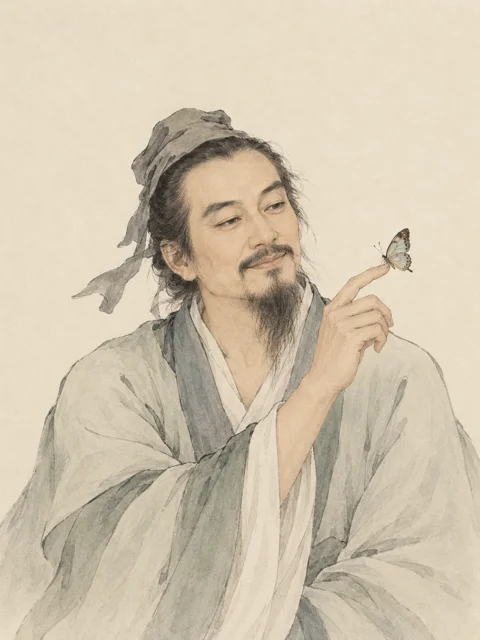
 AI 创作示意
GUANFU / zh-Hans
庄子
AI 创作示意應帝王 · 白话释义
版本按章对照,不代表逐句校勘对应。
中文原文(全三十三篇) / 庄子原典;维基文库贡献者整理
观复随文注释 · 48 条
齧缺寓言中的问道者問(道)於王倪寓言中的得道者,四問而四不知。齧缺因躍而大喜,行以告蒲衣子传说中的古代高士。蒲衣子曰:「而乃今知之乎!有虞氏指舜不及泰氏传说中的上古帝王。有虞氏,其猶臧一作「藏」仁以要人笼络、求取人心;要读 yāo,亦得人矣,而未始出於非人。泰氏,其臥徐徐,其覺于于舒缓自得的样子,一以己爲馬,一以己爲牛,其知情信,其德甚眞,而未始入於非人。」
肩吾見狂接輿楚国隐者,以狂者自处。狂接輿曰:「日中始何以語汝一作「女」?」肩吾曰:「告我:君人者统治人民的人,以己出經法度、准则,式義度人,孰敢不聽而化諸?」(狂)接輿曰:「是欺德也。其於治天下也,猶涉海鑿河而使蚊一作「蚉」負山也。夫聖人之治也,治外乎?正而後行,確乎能其事者而已矣。且鳥高飛以避矰弋系绳射鸟的箭与射法之害,鼷鼠一种小鼠;鼷读 xī深穴乎神丘神坛上的土丘之下以避熏鑿之患,而曾二蟲之无知!」
天根遊於殷陽,至蓼水之上,適遭无名人而問焉,曰:「請問爲天下?」无名人曰:「去!汝鄙人见识浅陋的人也!何問之不豫使人不快也!予方將與造物者爲人,厭則又乘夫莽眇之鳥寓言中超越形迹的大鸟,以出六極上下四方的极远处之外,而遊无何有之鄉,以處壙埌空旷无边的样子之野。汝又何寱梦话,引申为胡言;读 yì一作「帠」以治天下感予之心爲?」又復問,无名人曰:「汝遊心於淡,合氣於漠,順物自然,而无容私不夹杂私意焉,而天下治矣。」
陽子居通常认为指杨朱見老聃,曰:「有人於此,嚮疾彊梁行动迅疾、强悍有为,物徹疏明,學道不勌。如是者,可比明王乎?」老聃曰:「是於聖人也,胥易技係役于事务、拘于技巧;古注有异解,勞形怵心者也。且也虎豹之文來田招来猎取;田通畋,猨狙之便執,犛一作「斄」之㣘一作「狗」來藉。如是者,可比明王乎?」陽子居蹵然局促惊惧的样子曰:「敢問明王之治?」老聃曰:「明王之治,功蓋天下而似不自己,化貸施教养育;贷有施予义萬物而民弗恃,有莫舉名,使物自喜,立乎不測,而遊於无有者也。」
鄭有神巫曰季咸寓言中的占相巫者,知人之死生、存亡、禍福、壽夭,期以歲月旬日,若神。鄭人見之,皆棄而走。列子見之而心醉,歸以告壺子列子的老师,曰:「始吾以夫一作「天」子之道爲至矣,則又有至焉者矣。」壺子曰:「吾與汝,旣其文外在的表象、仪文,未旣其實。而固得道與?衆雌而无雄,而又奚卵焉?而以道與世亢,必信夫,故使人得而相汝给你看相。嘗試與來,以予示之。」明日,列子與之見壺子。出而謂列子曰:「嘻!子之先生死矣!弗活矣!不以旬數矣!吾見怪焉,見濕灰焉。」列子入,泣涕沾襟以告壺子。壺子曰:「曏一作「鄕」吾示之以地文如大地般寂静不动的状态,萌乎不震不正。是殆見吾杜德機闭塞生命发动的机窍也。嘗又與來。」明日又與之見壺子。出而謂列子曰:「幸矣!子之先生遇我也,有瘳病愈;读 chōu矣!全然有生矣!吾見其杜權矣!」列子入,以告壺子。壺子曰:「曏一作「鄕」吾示之以天壤天地生机的状态,名實不入,而機發於踵。是殆見吾善者機也。嘗又與來。」明日又與之見壺子。出而謂列子曰:「子之先生不齊,吾无得而相焉。試齊,且復相之。」列子入,以告壺子。壺子曰:「吾曏一作「鄕」示之以太沖莫勝虚静调和、无所偏胜。是殆見吾衡氣機也。鯢桓大鱼盘旋停留之处之審爲淵,止水之審爲淵,流水之審爲淵。淵有九名,此處三焉。嘗又與來。」明日又與之見壺子。立未定,自失而走。壺子曰:「追之!」列子追之不及,反以報壺子,曰:「已滅矣,已失矣,吾弗及已一作「己」。」壺子曰:「曏吾示之以未始出吾宗本原。吾與之虛而委蛇随顺变化的样子;读 wēi yí,不知其誰何,因以爲弟靡,因以爲波流。故逃也。」然後列子自以爲未始學。而歸,三年不出,爲其妻爨做饭;读 cuàn,食豕猪;读 shǐ如食人,於事无與親,彫一作「雕」琢復朴恢复自然质朴,塊然獨以其形立,紛而封哉,一以是終。无爲名尸名声的主宰;尸有主义,无爲謀府智谋聚集之府,无爲事任,无爲知主。體盡无窮,而遊无朕没有可执取的迹象,盡其所受乎天,而无見得,亦虛而已。至人之用心若鏡,不將不迎不送往、不迎来,顺其自然,應而不藏,故能勝物而不傷。
南海之帝爲儵寓言中的南海之帝;读 shū,北海之帝爲忽,中央之帝一作「地」爲渾沌寓言中未分化的自然整体。儵與忽時相與遇於渾沌之地,渾沌待之甚善。儵與忽謀報渾沌之德,曰:「人皆有七竅双眼、双耳、双鼻孔与口,以視聽食息,此獨无有,嘗試鑿之。」日鑿一竅,七日而渾沌死。
观复随文注释 · AI 辅助独立整理,待持续人工校订。释义以本章语境为依据;存在异说或底本疑讹的地方另作提示。原文及版本来源保留如下。
参考: 本站所收原典:應帝王 ↗
原典公有领域;电子文本据维基文库贡献者,按 CC BY-SA 4.0 保留署名及相同方式共享;调整空白与排版。 · 查看原始版本
欢迎引用本站资源,分享道家与道教文化。引用时请注明出处“观复”,并附上所引用内容的原始页面链接,方便读者查阅。
观复白话释义(AI 辅助) / 观复 · AI 辅助独立整理
【白话释义|AI 辅助独立整理,未经人工学术审定】
啮缺向王倪问道,问了四次,王倪四次都回答不知道。啮缺因此高兴得跳起来,前去告诉蒲衣子。蒲衣子说:“你到现在才明白吗!有虞氏还不及泰氏。有虞氏心中仍存着仁德,想用它招徕人心;他虽然得到了人心,却没有超出是非分别、评判他人的局限。泰氏睡时安闲,醒时自在,别人一会儿把他看作马,一会儿把他看作牛,他都不介意。他的认识真诚可信,德性十分纯真,从未陷入非议他人的分别。”
肩吾去见楚狂接舆。接舆问:“从前中始对你说过什么?”肩吾说:“他告诉我:统治别人的人,要由自己制定常规,以义理和法度衡量众人,谁敢不听从而受到教化?”接舆说:“这是欺骗、损伤德性的做法。用它来治理天下,就像渡海还去凿河,又叫蚊子背山一样。圣人的治理,难道专治外在吗?他先端正自己,然后行动,确实能顺应自己的事情就够了。鸟飞得高,来躲避带绳箭的伤害;小鼠在神丘下面挖深洞,来躲避烟熏和挖掘的灾害。那种统治者竟还不如这两种小动物有见识!”
天根游到殷山南面,来到蓼水岸边,恰好遇见无名人,便问:“请问怎样治理天下?”无名人说:“走开!你这个浅陋的人!怎么问这么让人不快的事!我正要同造物者结伴,倦了又要乘那高远缥缈的鸟,飞出天地四方的极限,游到无所有的乡境,安处于辽阔空旷的原野。你为什么又用治理天下这种话扰动我的心?”天根再问,无名人说:“让心游于恬淡,让气契于寂静,顺着万物自身的自然,不容个人私意插入,天下便能治理好了。”
阳子居拜见老聃,说:“假如有个人应对敏捷、刚强有力,对事物通彻明达,学道不倦。这样的人,可以比得上圣明的君王吗?”老聃说:“这样的人,在圣人看来,不过像供使唤的差役,被技能牵系,劳累形体,惊扰心神。再说,虎豹因为皮毛美丽招来猎取,猿猴因为动作灵便遭到捕捉,能捉鼠的犬因为有本领而被绳索拴住。这样的人,能比得上圣明的君王吗?”阳子居神情局促地问:“请问圣明君王怎样治理?”老聃说:“圣明君王的治理,功业遍及天下,却仿佛不是出于自己;化育、施惠于万物,却不使百姓依赖他;有其作用而无从举出名号,使万物各自欣悦。他立于不可测度的境界,游于不执着任何占有的领域。”
郑国有个神巫叫季咸,能预言人的死生、存亡、祸福、寿夭,时间说到年、月、旬、日,像神一样。郑国人见到他,都扔下东西逃走。列子见了,却佩服得心醉,回来告诉壶子:“起初我以为先生的道已到最高处,如今还有比这更高的。”壶子说:“我教给你的,只到了外在文理,还没到内在实质,你就以为已经得道了吗?只有一群雌鸟,没有雄鸟,怎么会有能孵化的卵?你拿学到的道同世人争高下,一定要别人相信你,所以才让人看出了你的表相。试着把他带来,让他看看我。”
第二天,列子带季咸见壶子。出来后,季咸对列子说:“唉,你的先生要死了,活不下去了,活不过十天!我看见了怪异的征兆,看见他像潮湿的冷灰。”列子进去,哭得泪湿衣襟,把话告诉壶子。壶子说:“刚才我给他看的是像大地一般寂定的形态,生机潜藏,不动也不显。他大概只看到我闭塞生机的状态。再带他来。”
第二天,列子又带季咸来。出来后,季咸说:“幸运啊!你的先生遇到我,病已经减轻,完全有了生机!我看到他闭塞处已有活动的契机。”列子进去告诉壶子。壶子说:“刚才我给他看的是天地相交、生机流行的状态,名实的分别没有进入心中,生机从脚跟深处发动。他大概看到了我显出的生机。再带他来。”
第二天,又带他来看壶子。出来后,季咸说:“你的先生状态变化不定,我无法给他看相。等他安定下来,我再来看。”列子进去告诉壶子。壶子说:“刚才我给他看的是极其虚静、没有一方偏胜的状态。他大概看到了我阴阳之气均衡的契机。大鱼盘桓停聚的深处是渊,静水积聚的深处是渊,流水回旋积聚的深处也是渊。渊有九种名称,这里只说了三种。再带他来。”
第二天,列子又带季咸来。季咸还没站定,就慌乱地逃走。壶子说:“追他!”列子追不上,回来报告:“已经不见了,踪影全无,我赶不上。”壶子说:“刚才我给他看的是从未离开根本、尚未显出固定形态的状态。我以虚静同他周旋,没有可供辨认的形迹,一会儿随势消退,一会儿随波流动,因此他逃走了。”
此后,列子才认为自己过去根本还没有真正开始学道。他回家,三年不出门,为妻子烧火做饭,喂猪也像供养人一样用心;对各种事情不偏爱、不亲疏分别,去掉雕琢,返回质朴。他安然独立于自身的存在,面对纷杂之事,把精神守藏在内,始终如此。
不要做名声的承受者,不要做谋略的仓库,不要以包揽事务为己任,不要自居为知识的主宰。体会无穷的变化,游于没有固定痕迹的境地,充分实现自己从自然禀受的东西,不炫示所得,也不过是保持虚静而已。至人用心,如同明镜:不追送已经过去的,不迎求尚未来到的;来则照应,过则不留。因此能够应付外物,而不受损伤。
南海的帝叫儵,北海的帝叫忽,中央的帝叫浑沌。儵和忽时常在浑沌的地方相会,浑沌待他们很好。儵与忽商量,要报答浑沌的恩德,说:“人都有七窍,用来观看、听闻、饮食、呼吸,唯独他没有,我们试着给他凿出来。”于是每天凿一个孔,凿到第七天,浑沌就死了。
校订说明:“泰氏”所指古帝有不同说法,保留原名。“犛之㣘”文字难通,按常见校读“狸之狗”一类理解为能捕鼠之犬而被系缚,此句须重点复核;也有不同动物训释。“地文”“天壤”“太冲莫胜”是壶子示现不同精神状态的寓言说法,非占卜技术说明。“九渊”原文仅列三种,释义也不补造其余六种。
观复白话释义:AI 辅助依据古文独立编写,已进行文本覆盖核对,未经人工学术审定;原典来源及电子底本署名、许可见对应中文版本。 · 查看原始版本
Herbert A. Giles 英译(全三十三篇) / Herbert A. Giles(翟理斯),1889
How to Govern.
[Translator’s note] Argument :—Princes should reign, not rule—Rulers find their standards of right in themselves—They thus coerce their people into obeying artificial laws, instead of leaving them to obey natural laws—By action they accomplish nothing—By inaction there is nothing which they would not accomplish—Individuals think they know what the empire wants—In reality it is the empire itself which know best—Illustrations.
Yeh Ch'üeh asked Wang I
[Translator’s note] See ch. ii .
four questions, none of which he could answer. Thereat the former was greatly delighted,
[Translator’s note] For now he discovered that ignorance is true knowledge:—an explanation which I adopt only for want of a better.
and went off and told P'u I Tzŭ.
[Translator’s note] Of whom nothing definite is known.
"Have you only just found that out?" said P'u I Tzŭ. "The Emperor Shun was not equal to T'ai Huang.
[Translator’s note] A legendary ruler. For Shun, see ch. i .
Shun was all for charity in his zeal for mankind; but although he succeeded in government, he himself never rose above the level of artificiality. Now T'ai Huang was peaceful when asleep and inactive when awake. At one time he would think himself a horse; at another, an ox.
[Translator’s note] So effectually had he closed all channels leading to consciousness of self.
His wisdom was substantial and above suspicion. His virtue was genuine indeed. And yet he never sank to the level of artificiality."
[Translator’s note] He was a monarch after the pattern of Tao .
Chien Wu meeting the eccentric Chieh Yü, the latter enquired, saying, "What did Jih Chung Shih teach you?"
[Translator’s note] Of the last nothing is known. The first two have been already mentioned in chs. i . and vi .
"He taught me," replied Chien Wu, "about the laws and regulations which princes evolve, and which he said none would venture not to hear and obey."
"That is a false teaching indeed," replied Chieh Yü. "To attempt to govern mankind thus,—as well try to wade through the sea, to hew a passage through a river, or make a mosquito fly away with a mountain!
"The government of the truly wise man has no concern with externals. He first perfects himself, and then by virtue thereof he is enabled to accomplish what he wants.
[Translator’s note] Passively, without effort of any kind.
"The bird flies high to avoid snare and dart. The mouse burrows down below the hill to avoid being smoked or cut out of its nest. Is your wit below that of these two creatures?"
[Translator’s note] That you should be unable to devise means of avoiding the artificial restraints of princes. Better than coercing into goodness is letting men be good of their own accord.
T'ien Kên
[Translator’s note] Of whom nothing is known.
was travelling on the south of the Yin mountain. He had reached the river Liao when he met a certain Sage to whom he said, "I beg to ask about the government of the empire."
"Begone!" cried the Sage. "You are a low fellow, and your question is ill timed. God has just turned me out a man. That is enough for me. Borne on light pinions I can soar beyond the cardinal points, to the land of nowhere, in the domain of nothingness. And you come to worry me with government of the empire!"
But T'ien Kên enquired a second time, and the Sage replied, "Resolve your mental energy into abstraction, your physical energy into inaction. Allow yourself to fall in with the natural order of phenomena, without admitting the element of self,—and the empire will be governed."
[Translator’s note] By virtue of natural laws which lead, without man's interference, to the end desired.
Yang Tzŭ Chü went to see Lao Tzŭ, and said, "Suppose a man were ardent and courageous, acquainted with the order and principles of things, and untiring in the pursuit of Tao —would he be accounted a wise ruler?"
"From the point of view of a truly wise man," replied Lao Tzŭ, "such a one would be a mere handicraftsman, wearing out body and mind alike. The tiger and the pard suffer from the beauty of their skins. The cleverness of the monkey, the tractability of the ox, bring them both to the tether. It is not on such grounds that a ruler may be accounted wise."
"But in what, then," cried Yang Tzŭ Chü, "does the government of a wise man consist?"
"The goodness of a wise ruler," answered Lao Tzŭ, "covers the whole empire, yet he himself seems to know it not. It influences all creation, yet none is conscious thereof. It appears under countless forms, bringing joy to all things. It is based upon the baseless, and travels through the realms of Nowhere."
[Translator’s note] The operation of true government is invisible to the eye of man.
In the State of Chêng there was a wonderful magician, named Chi Han. He knew all about birth and death, gain and loss, misfortune and happiness, long life and short life,—predicting events to a day with supernatural accuracy. The people of Chêng used to flee at his approach; but Lieh Tzŭ
[Translator’s note] See ch. i .
went to see him, and became so infatuated that on his return he said to Hu Tzŭ,
[Translator’s note] Who appears to have been his tutor.
"I used to look upon your Tao as perfect. Now I know something more perfect still."
"So far," replied Hu Tzŭ, "I have only taught you the ornamentals, not the essentials, of Tao ; and yet you think you know all about it. Without cocks in your poultry-yard, what sort of eggs do the hens lay? If you go about trying to force Tao down people's throats, you will be simply exposing yourself. Bring your friend with you, and let me show myself to him."
So next day Lieh Tzŭ went with Chi Han to see Hu Tzŭ, and when they came out Chi Han said, "Alas! your teacher is doomed. He cannot live. I hardly give him ten days. I am astonished at him. He is but wet ashes."
[Translator’s note] And cannot burn much longer.
Lieh Tzŭ went in and wept bitterly, and told Hu Tzŭ; but the latter said, "I showed myself to him just now as the earth shows us its outward form, motionless and still, while production is all the time going on. I merely prevented him from seeing my pent-up energy
[Translator’s note] Of Tao .
within. Bring him again."
Next day the interview took place as before; but as they were leaving Chi Han said to Lieh Tzŭ, "It is lucky for your teacher that he met me. He is better. He will recover. I saw he had recuperative power."
Lieh Tzŭ went in and told Hu Tzŭ; whereupon the latter replied, "I showed myself to him just now as heaven shows itself in all its dispassionate grandeur, letting a little energy run out of my heels. He was thus able to detect that I had some. Bring him here again."
Next day a third interview took place, and as they were leaving, Chi Han said to Lieh Tzŭ, "Your teacher is never one day like another. I can tell nothing from his physiognomy. Get him to be regular, and I will then examine him again."
This being repeated to Hu Tzŭ as before, the latter said, "I showed myself to him just now in a state of harmonious equilibrium. Where the whale disports itself,—is the abyss. Where water is at rest,—is the abyss. Where water is in motion,—is the abyss. The abyss has nine names. These are three of them."
[Translator’s note] Alluding to three phases of Tao as manifested at the three interviews above described, Tao being the abyss.
Next day the two went once more to see Hu Tzŭ; but Chi Han was unable to stand still, and in his confusion turned and fled.
"Pursue him!" cried Hu Tzŭ; whereupon Lieh Tzŭ ran after him, but could not overtake him, so he returned and told Hu Tzŭ that the fugitive had disappeared.
"I showed myself to him just now," said Hu Tzŭ, "as Tao appeared before time was. I was to him as a great blank, existing of itself. He knew not who I was. His face fell. He became confused. And so he fled."
Upon this Lieh Tzŭ stood convinced that he had not yet acquired any real knowledge, and at once set to work in earnest, passing three years without leaving the house. He helped his wife to cook the family dinner, and fed his pigs just like human beings. He discarded the artificial and reverted to the natural. He became merely a shape. Amidst confusion,
[Translator’s note] Of this material world.
he was unconfounded. And so he continued to the end.
By Inaction, fame comes as the spirits of the dead come to the boy who impersonates the corpse.
[Translator’s note] See ch. i . In the old funeral rites of China, a boy was made to sit speechless and motionless as a corpse, for the reason assigned in the text.
By Inaction, one can become the centre of thought, the focus of responsibility, the arbiter of wisdom. Full allowance must be made for others, while remaining unmoved oneself. There must be a thorough compliance with divine principles, without any manifestation thereof.
[Translator’s note] Non mihi res, sed me rebus, subjungere conar.
All of which may be summed up in the one word passivity . For the perfect man employs his mind as a mirror. It grasps nothing: it refuses nothing. It receives, but does not keep. And thus he can triumph over matter, without injury to himself.
[Translator’s note] Without the wear and tear suffered by those who allow their activities free play.
The ruler of the southern sea was called Shu. The ruler of the northern sea was called Hu. The ruler of the central zone was called Hun Tun.
[Translator’s note] This term is generally used to denote the condition of matter before separation and subdivision into the phenomena of the visible universe.
Shu and Hu often met on Hun Tun's territory, and being always well treated by him, determined to repay his kindness.
They said, "All men have seven holes,—for seeing, hearing, eating, and breathing. Hun Tun alone has none. We will bore some for him."
So every day they bored one hole; but on the seventh day Hun Tun died.
[Translator’s note] Illustrating the perils of action. "The empire," says Lao Tzŭ, "is a divine trust, and may not be ruled. He who rules, ruins. He who holds by force, loses."
[Translator’s note] "Men's actions," says Emerson, "are too strong for them."
[Translator’s note] With this chapter Chuang Tzŭ completes the outline of his system. The remaining chapters are either supplementary to the preceding seven, or independent essays upon cognate subjects.
原著及 Herbert A. Giles 历史译本公有领域;据 Project Gutenberg #59709,完整电子书及使用条款见本站资料来源。 · 查看原始版本
我的书签(此浏览器)
还没有书签。